
Michigan Air National Guard by Michigan National Guard
Popular Mechanics shared that 65 years ago this Sunday, an Air Force pilot flew into the record books but out of active flight duty by flying a B-47 bomber under the Mackinac Bridge:
Sixty years ago this week a person standing next to Michigan’s Mackinac Bridge might have been witness to an amazing sight: a six engine U.S. Air Force nuclear bomber flying between the spans of the bridge, barely clearing the structure. The stunt was roasted in the local press, which declared the incident “capricious” and “foolish”, and ended the military pilot’s flying career.
The incident, which took place on April 28th, 1959, involved Air Force Captain John S. Lappo, a native of Muskegon, Michigan. Lappo flew his B-47 nuclear bomber under the Mackinac Bridge.
The Mackinac Bridge is five miles long but there is only 155 feet maximum clearance between the bottom of the deck and the waters of the Great Lakes (Lake Huron and Lake Michigan) below. The B-47 bomber is 28 feet high, meaning there wasn’t much margin for error in Lappo’s flying.
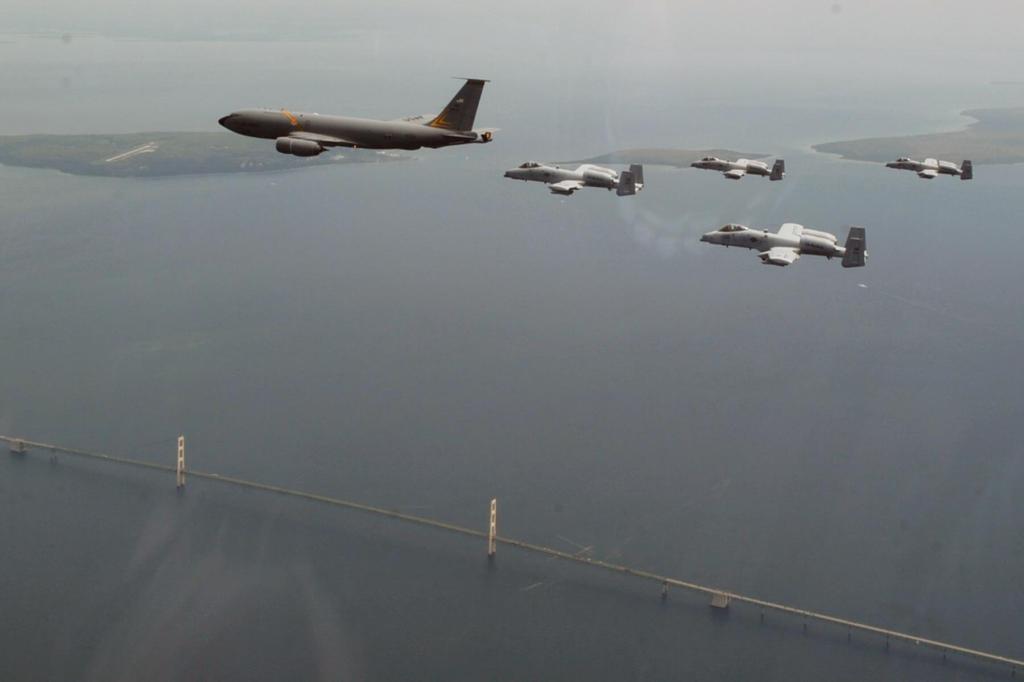
The Michigan National Guard shared this this is a pic of four A-10 Thunderbolt IIs and a KC-135 Stratotanker flying (safely) over Michigan’s iconic Mackinac Bridge back in 2016. The aircraft were based at Selfridge Air National Guard Base in Macomb County, Mich. (U.S. Air National Guard photo by Master Sgt. Elizabeth Hollicker) You can see their latest pics on Flickr.

 Michigan in Pictures