

Executive Level in the city of Detroit, photo by Dan Frei Photo
Follow @danfreiphoto on Twitter and view & purchase his work on his website.
Executive Level in the city of Detroit, photo by Dan Frei Photo
Follow @danfreiphoto on Twitter and view & purchase his work on his website.

Happy Halloween, photo by Julie
Happy Halloween everyone! I shared this story a few years ago, but since we’re back up on northern Lake Michigan at a time when the witch of November is rousing, why not share it again? In 1915, William MacHarg & Edwin Balmer wrote a book called The Indian Drum. The whole book is available online along with 53,000+ more books at Project Gutenberg. Chapter I begins:
Near the northern end of Lake Michigan, where the bluff-bowed ore-carriers and the big, low-lying, wheat-laden steel freighters from Lake Superior push out from the Straits of Mackinac and dispute the right of way, in the island divided channel, with the white-and-gold, electric lighted, wireless equipped passenger steamers bound for Detroit and Buffalo, there is a copse of pine and hemlock back from the shingly beach. From this copse—dark, blue, primeval, silent at most times as when the Great Manitou ruled his inland waters—there comes at time of storm a sound like the booming of an old Indian drum. This drum beat, so the tradition says, whenever the lake took a life; and, as a sign perhaps that it is still the Manitou who rules the waters in spite of all the commerce of the cities, the drum still beats its roll for every ship lost on the lake, one beat for every life.
So—men say—they heard and counted the beatings of the drum to thirty-five upon the hour when, as afterward they learned, the great steel steamer Wenota sank with twenty-four of its crew and eleven passengers; so—men say—they heard the requiem of the five who went down with the schooner Grant; and of the seventeen lost with the Susan Hart; and so of a score of ships more. Once only, it is told, has the drum counted wrong.
At the height of the great storm of December, 1895, the drum beat the roll of a sinking ship. One, two, three—the hearers counted the drum beats, time and again, in their intermitted booming, to twenty-four. They waited, therefore, for report of a ship lost with twenty-four lives; no such news came. The new steel freighter Miwaka, on her maiden trip during the storm with twenty-five—not twenty-four—aboard never made her port; no news was ever heard from her; no wreckage ever was found. On this account, throughout the families whose fathers, brothers, and sons were the officers and crew of the Miwaka, there stirred for a time a desperate belief that one of the men on the Miwaka was saved; that somewhere, somehow, he was alive and might return. The day of the destruction of the Miwaka was fixed as December fifth by the time at which she passed the government lookout at the Straits; the hour was fixed as five o’clock in the morning only by the sounding of the drum.
The region, filled with Indian legend and with memories of wrecks, encourages such beliefs as this. To northward and to westward a half dozen warning lights—Ile-aux-Galets (“Skilligalee” the lake men call it), Waugaushance, Beaver, and Fox Islands—gleam spectrally where the bone-white shingle outcrops above the water, or blur ghostlike in the haze; on the dark knolls topping the glistening sand bluffs to northward, Chippewas and Ottawas, a century and a half ago, quarreled over the prisoners after the massacre at Fort Mackinac; to southward, where other hills frown down upon Little Traverse Bay, the black-robed priests in their chapel chant the same masses their predecessors chanted to the Indians of that time. So, whatever may be the origin of that drum, its meaning is not questioned by the forlorn descendants of those Indians, who now make beadwork and sweet-grass baskets for their summer trade, or by the more credulous of the white fishermen and farmers; men whose word on any other subject would receive unquestioning credence will tell you they have heard the drum.
Read on at Project Gutenberg.
View Julie’s photo bigger and see more in her Holidays slideshow.
See 700 more Halloween photos in the Absolute Michigan photo group and more haunted, Halloween fun on Michigan in Pictures.
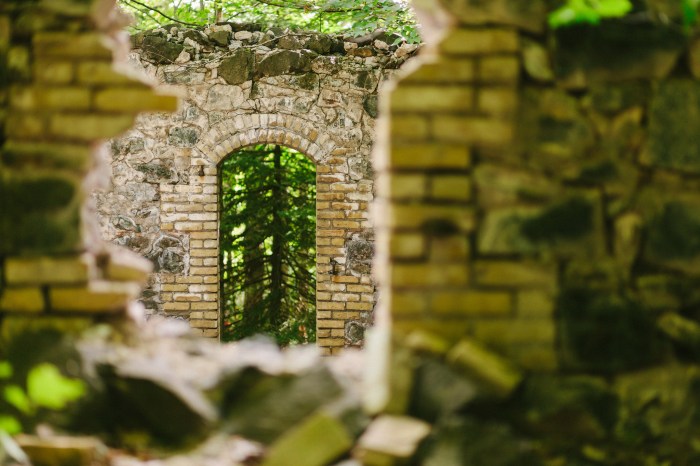
through the never, photo by Marty Hogan
mLive’s Emily Bingham has a feature on 11 eerie & intriguing ghost towns in Michigan that is definitely worth checking out. The slide for the Upper Peninsula ghost town of Central says:
This abandoned village on the U.P.’s Keweenaw Peninsula was a company town of nearly 1,300 residents, many of them German and Cornish immigrants who’d come to work in the copper mines. The town had a post office, three-story school, and one of the first telephone services in Copper Country. The mine closed in 1898, only four decades after it had opened, and residents quickly left to find work elsewhere. All that remains are thirteen houses and a Methodist church, maintained by the Keweenaw Historical Society; every year on the last Sunday of July, locals and descendants of the Central Mine villagers attend a special service at the church to honor those who lived there.
If you’re looking to get more ghost town goodness, look no further than Marty Hogan! His photo albums get up close and personal some of Michigan’s coolest forgotten communities. View this photo background bigilicious and see more in his Central slideshow.
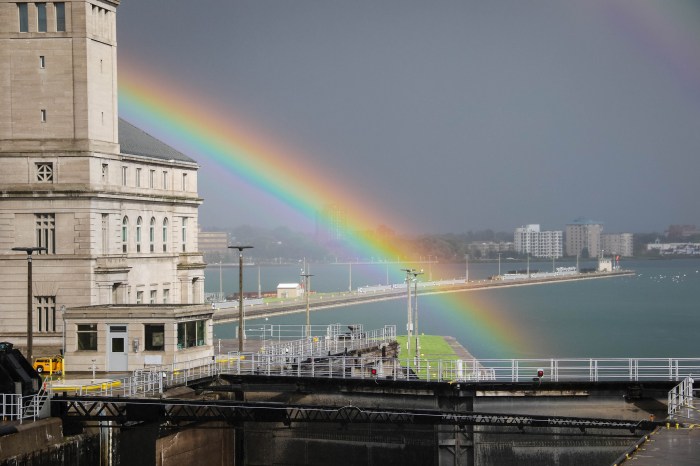
Rainbow at Soo Locks, photo by kdclarkfarm
Diane says that everyone was in awe at this rainbow apparently waiting its turn for the Soo Locks in late September.
View her photo background bigilicious and see more in her Freighters and the St. Clair River slideshow.
More rainbows and more Soo Locks on Michigan in Pictures.
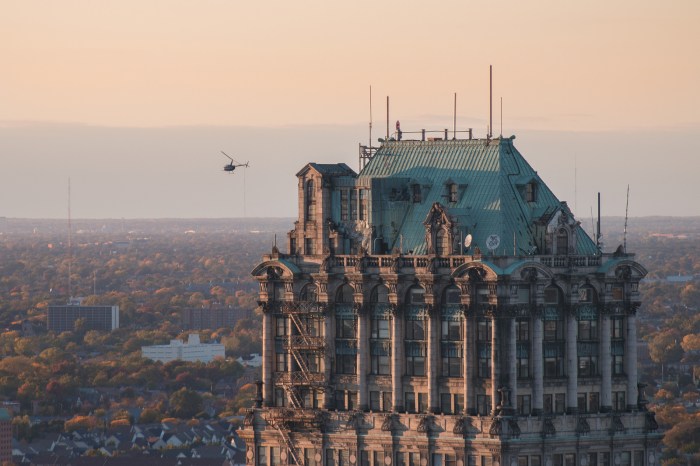
Fly By, photo by Tom Hughes
Historic Detroit is definitely one of the best websites if you want to dig deeper into the history of Michigan’s largest city. Dan Austin’s entry on the Book Tower & Book Building has current and historical photo galleries of both buildings, map and an extensive account about the history of the structure. It says in part:
She’s one of a kind. Some might even say beautiful in its ugliness.
No skyscraper in Detroit, let alone the Midwest, looks quite like the Book Tower on Washington Boulevard. It’s a rather awkward-looking building, whether you look at its unusual maze of an external fire escape or the intricate, over-the-top details on its crown that are tough to appreciate without a pair of binoculars. It’s an undeniably unique piece of the city’s skyline and a rare breed of classical Renaissance-style architecture and skyscraper. As an added bonus, joined at its hip is one of the city’s oldest surviving office buildings.
The 36-story Book Tower opened in 1926 on the southwest corner of Grand River Avenue and Washington, coincidentally, the original lot that the Books’ grandfather had bought on the boulevard. Its first tenant was Detroit Bond & Mortgage. At 475 feet tall, the Book Tower would lay claim to the title of tallest building in town. Though it would hold the honor only briefly: The 47-story Penobscot Building would overtake it two years later. Today, the Book Tower is good for only the seventh-tallest landmark in town.
…Intricately carved Corinthian columns, florets, scrolls and crests are all over the place. Horizontal bands of Italian Renaissance ornamentation break up the towering skyscraper with nude female figures gracing its midsection like a belt. Nearly from ground to the top of the 36th floor, the building is covered in detail. Ferry quotes Kamper as saying, with a trace of a Bavarian accent, “I like it varm.” “Varm” or not, Kamper’s strategy on the Book tower didn’t work. His decision has been ridiculed and criticized by critics almost from the onset for not realizing the limitations on designing a structure so tall. He didn’t take a fire evacuation route into consideration when designing it, necessitating the addition of the unusual fire escape all the way down the tower. Kamper had the building faced in a porous limestone that sucked up pollutants in the air, making it almost impossible to keep clean.
Read on for lots more and follow HistoricDetroit.org on Facebook – good stuff!
View Tom’s photo bigger, see more in his Detroit slideshow, and view and purchase work from his website.
More buildings & architecture on Michigan in Pictures.
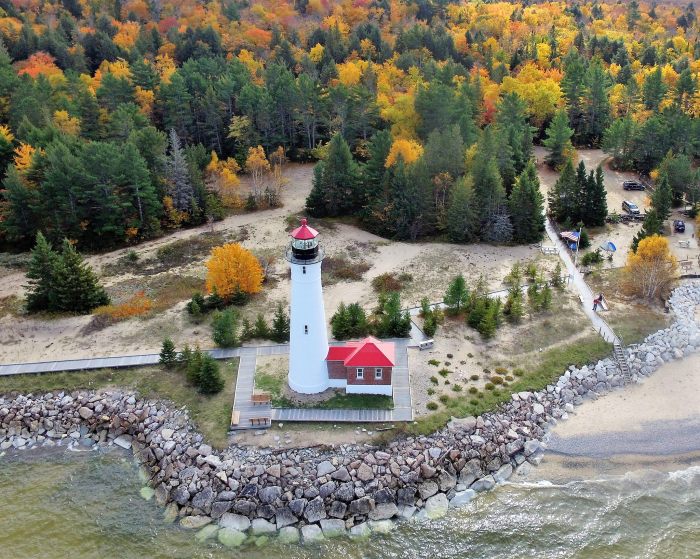
Colors of Crisp Point, photo by John Rothwell
Terry Pepper’s Seeing the Light says that Crisp Point Lighthouse is located on the Lake Superior coastline between Whitefish Point and Grand Island. It’s one of the most beautiful stretches of shoreline in all of the Midwest and:
It is difficult to imagine that during the 1800’s this stretch of seemingly bucolic coastline was known to mariners as “The Shipwreck Coast,” with the hulks of innumerable vessels pushed onto the shore by violent storms out of the north, or lost in the pea soup fogs which frequently enveloped the area.
Since the early 1850’s, the Lighthouse Board had been working on establishing a series of Lights to guide mariners along this treacherous stretch, with Lights established at Whitefish Point in 1848, Grand Island in 1867, Big Sable Point in 1874 and Grand Marais in 1895. As further witness to the dangers represented by this stretch of coastline, Congress approved the establishment of four life saving stations between Vermilion and Deer Park on June 20, 1874, one of which was designated as Station Ten, and built at an unnamed point approximately fifteen miles west of Whitefish Point. Although David Grummond was appointed as the first keeper at life saving station 10, it would be Christopher Crisp who served as keeper from 1878 until 1890 who would have the most lasting impact on the area, as Crisp became so well known that the point on which the station was established would become forever known as “Crisp’s Point.”
…The station was officially decommissioned in 1994, and without keepers maintaining the protective piers, shoreline erosion had progressed to the point that the lake was lapping at the very base of the tower itself. After the brick service room collapsed in November 1996, the GSA feared that the tower itself was in danger of toppling, and not wishing the responsibility and cost of stabilizing or demolishing the tower, the property was scheduled for auction in 1997.
Ohio visitors Don and Nellie Ross came across the old station, and taken with the natural beauty and history of the location, partnered with a number of area residents to form the Crisp Point Lighthouse Preservation Society, with their charter being the restoration and long term survival of what was left of the station.
Read on for lots more and historical photos. Terry adds that a visit to Crisp Point is a “must” for any lighthouse fans, as it remains one of the most desolate and beautiful locations in all of the Great Lakes. More about the lighthouse and its preservation at crisppointlighthouse.org.
View John’s photo background bigtacular and see more in his slideshow.
More lighthouses on Michigan in Pictures!
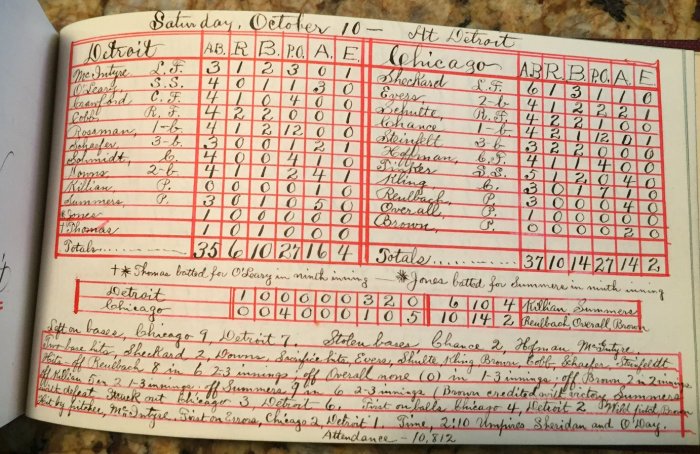 Saturday, October 10 at Detroit, photo by Kevin Guilfoile
#BaseballGeekAlert
Yesterday Kevin tweeted this box score, handwritten 108 years ago from Game 1 of the 1908 World Series between the Detroit Tigers and the Chicago Cubs. The comments are priceless – check them out for such gems you may have missed such as the fact that the Cubs peppered 6 singles in the 9th inning and that both Evers and Chance – two-thirds of one of the best infields ever – both committed errors!
Heavy.com has a great account of the 1908 World Series that includes photos and a recap of each game. SPOILER ALERT: The Cubs won. They do a great job of setting the stage:
The 1908 series, with the Cubs facing the Detroit Tigers — who were led by the greatest hitter of his era, Ty Cobb — was only the fifth World Series ever played between the National League and the upstart American League which had been in existence as a “major” league only since 1901. The NL was formed in 1876.
The great American writer Mark Twain was still alive the last time the Cubs won the World Series, as was the legendary Apache Chief Geronimo, as Sports Illustrated writer Mark Rushin noted in his history of the 1908 World Series. Both Butch Cassidy and the Sundance Kid were still around, and so was former slave and crusading abolitionist Harriet Tubman who, more than a century later, is about to get her face on the U.S. $20 bill.
Movies were still silent, and though radio had been invented about a decade earlier, the first baseball game broadcast in the new medium wouldn’t happen until 1921, 13 years after the Cubs last won the World Series.
View the photo bigger and head over to Kevin’s Twitter for several more of these 1908 box scores!
PS: Big thanks to Dave Hogg for tweeting this in my general direction!

Philip in Caseville, MI, photo by Philip’s Water Tower Project
Let’s just jump right in to Philip’s Water Tower Project:
Philip is a 5 year old Autistic boy from Michigan. He has recently developed a love of water towers. Upon a simple google search, he realized he couldn’t find many pictures of water towers in our area. So he made it his mission to “cheese” (take pictures) with as many water towers as he could. We are up to 21 cities so far in the thumb of Michigan.
After speaking with one of my friends who came up with the idea to have others send in pictures from all over the country of them with water towers, I spoke with Philip about the idea and he loved it. So this page was born. If you’d like to participate please message or post a picture of yourself (or your kiddos) with a water tower near you. Be sure to point at the water tower in the picture, it’s his signature move!
View more photos right here and definitely share a pic with Philip’s page if you’re near a water tower in Michigan or elsewhere!

Good Luck Aurora, photo by Lake Superior Photo
Shawn of Lake Superior Photo shared this and writes:
So.. it looks like aurora could be active through the weekend… good luck photo: one of the more memorable geomagnetic experiences from the south shore of Superior… a very animated proton arc from a little over a month ago
NOAA/NWS Space Weather Prediction Center confirms that a G1 warning is in effect tonight & tomorrow that brings the chance of northern lights sightings to Michigan and an even more potentially potent G2 warning is in effect for the 24th. Click for more about the scales and definitely consider subscribing for aurora alerts!!
Follow Lake Superior Photo on Facebook and view & purchase photos of northern lights (aurora panoramas too!) and more at LakeSuperiorPhoto.com!
More about northern lights including what a “proton arc” is on Michigan in Pictures!
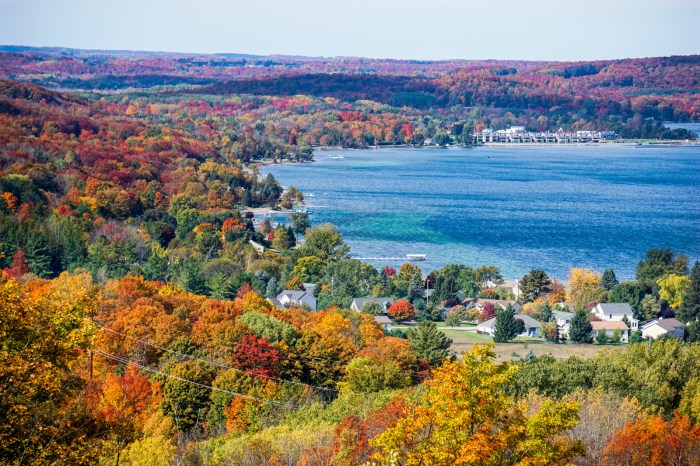
Lake Charlevoix Fall Colors, photo by frank wulfers
Frank took this shot on Wednesday from the Avalanche Mountain Scenic Overlook in Boyne City. As you can see, this will be the weekend for fall color across much of Michigan, so check out some great fall scenes on Michigan in Pictures and make your plans for a getaway!
View Frank’s photo bigger and see more in his Michigan – Northwest slideshow.

 Michigan in Pictures