Kalamazoo Fire Department: Truck 17 in front of Old Central

Truck 17 In front of Old Central

Truck 17 In front of Old Central, photo by Stoney06.

Joel Dinda knows old photos, so it’s not at all surprising that he found this great collection of historical photos from Brian Stone of the fire stations, fire trucks and the men of the Kalamazoo.

An added plus are his informative captions such as the one for the above: Old Central Station Kalamazoo Michigan. Truck is a 1936 Seagrave City Service Ladder. “Pride of the Department”.

Indeed. View the photo large and you can see that’s true.

A Challenge for Michigan

Dead River Fog

Dead River Fog, photo by bgreenlee.

Brad took this photo at Dead River Basin, north of his hometown of Ishpeming, Michigan.

I saw this photo several days ago and was struck by its richness. For me – maybe for anyone who has ever stood next to a glass calm and still Michigan lake on a late summer morning – this picture holds an armload of images. The way the shore floats in and out of focus in the slowly moving mist … the haunting call of a loon … the splash of fat trout. All of this and so much more.

Further to the north – too far to walk in a day but not all that far – are the Yellow Dog Plains, one of the fronts in a battle that if lost, would change this image of Michigan forever.

The Yellow Dog is not the only front though. Consider White River, where Michigan’s water is poured out to the rest of the world, never to return. Or all the inland lakes where exotic zebra mussels have poured in, sterilizing them of other life. And countless other places and ways that our rivers, lakes, streams, ponds, wells and wetlands face the pressure that comes where a resource is not valued.

This is probably the point where right around 50% of brains will want to shut off and wander off, thinking “Here comes another environmentalist rant.” While I am a huge fan of the environment (which I like to think of as my life support system) this isn’t about politics.

This is about money.

Tourism is Michigan’s second largest industry. Unlike extractive industries like acid mining or water bottling that send most of the revenue away from Michigan, tourism sends income rushing through our local economies, generating business profits (and tax revenues) along with many jobs in hotels, motels, B&Bs and cabins, restaurants, shops, outfitters, galleries, musicians and countless other industries. Economists talk about “the multiplier effect”, describing how one dollar pays for a room for the night, then morning coffee, afternoon canoe rental, evening dinner and fifty more things before it moves along.

That dollar has a future from the moment it is laid on the counter. The other dollar doesn’t.

This is not only about money though.

I have chosen to make my lifelong home in Michigan for the same very simple reason that I made this web site: I am hopelessly in love with the beauty of Michigan. From the towering face of the Pictured Rocks to the corn stalk stubbles in the next field, I am head over heels for Sweet Mama Michigan and I cannot bear to see her carved up and sold off.

Even in our hour of need, I hope we can all agree that it is precisely this beauty, this richness of water and wild that is among Michigan’s greatest treasures.

It’s in that hope (and also for pay) that I worked with others to make a challenge to all of you: Make a short video that tells why we should protect Michigan’s water.

We call it the Save the Wild UP Video Challenge and I invite you to learn more about it.

PS: Apologies to Brad for tacking all on this on to what could have been a simple post of a great photo.

PPS: Those of you who are Flickrites might want to check out the Save the Wild UP Challenge group.

PPPS: Apologies also for any over-preachyness. I promise to try and keep it to a minimum.

Michigan Photographers: Bobby’s Favorite

Fearless by Bobby Alcott

Fearless, photo by Bobby Alcott

I was working one day in the Book Building where I shared an office a couple of summers ago, when my associate and I started to smell the familiar wafts of a building fire — which is not very good when you work in a highrise downtown. The Book, being as old as it is, doesn’t have either the proper capabilities to fight off a major fire, nor the alarm system swift enough to notify those on the 23rd floor (et al) that there’s a blaze in the building. So, worried, we stuck our heads out the big picture windows and saw the small building next to the partly-demolished Statler ablaze. VERY ablaze.

We ran down to the street level and actually got very close to the fire; on the same block, in fact, and got there before the fire crews did.

The fire got bigger and bigger until we realized that this was getting more than slightly out of hand. The fire crews were already on the scene, and as they hoisted the firefighters up in the water cranes, they also put the ladders leading to the roof in place. I could NOT believe the brave souls moving steadily but cautiously up to this burning roof with literally 50 foot flames coming from the surface.

This photo, as dear to me as it is for obvious reasons, also has different meanings for me. I think about the fire signifying our city and it’s troubles, and the fact that so few are actually trying – honestly trying – to put out the fire. There are so many causes for the blaze: carelessness, neglect — and possibly direct intent. You look at the fire and wonder if it will be extinguished before the structure is destroyed altogether; such an unfair, uphill battle.

Those that live outside the city, and remember it as it was, tend to reminisce about the ‘good old days’ when everything about Detroit was right. This, in many cases, is done in a very shallow manner — why do people believe the ‘good old days’ were good for everyone? The old buildings in Detroit, to many native Detroiters, symbolize an era when many citizens were not afforded equal rights and protections; a time when segregation was alive and well in many forms, and law enforcement did not always look kindly on a large swath of the city’s residents. Why, then, should many people that lived in the city at that time celebrate the ‘rebirth’ of a city that they were not privy to in the first place? When the berms at the RenCen were removed, very few Metro Detroiters understood how significant that was in the city’s communities, as symbolic as it might have seemed. These buildings – some built for visiting royalty both foreign and domestic – were not originally built for all people. This is not forgotten, and should not be forgotten.

I’m very thankful to live in this city built on so much beautiful diversity — diversity of people, races, cultures, attitudes, symbolisms and, yes, histories. Even though we all share one history, we all have our own parts of it… and sometimes, we forget how easily we put that, which is behind us, firmly in our path to the future – for the simple fact that we fail to address it properly when it occurs. Maybe we can all learn, finally, from the past.

Michigan Photographer Profile III

Prequel: Skyed

Day I: Michigan in Pictures talks with Bobby Alcott

Day II: Bobby Alcott responds to reader questions

Day III: Bobby’s Favorite 

Atop Mt. Bohemia

1

1, photo by edm00se.

Here’s a photo from a few years ago of Mt. Bohemia, a ski area located on the Keewenaw Peninsula near Copper Harbor. Eric has several more photos of Mt. Bohemia that you’ll want to check out.

With a hefty vertical and a ton of back country options, Mt. Bohemia has a well-earned reputation as Michigan’s most challenging ski area. Check their web site for a great extreme skiing photo gallery!

Remembering the Flint Sit-Down Strike on a Labor Day

Flint Sit Down Strike

A movie produced by General Motors in 1936 called Master Hands that Christine Barry posted to her blog provided the impetus for today’s Labor Day holiday post. She dedicates it to her grandfather and it’s likely that many of us in Michigan have some relative who took some part (for or against) in the tumultuous labor struggles. Below are several links about Michigan’s most famous strike, the Flint Sitdown Strike of 1936-37 at GM’s Fisher Body #1 plant in Flint.

According to Remembering the Flint Sit-Down Strike at HistoricalVoices.org (an amazing web site that includes recordings of workers recalling the strike):

Working on the line at General Motors in Flint was a job many men needed desperately in the 1930’s, but it was also tremendously difficult. Terrible working conditions, combined with unfair and devious payroll practices, made the auto plants of Depression-era Flint into ripe locations for union organization.

The union was the United Auto Workers. The UAW pages on the 44-day strike that ended Feb. 11, 1937 say that it  was the most pivitol event the early history of the UAW. The result was the first UAW contract with General Motors and the establishment of the UAW as the sole bargaining representative for GM workers. This account has a lot of details on the political events surrounding the strike.

A couple more excellent resources are Michigan Epic’s multimedia exploration of the Flint strike, The historic 1936-37 Flint auto plant strikes from the Detroit News, Wikipedia’s entry on the Flint Sit-Down Strike and this great slideshow of the monument commemorating the strike in Flint Sitdowners Memorial Park.
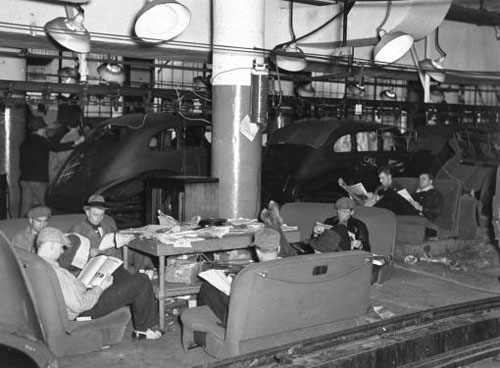
Note: The above photo is credited to the Walter P. Reuther Library of Wayne State University. The keen of eye will see that the striking workers are sitting on car seats.

Also check out The Reo Ramblers at the 1937 sit-down strike from Michigan in Pictures & the Archives of Michigan.

Central Lake, Michigan … all week long in 1973

1976_july_001

1976_july_001, photo by kbreenbo.

I guess we’ll continue yesterday’s “when we were younger than we are now” theme with today’s pic.

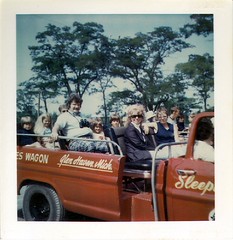
The photo is one of a large set that reminded me of a recent conversation with a friend who told me we can’t have any fun anymore – the world moves too fast and our work and free time are all tied together with email and cell phones and beeping reminders (or something like that). I don’t know if he’s right or not and I’m curious to know what you think so feel free to comment! (or just skip the comment and head out to do something fun and unwired). Click the Dune Ride picture to view Central Lake, MI 1970s … and some other parts of northern Michigan.

view dunemobile photo

.steel worker.

.steel worker.

.steel worker., photo by tEdGuY49.

Hope you all get some time away from work and internets this weekend!