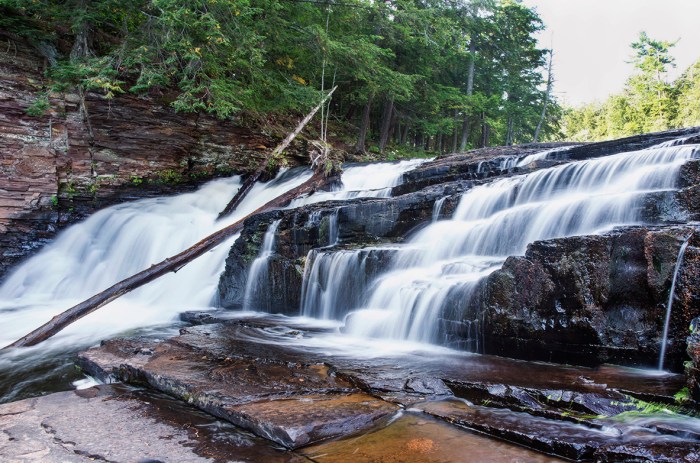
Bonanza Falls on the Big Iron River

"Bonanza Falls" - (Big Iron River) Silver City, Michigan

“Bonanza Falls” – (Big Iron River) Silver City , Michigan, photo by Michigan Nut

The photo is of Bonanza Falls, about which Go Waterfalling says:

Bonanza Falls is a wide, low falls on the Big Iron River. The falls is at most 10 feet high, but in the spring the falls is 100 feet wide. In summer it is broken up into a number of segments. The bedrock here is tilted back against the flow of the river, creating many obstacles for the water to overcome.

Bonanza Falls is located about a mile south of Silver City along Route 64. This is a sign on west side of the highway visible as you head south for Bonanza Falls. A short gravel road leads to the river. The “Bonanza” refers to the mining boom times of the 1800’s.

Check this out on black, check out a long exposure and see many more in John’s Michigan Waterfalls slideshow.

Many more Michigan waterfalls on Michigan in Pictures.

Bond Falls in black & white

Bond Falls

Bond Falls, photo by wingsfan1705

Michigan in Pictures has a number of photos from Bond Falls, but there’s always room for one more. ;)

Check this out background bigtacular and see more including some detail shots in Kim’s slideshow.

More black & white photography on Michigan in Pictures.

MNA Memorial Falls aka Twin Falls

Memorial Falls in Winter (pano)

Memorial Falls in Winter (pano), photo by nasunto

GoWaterfalling’s page on Memorial Falls in Munising says:

MNA Memorial Falls is in Munising, off of H-58. Some of the locals refer to this waterfalls as “Twin Falls”. This is a very seasonal waterfall and is often dry. However when the water is flowing, which may only be after a good rain or when the snow is melting, you will be treated to a very pretty gorge with two waterfalls in it. MNA Memorial Falls is owned by the Michigan Nature Association and it is open to the public.

…Two streams empty into this gorge, but the second one likely only has water after or during a good rain. One very interesting feature of this gorge is a “window” in the walls between the two falls. You can crawl through this window, or just walk around it. You can see each of the waterfalls through this window.

Another nice thing about this waterfall is its proximity to Tannery Falls. The trail from Nestor streets forks just before it descends into the gorge. The trail to the right leads to the base of the falls. The trail to the left leads to H-58, about 100 feet away from the stairway to Tannery Falls, so you can visit both falls on the same hike.

In the winter both of these falls turn into ice columns that are tackled by the ice climbers. Despite their low volume of water, each of these falls manages to produce a very impressive column. Every winter Munising hosts an ice climbing festival. After the festival the ice columns look like they have been attacked by woodpeckers. There are many other interesting ice formations to see in the area.

Read on for more and definitely click through to see a pic of a person beside the 40′ fall and a shot of the “window”. Also see Memorial Falls at the Waterfall Record.

Check this out background big and see more in Nina’s Michigan Waterfalls slideshow. If you look carefully, you’ll see another photographer in the shadows!

There’s many more waterfalls on Michigan in Pictures including the above-mentioned Tannery Falls.

Know Your Michigan Waterfalls: Morgan Falls Edition

Calming Currents - Morgan Falls (Marquette, MI)

Calming Currents – Morgan Falls (Marquette, MI), photo by Aaron C. Jors

GoWaterfalling’s page on Morgan Falls explains that:

Morgan Creek tumbles 20 feet into the Carp River, creating this small wild waterfall. This is one of the more accessible of the Marquette waterfalls. The more impressive, but much hard to visit Carp River Falls are half a mile away.

Morgan Falls is located about two miles south of the city of Marquette. Of the many waterfalls in Marquette county this is one of the easier to visit, especially if you have four wheel drive. The waterfall is located at the confluence of Morgan Creek and the Carp River. The creek cascades down 20 feet to join up with the Carp.

…There is some disagreement about the name of this falls. According to some Morgan Falls is actually a cascade further upstream, and this is just an unnamed waterfall. This is the more distinctive and photogenic of the two features.

Read on for more information including directions.

You can view this photo on black. Aaron has several more great waterfall shots on Michigan in Pictures and even more in his Michigan waterfalls slideshow.

There are even more Michigan waterfalls on Michigan in Pictures too!

Two seconds at Tahquamenon Falls

upper tahquamenon falls, michigan

upper tahquamenon falls, michigan, photo by twurdemann

A waterfall for your Wednesday morning.

Check this out on black and see more including another view of this scene in twurdemann’s Michigan slideshow.

Many more Michigan waterfalls and also quite a lot of Tahquamenon Falls on Michigan in Pictures.

How Miners Falls got their name

Winter at Miners Falls

Winter at Miners Falls, photo by gkretovic

The Pictured Rocks National Lakeshore explains that Miners Falls is about five miles north of Alger County Road H-58 off Miners Castle Road. It’s a short hike of just over a mile round-trip from the parking area and Miners Castle.

I always wondered about the whole “miner” thing with Miners River/Falls/Castle.  The Miners Falls Trail Guide explains that:

Visited by passing English geologists in 1771-1772, the nearby Miners River was named by employees of Alexander Henry during one of his exploratory trips on Lake Superior. At that time, indicators or “leaders” were used to locate mineral deposits. Discolored water oozing from bedrock was one such leader found in the Miners Basin, although no minerals were ever extracted from this area.

Who was Alexander Henry you ask? Wikipedia explains:

Alexander Henry ‘The Elder’ (August 1739 – 4 April 1824) was one of the leading pioneers of the British-Canadian fur trade following the British Conquest of New France; a partner in the North West Company, and a founding member and vice-chairman of the Beaver Club. In 1763-64, he lived and hunted with Wawatam of the Ojibwa, who had adopted him as a brother. “Blessed with as many lives as a cat,” his time with the Ojibwa and subsequent explorations are retold in his Travels and Adventures in Canada and the Indian Territories between the years 1760 and 1776 (published New York, 1809), which he dedicated to his friend Sir Joseph Banks. The book is considered an adventure classic and one of the best descriptions of Native Indian life at this time.

An “easy and dignified” raconteur, in 1776 Henry was invited to give an account of his journeys at the Royal Society in London and at Versailles to Queen Marie Antoinette. In the 1780s, Henry introduced John Jacob Astor into the Canadian fur trade and subsequently Astor would stay as Henry’s guest during his annual visits to Montreal.

You can read Henry’s Travels and Adventures in Canada online from Google Books. Also see the GoWaterfalling page on Miner’s Falls.

See it on black and see more in Greg’s great slideshow which includes a shot of a UP moose! From the Small World Files, Greg took this photo on November 27th. On the 28th, John McCormick was also there and also shared his shot on the Absolute Michigan group on Flickr!

More from Pictured Rocks National Lakeshore on Michigan in Pictures.

Michigan Architect Minoru Yamasaki

Roofline: DeRoy Auditorium, Wayne State University--Detroit MI

Roofline: DeRoy Auditorium, Wayne State University–Detroit MI, photo by pinehurst19475

“When people go into good buildings there should be serenity and delight.”
~Minoru Yamasaki

Minoru Yamasaki  (December 1, 1912 – February 7, 1986) was an American architect best known for his design of the Twin Towers of the World Trade Center who ended up making his home in Michigan.

The Detroit News has a feature titled world-class architect Minoru Yamasaki that gives a good overview of the architect and his somewhat tumultuous life, and you should also read the Seeking Michigan feature on Yamasaki and his Michigan architectural practiceMichigan Modern has a list of Yamasaki designed buildings in Michigan as well.

Check this out background bigtacular and see more in Anthony Lockhart’s Wayne State and the Cultural Center slideshow.

More architecture on Michigan in Pictures.

Tahquamenon Falls are pretty big

Tahquamenon Falls Panorama

Tahquamenon Falls Panorama, photo by Unified Photography

Wikipedia’s Tahquamenon Falls entry says that the upper Tahquamenon Falls in Tahquamenon Falls State Park are more than 200 feet across with a drop of approximately 48 feet. In the spring, the falls can push as much as 50,000 gallons of water per second. That makes it the third most voluminous vertical waterfall east of the Mississippi, after Niagara Falls and Cohoes Falls in New York.

As you can see, they are impressive even during times of lower flow. I thought this shot did a great job of conveying the size of these magnificent falls and really hope you get a chance to see them!

Check this out big as a waterfall and see more in Kenneth’s Pure Michigan slideshow.

Much more about Tahquamenon Falls on Michigan in Pictures!

Nawadaha Falls and the Sweet Singer of Hiawatha

Nawadaha Falls

Nawadaha Falls, photo by Jason W Lacey

Should you ask me, whence these stories, whence these legends and traditions,
With the odors of the forest, with the dew and damp of meadows,
With the curling smoke of wigwams, with the rushing of great rivers,
With their frequent repetitions, and their wild reverberations,
As of thunder in the mountains.

I should answer, I should tell you: “From the forests and the prairies,
From the great lakes of the Northland, from the land of the Ojibways,
From the land of the Dacotahs, from the mountains, moors, and fenlands,
Where the heron, the Shuh-shuh-gah,  feeds among the reeds and rushes.
I repeat them as I heard them.
From the lips of Nawadaha, the musician, the sweet singer.”

~Henry Wadsworth Longfellow, The Song of Hiawatha

You may already be aware that one of the main purposes of this blog is to allow me to indulge in my passion for Michigan and its history. Names of the first people who dwelt in Michigan are of particular interest to me, and I was very gratified to discover not only that nawadjiwan is an Ojibway word meaning in the midst of the rapids, but also that it was the name of the singer who taught Longfellow The Song of Hiawatha.

I almost had to leave it there, but then I found a reference in Michael Witgen’s book An Infinity of Nations: How the Native New World Shaped Early North America.

Longfellow acknowledges Schoolcraft’s influence on veiled fashion, when he tells the reader he learned Hiawatha’s story “from the lips of Nawadaha.”  Few readers would realize that this was the Indian agent’s Ojibwe name. Logfellow asserts that Nawadaha had merely repeated these stories, not unlike himself and not unlike an Indian sitting in his lodge on long winter nights telling stories to amuse the children.

You can read on for the author’s puzzlement that Michigan Indian agent Henry Rowe Schoolcraft – himself married to a native woman Jane Johnston Schoolcraft (Oshauguscodawaquat) – would tell tales that are in large part false. As the Wikipedia entry on the Song of Hiawatha notes however,  Longfellow was far more concerned with excitement over accuracy and made numerous editorial decisions in the construction of his epic poem.

GoWaterfalling.com says that Nawadaha Falls is the upper most of the three falls along the Presque Isle Rivers final stretch.

This is a low, wide waterfall. Its width varies greatly depending on the water levels. Nawadaha Falls is similar to but a little higher than Manido Falls. The steepest part of the falls is on the eastern side, and when the river is low, most of the water flows there. There is a nice natural overlook out in front of this drop easily reached from the trail on the east side of the river.

South Boundary Road is not to far beyond Nawadaha Falls. You can cross river here and hike down the other side to make a loop around all the Presque Isle Falls. The eastern side is much wilder, but the whole hike is very enjoyable.

They add that Manabezho Falls is the larger and most interesting but that the whole hike is well worth it. To bring this full circle, the figure that Hiawatha is modeled on is the trickster god and emissary of the Great Spirit, Manabezho.

Check this out background bigtacular and see more in Jason’s great Michigan slideshow.

Many more Michigan waterfalls on Michigan in Pictures!

Waterfall Wednesday: Greenstone Falls

All About Fall - Greenstone Falls (Porcupine Mountains State Park - Upper Michigan)

All About Fall – Greenstone Falls (Porcupine Mountains State Park – Upper Michigan), photo by Aaron C. Jors

GoWaterfalling’s minor waterfalls page says:

Greenstone Falls is a small scenic falls on the Little Carp River. The falls is about 20′ wide, and less than 10′ high. This is the most easily reached of the “backcountry” falls in Porcupine Mountains State Park, being about 1/2 mile from the trailhead. The trailhead to the falls is at the end of Little Carp River road. If you continue on the trail for another 2+ miles you will reach the much larger Trappers Falls.

Trappers Falls looks like a pretty cool natural waterslide!

Check this out on black and see more in Aaron’s great Waterfalls slideshow. Aaron has several more waterfall shots on Michigan in Pictures too.

Many more Michigan waterfalls on Michigan in Pictures.
