Deer, Presque Isle and sunset on Mother’s Day

deerlighthoue

deerlighthoue, photo by Zen Me.

I kind of ignored Mother’s Day here on Michigan in Pictures.

I think that’s OK because I didn’t ignore it offline … and maybe because I found you all this great collection of photos taken on Presque Isle on Mother’s Day.

Thanks, moms, for all you do.

The Mackinac Bridge: Making Michigan, Michigan

Mackinac Bridge by rdmegr

Mackinac Bridge by rdmegr

The photo by rdmegr was taken from high above the Straits of Mackinac, the name for the narrow passage between the Lower and Upper Peninsulas of Michigan. Lake Michigan is on the left and Lake Huron, the right with Mackinaw City (with a “w”) and the Lower Peninsula in the foreground and St. Ignace and the UP in the distance. It’s part of his Daytrip to Mackinac set of photos. Another photo from his flight to Mackinac of a freighter, the North Manitou Shoal Light and South Manitou Island was also blogged to Michigan in Pictures for general coolness and the fact that I heard his plane fly over my house.

I also have a confession to make: For months, I have been scared of the Mackinac Bridge.

This is distinct from the uneasiness that my mild phobia of falling off the Mackinac Bridge gives me when I drive over it.

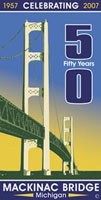
Michigan’s Mackinac Bridge - 1957 - 2007I have been scared because 2007 is the 50th Anniversary of the Mackinac Bridge. To me, other than the lake-etched outline of our state, there is no greater symbol of Michigan than the Mighty Mac.

5 miles long, 552 feet tall in nearly 300 feet of water, the Mackinac Bridge has seen over 120 million crossings required 3 years, over 11,000 people and 4 million tons of concrete and steel to build. (more facts)

And that’s only the barest glimmer of the story that needs to be told. From its conception in the 1800s, through the difficult construction, all the way up to the people who cross it for business or pleasure every day with hardly a pause, the Bridge is an essential part of what joins Michigan’s two peninsulas as one state.

If you have some links to share, please add them in the comments. We’ll be telling the story of the Mackinac Bridge piece by piece here and on Absolute Michigan, and we’ll post links to all the photos, stories and videos on The Mackinac Bridge page at Absolute Michigan. (look for the button!)

The Mackinac Bridge

Waterfall Hunting in the Upper Peninsula

Ripley Falls

Ripley Falls, photo by We Are CS.

It’s probably fitting that I came to today’s post in a roundabout fashion. I was checking out UPLiving.com, a new addition to Absolute Michigan. On their photo page I saw this gorgeous photo of Ripley Falls. A quick check of The Google found a page on the Hiawatha National Forest site that itself seemed lost from their waterfalls page titled
115 Waterfalls of Michigan’s U.P.:

It’s been said there are two things man never tires of watching – fire and falling water. Hence the fascination of fireplaces and waterfalls. Fireplaces, fortunately, are found everywhere in the land. But waterfalls are found only in very special parts of the land. One of these is Michigan’s Upper Peninsula. There are more than 150 waterfalls across the length and breadth of this rugged peninsula – enough to satisfy any collector of cascades. Some are tall and stately like the Laughing Whitefish. Some are broad and massive like the mighty Tahquamenon. All are spectacles of white splendor … A few of the Upper Peninsula’s falls are located conveniently along well-traveled highways. More often the falls are the dramatic climax to a rewarding hike through the woods and in every case they are well worth the effort involved in getting there. Some waterfalls are located on private property permission should be secured from the owner to cross the property. When large land holders such as paper, utility, mining, and forest companies are involved, the public is usually welcome to use the forest lands, unless posted against entry.

Ripley Falls was listed as #42 with just the terse note Ripley Falls, on Ripley Creek behind school of Ripley. Springtime flow only.. The Keweenaw Local Resource Guide has better directions, but still not much to say.

Then I stumbled onto Wayne Premo’s Waterfalls from Hunt’s Guide to Michigan’s Upper Peninsula. Wayne tells the tale of how he lost the Michigamme Falls and then says:

As an adult I started to explore the Upper Peninsula further. The state’s Department of Natural Resources county maps became my guide. All the squiggles marking falls became increasingly intriguing. Would any of these be as impressive as Michigamme Falls, the one I had lost? I charted my plan of attack.

My goal was to search out every squiggle and photograph it, so that then I would have seen every waterfall of consequence in the Upper Peninsula. At the time, I was in no hurry and the task did not appear formidable.

Michigan WaterfallsSo go to Hunt’s Guide and read Wayne’s tale and check out some of the waterfalls he has photographed. Then think about bagging a few waterfalls this year. You can click the photo to the right to go on a Flickr tour of Michigan waterfalls.

And after all this, what does Wayne say about Ripley Falls? Only that it’s one of the few falls not on the DNR maps.

Fitting.

Timber Cruising and Hulbert Lake

Hulbert Lake

Hulbert Lake, photo by Joslynan.

Josie took this photo in August of 2006 and you can also check out this satellite view of Hulbert Lake and the UP.

Exploring the North’s page on Hulbert Lake says that the lake was also named Lake Glimmerglass by William Hulbert. The page tells an interesting story of William’s grandfather, Francis, who was a “timber cruiser” and raced a fellow cruiser to file for title to the lake in Marquette. He won the race.

When Pine Was King (excerpted from Larry B. Massie’s “Voyages into Michigan’s Past) tells a little more of timber cruising:

The logging cycle began with the timber cruiser. Armed with a map and compass he would tramp the wilderness for weeks seeking prime stands of white pine located near a stream, then race to the nearest U.S. land office to register the find.

104

104

104, photo by Cara Jo Miller.

Cara Jo explains that this is a double exposure of the same negative – done in the dark room.

She is a photography & web design at Northern Michigan University. You can see a lot more of her work on Flickr and at her web site, cara-jo.net.

A Challenge for Michigan

Dead River Fog

Dead River Fog, photo by bgreenlee.

Brad took this photo at Dead River Basin, north of his hometown of Ishpeming, Michigan.

I saw this photo several days ago and was struck by its richness. For me – maybe for anyone who has ever stood next to a glass calm and still Michigan lake on a late summer morning – this picture holds an armload of images. The way the shore floats in and out of focus in the slowly moving mist … the haunting call of a loon … the splash of fat trout. All of this and so much more.

Further to the north – too far to walk in a day but not all that far – are the Yellow Dog Plains, one of the fronts in a battle that if lost, would change this image of Michigan forever.

The Yellow Dog is not the only front though. Consider White River, where Michigan’s water is poured out to the rest of the world, never to return. Or all the inland lakes where exotic zebra mussels have poured in, sterilizing them of other life. And countless other places and ways that our rivers, lakes, streams, ponds, wells and wetlands face the pressure that comes where a resource is not valued.

This is probably the point where right around 50% of brains will want to shut off and wander off, thinking “Here comes another environmentalist rant.” While I am a huge fan of the environment (which I like to think of as my life support system) this isn’t about politics.

This is about money.

Tourism is Michigan’s second largest industry. Unlike extractive industries like acid mining or water bottling that send most of the revenue away from Michigan, tourism sends income rushing through our local economies, generating business profits (and tax revenues) along with many jobs in hotels, motels, B&Bs and cabins, restaurants, shops, outfitters, galleries, musicians and countless other industries. Economists talk about “the multiplier effect”, describing how one dollar pays for a room for the night, then morning coffee, afternoon canoe rental, evening dinner and fifty more things before it moves along.

That dollar has a future from the moment it is laid on the counter. The other dollar doesn’t.

This is not only about money though.

I have chosen to make my lifelong home in Michigan for the same very simple reason that I made this web site: I am hopelessly in love with the beauty of Michigan. From the towering face of the Pictured Rocks to the corn stalk stubbles in the next field, I am head over heels for Sweet Mama Michigan and I cannot bear to see her carved up and sold off.

Even in our hour of need, I hope we can all agree that it is precisely this beauty, this richness of water and wild that is among Michigan’s greatest treasures.

It’s in that hope (and also for pay) that I worked with others to make a challenge to all of you: Make a short video that tells why we should protect Michigan’s water.

We call it the Save the Wild UP Video Challenge and I invite you to learn more about it.

PS: Apologies to Brad for tacking all on this on to what could have been a simple post of a great photo.

PPS: Those of you who are Flickrites might want to check out the Save the Wild UP Challenge group.

PPPS: Apologies also for any over-preachyness. I promise to try and keep it to a minimum.

The Eben Ice Caves

Columns of Ice, Eben Ice Cave

Columns of Ice, Eben Ice Cave, photo by John Clement Howe.

This photo is one of a nice set titled At the Ice Cave of Eben taken in March of 2007 (or view slideshow of the Eben Ice Caves). A document from a field trip led by Dr. John Anderton of the Northern Michigan University Department of Geography explains:

The Eben Ices Caves are located just a few miles north of the little town of Eben, within the Rock River Canyon Wilderness Area (RRCW). The RRCW, which became a Wilderness in 1987 as a part of the Michigan Wilderness Act, is located approximately 15 miles west of the town of Munising, MI, within the Munising Ranger District of the Hiawatha National Forest. It comprises 4,460 acres and contains outstanding natural features including Rock River, Silver Creek and Ginpole Lake. Within its interior there are two short user-developed trails (totaling about 1.75 miles) leading to Rock River Falls and the Eben Ice Caves. An estimated 1,700 people visit the area annually (USFS records) …

The Ice Caves are not true caves at all. They consist of walls or vertical sheets of ice that form across the face of overhanging rock outcrops. In the summer, small unimpressive waterfalls and groundwater seeps may found along the overhangs. In the winter, however, the water hits the cold air, drips downward under the influence of gravity and freezes, creating spectacular ice caves. Each winter they look a little different, but typically there are openings in the ice that allow you to walk behind the ice walls.

The rock overhangs, where the ice caves form, consist of outcrops of Munising Formation (Cambrian) with a capstone of AuTrain Formation (Ordovician). The outcrops are found along the south side of the valley of Silver Creek, which is part of a network of secondary glacial drainage channels that formed during the Marquette Advance (about 10,000 years ago). Theses secondary drainage channels flowed easterly into the AuTrain-Whitefish Channel, a primary glacial meltwater channel that flowed south to the Lake Michigan basin. Groundwater naturally seeps from these rocks, providing the water necessary to form the ice caves in the winter.

For directions and more info, check out Rock River Falls & Rock River Canyon Wilderness Area (Hunts’ UP Guide) and Visit The Eben Ice Caves (Marquette Country CVB).

Shaft entrance at the abandoned Hiawatha Iron Ore Mine, U.P. Michigan

Shaft entrance at the abandoned Hiawatha Iron Ore Mine, U.P. Michigan

Shaft entrance at the abandoned Hiawatha Iron Ore Mine, U.P. Michigan, photo by dietrichlawrenz.

Dietrich writes that the cement is stained from iron ore dust that came out from the shaft.

This photo is part of a great set rusty/snowy photos of Upper Michigan and you absolutely must view it large.

The Salmon Trout River on the Yellow Dog Plains

The Salmon Trout River on the Yellow Dog Plains

The Salmon Trout River on the Yellow Dog Plains, photo by savethewildup.

Somewhere there are lines, and I’m pretty sure that today I will cross a few. Over the life of this blog, I have stayed away from things that have sides, because sides too often divide us and this blog is really all about loving Michigan.

In my day job, I build web sites. A short while ago, I and some really talented people put together a new site for some people that have spent the last few years at a hard and lonely task: speaking up and standing up for Michigan’s rivers and lakes against the terrible risks posed by metallic sulfide mining and acid mine drainage.

They have been focused on the Salmon Trout River on the Yellow Dog Plains, but that is just the first of many that will follow. To be very clear: There has never been a metallic sulfide mine that has failed to pollute its watershed. You can read more from Save the Wild UP … and scroll down for a special treat featuring tons more photos and music from Greg Brown’s upcoming CD, Yellow Dog.

More photos of the beauty of the Yellow Dog Plains and Salmon Trout River can be seen at Save the Wild UP’s web site.

If you are a photographer who loves Michigan’s water and wild, please consider making them available to be used in fighting metallic sulfide mining and other threats to Michigan’s legacy of unspoiled water and add them to the Save the Wild UP photo pool.

Greg Brown, Yellow Dog slide show (or new window)

Magic: Ice boating in Michigan

2006_01_20icebt042

2006_01_20icebt042, photo by gretchdorian.

Gretchen Dorian has a great set of photos from a day of DN ice boating at Indian Lake State Park near Manistique. – makes a great slideshow!

Michigan has a long history of iceboating. The Detroit News’ excellent Rearview Mirror series includes Sailing on Lake St. Clair’s icy winter winds. They write that ice boating or ice yachting began over 4000 years ago in Northern Europe and was a source of entertainment in Michigan lumber camps. DN IceboatThe article also relates what the “DN” you see on so many ice boat sails stands for:

During the winter of 1936-37, in the sawdust covered hobby shop of the Detroit News, master craftsman Archie Arroll along with ice boaters Joseph Lodge and Norman Jarrait designed a racing ice boat they called the Blue Streak 60. Later the craft would come to be called the DN 60, the DN standing for the Detroit News, and the 60 referring to the size of the sail. Howard Boston, whose family remains in the sailing business, helped construct the first sails. (Doyle Boston Sailmakers of Holland)

Ice Boating Timeline reminds us not to forget about the other side of the state and Gull Lake and (as usual) Wikipedia can tell you more about iceboats & iceboating.

Update: I was just sent a nice video featuring Jack Jacobs (owner of Magic) talking about ice boating.