Thru the Woods on an Aero Sleigh

thru the woods

thru the woods, photo by litchard.

I’d never heard of the Wing Aero Sleigh – designed & built by Blain Wing in St. Ignace, Michigan in the 1940s – but Milton has a bunch of cool photos of the Aero Sleigh in action (slideshow)

There’s some information about how these were used from the Drummond Island Yacht Haven.

He uploaded the photos pretty large so be sure to click through check them out!

Climbing Munising’s Amazing Ice Formations

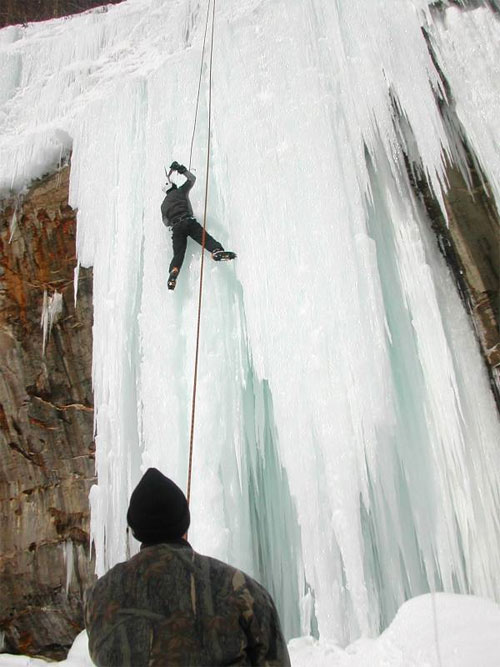
Ice Climbing on Grand Island

Grand Island VI, photo by gowaterfalling.com

Waterfalls of the Great Lakes Region and Beyond is an incredible website – packed with pictures of waterfalls – including a ton of Michigan falls (full list on the home page). You may know about the beauty of Michigan’s tumbling cascades, but have you seen them when winter freezes them in their course? The picture above is from the cliffs on the east side of Grand Isle opposite Sand Point is just one of many on their Munising Ice Formations page which explains:

Munising, Michigan is located at the western end of the sandstone cliffs that dominate the Pictured Rocks National Lake Shore. Every winter, water seeping over and through the sandstone freezes forming ice columns, curtains and other formations. Ice climbers flock to the area to tackle the ice, but even if you do not climb the ice formations are a fascinating sight…

Grand Island sits in Munising Bay. In summer there is a ferry service that takes you to the island, but in winter the bay usually freezes over and you can walk, ski or snowmobile out to the island.

Numerous ice formations form on the sandstone cliffs shores of the island. The most accessible ice is on the east side of the island opposite Sand Point, but there is ice all around the island. All the pictures below are of the cliffs opposite Sand Point and were taken in February 2003.

They advise to check with the locals on the ice conditions before crossing – and I advise you to click over and look at more of the pictures – there’s a bunch of great views! If you don’t have a snowmobile, it looks like Grand Island Sled Rentals can help you out (some more great pictures of the ice too!).

You should probably check out the Waterfall Mosaic too!

The Grand Marais Lifesaving Station

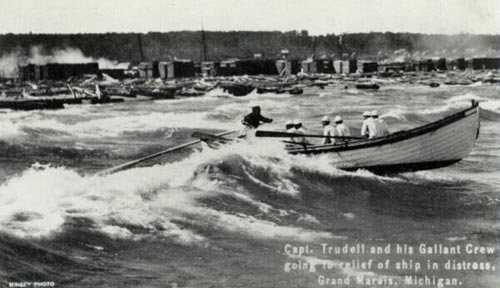
Captain Trudell and his crew from the Grand Marais Lifesaving Station

Captain Trudell and his Gallant Crew, courtesy Archives of Michigan

Something about the weather of the last few days has made me think about what an amazingly tough job members of the US Lifesaving Service must have had. This photo is of Captain Trudell and his Gallant Crew going to relief ship in distress, Grand Marais, Michigan (c. 1910). Anyone who has ever been to Grand Marais during inclement weather will know that those rollers they’re stroking through for a photo op are mere ripples compared to what they saw when they were really needed.

The Grand Marais Lighthouse page on Terry Pepper’s Seeing the Light has a brief bit about the station:

With traffic exploding along the south shore, the frequency of maritime accidents increased proportionally. To help guard the safety of mariners, 1898 also saw the beginning of construction of a life-saving station at the foot of the west pier. On its completion the following year, the station was considered one of the finest in all of the Great Lakes, boasting 2 surf boats, a 34-foot self-righting life boat, and a full complement of beach apparatus.

There’s a nice photo of the entirety of the Grand Marais complex from 1910, and you can see a few more photos at the Archives including a view of the station and the track to launch the surfboats, a Captain Trudell & his crew at attention in front of the station and the Grand Marais Harbor Range with the station in the background. The awesome historic photo gallery from the Grand Marais Chamber of Commerce has an aerial view of the complex, a photo of the station on July 4, 1927 and some other photos of maritime history.

The lifesaving station was replaced in 1938 by a US Coast Guard Station, which was deactivated in 1981 and transfered to the Pictured Rocks National Lakeshore for use as a ranger station.

Michigan Snowshoe: Extreme Edition

100_2066

100_2066, photo by tomthebomb.

tomthebomb says that this is a photo of Fisher getting EXTREME.

Michigan in Pictures regular Matt Callow tipped me off to the annual Bigfoot Snowshoe Race in Traverse City. The race takes place January 26, 2008 and while it probably won’t be this extreme, it is the Midwest qualifier for the National Championship Snowshoe race and looks like a lot of fun from the photos.

Rivers from the sun, unlocking the mystery of the Northern Lights with THEMIS

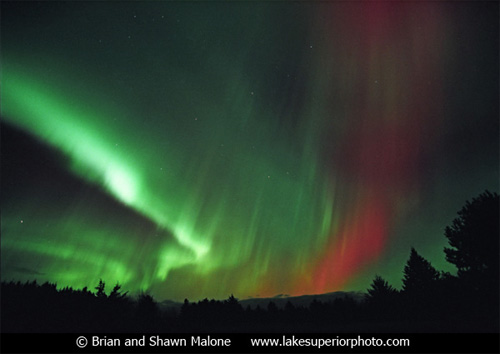
November 7-8, 2004 Aurora Borealis by Brian & Shawn Malone

November 7-8, 2004 Aurora Borealis, photo by Brian & Shawn Malone

This photo is one of many taken by Upper Peninsula photographers Brian & Shawn Malone of LakeSuperiorPhoto.com from the fantastic Northern Lights displays of November 2004 and other years. They have a ton more from all kinds of U.P. places and events that you can view and purchase if you’re so inclined.

The source of the aurora borealis (Northern Lights) has long been a beautiful mystery. Last week, however, CNN featured an article on the possible discovery of the energy source for the Northern Lights.

New data from NASA’s Themis mission, a quintet of satellites launched this winter, found the energy comes from a stream of charged particles from the sun flowing like a current through twisted bundles of magnetic fields connecting Earth’s upper atmosphere to the sun.

The energy is then abruptly released in the form of a shimmering display of lights…

You can get more in the article above or head over to NASA’s THEMIS mission for all the crunchy details including some multimedia (which in turn includes the THEMIS Mission Trailer – guaranteed to get your inner geek jumping!). Also see the THEMIS video & image gallery at the University of California – Berkley. Themis was the Greek goddess of justice (aka “the blindfold lady”) and the daughter of sky god Uranus and earth goddess Gaia.

The Copper Miner’s Strike of 1913 and the tragedy at Calumet’s Italian Hall

Copper Miners outside Dunn's Bar

dunns 6th calumet, photo by Ztef

I usually try to make Michigan in Pictures a happy place to be because there’s enough unhappy things out there. Every so often, however, I think there are stories that warrant a look and rememberance if only to say: “Let’s make darn sure this never, ever happens again.”

Ztef captioned the above photo rather sparsely with Copper miners strike outside of Dunn’s bar on 6th Street in Calumet, Michigan – 1913, but he has provided a link to Calumet: The Copper Miner Strike of 1913. This page offers a very detailed and readable account (complete with some great old photos) of the labor troubles in Keweenaw during the early part of 20th Century from the perspective of the Zawada family, Poles who worked in the copper mines for the mining giant Calumet & Hecla. Of this photo it says:

Strikers outside of Dunn’s Bar, a favourite among miners. Just next door to Dunn’s was the No. 203 local WFM office (Western Federation of Miners). The sign on the left reads: “Something just as good Miners ask for bread, Jim [MacNaughton, C&H General Manager] offers lead”. The sign in the middle reads: “One man machine Our Agitator”. The sign on the right reads: “We demand higher wages and better working conditions”. The men in front are holding copies of the Miner’s Bulletin, but the headlines are not clear.

As you can read at the link above, the strike was characterized by escalating violence, calling in of the National Guard and even murder. The chaos culminated with what has been called a Disaster, Tragedy and even Massacre at Calumet’s Italian Hall. Copper Country Reflections’ Italian Hall Tragedy page at Pasty.com explains:

By the end of December, the miner’s strike had been waged for 5 long months, with no end in sight. The mining companies and their supporters were holding firm in their resistance to the WFM, while the union was still somewhat solid in its position.

To temporarily set aside their cares, a group of union members planned a Christmas eve celebration for their children at the Italian Hall on Seventh Street in Calumet. I can only assume that the activities that evening must have been the most fun these children had since the start of the strike. Unfortunately, the excitement turned to tragedy as someone, his identity never learned, cried FIRE. As the children and adults panicked, many worked their way towards the stairwell. The first unlucky souls quickly realized the doors at the bottom would not open. Were they locked? Was somebody holding them closed?

It is hard to comprehend, but 73 men, women and children died in that staircase. Some were crushed, others died from suffocation. Can you imagine the shock of the rescuers when they finally pried open the doors? As they pulled bodies up and out of the staircase?

The page above also includes photos that are definitely not for the faint of heart. If you’d like to explore further, there’s more information and photos at the Italian Hall 1913 Massacre site and you can see a photo of the Michigan historical marker & memorial at the site of Italian Hall in Calumet.

One thing you definitely should do is watch the moving accounts of survivors of the tragedy at the December 2007 update from the 1913 Massacre Film Project. The movie project has been going for several years and it looks like it will be very good.

The Absolute Michigan map of Michigan has the location of Italian Hall in Calumet.

Fiborn Quarry and the Michigan Karst Conservancy

Portal for the locomotives.jpg

Portal for the locomotives, photo by smartee_martee.

In addition to taking some great pictures, Marty does a wonderful job of digging up and presenting background information. Fiborn Quarry was one of the largest early 20th century quarry operations in the Upper Peninsula, and Marty’s Fiborn Quarry set (slideshow) begins:

Fiborn Quarry was created by a partnership of the Duluth, South Shore & Atlantic Railroad in 1904. This small company town was built to house the workers (homes and a boarding house), offer a school and a general store. The operations consisted of the quarry plant, crusher house and steam engine shop.

Marty goes on to tell you about the role of limestone in the history of the UP, and he also links over to the Michigan Karst Conservancy. In addition to extensive information on the history of Fiborn (be sure to click the little photos at the bottom of the pages too), the MKC tells you about karst:

Karst is a term that was first applied to a plateau region of the Dinaric Alps in Yugoslavia. It is now used to describe similar regions throughout the world that have features formed largely by underground drainage. Karst terrains are characterized by caves, steep valleys, sinkholes, and a general lack of surface streams because drainage is underground…

What does this have to do with Michigan, a land literally scoured by glaciers, a land covered with glacial clay, sand and gravel? Surprisingly, Michigan contains some areas of true karst. They are limited in extent, but this rarity increases their interest and importance. There is also considerable variety in Michigan karst areas: gypsum karst is found in Kent and Iosco counties; a significant amount of surface drainage goes underground in Monroe County, and reappears at “blue holes” in Lake Erie; spectacular sinkholes and earth cracks are found in Alpena and Presque Isle counties; and the broad band of outcrops of the Niagara Escarpment in the Upper Peninsula hosts a number of karst sinks, springs and caves.

Diving the Wreck of the Vienna off Whitefish Point

Vienna - 19

Vienna – 19, photo by mschout.

Global Underwater Explorers page on diving the Vienna says that although extended range divers often use the Vienna as a “blow-off dive because it’s shallow and near shore, it’s also one of the finest wrecks to dive in Michigan’s Upper Peninsula. They write that this 191′ wooden steamer:

…came to her demise the same way that many do in Lake Superior, by collision. On 16 September 1892, she was down bound from Marquette, Michigan, with a load of iron ore. In tow was the schooner Mattie C. Bell. At Whitefish Point, the Vienna met up with the Nipigon. The Nipigon also had schooners in tow. Without warning, the Nipigon suddenly veered and struck the Vienna. Despite the efforts of both crews to save the Vienna, the vessel sank approximately one mile from shore. It was never fully understood why the Nipigon veered off course.

You can get more information about this wreck and others near Whitefish Point including a great photo of the Vienna at the ore docks in Marquette at Nordic Diver’s page on the wreck of the steamer Vienna.

Michael Schout has more photos of diving the Vienna (slideshow) and from diving more Great Lakes wrecks including the William Young, Panther, Minneapolis, Northwest, Sandusky and the Eber Ward in his very cool Diving set.

Much more shipwreck info (along with another great photo from Michael) can be found at the Absolute Michigan word of the week: Shipwreck!

Along the Graveyard Coast

Keel at Au Sable

Keel at Au Sable, photo by swaneesimpalass.

The Pictured Rocks National Lakeshore says that the shipwrecks of Lake Superior’s “Graveyard Coast” represent many eras of shipping. They are relatively well preserved because they have been spared from the human pressures of population and industry.

Some of them have lost their names, while others like the Mary Jarecki or the Annie M Peterson retain some of their stories:

The Annie M. Peterson was a 2-masted wooden schooner-barge built in 1874. She sank in a storm on November 19, 1914 off the mouth of Two-Hearted River on Michigan’s Upper Peninsula, when she was lost from her towline, and broke up offshore in heavy seas.

Winter storms in 2003 revealed her ice-encased remains, embedded in the Lake Superior shoreline, about 6 miles east of Grand Marais. Last I heard, she had disappeared again.

Click over to Bruce Moore’s site for the a map to the wreck and stay tuned to Absolute Michigan keyword shipwreck (there’s already a ton of stuff there!) and Michigan in Pictures all November for tales of the wrecks and information about museums, preserves and web sites to learn more about the unfortunate side of Michigan’s rich maritime history.

A Letter from Downstream

In the Michigan Immense Public Park, photo by Andy McFarlane

In the Michigan Immense Public Park, photo by Andy McFarlane

Welcome to a “Soapbox Saturday” on Michigan in Pictures, where your host takes you a little ways past “ain’t it cool” towards “ain’t it a shame.” Don’t worry though – it’s still cool. If it doesn’t seem cool – please click the photo above. I figured that since I was going to be sharing some personal feelings, I probably should use one of my own photos. This photo of my daughter exploring something on the Lake Michigan beach was taken a few years ago at the base of Pyramid Point in the Sleeping Bear Dunes National Lakeshore. I had posted it in gratitude to the Michigan Supreme Court for upholding our right to walk the Great Lakes shore.

Flash forward to the present day when Michigan’s regulators appear poised to permit the first metallic sulfide mine in Michigan. Several years ago, my friend Dick Huey and a few others started a group called Save the Wild UP when Kennecott Minerals, a subsidiary of mining giant Rio Tinto (one of the world’s largest polluters), began the process of securing a permit for a sulfide mine north of Marquette. The proposed mine is located directly under the Salmon-Trout River on the wild and beautiful Yellow Dog Plains. This is state land, our land, and the Salmon-Trout flows just a few miles through it and then empties into Lake Superior. Over that time I’ve been working for them to maintain their web site and have learned a thing or two about “acid mining”.

Iron and copper mining are things that helped forge the character of the Upper Peninsula. You can think of traditional mining as picking the chocolate chips out of a cookie. Sulfide mining is like getting the sugar out of a cookie – a chemical rather than mechanical process that yields a dust as a by-product. If this dust mixes with water and air, it forms sulfuric acid aka battery acid. There has never been a sulfide mine with the potential to pollute ground or surface water that failed to do so. Sulfide mining has polluted 40% of the watersheds in the West, and you can read more of the facts about metallic sulfide mining at Save the Wild UP (has a nice video if you prefer).

Sulfide Mining waste in PennsylvaniaA process with 100% failure rate of protecting water located directly under a pristine river that flows into the largest body of freshwater in the world seems like a bad idea. When you realize that they also plan to blow the sulfide dust into the air and that there are hundreds of other prospected sites waiting in the wings, it becomes terrifying. Michigan and the UP have a lot of challenges right now, but something we do have going for us is our water and wild places and the tourism dollars and jobs they generate. The picture to the right is a result of sulfide mining from Sudbury, Ontario. Multiply that across Michigan’s Upper Peninsula and consider how many thousands of tourism jobs and millions of tourism and tax dollars might be lost.

One of the people who has considered this is a wonderful musician named Daisy May. She has donated a song called A Letter from Downstream to Save the Wild UP and I hope you take the time to listen to it and see the photos that folks have shared about what Michigan’s water means to them.

If you’re a Flickr member, consider adding a photo to the Downstream group.