
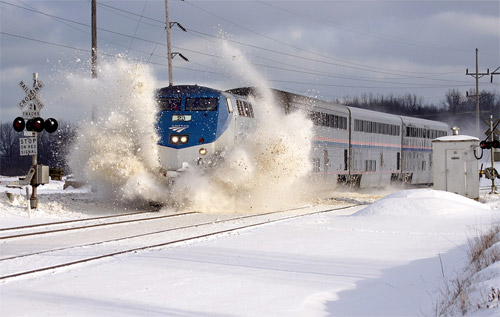
Jim writes that this is Amtrak 23 at 50 MPH, blasting through a freshly plowed crossing in snowy west Michigan.
He’s got a lot more great train photos.
Jim writes that this is Amtrak 23 at 50 MPH, blasting through a freshly plowed crossing in snowy west Michigan.
He’s got a lot more great train photos.
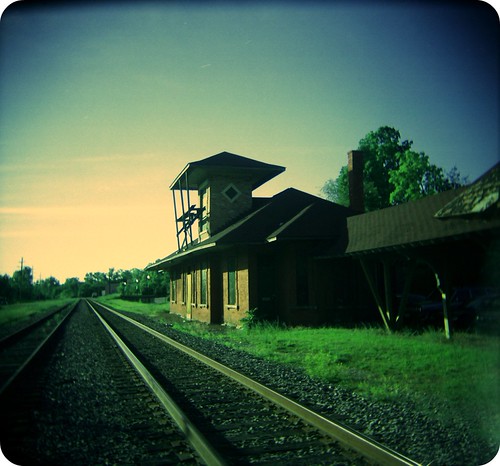
Holga_04_15.jpg, photo by Andy Tanguay
I think that Michigan in Pictures is the best web site that I have ever been involved with. Then again, my response to “You’ve won a trip to Milan!” would probably be “Milan, Michigan?”
One of the happiest parts of my life is that I get to spend some time every day looking at photos about Michigan from some amazing photographers and then learning about the subjects of the photographs and often times the people behind the lens. I’m very grateful for all that the photographers and readers contribute to make Michigan in Pictures what it is. Thanks!
The random background of the day on my computer is this photo from Andy’s Hardcore 313 set. This picture is of an abandoned train station station in Ypsilanti. It might be the same Ypsilanti train station where Presidents Ulysses S. Grant & Martin Van Buren delivered speeches and where Charles J. Guiteau, the assassin of President Garfield, was thrown off the train when the conductor found out he didn’t have a ticket.
Then again, it might be just an abandoned train station. You can view it bigger on white, or in Andy’s photostream.
Edit: Almost forgot! I did this post about Michigan in Pictures so I could link to it from the new Absolute Michigan group on Facebook.

Untitled, photo by Jenny Murray.
So when I was looking through Michigan Obama photos I found this one by Jenny Murray.
It was one of two photos that was taken by photographers I know in Time Magazine’s Barack Obama on Flickr.
I thought that was pretty neat.

Holiday Train, photo by StormchaserMike Photography
The holiday season seems to too often become about things that I have no desire to celebrate – busy-ness, consumption and another excuse to fight about the fact that we are a country that is predicated on the acceptance of all religions and lack thereof.
Still, there’s a part of me that sat at the top of the stairs, waiting for the report as to whether or not Santa came, one that snuggled in bed with my grandmother listening to the radio announcer tracking that red and white clad superhero of wishes and dreams, who sang carols with my family around the tree on Christmas Eve.
 That part wants – with much thanks to Samara and Paws of Roar of the Tigers – to wish all of you a Happy Chanukah, Merry Christmas, Happy Kwanzaa a belatedly Happy Eid al-Adha, a Happy Winter Solstice/Yule and a Happy Winter Season for those who prefer not to celebrate anything.
Be sure to check Mike’s Holiday Train out bigger and his whole Holidays slideshow.

Destination, photo by Stephen K. Willi
In keeping with this blog’s tradition of “Well here I am, now where is that actually?” (as opposed to “Hey that looks cool, I wonder what’s up with that?”) I thought I’d take a look at the city of Albion. Although I come here once or twice a year, my knowledge has been confined to Albion College (which is always closed when I’m here), Albion’s world class sledding hill, the Bohm Theater, the “other” Cascarelli’s (cause Homer’s Cascarelli’s rocks), the Coca-Cola sign and one very cool bookstore. I suppose that could be enough to build a post on, but I have my reputation to think about. And so, with already far too much adieu…
Wikipedia’s entry for Albion, Michigan says that this city in Calhoun County had a population of 9,144 in 2000.
The first white settler, Tenney Peabody, arrived in 1833. As local legend goes, Peabody’s wife decided to name the city after Albion, Oswego County, New York where another prominent pioneer, Jesse Crowell, came from. The city was almost named Peabodyville, but Albion was the preferred choice.
….The forks of the Kalamazoo River provided power for mills and Albion quickly became a mill town as well as an agricultural market. A railroad line arrived in 1852, fostering the development of other industries.
From the time that the earliest English-speaking settlers arrived, the area has also been known as The Forks, because it is situated at the confluence of the north and south branches of the Kalamazoo River. The Festival of the Forks has been celebrated annually since 1967, celebrating Albion’s ethnic heritage.
If you want to really dive into the history, you’re in luck because the Albion Michigan website has an amazing amount of historical information courtesy of historian Frank Passic. The site is framed so it’s hard to link directly to stuff, but be sure to go to the Albion History section and click into the gallery of photographs.
See this photo larger in Stephen’s Black and White Photography slideshow (view set).

Berry Branch, photo by Voxphoto.
In Bokeh: What it is and isn’t, Ross (Vox) says that although “bokeh” is the Japanese word for blurry, before this useful term degenerates into just another name for “blurry” we should take a stand to preserve its specific technical meaning:
Bokeh refers to the subjective quality of the blur. Is it “jangly” and busy-looking, or creamy and smooth? Do out-of-focus highlights have odd, distracting shapes, or are they unobtrusive circles? Does the blurred area seem to “swirl” around the center of the photo in arcs? These are some of the factors which might be mentioned as aspects of the bokeh for a particular lens. And these may be the reasons why a serious bokeh geek would chose one particular lens over a different brand with otherwise identical specs.
The word “bokeh” officially entered the English language in 1997, in an issue of the magazine Photo Techniques—whose editor Mike Johnston decided to add the final ‘h’ to make the pronunciation less ambiguous. He tells the story here, and includes some interesting photos showing different subjective effects in various blurred backgrounds.
Read the rest for more technical observations on bokeh from Ross’s excellent photography blog silverbased.org and check out this bokeh slideshow from the Absolute Michigan pool.

Railroad Bridge, photo by kek19.
The DNR’s page on Newaygo State Park says it is:
…a 99-site rustic campground, which sits atop 20-foot embankments overlooking the Hardy Dam Pond, a six-mile flooding of the Muskegon River (view on the Absolute Michigan map). The park caters primarily to campers, anglers and recreational boaters. There are several picnic sites overlooking the reservoir for day users. The campground is nestled in oak and poplar forests and is noted for its large, private sites and scenic beauty. There is a 20-30 foot forested buffer between sites, and each site is provided with a picnic table and a fire ring.
This TTV (through the viewfinder – more TTV on Michigan in Pictures) photo is part of Karri’s Nature set – definitely view it as a slideshow.
View more of Karri’s photos at RedBubble and see more from Newaygo County in the Newaygo County group on Flickr.

tracks pano, photo by scott.gosnell.
Click the photo to see this excellent panorama larger and to see it on a map. Michigan in Pictures often features stories of historical structures that are being preserved. As near as I can tell, this is not one of those.
The Michigan Passenger Stations page on Clare Union Station begins:
The Clare depot was built by the Pere Marquette and Ann Arbor Railroads in 1898 at a total cost of $6585. The Queen Ann style depot has wings paralleling each set of tracks. There are two bay windows, presumably for agents of both railroads. The door and window arrangement suggests waiting rooms and freight rooms for both roads also.
The Pere Marquette built through Clare around 1870. This was part of the original PM land grant railroad…
Passenger service on the Ann Arbor ended in 1950 and after being used for many years for storage, the building was abandoned. Click to read more and see some more views of the station, including historical photos.
For more photos of the station you can check out Clare, Michigan at Michigan’s Internet Railroad History Museum.
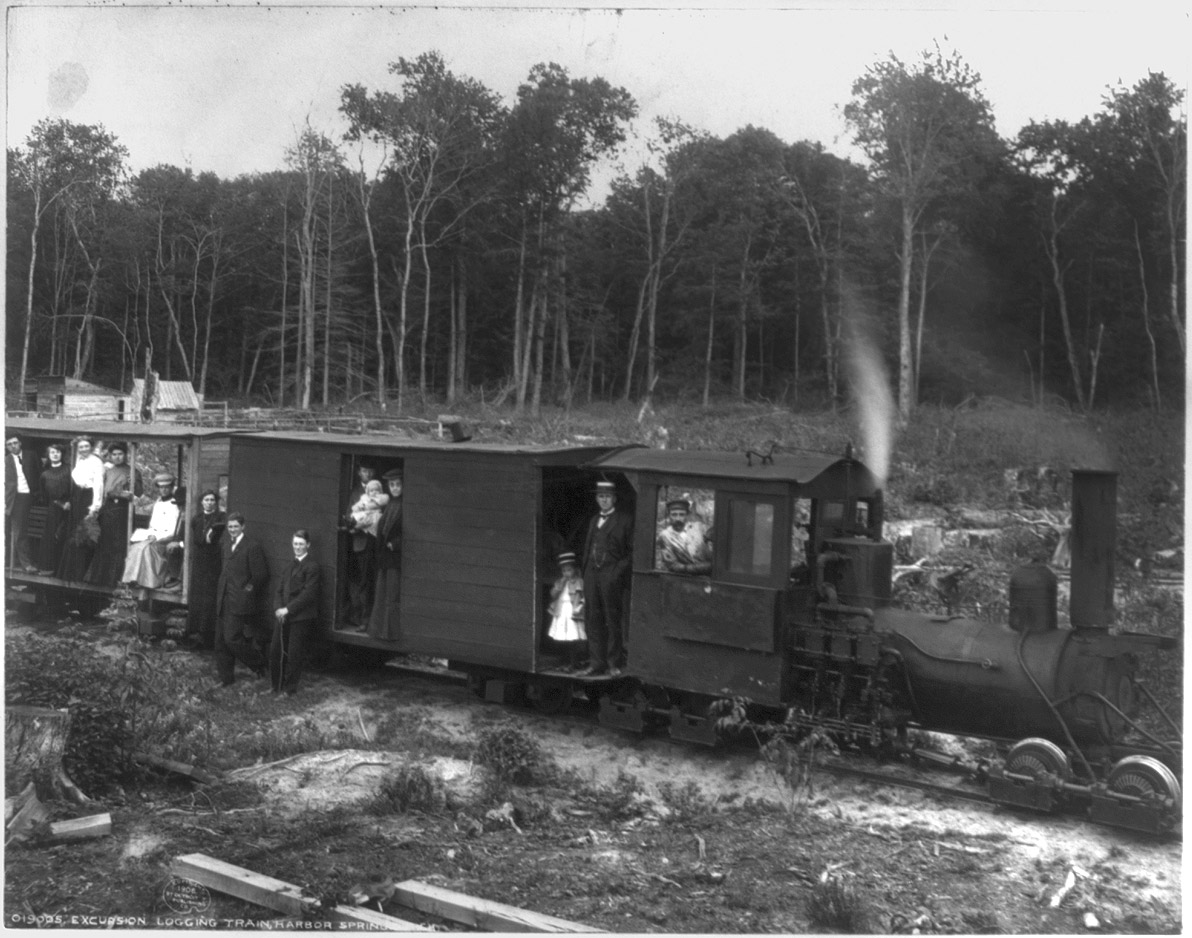
Excursion Logging Train, Harbor Springs, photo from Detroit Publishing Co., c1906 (at the Library of Congress)
I noticed that the Newaygo Logging Festival (Eventful link w/ map) happens this weekend. Several recent conversations and excursions of my own have driven home how profoundly the logging industry has shaped Michigan. Like miners, the timber trade roamed from river mouth to natural harbor up and down our Great Lake shoreline, into connected lakes and with the coming of the railroad, across the entire Lower & Upper Peninsulas.
At every stop, when the trees were gone, the land was left cleared and ready for villages and farms. Many of those working in the timber trade turned to farming and town building, and the names of the founders of these towns (and the owners of the dry goods stores) were often the names of the principals of the lumber companies.
Over Labor Day Weekend, I think it would be neat if Michigan were to somehow remember and honor the role of logging and loggers played in creating our state.
…and when it’s not such a lovely, last weekend of summer out there, be sure to check out some Michigan lumbering history and this really cool collection of Michigan logging photos from MichiganEpic.org.
Seriously, these logging photos are great!

Chelsea Tracks – Optimism, photo by aTanguay.
I thought that Andy’s photo is a perfect expression of how I feel about Earth Day this year. While in year’s past, it has seemed to be a day that highlights an impossible task, it now seems a day that we can begin to celebrate our journey towards a sustainable society.
Happy Earth Day, Michigan – hope you get a chance to get out and enjoy it!
Also see Absolute Michigan’s Earth Day post
 Michigan in Pictures