Along the Trail at Pictured Rocks

Along The Trail

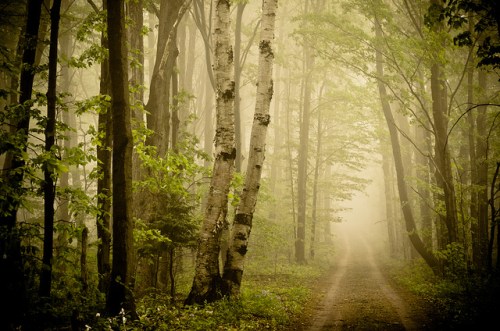
Along the Trail, photo by nasunto

Michigan in Pictures regular Nina Asunto is posting trip reports about her trip at the end of June to the Pictured Rocks National Lakeshore. In Day One: Chapel / Mosquito Trailhead to Chapel Beach she writes about a common June annoyance in the Upper Peninsula that this year proved more that annoying:

We arrived at Chapel Beach campground just before noon and had to put our bug nets on as soon as we got there. The campground consists of six sites, which are in the woods at the top of a bluff above Lake Superior. One of them (#6) is at the edge of the woods, and it is close enough to the beach to benefit from the breeze coming from the lake. This site was already occupied, of course, so we chose site #3, which was further into the woods. Under normal circumstances, this would be a really good campsite, with Chapel Creek running alongside it creating a nice atmosphere. Unfortunately, the exceptionally wet spring had ensured that this typically buggy season far exceeded expectations. The word “brutal” doesn’t quite do it justice – it was a buzzing hell-scape. The only thing to do was to set up camp as quickly as possible and flee to the beach.

Curiously enough, I was also in the UP and stopped at Pictured Rocks that weekend. Without Deep Woods Off, I am pretty sure I would have ended up a bloodless corpse! Click to read more (including her analysis of permethrin vs mosquitos). Follow along as Nina posts the rest of the report on Black Coffee at Sunrise.

Check it out bigger and see more in Nina’s Pictured Rocks National Lakeshore | June 2013 slideshow.

Living in the Light at Friends of Miners Memorial Heritage Park

Miners Memorial Heritage Park (2)

Miners Memorial Heritage Park (2), photo by siskokid

I’ve always found snow & cold to be a lot more tolerable when accompanied by a healthy dose of sun & blue skies. About this photo Jim writes:

During the recent snowshoe weekend with my buddies Jim, Fred and Roger, we snowshoed the trails of this beautiful park located in my hometown. A recent snowfall had left a good blanket of powder that hadn’t been groomed as of yet for cross-country skiing. Lucky for us!

The City of Ironwood, Michigan passed an ordinance in 2011 that designated 167 acres of city-owned land in the center of Ironwood as the Miners Memorial Heritage Park. This area once contained five iron ore mines, the last of which closed in the 1960’s. The Friends of Miners Memorial Heritage Park has created a 2.6 mile looping trail through a portion of this area for hiking in the summer and cross-country skiing and snowshoeing in the winter. The Park is “Dedicated to those who toiled underground to work these mines. Many died in the darkness so future generations could live in the light.”

More about the park including some old photos at fmmhp.com.

Check this photo out on black, see more from the park in Jim’s slideshow and also view more of his UP shots on Michigan in Pictures.

How Miners Falls got their name

Winter at Miners Falls

Winter at Miners Falls, photo by gkretovic

The Pictured Rocks National Lakeshore explains that Miners Falls is about five miles north of Alger County Road H-58 off Miners Castle Road. It’s a short hike of just over a mile round-trip from the parking area and Miners Castle.

I always wondered about the whole “miner” thing with Miners River/Falls/Castle.  The Miners Falls Trail Guide explains that:

Visited by passing English geologists in 1771-1772, the nearby Miners River was named by employees of Alexander Henry during one of his exploratory trips on Lake Superior. At that time, indicators or “leaders” were used to locate mineral deposits. Discolored water oozing from bedrock was one such leader found in the Miners Basin, although no minerals were ever extracted from this area.

Who was Alexander Henry you ask? Wikipedia explains:

Alexander Henry ‘The Elder’ (August 1739 – 4 April 1824) was one of the leading pioneers of the British-Canadian fur trade following the British Conquest of New France; a partner in the North West Company, and a founding member and vice-chairman of the Beaver Club. In 1763-64, he lived and hunted with Wawatam of the Ojibwa, who had adopted him as a brother. “Blessed with as many lives as a cat,” his time with the Ojibwa and subsequent explorations are retold in his Travels and Adventures in Canada and the Indian Territories between the years 1760 and 1776 (published New York, 1809), which he dedicated to his friend Sir Joseph Banks. The book is considered an adventure classic and one of the best descriptions of Native Indian life at this time.

An “easy and dignified” raconteur, in 1776 Henry was invited to give an account of his journeys at the Royal Society in London and at Versailles to Queen Marie Antoinette. In the 1780s, Henry introduced John Jacob Astor into the Canadian fur trade and subsequently Astor would stay as Henry’s guest during his annual visits to Montreal.

You can read Henry’s Travels and Adventures in Canada online from Google Books. Also see the GoWaterfalling page on Miner’s Falls.

See it on black and see more in Greg’s great slideshow which includes a shot of a UP moose! From the Small World Files, Greg took this photo on November 27th. On the 28th, John McCormick was also there and also shared his shot on the Absolute Michigan group on Flickr!

More from Pictured Rocks National Lakeshore on Michigan in Pictures.

Back into the Woods Day, 2012

Sandstone Creek Ravine

Sandstone Creek Ravine, photo by joeldinda

The hardest 15 days for the year for the non-hunting lover of the outdoors in Michigan are November 15-30th. I think of December 1st as a mini-holiday. Call it “Back into the Woods Day” and celebrate as you will.

Joel’s photo is from Fitzgerald Park aka “The Ledges”, an amazing park along the Grand River near the town of Grand Ledge. Check this out background bigtacular and see more in his Into the Woods slideshow.

Have you gotten your dose of Vitamin N today?

Green Point in Fog

Green Point in Fog, photo by *ojoyous1*

I was paging through a copy of the AARP Bulletin (not mine … yet) and came across an interesting little article about the benefits of spending time in nature by Richard Louv. Louv wrote the book Last Child in the Woods, which introduced the concept of “nature-deficit disorder”. He writes:

A growing body of research links more time in nature — or in home, work or hospital environments enhanced through nature-based design — with reduction of stress and depression, faster healing time and less need for pain medication.

Health care professionals are taking note. In 2010, a pilot program in Portland, Ore., began pairing physicians with park professionals, who helped children and families get their green exercise or, as I call it, their dose of “vitamin N.”

Other benefits of vitamin N include enhanced use of the senses and higher work productivity. In 2008, University of Michigan researchers demonstrated that, after just an hour interacting with nature, memory performance and attention spans improved by 20 percent. In April, researchers at the University of Kansas reported a 50 percent boost in creativity for people who were steeped in nature for a few days.

Michigan is blessed with an amazing amount of opportunities to slip into nature for ten minutes or ten days so what’s stopping you?? Check out books and more at Richard Louv’s website.

Joy took this photo at the Green Point Nature Reserve near Elberta. Check it out bigger and in her Up North slideshow.

More nature on Michigan in Pictures!

Tunnel of Trees

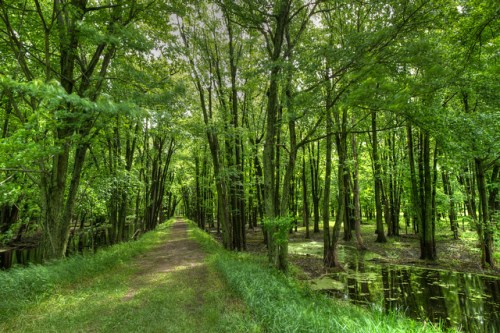
Tunnel of Trees Ferguson Slough Trail

Tunnel of Trees Ferguson Slough Trail, photo by DTWpuck

Scott wonders who in Michigan doesn’t get weak in the knees when looking down a tree canopied road or trail. This trail is located alongside the Ferguson Slough in the Shiawassee National Wildlife Refuge.

Check it out background bigtacular and see more on his map.

The Hiawatha National Forest

Hiawatha National Forest

Hiawatha National Forest, photo by Sean Depuydt.

Ever thicker, thicker, thicker
Froze the ice on lake and river,
Ever deeper, deeper, deeper
Fell the snow o’er all the landscape,
Fell the covering snow, and drifted
Through the forest, round the village.
~Henry Wadsworth Longfellow
The Song of Hiawatha

The Hiawatha National Forest in the Upper Peninsula is known as “the Great Lakes National Forest” because nearly 1 million acre forest touches three Great Lakes: Superior, Huron and Michigan.

The landscape of sandstone and limestone includes the watersheds of the three Great Lakes, five National Wild & Scenic Rivers – the Carp, Indian, Sturgeon, Tahquamenon, and Whitefish.

Northern hardwood and mixed forest types are common on the Hiawatha National Forest. Tree species include sugar maple, red maple, American Beech, white pine, red pine, northern white cedar, eastern larch/tamarack, and balsam fir. Jackpine savannahs are also common in some areas. Much of the Hiawatha is covered in wetlands, and as a result there are many wetland plants.

Spring wildflowers bloom in May and June.
The Forest contains habitat for northwoods species like whitetail deer, gray wolf, and lynx. Kirtland’s warbler, an endangered species, relies on young jackpine stands for its nesting grounds, and piping plover nest along our pebbly Great Lakes beaches. Trout are native to coldwater streams, and our inland lakes support strong, diverse fisheries

In short, a wonderful place. Here’s hoping you get a chance to have fun as the covering snow piles deeper this winter.

Check the photo out on black and in Sean’s Upper Michigan slideshow.

Bare Bluff overlooking Bete Grise Bay

n2c_111-8083

n2c_111-8083, photo by sgowtham.

The Keweenaw Free Guide’s entry for Bare Bluff begins:

Towering some 500 feet above the sparkling waters of Lake Superior, Bare Bluff commands a spectacular view across the lush green forest of the Keweenaw Tip and the encompassing waters of Lake Superior. The rocky bluff sits several miles from any semblance of civilization, standing along the far northern arm of Bete Grise Bay. In fact the only hint of civilization glimpsed from its vantage point os the Mendota Canal breakwaters and lighthouse – producing a landscape much like the early explorers to the region might have experienced. Highlights include the rocky shore of the Keweenaw, Smith Fisheries, the mouth of the Montreal River, Bete Grise Beach, and on clear days the Huron Mountains on the horizon.

Read on for directions. While the Guide deems it “a very difficult trail with a good amount of steep cliffs and sudden drop offs along the way,” Gowtham says it’s a “moderate hike is a price worth paying any day for a glorious view of the eastern shore of Michigan’s Keweenaw Peninsula.”  We should add a link to the Fall Color Tour for the Keweenaw Peninsula (Houghton, Eagle River, Copper Harbor) courtesy Pure Michigan’s Fall Color Tours.

In any case – stunning vista! He took it on October 4th, and you can see there’s still lots of color left! Check it out bigger and on his photo map.

Michigan Cougar Photo Evidence


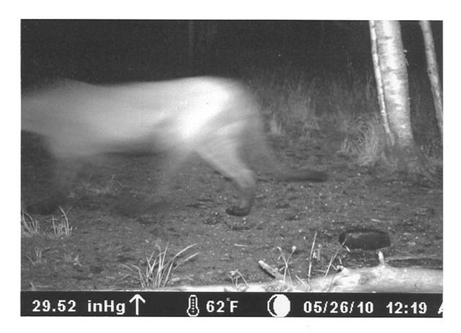
Menominee County Cougar, June 2010, photo courtesy Michigan DNRE

The Michigan Natural Resources and Environment reports that a trail camera photo from Menominee County on May 26th is likely a cougar:

“This is the first confirmed cougar picture in Menominee County. We appreciate the cooperation of the caller who shared the photograph and contacted the DNRE,” said DNRE wildlife biologist Kristie Sitar, who is a member of the DNRE’s cougar team. “Other landowners who believe they have evidence of a cougar on their property, such as tracks or a kill site, are encouraged to contact their local DNRE field office as soon as possible, which allows staff to investigate before the evidence is compromised. Without good evidence, such as verifiable photographs or tracks, confirmation becomes increasingly difficult.”

Cougars, also known as mountain lions, originally were native to Michigan but were thought to have been extirpated around the turn of the last century. The last known wild cougar taken in Michigan was killed near Newberry in 1906. The Menominee County photograph represents the latest in a series of track and photo verifications of cougars in the Upper Peninsula. Since March 2008, five sets of tracks and two trail camera pictures have been verified in Delta, Chippewa, Marquette, Schoolcraft and now Menominee counties. The origin of the animal or animals is unknown. There have been no confirmations of breeding activity of cougars in Michigan in recent years.

If you sight a cougar or find evidence, call your local DNRE office or the 24-hour Report All Poaching line at 800-292-7800. Click through to the story for more, including tips on human/cougar encounters.

While the DNR is only prepared to admit cougars in the UP, SavetheCougar.org has reports from all over Michigan and there’s lots more at michigancougar.com.

Rain Forest, Michigan style

Deep Woods Magic

Deep Woods Magic, photo by CreateWithKim.

Hey everyone – very sorry for not updating Michigan in Pictures yesterday and Monday. I was in the El Yunque rain forest* and the Internet wasn’t!! I’m back in the arms of Mama Michigan and ready for spring!

Since we were on the subject of rain forests, I figured this photo from an Eastern Hemlock Forest on the Little Union Gorge Trail in the Porcupine Mountains would be nice. You have to check it out large on black and in her Porcupine Mountains Autumn 2009 set (view the slideshow).

*If you want to see my pics, they’re right here.