Holland, by rail and sail

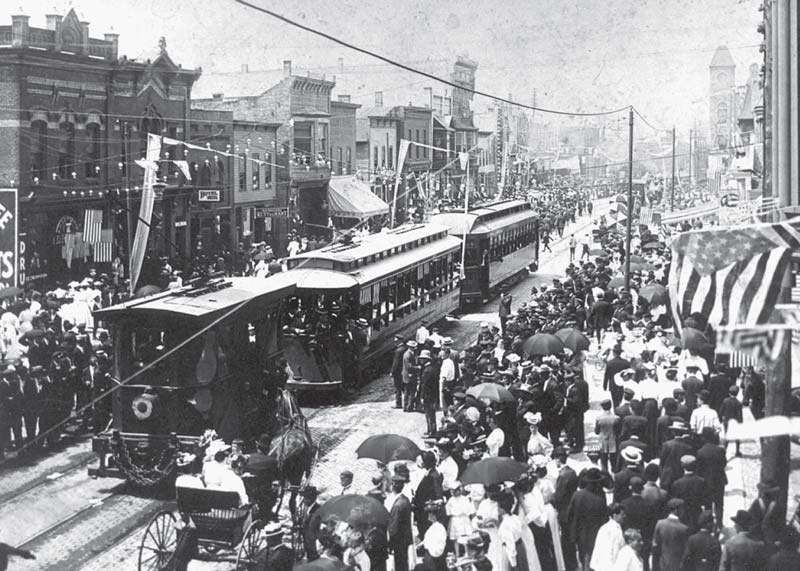
Interurban electric railroad on the Holland and Lake Michigan Railway

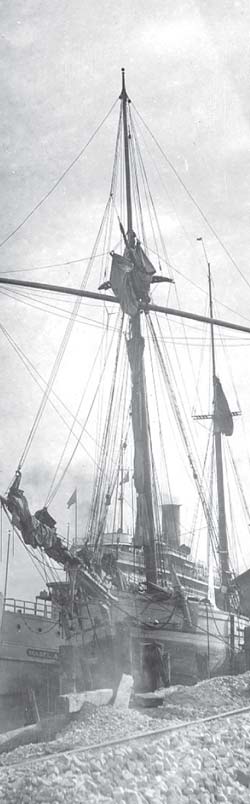
Mabe Bradshaw, the first passenger ship

On July 4, 1898, the first Interurban electric railroad car to carry passengers arrived in Holland. The first rails in Holland had been laid by the Holland and Lake Michigan Railway at River (Avenue) and Eighth Street. These cars are on the track a half-block east of there. More than 100 men and 17 teams of horses constructed the line. The payroll for construction workers was $1,000 weekly. The trains ran from Grand Rapids through Grandville, Jenison, Shack Huddle, Jamestown, Forest Grove, Vriesland, Zeeland, Holland, Jenison Park, Macatawa Park, and Saugatuck. The Interurban freight office was on Eighth Street near Pine Avenue. The passenger train continued south on River and turned west on 13th Street. The line continued near South Shore Drive, stopping near Sunnybrook Station at Virginia Park. Extending south near 160th Street, the train headed to Castle Park and Saugatuck. The train met its demise November 15, 1926.

The first time a passenger ship connected Holland directly with Chicago, via Lake Michigan, was July 4, 1889, when the Mabel Bradshaw docked at the foot of Fifth Street at the old Harrington Dock. That first year the ship made four trips a week, leaving Holland on Sunday, Monday, Wednesday, and Friday evenings, after the arrival of trains at 6:35 p.m. The fare was $2 one way or $3.50 round trip. Owner Hugh Bradshaw named the ship after his daughter Mabel. She was to christen the ship with a bottle of champagne. As she reached for the bow, the bottle slipped from her hand and fell into the water, leaving the ship unchristened. The ship was used for a ferrying service a few years later and spent its last years on Lake Superior.

Be sure to click the photos for a larger view!!

Photos reprinted with permission from Holland: The Tulip Town by Randall P. Vande Water. Available from the publisher online at www.arcadiapublishing.com or by calling 888-313-2665.

View other excerpts from Arcadia Publishing’s Michigan books at Michigan in Pictures!

Time again for Holland’s Tulip Time Festival

214_1469

214_1469, photo by pablohart.

As someone who lives near a city (Traverse City) that is inextricably tied to an event (Cherry Festival), I imagine that the approach of Tulip Time can be a bittersweet thing.

According to the Tulip Time Festival web site

The idea of Tulip Time was introduced in 1927 at a Woman’s Literary Club meeting. Miss Lida Rogers, a biology teacher at Holland High School, suggested that Holland adopt the tulip as its flower because of its close ties to the Netherlands, and set aside a day for a festival. She titled her talk that day “Civic Beauty” and spoke at length about the area’s unique sand dunes, its fine trees, safe water supply, pure milk, and ample playgrounds. She advocated planting more trees, and because the Chamber of Commerce was seeking something appropriate, suggested planting tulips in every yard. She concluded with reading a poem, “Come Down to Holland in Tulip Time.”

In 1928, City Council, under Mayor Ernest C. Brooks, appropriated funds to purchase 100,000 tulip bulbs from the Netherlands. These bulbs were to be planted in city parks and other areas. Initial plans called for a “Tulip Day.” Bulbs were available to Holland residents at one cent a piece…

Tulip Time Festival will be held May 3-10, 2008 and features many musical acts, parades, trolley tours of Holland, an art & craft fair, fireworks and of course, klompen dancing.

For more Holland Tulip goodness…
Tulip Time, Holland Michigan from last year on Michigan in Pictures
The Tulip Time group and the Holland Michigan group, both on Flickr
Tulip Time Festival photo gallery from the Holland Sentinel

Lake Michigan Shore

Lake Michigan Shore

Lake Michigan Shore, photo by Anthony Bergman.

About 10 miles south of Grand Haven … highly recommended as wallpaper for the cabin feverish.

of Heads, Hands and Frandor

self reflection, photo by Bridget Johnson

self reflection, photo by Bridget Johnson

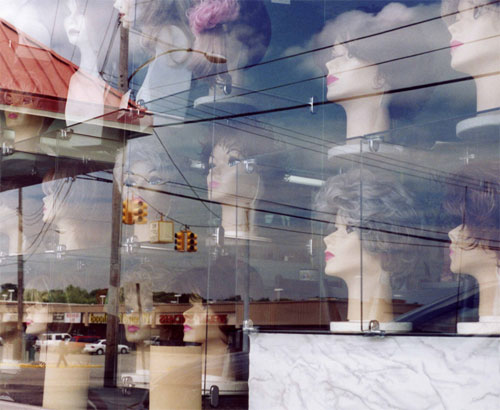
Bridget relates that this photo was taken at the Frandor Mall in East Lansing … or Lansing … or right between the two. I am a bit depressed that there is no entry for Frandor at Wikipedia (yet at least). The Lansing entry says that in 1954, Frandor Mall was the first in the area and the second in the state.

On second thought, Joey Harrison’s photo of the old FRANDOR sign on Flickr is lots better than any Wikipedia entry probably would be because it has a bunch of people’s reflections on the history of the mall, including his mom, who says:

What I’m about to say can’t be certified, but this is what I seem to remember: Frandor was developed by Francis and Doreen Corr in 1954 from a former golf course. It was the second outdoor mall, the first being Northland in Southfield.

Bridget Johnson is a Traverse City based photographer who will be among the over 150 women artists of all media whose work will be on display at the 5th annual From Women’s Hands art show, sale and benefit for The Women’s Cancer Fund from April 27-29 at the Hagerty Center in Traverse City.

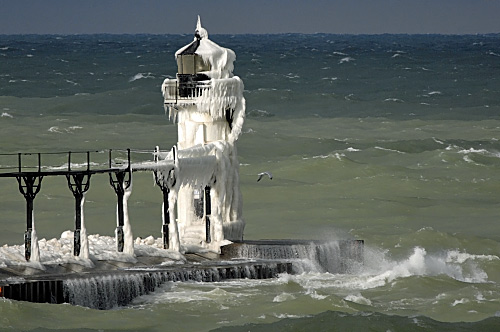
St. Joseph, Michigan outer light in winter

St Joseph Michigtan Outer Light by Dan Sheehan

St. Joseph, Michigan outer light, photo by Dan Sheehan

Dan says he captured this photo during a break in lake effect snow squalls. He lives in St Joseph, so he has a lot more photos of this lighthouse (and tons of other Michigan ones). In addition to lighthouses and nature photography, Dan also has numerous photos of military aircraft all available at gearupsix.com.

Grand Rapids Bicycle Factory Ruins

Grand Rapids Bicycle Factory fire

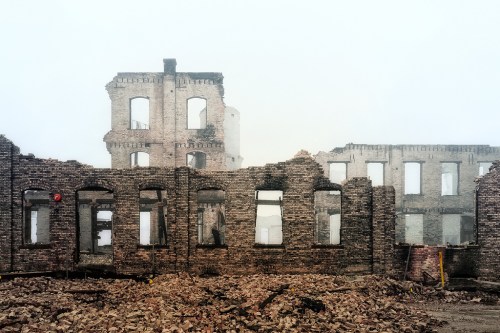
Former Grand Rapids Bicycle Factory Fire | Smoldering Ruins 2, photo by Mr. Gillette & His Image-Making Apparatus.

A fire destroyed the former Grand Rapids Bicycle Factory last week, leaving a nothing but a burned out hulk that looks like something you’d have seen in London during the blitz. Brad also took some photos during the massive fire.

According to a story from WOOD-TV:

At one time the city had six factories making bicycles and Grand Rapids Cycle Company was the first and largest. The company put out 30,000 bicycles and the factory employed 200 people in its prime in the late 1800s.

Bicycle manufacturing in Grand Rapids was abruptly halted in 1899 as most of the bike makers were bought out and shut down by the bicycle trust out of New York. By 1903 the bicycle industry was completely gone.

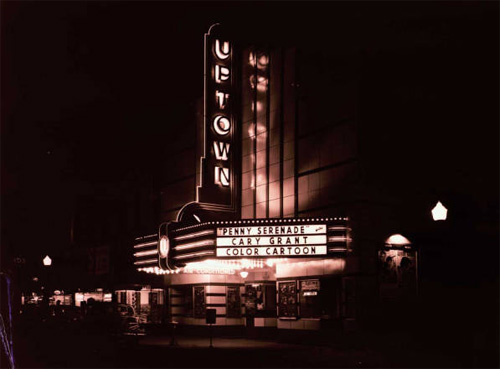
Kalamazoo’s Uptown Theater – September 1, 1941

Uptown Theater, photo by John Todd

Uptown Theater, photo by John Todd

I found this photo via the revamped Michigan eLibrary. It’s from the John Todd Photographic Collection at the Portage District Library. The collection contains over thirteen-thousand negatives of Kalamazoo, Kalamazoo County communities and southwest Michigan taken from 1940 to 1981. It includes all manner of pictures including aerial photos of Kalamazoo and the surrounding area.

The description might give you an idea of the breadth of the collection and the degree to which it’s indexed. Go ahead, click…

Night view of the Uptown Theater located at 247 North Burdick Street in downtown Kalamazoo, Michigan with the camera looking towards the southwest. As of 2006 this theater has been demolished and replaced with the Kalamazoo Valley Public Museum. North Burdick Street in this block no longer functions as a roadway but has been converted into a pedestrian mall.
CATEGORY: Entertainment

Magic: Ice boating in Michigan

2006_01_20icebt042

2006_01_20icebt042, photo by gretchdorian.

Gretchen Dorian has a great set of photos from a day of DN ice boating at Indian Lake State Park near Manistique. – makes a great slideshow!

Michigan has a long history of iceboating. The Detroit News’ excellent Rearview Mirror series includes Sailing on Lake St. Clair’s icy winter winds. They write that ice boating or ice yachting began over 4000 years ago in Northern Europe and was a source of entertainment in Michigan lumber camps. DN IceboatThe article also relates what the “DN” you see on so many ice boat sails stands for:

During the winter of 1936-37, in the sawdust covered hobby shop of the Detroit News, master craftsman Archie Arroll along with ice boaters Joseph Lodge and Norman Jarrait designed a racing ice boat they called the Blue Streak 60. Later the craft would come to be called the DN 60, the DN standing for the Detroit News, and the 60 referring to the size of the sail. Howard Boston, whose family remains in the sailing business, helped construct the first sails. (Doyle Boston Sailmakers of Holland)

Ice Boating Timeline reminds us not to forget about the other side of the state and Gull Lake and (as usual) Wikipedia can tell you more about iceboats & iceboating.

Update: I was just sent a nice video featuring Jack Jacobs (owner of Magic) talking about ice boating.

Better than TV

Better than TV #7

Better than TV #7, photo by norjam8.

Norm writes: The next in my lone bench series. If you look closely, you can see the snow blowing across the frozen lake. And yes, it was very cold. This was handheld, so It does have some slight hdr alignment issues. Oh well. When it’s warmer, I’ll take the time to pull out my tripod.

This is the latest photo in Norm’s cool set of HDR photos titled Better than TV.

Back in time on the Fallasburg Bridge

Vintage bridge

Vintage bridge, photo by pnygirl1.

BJ writes Playing around with some techniques – liked how this effect captured the old wooden bridge…like it was captured back in time. She has more views of this and other bridges (and a ton more photos).

The Michigan Historical Markers page on the Fallasburg Bridge (includes map) has the text of the marker:

John W. and Silas S. Fallas settled here in 1837, founded a village which soon boasted a chair factory, sawmill, and gristmill. About 1840 the first of several wooden bridges was placed across the Flat River, but all succumbed in a short time to high water and massive spring ice jams. Bridge builder Jared N. Bresee of Ada was given a contract in 1871 to build the present structure. Constructed at a cost of $1500, the bridge has lattice work trusses made of white pine timbers. As in all covered bridges, the roof and siding serve to protect the bridge timbers from rot. Repairs in 1905 and 1945 have kept the bridge safe for traffic for one hundred years.

You can learn a bunch more about the bridge from Michael Frazier’s Covered Bridges of Michigan, get a surprising amount of information and links from Wikipedia’s entry on the Fallasburg Bridge and get details on Fallasburg Park from Kent County Parks.