
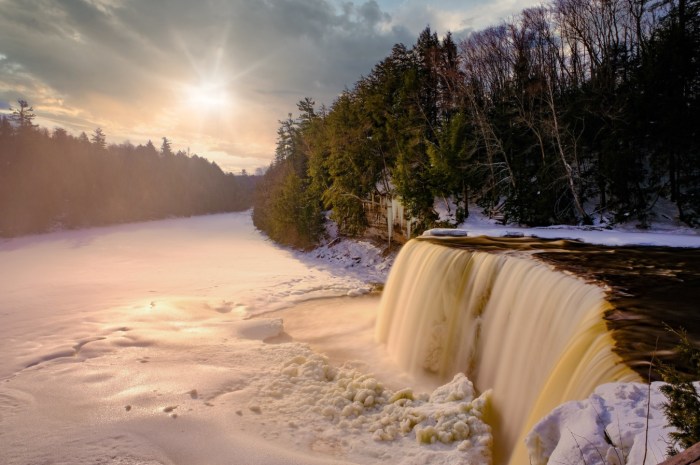
Sunrise at Tahquamenon by Dan Gaken
Here’s a stunning moment from Tahquamenon Falls that Dan captured this weekend. More from Dan in his Michigan’s Upper Peninsula gallery on Flickr!

Sunrise at Tahquamenon by Dan Gaken
Here’s a stunning moment from Tahquamenon Falls that Dan captured this weekend. More from Dan in his Michigan’s Upper Peninsula gallery on Flickr!
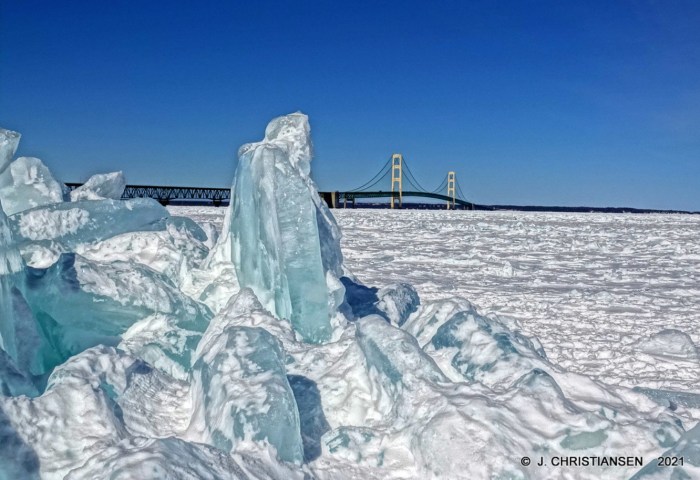
Julie shares:
Rode up to Mackinaw yesterday and checked out the blue ice. Huge chunks and most phenomenal. The ice, however, is not actually turning blue. The color is a result of the way sunlight is bouncing off this particular ice.
Sometimes, weather conditions — such as a lack of high winds — allow water to freeze slowly and evenly, resulting in ice composed of large crystals (unlike snow, which is formed quickly and made up of small crystals).
When light hits these big ice crystals, it can travel deep into the structures (compare this to snow, wherein light hits a sharp edge and reflects off of it right away, resulting in blinding white). When the light travels deeper into slowly formed ice, some of the red wavelengths of sunlight — which is the longest wavelength of visible light — get absorbed into the ice structure.
The blue, which is the shortest wavelength of visible light, bounces back out, meet our eyes, and results in a deep aqua color.
See more in her Winter gallery on Flickr!
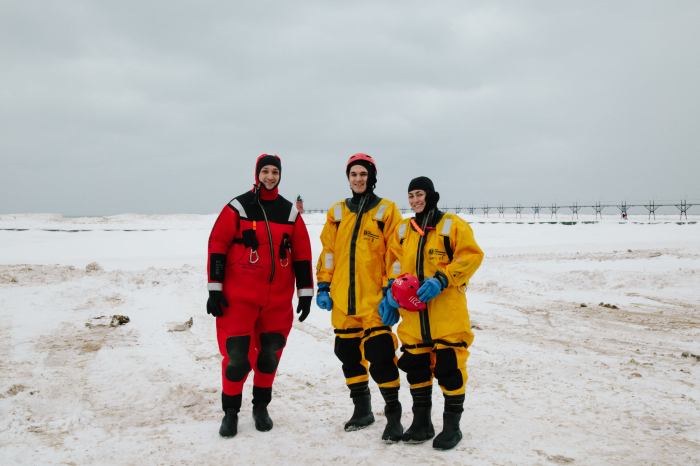
South Haven Area Fire-Rescue-EMS by William Dolak
We’re getting to the portion of the winter where the ice begins to build out on the Great Lakes. As a person who grew up on Lake Michigan, I’ve enjoyed the ice safely for decades & will undoubtedly continue to do so and also to share photos of the incredible beauty of the frozen lakes. I want to make sure however that folks understand venturing on the ice in winter can be deadly, particularly if you don’t take precautions. Though EMT workers know this and train to help people in peril, if you fall into one of the Great Lakes, you will very probably die. You can read more of my thoughts on this post on Michigan in Pictures.
Bill took this last weekend in South Haven & writes:
It’s 16 degrees at the beach – this is what the cool kids are wearing on South Beach, South Haven. These three are with the South Haven Area Fire-Rescue-EMS and were out to practice a little cold-water rescue, ‘cuz, unfortunately, someone is gonna need it sooner or later.
See the photo bigger in our Michigan in Pictures Group on Facebook & for sure follow him on Flickr!
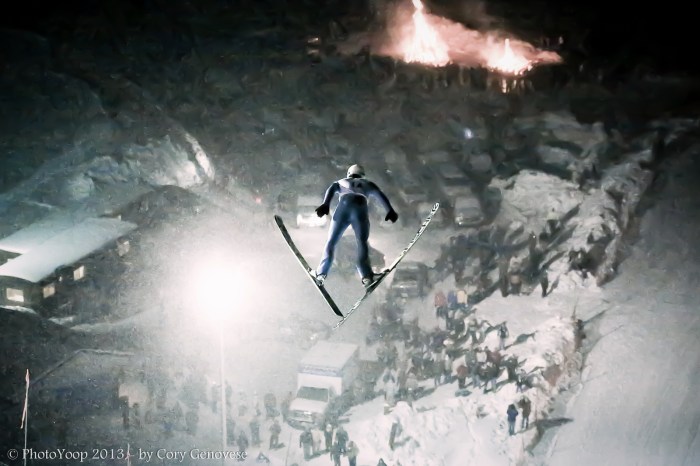
126 Suicide Jumps by PhotoYoop
I thought I’d bring back this photo from February of 2013 when Cory attended the 126th annual ski jumping tournament at Suicide Bowl in Ishpeming, where skiers have been jumping annually since 1887! Suicide Hill is run by the Ishpeming Ski Club. You can get more photos including shots from last weekend’s USA Nordic World Cup weekend on their Facebook!
Here’s a feature by Bob Garrett of Seeking Michigan about the history of Ishpeming’s Suicide Hill from a on Michigan in Pictures.
See more of Cory’s ski photos on Flickr & Be sure to follow him at PhotoYoop on Facebook too!
More skis and skiing on Michigan in Pictures.
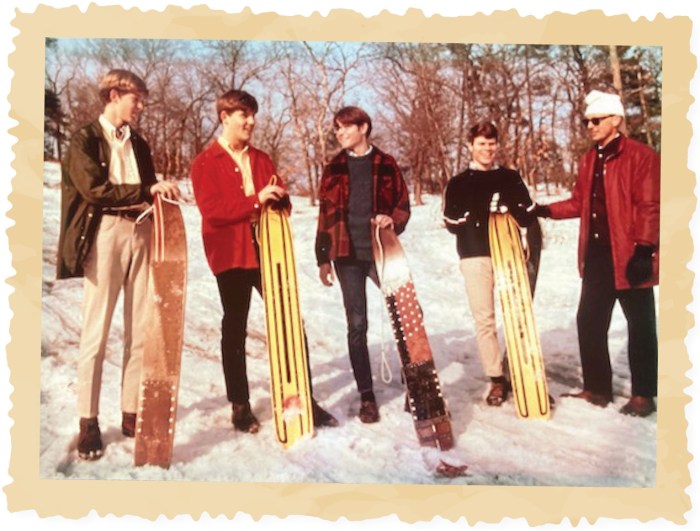
1969 snurfing competitors courtesy Tracy Tebeau Kirksey
The Freshwater Reporter has an interesting story by Stewart McFerrin on the Michigan-invented Snurfer and the roots of snowboarding that says (in part):
Snowboarding has become a worldwide phenomenon. The big air tricks of mega stars, such as Shaun White in the Olympic Half Pipe, rival the traditional Nordic pursuit of Alpine skiing. You may be surprised to know it all began in the dunes of West Michigan, where my friends and I pursued the sport of snurfing, a.k.a. snow surfing.
…The Snurfer was invented by a man with ties to the Brunswick Corporation. Brunswick produced bowling equipment and flooring at its headquarters in Muskegon, Mich. Sherman “Sherm” Poppen created the Snurfer, a shorter and wider version of a ski, and talked his kids into trying his invention on the “Sugar Bowl” at the Muskegon State Park. Friends of friends joined in and rode the deep powder on Snurfer boards all the way to the bottom, in a style and stance that would later become snowboarding. After obtaining a patent, Poppen licensed Brunswick to make the Snurfers.
This all happened in the late sixties and seventies when, after a long afternoon of snurfing, I recall my “bell bottoms,” frozen and encrusted with snow, ringing out as they brushed together during a trick performed from the edge of a steep dune. Lake Michigan loomed large as the lake-effect powder snow piled up to cushion my falls off the Snurfer.
Read on at the Freshwater Reporter for much more!
The photo is courtesy Tracy Tebeau Kirksey & shows Snurfer inventor Sherman “Sherm” Poppen (R) with the 1969 snurfing competitors and their Snurfer boards. From left: Rick Tebeau, Tom Metzdorf, James T., and champion Ted Slater. There are two types of Snurfers. The wooden ones had a metal skeg (similar to a boat’s keel fin) at the rear, to facilitate turns on hard-packed snow or ice.
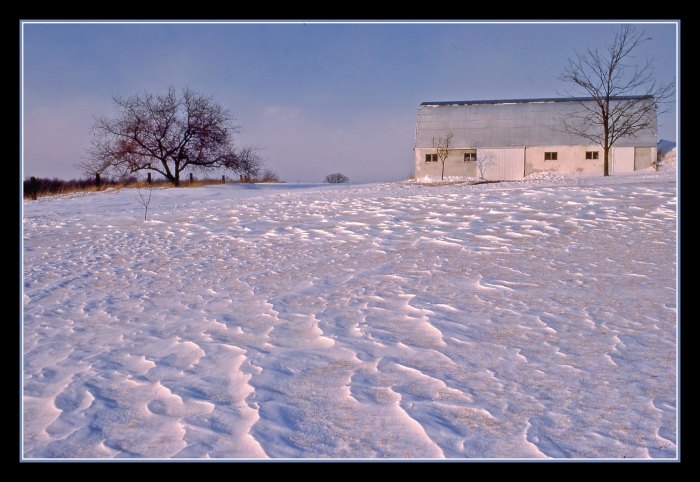
Michigan Blizzard Creates Ocean Waves – 1972 by Steve Brown
As Michigan gets popped by a winter storm, here’s a look back to 1972. Steve writes:
Quite amazing what a wintry wind can do to fallen snow across an open field. I took this photo in February, 1972 after the winds of a modest blizzard had reshaped the fallen snow on the front yard of the home where I lived near Manchester, Michigan.
See more in Steve’s great Michigan Winter gallery on Flickr & stay safe everyone!
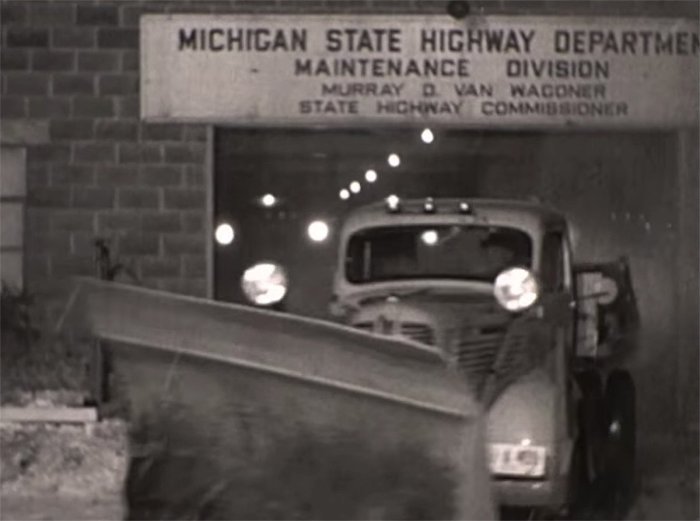
1930s Michigan Snowplow
With a major winter storm bearing down on Michigan, it seems like a good time to feature this old Department of Transportation video featuring winter fun & battling blizzards. MDOT relates:
This 1930s-era newsreel was recently discovered by sisters Nancy and Barbara Sleeper of Newberry, whose grandfather, Sanborn Sleeper, was the superintendent of the Luce County Road Commission from 1928 until sometime around World War II. The Sleepers donated the film to MDOT for public display. Enjoy this glimpse of the era when Murray Van Wagoner, a future Michigan governor, ran the department from 1933-1940.
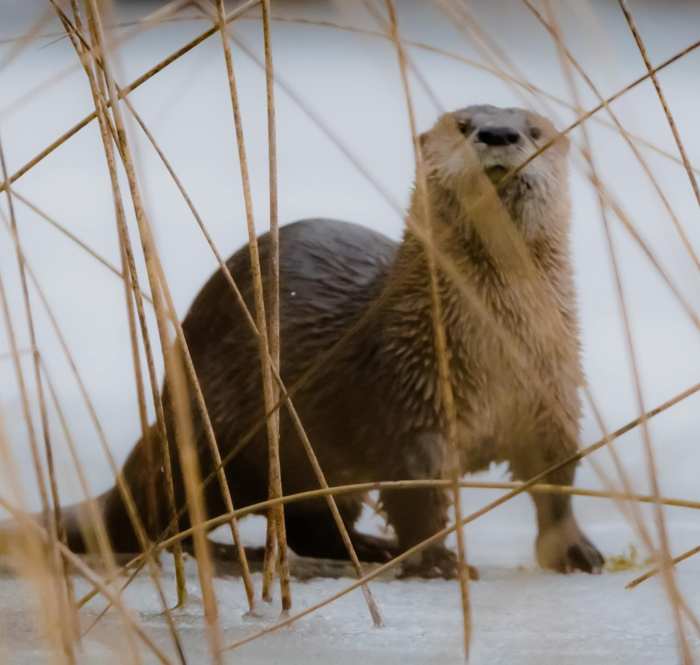
Otter at Otter Lake by Nicholas McCreedy
Nicholas writes that this otter spotted him at Otter Lake in the Sleeping Bear Dunes National Lakeshore. See a couple more shots & follow him on Facebook!
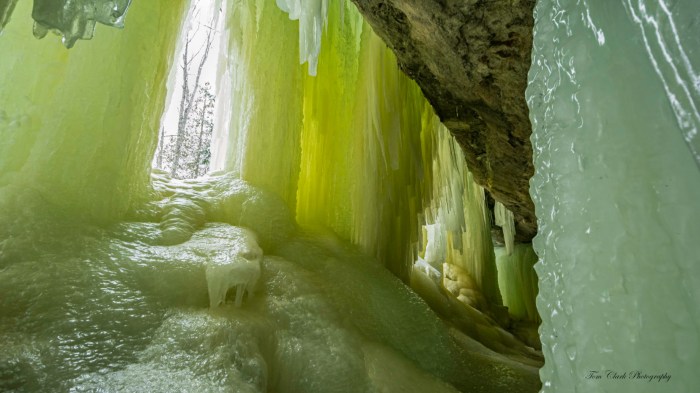
Eben Ice cave in Michigan’s Upper Peninsula by Tom Clark
One of Michigan’s awesome winter features are the Eben Ice Caves in the Hiawatha National Forest. They explain that the Eben Ice Caves are located within the Rock River Canyon Wilderness (RRCW) which:
…includes approximately 4,700 acre (7.5 sq mile) and was designated in the Michigan Wilderness Act of 1987. During the mid- and late-winter months, many people visit RRCW to see the Eben Ice Caves.
…Although not “true” caves, they are made up of vertical walls of ice formed by water seeping through the sandstone bedrock cliff edge. As the temperature drops, these intermittent leaks create ice stalactites over the entrance to the bedrock undercuts. While ice caves are a phenomenon in the winter, the summer visitor would only see algae-covered rocks and dense foliage. The caves are within RRCW. Wilderness designation is the highest level of protection granted to federal lands.
You can read on for more & also be sure to check out the Eben Ice Caves Facebook page for tips & information on visiting.
Tom took this photo a couple of Januarys ago. Follow Tom on Facebook & at tom-clark.net. See more in his awesome U.P. Roadtrip to find ICE – 1/22/19 gallery on Flickr!
More pics from the Eben Ice Caves on Michigan in Pictures!
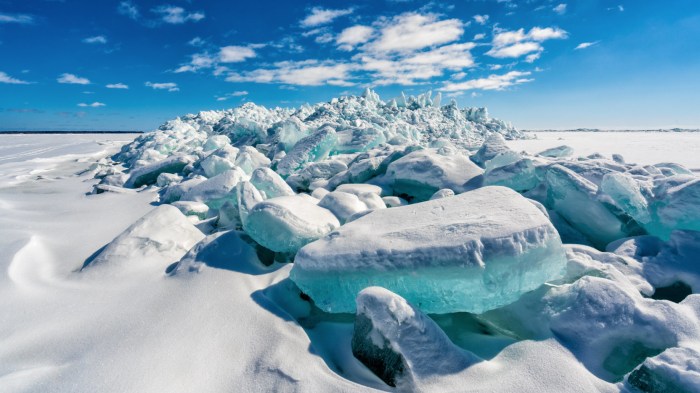
There hasn’t been much in the way of ice buildup yet on Michigan’s Great Lakes so far in 2021, so I decided to reach back a couple of years to March of 2019 for this beauty from Au Gres on Lake Huron. The Causes of Color answers the question what causes the blue color that sometimes appears in snow and ice?
As with water, this color is caused by the absorption of both red and yellow light (leaving light at the blue end of the visible light spectrum). The absorption spectrum of ice is similar to that of water, except that hydrogen bonding causes all peaks to shift to lower energy – making the color greener. This effect is augmented by scattering within snow, which causes the light to travel an indirect path, providing more opportunity for absorption. From the surface, snow and ice present a uniformly white face. This is because almost all of the visible light striking the snow or ice surface is reflected back, without any preference for a single color within the visible spectrum.
The situation is different for light that is not reflected, but penetrates or is transmitted into the snow. As this light travels into the snow or ice, the ice grains scatter a large amount of light. If the light is to travel over any distance it must survive many such scattering events. In other words, it must keep scattering and not be absorbed. We usually see the light coming back from the near surface layers (less than 1 cm) after it has been scattered or bounced off other snow grains only a few times, and it still appears white.
In simplest of terms, think of the ice or snow layer as a filter. If it is only a centimeter thick, all the light makes it through; if it is a meter thick, mostly blue light makes it through. This is similar to the way coffee often appears light when poured, but much darker when it is in a cup.
Definitely check out more in Charles’ excellent Michigan Winter Ice gallery on Flickr.
 Michigan in Pictures