Kirtland’s Warbler and the Kirtland’s Warbler Festival

Kirtlands Warbler (Dendroica kirtlandii)

Kirtlands Warbler (Dendroica kirtlandii), photo by birdman06.

The photographer notes that Kirtland’s Warbler is the rarest warbler in the US. It’s part of his cool set of photos of Songbirds and birds like Songbirds (slideshow).

The Michigan DNR’s page on Kirtlands Warbler (Dendroica kirtlandii) begins:

The endangered Kirtland’s warbler is one of the rarest members of the wood warbler (Parulidae) family. It is a bird of unusual interest for many reasons. It nests in just a few counties in Michigan’s northern Lower and Upper peninsulas, in Wisconsin and the province of Ontario and, currently, nowhere else on Earth. Its nests generally are concealed in mixed vegetation of grasses and shrubs below the living branches of five to 20 year old jack pine (Pinus banksiana) forests.

Click through to read about how the bird was named in honor of Ohio physician, teacher, horticulturist and naturalist Dr. Jared P. Kirtland, that it wasn’t until 1903 that Norman A. Wood discovered the first nest in Oscoda County in northern lower Michigan and much more about this truly rare bird. You can read more and see some pictures at Dendroica kirtlandii (Kirtland’s warbler) from the Animal Diversity Web at U-M and Wikipedia’s Kirtlands warbler entry. There’s even a Kirtland’s Warbler Audubon Society in Comins, Michigan that is a chapter of the Michigan Audubon Society and keeps track of all things warbly.

It’s maybe unsurprising then that there is an annual Kirtland’s Warbler Festival held every May on the campus of Kirtland Community College in Roscommon. The festival is billed as a celebration of nature and takes place next weekend (May 17, 2008). It features field trips to see Kirtland’s warblers, presentations about these and other rare or endangered Michigan species (piping plovers, osprey, eagles, turtles) and birding in general, plenty of activities for kids and a concert by the Great Lakes Myth Society

In addition to a ton more information about the festival and the feathered feature, the festival site features a Kirtland’s warbler video where you can hear the bird’s song.

Invisible Harvest

Spinners 1

Spinners 1, photo by n8xd.

Keith (n8xd) took this photo at Harvest, Michigan’s first commercial wind farm. The farm is owned by John Deere Wind Energy and located near Elkton in the Thumb.

Read more (and see another photo from Keith) in Harvest, Michigan’s first commercial wind farm starts spinning on Absolute Michigan. You can also check out keithdelong.com andbe sure to click through to the photo to see it bigger!

Pickerel Spears, Ice Shanties and the Fishing History of Saginaw Bay

Saginaw Bay Ice Shanty c.1925

Saginaw Bay Ice Shanty c.1925, photo by oldog_oltrix.

Larry writes that this photo was taken by his grandfather at his ice shanty on Saginaw Bay (probably near Bay Park) in the mid-1920s. The 6′ bar between the shovel and the axe is a “spud” used with the axe to make the hole in the hole in ice and the pole coming from the top of the shanty is likely a “pickerel spear”. The This is one of the photos in his Oldog’s OLD PHOTOS set, and it also appears in the Michigan Thumb Memories group.

Over on Michigan Sportsman, Capt. Dan Manyen has written a nice little article titled The Fishing History of the Saginaw Bay. In it, he shares a number of old photos and provides a nice overview of the last few centuries of fishing on what I’m going to guess is Michigan’s largest bay. Capt. Manyen writes that walleye was mis-identified by many back then as pickerel and sold in great numbers to both local fish market outlets and buyers from the eastern states. He says that for many in the area, the burgeoning auto industry…

…did not stop or ease the pain of the Great Depression during this time. What did for many though, including my own Grandfather, was the plentiful fishing and hunting resources the Bay area offered. When Grandpa couldn’t get a job unloading the (Bean Boat) as he called it for .50 cents a day, he’d be out hunting or fishing for a meal for his family. Grandpa talked often about spending all winter out on the ice on Saginaw Bay in a (Pickerel Shanty) spearing pickerel.

I’m not sure where you might want to take this, so here’s the Wikipedia entries for Pickerel, Walleye and Saginaw Bay. You might also be interested in the Saginaw Bay Watershed Initiative Network, the Saginaw Bay Fishing Report and a more recent photo of ice fishing on Saginaw Bay.

Also see Saginaw Bay on Absolute Michigan’s Map of Michigan.

Exploring the Florida in the Thunder Bay National Marine Sanctuary

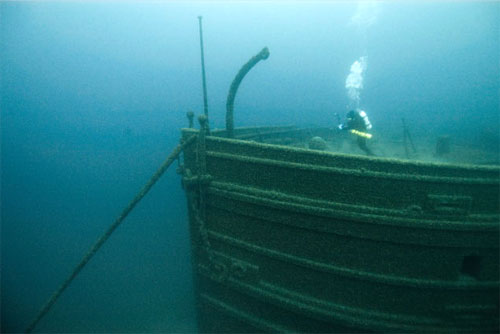
Diver exploring the wreck of the Florida

Exploring the Florida, Thunder Bay National Marine Sanctuary

The Thunder Bay National Marine Sanctuary encompasses almost 450 square miles of Lake Huron’s bottomlands off Alpena. It is the thirteenth national marine sanctuary and was established in 2000 to protect a nationally significant collection of nearly 200 shipwrecks, spanning over a century of Great Lakes shipping history. Thunder Bay is the first Great Lakes sanctuary and also the first to focus solely on a large collection of underwater cultural resources. The headquarters of the Sanctuary is the Great Lakes Maritime Heritage Center in Alpena.

The photo above is one of many awesome underwater photos of the Florida and other shipwrecks that can be viewed in their Fieldwork 2007 Gallery. Seriously, this is cool – go look at it and be sure to click the “slideshow” view at the top left to see the larger sized images.

Dave Swayze’s amazing Great Lakes Shipwrecks File includes information on 4,760 great lakes shipwrecks. It says that on May 21, 1897 in dense fog off False Presque Isle, the 271′ package freighter Florida, one of largest boats on the Great Lakes, collided with one of the few that was larger, the steamer George W. Roby. The Roby rescued her crew, but with a large hole in her starboard side, the Florida sank in just 12 minutes in 250′ of water.

There’s more information on the Thunder Bay National Marine Sanctuary and Underwater Preserve over at Absolute Michigan.

Grayling legend David Shoppenagon

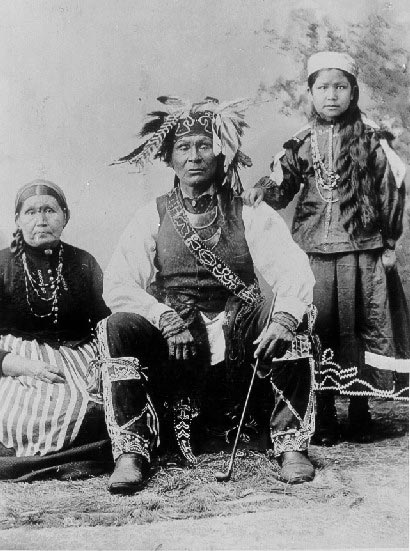
Chief David Shoppenagon with wife & child

Shoppenagon, photo courtesy the Archives of Michigan

November is Native American Heritage Month and last year, the Archives of Michigan featured one of Michigan’s most famous Native Americans, David Shoppenagon.

Shoppenagon’s birth date is unknown. He died in 1911 and was generally believed to be about 103 at the time! He was a Chippewa from the Saginaw River Valley who settled in Grayling sometime in the 1870’s. Locals believed him to be a chief. However, the Grayling Centennial history (The First Hundred Years: An Introduction to the History of the Grayling Area, edited and published by the Grayling Centennial Commission, 1972), notes that Shoppenagon himself may have never claimed such a title.

“Old Shop,” as he was affectionately known, built a home at the mouth of the Au Sable River’s east branch. He gained wide renown as an expert trapper, hunter and fisherman. Whites often hired him as a guide, and his services were greatly in demand.

The Grayling Centennial history characterizes Shoppenagon as a man who knew the value of promotion. It’s noted that he frequently dressed in Native American regalia to impress his clients. The Grayling history also states that Rasmus Hanson, a local lumber baron, had an arrangement with Shoppenagon and used his image to sell his products. During his long life, Shoppenagon contributed greatly to Grayling area commerce and to general awareness of the Northern Lower Peninsula’s abundant natural resources.

You can read the rest of Shoppenagon and get some links to resources for Michigan Native American history (including the Clarke Library at Central Michigan University) at the Archives and also check out the Michigan Historical Marker at the Shoppenagon home site in Grayling from Waymarking.

Yesterday & today at Round Island Lighthouse

Since yesterday was technically not Michigan in Pictures, here are two photos for today!

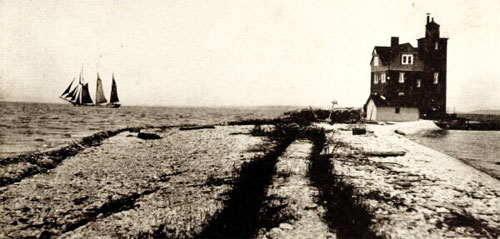
Round Island Lighthouse, c 1920

Round Island Lighthouse c. 1920, courtesy Archives of Michigan

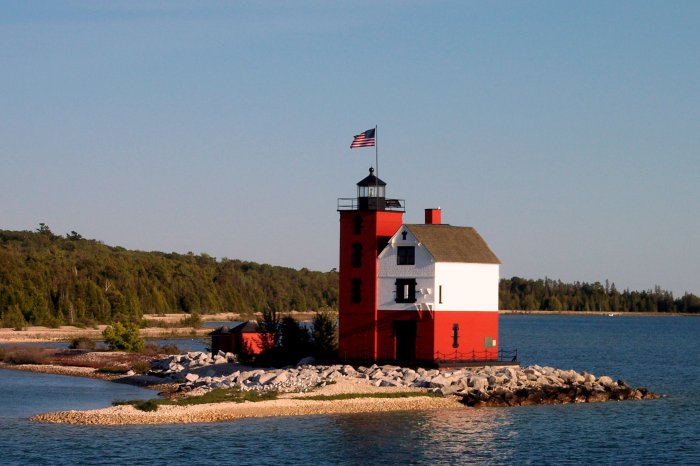
round-island-lighthouse-mackinac

Light House, photo by frostman721

You can see more historical photos of Round Island Lighthouse in the Archives of Michigan’s Lighthouse Collection. Terry Pepper’s Seeing the Light has a great history of the Round Island Lighthouse that begins:

The area around the Straits of Mackinac is riddled with islands and reefs, which made vessel traffic at the transition from Lakes Huron, Michigan and Superior particularly difficult. While the construction of the Old Mackinac Point Light in 1892 eased the situation, the Lighthouse Board requested funds from Congress to augment the Mackinac Light with a second light in the Straits to be located on a shoal off Round Island.

Congress responded to the request with an appropriation of $15,000 for the construction of such a light in 1894. The construction contract was awarded to the local contractor Frank Rounds. The construction was completed, and the light first exhibited on May 15.

Terry has a number of views of the light, including the one above which he dates around 1900 (which might make more sense in light of the schooner pictured). There’s also a shot of the Round Island light nearly destroyed following a violent 1972 storm. For many of Michigan’s lighthouses, such an event was a death knell, but Mackinac Islanders rallied and work continues through the Boy Scouts and the Great Lakes Lighthouse Keepers Association. You’ll probably also want to see check out Wikipedia’s entry on Round Island (info about the uninhabited island and a cool aerial view of the light!), the Mackinac Visitors Bureau photos of the light, this page with interior and exterior photos of Round Island Lighthouse and this view of restoration work and Round Island (he also has a cool shot of the lighthouse in the fog).

Speaking of lighthouses, if you’re in the Alpena area this weekend (Oct 11-14), be sure to check out the annual Great Lakes Lighthouse Festival.

Not much remains of Grindstone City

grindstone03.JPG

grindstone03.JPG, photo by smartee_martee.

Marty Hogan writes:

One of the few remaining grindstones on the beach. This one is about 3.5 feet in diameter. The beach used to be covered in the old Grindstones; from 1.5 feet to six feet in diameter. Bad, bad thieves plundered them all away.

This photo is part of Marty’s great Huron County, Michigan photo set (slideshow)

I went looking for a photo and details on Grindstone City so I could feature a site I found the other day, but there was little to be found from Michigan.org’s page on Grindstone City or the Port Austin Chamber.

UPDATE: March 2012: The best resource I found at the time of this post was willett.org, which featured piles and piles of photos and information about Michigan and its history. Among their were some postcards and old photos from Grindstone City, from which I learned that Grindstone City had a quarry and stone mill and made and shipped a whole lot of grindstones. Nothing at willett.org seemed to have been updated, and it felt like going up to an attic in an abandoned farm and poking through partially labeled boxes. Sadly the digital room has since fallen in, leaving nothing.

Fortunately, there are other resources, so check out today’s post Truing up a 3 ton stone in Grindstone City.

If you have anything to share about Grindstone City, post it in the comments!

Lost on vacation

Lost by Terrapin Dawg

Lost, photo by Terrapin Dawg

One of the great things about being on vacation is getting lost. Not the kind of lost where everyone’s hot and cranky, but rather the kind of lost where you see things you never expected and aren’t even sure you could find your way back.

This photo from Cheboygan County, Michigan is part of a great set of photos of Northern Michigan, which Matt says is his favorite place in the world. (slideshow).

In the Pigeon River State Forest…

2007_0703July40155

2007_0703July40155, photo by JJ Murletti.

I don’t know the name of this lake but was struck by just how peaceful it looks.

There’s a campground in the Pigeon River State Forest and lots and lots of trails. The DNR says that the Pigeon River Pine area has over 100 acres of white pine (most about 100 years old) and that the Dog Lake area is considered to be one of the most remote and wild areas in the region. Nesting loons, bald eagles, and osprey are a few of the many animals using the lakes.

The International Mountain Biking Association is quite taken with:

An awesome ribbon of trail looping through the heart of elk country, the High Country Pathway (HCP) embodies the classic definition of an IMBA Epic Ride. The first IMBA Epic Ride in Michigan will take you far into the backcountry with beautiful lowlands and panoramas in the highlands.

Be sure to outfit for self-support, as you may not see another human on this 80-mile soul searcher. The trail passes through a variety of woodlands and wetlands containing massive groves of silver beech, tamarack swamp and leather leaf bogs. The area is home to beaver, black bear, bobcat, pine martin, snowshoe hare, wood ducks, bald eagles, deer, wild turkey and the largest elk herd east of the Mississippi River.

Michigan History magazine needs your photos!

Untitled, photo by jacalynsnana.

Christine Schwerin is a photo editor looking for a good venue to find specific images from Michigan photographers on a regular basis to be used in Michigan History magazine. She’s hoping to find photographers interested in joining an email list to receive a monthly list of images they’re looking for. If you are, send her an email!

Christine says that the first photo they’re looking for is a nice scenic picture – river, meadow, whatever, so long as it is in the Huron National Forest. Do you have one? Let her know!

A quick review of the Huron National Forest (part of the Huron-Manistee National Forests) tells me that we’ll have to return for an extended visit another day.

The above photo is of one of the world’s premier trout streams, the Au Sable River – a large portion of which winds through the Huron National Forest.