Remembering the Carl D. Bradley

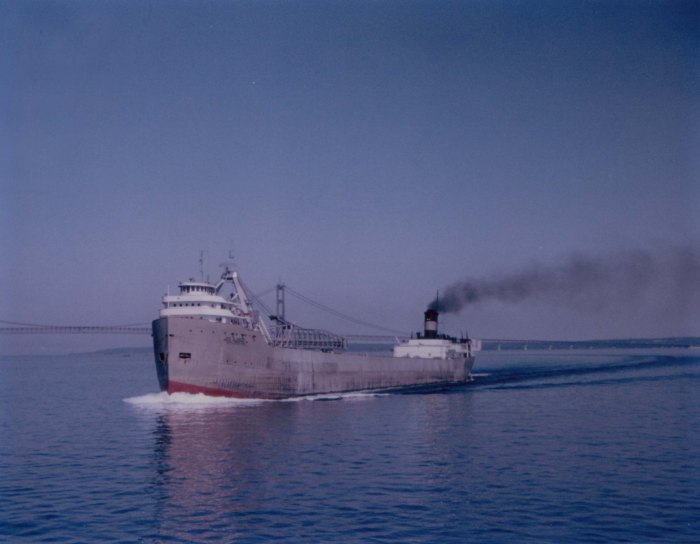
Carl D Bradley on the Great Lakes

Bradley – Color – 300 dpi, photo by Presque Isle County Historical Museum.

23 women became widows in that instant and 53 children lost their fathers.
~Rogers City resident on the sinking of the Bradley

The Edmund Fitzgerald gets the majority of the attention when Michigan shipwrecks are discussed, but it can be argued (very convincingly) that the wreck of the Carl D Bradley on November 18, 1958 was the greatest of Great Lakes tragedies. 33 of 35 crewmen – most from her home port of Rogers City – perished, leaving the small city in northeastern lower Michigan stunned by grief.

Over on Absolute Michigan today we have an excellent feature from the Archives of Michigan on the Wreck of the Carl D. Bradley that includes a riveting video from the documentary November Requiem. An article by Warren J. Toussaint about the sinking begins:

Tuesday, Nov. 18, 1958, at 5:31 p.m., the limestone carrier, Carl D. Bradley, was up bound on Lake Michigan, having delivered her last limestone cargo of the year to Indiana on November 17,1958. She stayed close to the Illinois and Wisconsin shores because of reports of severe weather conditions rapidly developing from the west. As it reached the area of Sturgeon Bay, Wis., it had to turn to the northeast in order to cross the upper area of Lake Michigan on its way to the homeport of Rogers City, Mich., on Lake Huron. Suddenly, the Bradley’s steering wheel went slack, as if the gears had suddenly disconnected. On the course it was on, the winds and waves were striking the ship on the aft quarter of the port side causing the ship to rock severely. First Mate, Elmer Fleming, knew the ship was in trouble. He jerked the radio telephone from its cradle and shouted a desperate call “Mayday, Mayday, – Mayday. This is the Carl D. Bradley. Mayday Mayday Mayday.”

Read on and see much more at carldbradley.org!

The photo is one of the last known photos of the Steamer Carl D. Bradley, taken after she passed under the Mackinac Bridge and was making the turn to the southeast to set a course for Rogers City. Check it out background big and in their great Bradley Transportation Fleet slideshow. Definitely have a look at the Presque Isle County Historical Museum website for more on the Bradley and the history of the region and to order the Bradley DVD!

The PIX Theatre and the Made in Michigan Film Festival

The PIX!

The PIX!, photo by DarrylW4

The Made-in-Michigan Film Festival (MiMFF) takes place October 21-22 in Lapeer. The festival was created to showcase independent films exclusively from the state of Michigan, thereby enhancing the quality of economic and cultural life in the State of Michigan. They’ll have nearly 50 films this year – click the link above to learn more and also get info from the MiMFF Facebook (MiMFFF?).

The host theatre is the Pix Theatre in Lapeer. Their history page begins:

The PIX Theatre was built by George Smith, who began his “show business” life in a production of Uncle Tom’s Cabin at the White Opera House. When the show went on the road, 18 year-old George went with it. Before long the troupe ended up broke in Chicago and George returned to Lapeer. Next, George began playing in theater orchestras in Flint and Saginaw where he met and married Vera, the band’s pianist. In 1914, the Smiths opened a small movie theater next door to what would become the PIX Theatre. Business was good, with tickets selling for five and ten cents. By 1921, the Smith’s were ready to expand their business, so they built the Lyric Theatre, “the fanciest show house around.” Silent movies reigned supreme, accompanied by Vera on the piano until 1928, when the “talkies” came to town.

Early in 1940, with movies at the peak of popularity, it was rumored that Harry Holboth, owner of the Deluxe Theater in neighboring Imlay City, was planning to build a new theater in Lapeer. George Smith, not to be outdone by the competition, quickly set to work locating a site for a new, modern movie house that he would name The PIX Theatre… (read more)

The PIX closed in 1996 and was purchased by the City of Lapeer Downtown Development Authority. PIX Arts Council now manages the Theatre on behalf of the DDA, offering around fifty live performances per season. FYI, the Made-in-Michigan Film Society that produces the MiMFF shows Michigan films at a monthly gathering, providing a regular opportunity for film-goers to interact with film makers.

Check Darryl’s photo out bigger and in his Lapeer slideshow.

More movies & theaters on Michigan in Pictures.

Into the Big Sky in the Huron National Forest

Into the Big Sky
Into the Big Sky, photo by Neil Weaver

The Huron-Manistee National Forest is actually two separate and non-contiguous national forests, the Huron National Forest (established in 1909) and the Manistee National Forest (established 1938). They were combined in 1945 for administrative purposes. Wikipedia says:

The Huron National Forest portion is in northeast lower Michigan. Its southern boundary is approximately at the latitude of Manistee’s northern boundary. It has a total area of 438,538 acres (685.22 sq mi, or 1,774.70 km²). It lies in parts of Oscoda, Alcona, Iosco, Crawford, and Ogemaw counties. There are local ranger district offices in Mio and Oscoda.

The threatened Kirtland’s Warbler nests in the area, and tours are available, subject to time restrictions.

Check this out bigger and see more in Neil’s Huron National Forest slideshow. You can purchase Neil’s photos from his website and also keep up with his travels around Michigan on Facebook!

Michigan in Pictures has more about Kirtland’s Warbler.

Renewable energy in Michigan costs less than expected

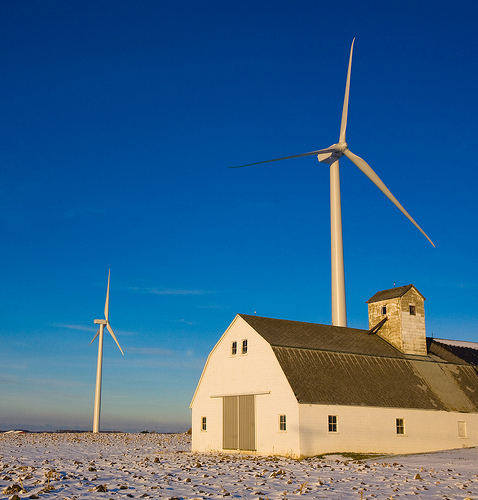
Wind farm in Ubly Michigan, photo by Ray Dumas RTD Photography

An in-depth article on the cost of renewable energy in Michigan in the Muskegon Chronicle notes that although a common argument from wind turbine opponents is that wind farms will significantly increase our electric bills, the State of Michigan reports initial contracts show significantly lower costs than the power generated from new coal plants. This excellent feature on the hard numbers and debate on renewable energy is well worth a read.

State regulators find the current cost of a new coal power plant over the life of the facility is $133 per mega watt hour of production.

Based on more than two dozen actual renewable energy contracts for solar, wind and bio-gas generated electricity, the average price is about $100 per mega watt hour of production. Bio-mass incineration is at $98, wind $101, landfill gas $113, digesters $128 and several small-scale solar installations at approximately $500.

“Wind is competitive with coal and natural gas on cost as long as you find the best winds,” said Paul Isely, the head of Grand Valley State University’s economic department.

See this photo and others from the wind farm in Ubly bigger in Ray’s alternative energy slideshow.

C is for Camp Cusino Civilian Conservation Corps … and COLD!

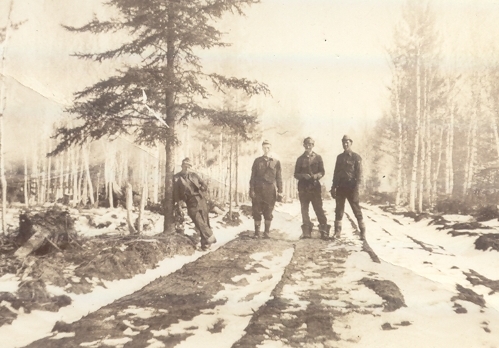
Road building by CCC men of Camp Cusino, photo courtesy Archives of Michigan

Read the story behind this photo and see a video of 94 year old Ernest Hubacker’s story of his time with the Civilian Conservation Corps at Seeking Michigan: Cold Conservation Corps. Check out a lot more features and Michigan history at seekingmichigan.org!

Harvest the Wind

wind_farm_pigeon 002

wind_farm_pigeon 002, photo by eXtension Ag Energy.

Yesterday on Absolute Michigan we posted an article from Great Lakes Echo wondering if Michigan will harness offshore wind and pass the bill in the House to regulate wind farms in Michigan’s Great Lakes waters.

Land based wind farms around the state are already tapping this resource. The largest of these is the Harvest Wind Farm that spans 3,200 acres between Elkton and Pigeon, Michigan, in Huron County. Each of the wind farm’s 32 turbines stand 262 ft tall (393 with the 131′ blades) and is capable of producing 1.65 megawatts of electricity, for a total project capacity of 52.8 megawatts.

You can get a sense of the scale of the farm in these cool aerial shots. Something to consider is that 52.8 megawatts is enough to power 15,000 or so homes. When you think about the total population of Michigan and the space available to site wind turbines, it’s hard to see how we will be able to meet our energy demands without using the Great Lakes.

MSU Extension Bioenergy Educator Dennis Pennington took the shot above in July of 2009. Check it out background big and also in his wind slideshow (some of the shots show construction and give a sense of the scale of these massive machines).

About Lake Huron … and a double rainbow

double rainbow

double rainbow, photo by Morganshev.

Wikipedia’s entry for Lake Huron says that Lac Huron was named by early French explorers after the Huron people inhabiting the region. Lake Huron is the second largest of the Great Lakes and the third largest fresh water lake on earth with a surface area of 23,010 sq mi, a volume of 850 cubic miles and a shoreline length of 3,827 mi.

The Great Lakes Information Network page on Lake Huron pegs it as the 5th largest lake in the world and adds:

  • It has the longest shoreline of the Great Lakes, counting the shorelines of its 30,000 islands.
  • It contains Manitoulin Island, largest freshwater island in the world.
  • Georgian Bay and Saginaw Bay are the two largest bays on the Great Lakes.
  • Huron was the first of the Great Lakes to be discovered by European explorers. Since its French discoverers knew nothing as yet of the other lakes, they called it La Mer Douce, the sweet or fresh-water sea. A Sanson map in 1656 refers to the lake as Karegnondi, simply meaning “lake” in the Petan Indian language.

I found a cool site by the Lake Huron Lore Marine Society that has a great page on early steamships and sailing vessels on the Lake. Check it out!

See this out bigger in Morgan’s slideshow or see it in the Lake Huron Rolls Group slideshow!

Hope you find that pot of gold today and check out more at absolutemichigan.com/Lake Huron and explore Lake Huron on Michigan in Pictures.

Roadside Ramblings in the Michigan Radio Picture Project

towers
towers, photo by mfophotos

This “castle” in Owosso was actually a place used for entertainment and a writing studio for James Oliver Curwood. Now owned by the city of Owosso, it overlooks the Shiawassee River. Curwood made a living as a writer of wilderness adventure stories, some of which became screenplays for early movies. The castle was constructed to resemble a French chateau. August, 2009.

The above picture is one of many in the latest photo essay at the Michigan Radio Picture Project: Roadside Ramblings, the photography of Mark F. O’Brien. Mark is a regular on Michigan in Pictures (as is his daughter Marjorie) and shoots with all kinds of cameras. He writes:

Michigan is a state criss-crossed with highways. As the home state for the auto industry, the roads have played an important part in connecting communities, bringing in tourism, as well as being the main thoroughfare for commerce. Exploring Michigan’s roads, whether the major highways or the gravel backroads, has become one of my photographic pursuits. I often shoot with a “toy camera” — simply a plastic camera with a cheap plastic lens, limited exposure control, and infinite possibilities for photography. While I use all kinds of really nice cameras, it’s the Holgas, Dianas, and thrift-shop wonders that produce many of my most memorable and endearing photographs.

A full tank of gas, some maps, and a few cameras inevitably leads to a long day traversing some part of the state. If one is curious enough, just traveling all of the roads in a single county can take a long time to complete. Driving around and letting serendipity take its course is one way of learning about my state, as well as coming back with some photographs that sometimes offer a surreal aspect of what’s off the side of the road.

Click through to see the photos and I hope you get to do some roadside rambling of your own this weekend or soon!

Be sure to check this out bigger and also his whole Michigan Roadsides set (slideshow).

I know of a place…

I know of a place...

I know of a place…, photo by Kiran Bhat..

Port Austin, Michigan. Hasselblad 500C.

Check it out bigger in Kiran’s Hasselblad slideshow.

Hope you’re having a wonderful weekend.

Previewing the Winter Olympics at Otsego Club

SNOWBOARD Training in Gaylord, Michigan

SNOWBOARD Training in Gaylord, Michigan, photo by MyWheelsareTurning.

If a trip to Vancouver for the 2010 Winter Olympics (February 12-28) isn’t in your budget, consider the shorter jaunt to Gaylord next week.

Many of the world’s finest snowboarders are training for the Winter Games at Otsego Club in Gaylord, Michigan. The New York Times reports:

The Otsego Club, a private ski/golf club and resort founded in 1939, has been a good destination for snowboarders, with a terrain park of 45 trails and jumps to complement its 31 downhill runs. This season, it decided to take a chance and spend more than $100,000 to build the halfpipe…

The grounds were reshaped and prepared over the fall, and the architects of Planet Snow built the 500-foot-long, 22-foot-high halfpipe of ice and snow.

The club hoped adding the halfpipe could attract interest, but the general manager, Kris Klay, said the experiment had far exceeded expectations.

“Every day I am getting calls from coaches and athletes asking if they can come here too — do we have room?” Klay said. “We’re going to make the room. This has been an incredible experience for us to host them and for the community to be able to have exposure to this. We feel like we’re so lucky, we’re getting to see a preview of the Vancouver Olympics every day in our own backyard.”

They also have a nice feature on one of the biggest stars you can see there, Gold Medal hopeful Torah Bright. I’ve been told that even more of the top boarders will be in early next week, and my own resident snowboarding expert returned beaming from ear to ear at how he’d been able to board with Olympians, a chance that few get. I believe that the resort is closed to the public on the weekend, so be sure to call ahead!

You can see this photo of Japanese rider Shiho Nakashima larger in Gary’s Gaylord: Olympic Snowboard slideshow and check out his blog about
Walking, Biking, Getting Around in Northern Michigan & Beyond
.