Halloween Rewind: Le Loup Garou

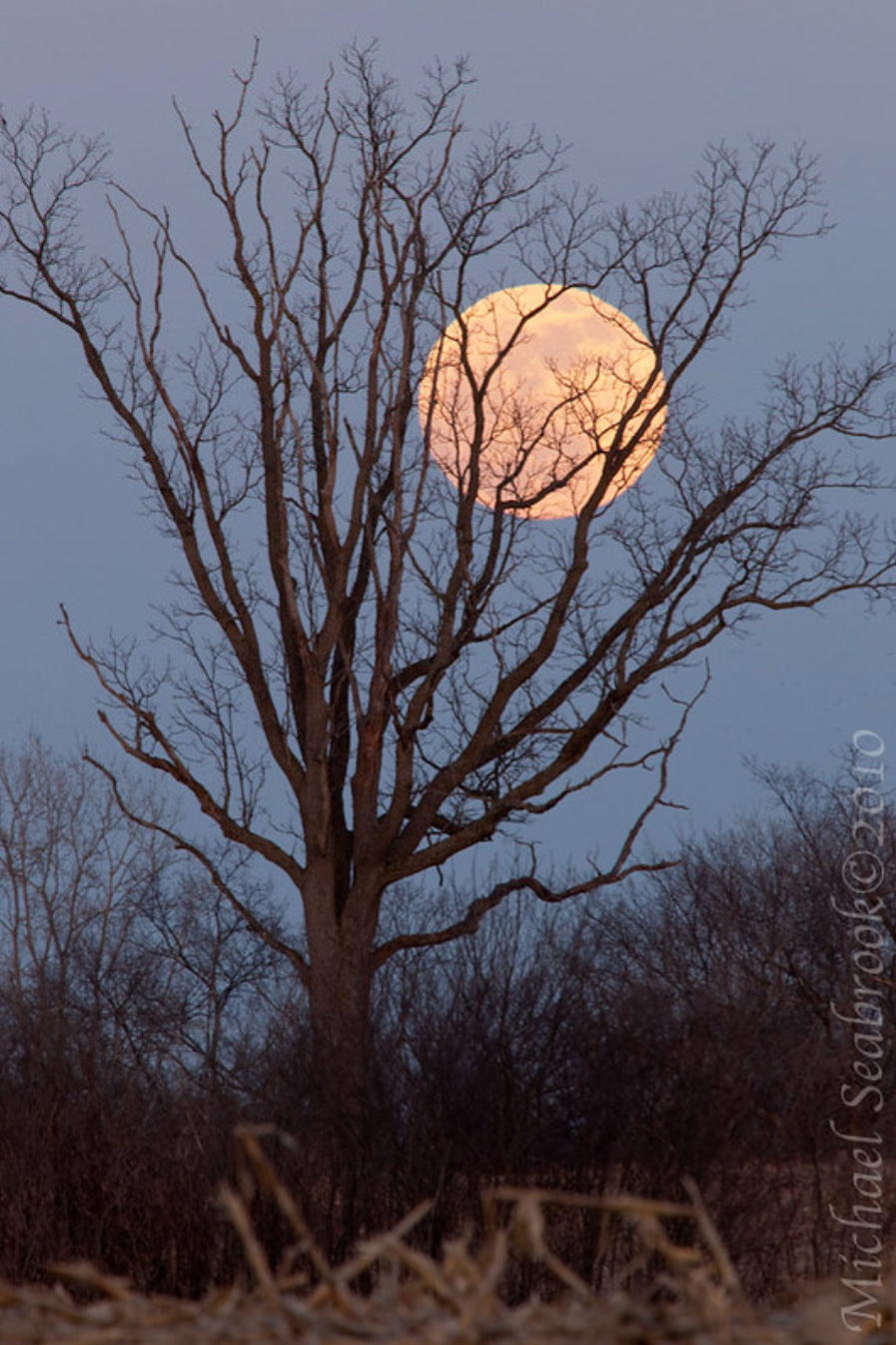
Where Wolves Play by Michael Seabrook

Where Wolves Play by Michael Seabrook

He was beloved by all, and most of all by the children.
For he told them tales of the Loup Garou in the forest.
And of the goblin thai came in the night to water the horses.
And of the White Letiche, the ghost of a child who unchristened
died, and was doomed to haunt unseen the chambers of children.
 ~Henry Wadsworth Longfellow, Evangeline

My favorite Halloween book on archive.org’s Internet Book Reader is Legends of Le Détroit by Mary Carolyn Watson Hamlin, illustrated by Miss Isabella Stewart, and published in 1894 in Detroit by Thorndike Nourse. In addition to Ms. Hamlin’s descriptive prose that really sheds light on what life was like for early settlers in the Detroit area through stories that raise your hackles spark a feeling that Michigan is wilder and more wonderful than you may have known.

I featured this story back in 2015, but thought you all would enjoy Le Loup Garou which is a lot longer than usual. I’ve tried to share the highlights of the story, but you really should click that link to read it all! We begin at Grosse Pointe where:

…a trapper named Simonet had settled near there on the margin of the lake.

His young wife had faded away in the early years of their married life, but as if in compensation, had left the little prattler Archange to wean him from his grief and to cheer his loneliness. And the strong, hardy man, with his sunburnt face and brawny arms hardened by toil and exposure, in his yearning love for his child, learned to soften his rough manners and soothe her with the gentle ways of a woman. Anxiously he watched the unfolding of his “pretty flower,” as he called her, and with a solicitude touching in its simple pathos, he would select the softest skin of the bear to keep her feet warm, search for the brightest wings of the bird to adorn her hat. When she grew up he taught her to skin the beaver, muskrat and deer which he brought home, and to stretch them out on the drying frame near the house. He was wont to boast that no one could excel Archange preparing the poisson blanc (whitefish), poisson dore (pickerel), or give that peculiar shade of brown which is in itself an art, to the savory cochon au lait (sucking pig).

She was as light-hearted as the cricket that chirped on the hearth, and her cheery voice could be heard caroling away to the music of her spinning wheel. In the long winter evenings her deft fingers would plait the straw into hats which found a ready sale, and which, added to the sum she gained by her knitted socks and dried corn, enabled her to secure many little articles that her vanity suggested to enhance her charms. For the Canadian girl, in the rude surroundings of her forest home, was as anxious to please and be witch by her toilet as her more favored Parisian sister ; the instincts of the sex still lived in the wilderness. At the corn-huskings and dances on the greensward Archange was the reigning belle, and held her little court of homespun dressed youths fascinated by the magic of her dark eyes, her brunette complexion with its warm glow, her raven tresses and piquante tongue. Many admiring eyes followed her lithe form as she tripped in marvelous rapidity la jig a deux or as she changed into the more graceful, swaying motion of la dance ronde.

Enter the capable young farmer Pierre La Fontaine, whose marriage proposal was happily accepted by Simonet, was building a cabin for his bonnie bride, and apparently driving his fragile canoe along the rippling waters lit up by elfish moonbeams (Ms. Hamlin’s words) as they made wedding plans that included the gift of a red cow from Archange’s god-father. Well…

One evening as Pierre placed Archange on the beach near her home and she lingered, following him with her loving eyes as he swiftly rowed away until he had disappeared and only the faint echo of his Canadian boat song floated towards her, she was startled by a rustling sound near by. Looking up a wild shriek escaped her, for a monster with a wolf’s head and an enormous tail, walking erect as a human being, crossed her path. Quickly the cabin door was thrown open by Simonet, who had been roused by his daughter’s scream. Archange flew into her father’s arms and pointed to the spot where she had seen the monster, but the animal surprised by the light, had fled into the woods. Simonet’s face grew pale as Archange described, as accurately as her fears had allowed her to see, the apparition, and he recognized the dreaded Loup Garou.

Did I mention long?

Simonet worried about the Loup Garou (werewolf), but soon the wedding day arrived:

…Soon after she (Archange) joined Pierre and hand in hand, followed by all the habitants in their holiday attire, they entered the little church of logs hewn square, the interstices chinked in with clay, the roof of overlapping strips of bark. In front of the altar, decorated with flowers arranged by loving hands, they knelt. Father Freshet, who had baptized Pierre and Archange and prepared them for their first communion, now came to unite them in the holy bonds of matrimony. After the ceremony they went to the sacristy and inscribed their names in the registry, then hurried off to Pierre’ s new house, where the festivities were to take place. On the green lawn in front of her new cabin the blushing Archange greeted all her friends. The Seigneur of the neighborhood came to claim the right of premier baiser (first kiss). The refreshments were in abundance and all gave themselves up to the enjoyment of the moment, for the Canadians dearly loved a wedding and kept up its festivities for days.

Whilst the merry making was at its height the dreaded Garou with a rush like the wind sprang into their midst, seized Archange and escaped with her into the forest. All were paralyzed by the sudden, daring deed. But Pierre recovering, started in quick pursuit guided by the despairing cry of Archange, followed by all the men, whilst the women and children said their prayers and gave vent to loud lamentations. Long after the shadows had fallen they returned to report to the anxious, trembling crowd, and their sad, dejected faces spoke of the fruitlessness of their search. The monster had baffled them. But Pierre returned not. He was shortly after found by his friends wandering around and around a swamp, and clutching a piece of white batiste. When questioned as to how he had obtained this clue to Archange, he returned a maniacal stare and with a blood-curdling shriek, would have juimped into the swamp if he had not been held back by his companions, who with sorrowful accents said “La folie du bois.”* He would always return to the same swamp, remaining there for hours gazing vacantly in the weird reflections of its slimy, stagnant waters, until some friend led him home.

At the marriage of his sister, which occurred about a year afterwards, Pierre, always dead to the outside world, seemed to be roused by the preparations. After the ceremony he rushed into the woods as if in pursuit of something. He did not return until nearly sunset when he was seen, with wild eyes, flying hair, his clothes torn as if lay briers, chasing a Loup Garou to the very edge of the lake. All stood petrified by the strange apparition and feared a repetition of Archange’s fate. But the animal, seeing no escape, stood on one of the boulders strewn along the shore and stretched out his arms as if beckoning to some mysterious one. A large catfish was seen to rise on the surface of the water and open its mouth, into which the Loup Garou vanished. To this day no Canadian will eat catfish. The footprint of the wolf is still shown at Grosse Pointe, indelibly impressed on one of the boulders.

As I said, read the story in full and if anyone has a shot of the footprint in the boulder, please send it to me!!

Michael took this back in 2010. If you’d like to see some great shots for the Halloween season, check out his Ghosts gallery on Flickr!

More ghost & spooky stories on Michigan in Pictures!

*La folie du bois (the folly of the woods) alludes to the well- known insane tendency which prompts those lost in the woods to go round in a continuous circle, instead of following a direct path which would lead to a clearing.

Support Michigan in Pictures with Patreon

Under the Same (Shooting) Stars

Under the Same Stars by Fire Fighter's Wife

Under the Same Stars by Fire Fighter’s Wife

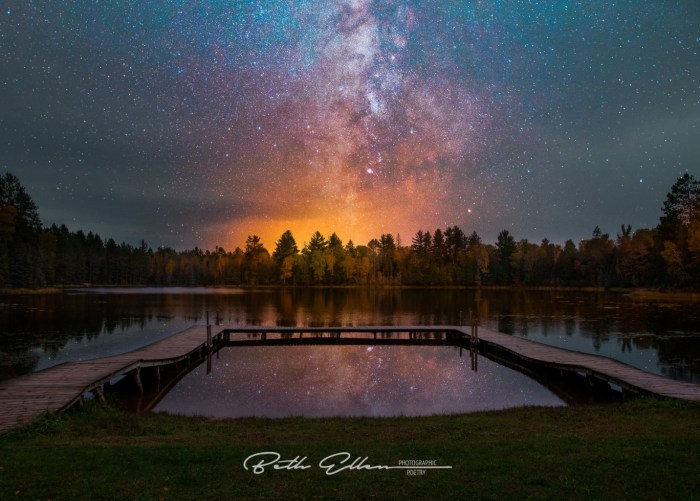
“When you fall asleep tonight just remember that we lay under the same stars.”
~Shawn Mendes

C-Net’s report on how to see the annual Orionid Meteor Shower says that:

The Orionids are considered a major meteor shower based on the amount of visible meteors that can be seen racing toward inevitable doom during its active period, which runs roughly from the first week of October to the first week of November.

The show is already active and the American Meteor Society forecasts that a handful of meteors per hour may be visible over the next several days, leading up to the peak on Oct. 20 and Oct. 21, when the number could increase to 20 per hour.

The Orionids are really just bits of dust and debris left behind from famed Comet Halley on its previous trips through the inner solar system. As our planet drifts through the cloud of comet detritus each year around this time, all that cosmic gravel and grime slams into our upper atmosphere and burns up in a display we see on the ground as shooting stars and even the occasional fireball.

Here’s another gorgeous photo & thought from Beth. See more in her Explore gallery on Flickr!

Support Michigan in Pictures with Patreon

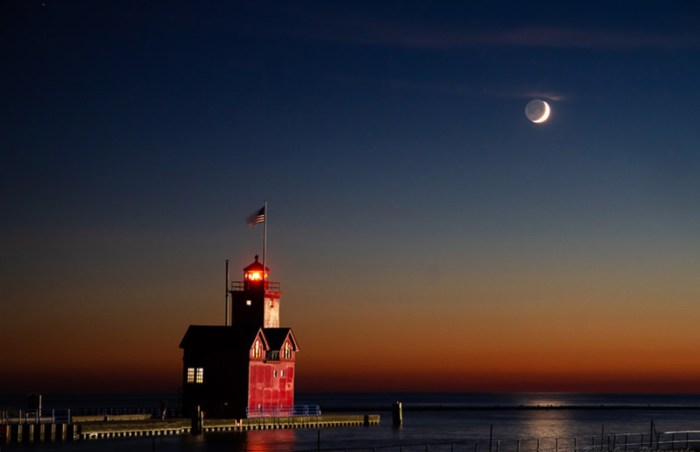
Big Red & Lunar Earthshine

Evening Lunar Earthshine by Kevin

Evening Lunar Earthshine by Kevin

Our friends at EarthSky explain that lunar earthshine happens:

When you look at a crescent moon shortly after sunset or before sunrise, you can sometimes see not only the bright crescent of the moon, but also the rest of the moon as a dark disk. That pale glow on the unlit part of a crescent moon is light reflected from Earth. It’s called earthshine.

To understand earthshine, remember that the moon is globe, just as Earth is, and that the globe of the moon is always half-illuminated by sunlight. When we see a crescent moon in the west after sunset, or in the east before dawn, we’re seeing just a sliver of the moon’s lighted half.

Now think about seeing a full moon from Earth’s surface. Bright moonlight can illuminate an earthly landscape on nights when the moon is full.

Likewise, whenever we see a crescent moon, a nearly full Earth appears in the moon’s night sky. The full Earth illuminates the lunar landscape. And that is earthshine. It’s light from the nearly full Earth shining on the moon.

Read more at EarthSky.

Kevin captured the crescent moon hanging in the western sky over the “Big Red” Lighthouse at Holland State Park. See more in his gallery The Moon on Flickr.

More of and about the moon on Michigan in Pictures!

Support Michigan in Pictures with Patreon

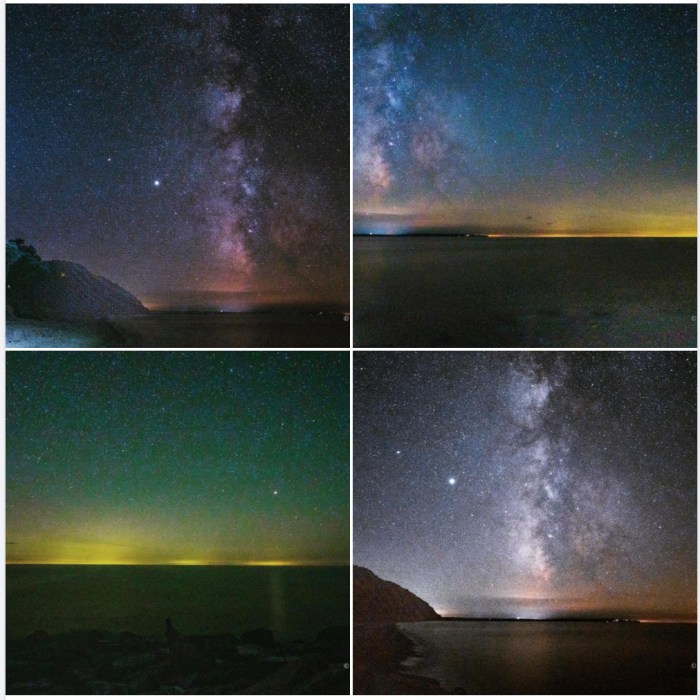
Night Sky & Aurora from Empire Beach

Night Sky from Empire Beach by Imagination Works

Night Sky from Empire Beach by Nicholas McCreedy

The NASA/NOAA Space Weather Prediction Center has issued a G2 (Moderate) Storm Watch for September 28-29th. This means that folks in Michigan, particularly in the northern half, have a solid chance to see the northern lights!

Nicholas shared some tasty photos of the Northern Lights from Empire Beach in the Sleeping Bear Dunes National Lakeshore. Click to see them in the Northern Lights/Skies of Leelanau County NW Michigan group on Facebook & you can follow him at Imagination Works on Facebook as well!

Dig into our posts about the Aurora Borealis (northern lights) on Michigan in Pictures for all kinds of tips & science behind this beautiful phenomen!

Support Michigan in Pictures with Patreon

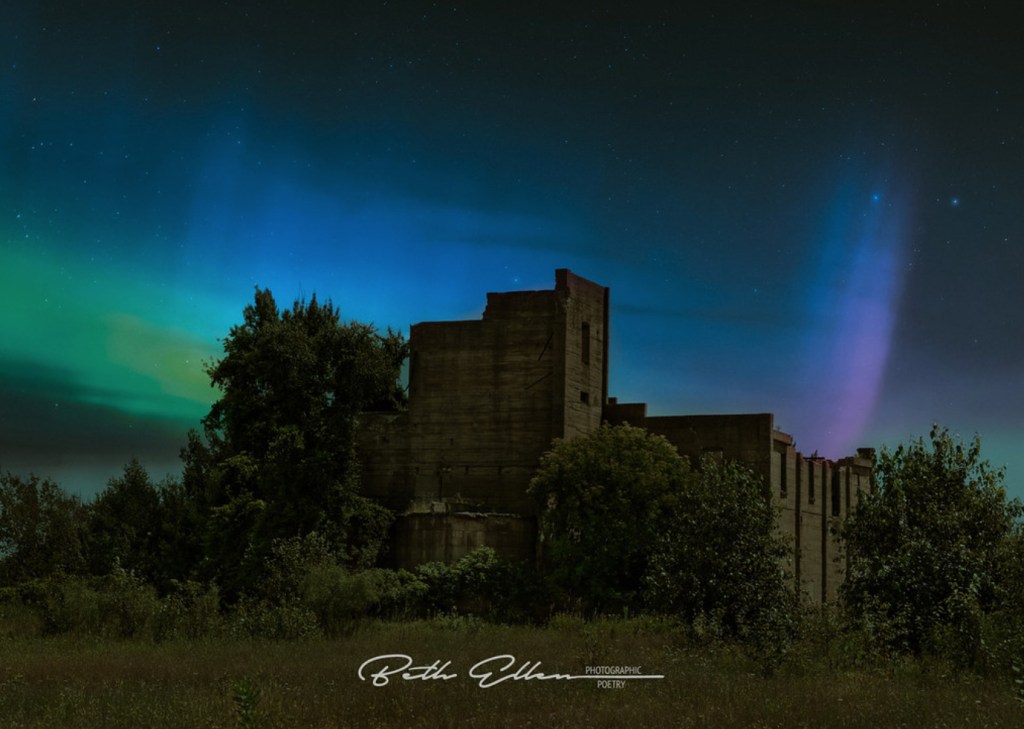
Painting the Night Sky

The Sky Grew Darker… by Fire Fighter’s Wife

“The sky grew darker, painted blue on blue, one stroke at a time, into deeper and deeper shades of night.”
― Haruki Murakami, Dance Dance Dance

Beth shared this lovely photo & sentiment. See more in her Landscape album on Flickr.

Also, don’t forget to look for Perseid meteors tonight & for the next week or two!

Support Michigan in Pictures with Patreon

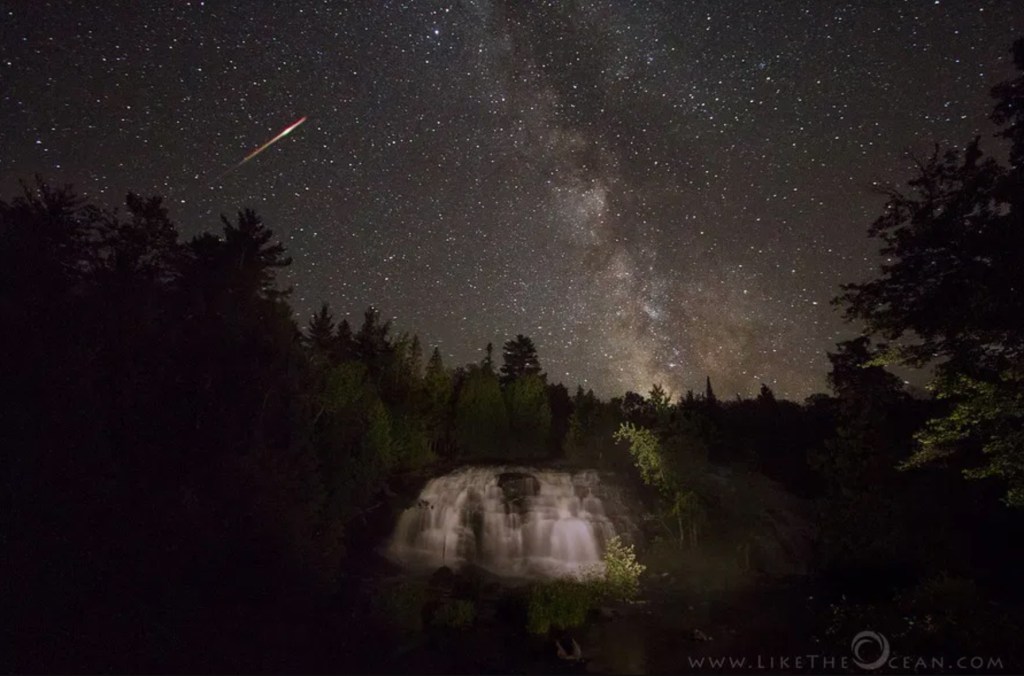
Chasing the 2020 Perseid Meteor Shower

Milky Way over Bond Falls with a dash of Perseids by Sathya

“I am beginning to love the stars too fondly to be fearful of the night.”
~Sathya R.

EarthSky explains that the annual Perseid meteor shower is one of the most beloved meteor showers of the year, especially in the Northern Hemisphere, where the shower peaks on warm summer nights:

No matter where you live worldwide, the 2020 Perseid meteor shower will probably produce the greatest number of meteors on the mornings of August 11, 12 and 13. On the peak mornings in 2020, the moon will be at or slightly past its last quarter phase, so moonlight will somewhat mar this year’s production. Still, there are some ways you can minimize the moon and optimize your chances for a good display of Perseids this year. Here are some thoughts:

The Perseids tend to be bright, and a good percentage of them should be able to overcome the moonlight. Who knows? You still might see up to 40 to 50 meteors per hour at the shower’s peak, even in the light of a bright moon. Will you see over 100 per hour, as in some years? Not likely. Still …

Try to watch after midnight but before moonrise. If fortune smiles upon you, the evening hours might offer you an earthgrazer – a looooong, slow, colorful meteor traveling horizontally across the evening sky. Earthgrazer meteors are rare but memorable. Perseid earthgrazers appear before midnight, when the radiant point of the shower is close to the horizon.

Watch in moonlight, but place yourself in the moon’s shadow.

Consider watching after the peak. People tend to focus on the peak mornings of meteor showers, and that’s entirely appropriate. But meteors in annual showers – which come from streams of debris left behind in space by comets – typically last weeks, not days. Perseid meteors have been streaking across our skies since around July 17. We’ll see Perseids for 10 days or so after the peak mornings on August 11, 12 and 13, though at considerably reduced numbers. Yet, each day as the moon wanes in the morning sky, less moonlight will obtrude on the show. Starting on or around August 17, moon-free skies reign all night long.

You can read about the taking of this photo & purchase a print from Sathya in Chasing the Perseids at his blog Like the Ocean & see more in his awesome Showcase album on Flickr.

There’s more Bond Falls & more Perseids at Michigan in Pictures.

Support Michigan in Pictures with Patreon

Comet Neowise gets better & better!

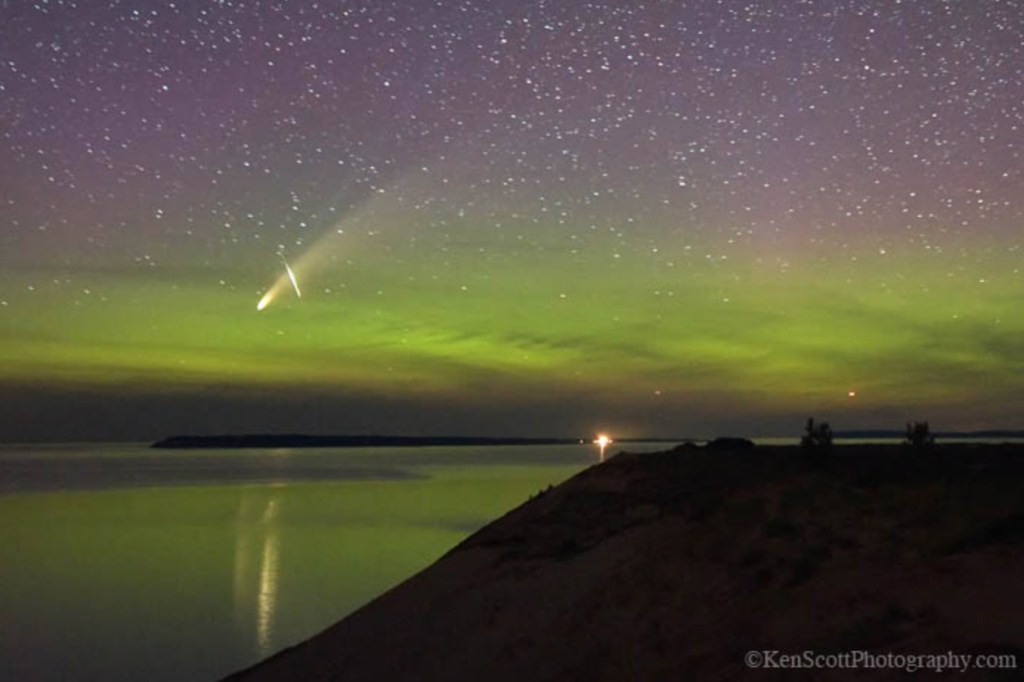
Lake Michigan … trifecta! by Ken Scott Photography

Space.com says that those who have gotten up before sunrise to gaze into the twilight skies to see Comet Neowise have been greeted by the best comet performance for Northern Hemisphere observers since the 1997 appearance of Comet Hale-Bopp, emphatically ending nearly a quarter-century of lack of spectacular comets, and it’s only going to get better:

The first good opportunity for evening viewing begins on July 12, when the head of the comet will stand 5 degrees above the north-northwest horizon, 80 minutes after sunset (the end of nautical twilight). By July 14 its altitude will have already doubled to 10 degrees, and by July 19 it will have doubled yet again to 20 degrees up by the end of nautical twilight. By then it will have moved to above the northwest horizon.

So, we at Space.com feel that the best time to view the comet during the evening will come during the July 14-19 time frame.

We also strongly recommend that observers should seek the most favorable conditions possible. Even a bright comet, like this one, can be obliterated by thin horizon clouds, haze, humid air, smoke, twilight glow and especially city lights. We especially emphasize that last factor: the farther away you get from a metropolitan area, the darker your sky and the better your view of NEOWISE. Binoculars will enhance your view.

And more good news: No moonlight will brighten the sky, as the moon will be a waning crescent and visible only in the morning sky through July 20. On successive July evenings the comet will grow fainter, but it will be farther from the sun, setting later and visible in a darker sky. As we move into August, the comet will be very well placed for observers with small telescopes.

Read on for more tips & happy comet hunting to you all!

Ken was in the Sleeping Bear Dunes National Lakeshore looking towards the Manitou Islands & writes that he captured Comet Neowise, the Northern Lights and an Iridium Flare plus the bonus reflection on Lake Michigan!! The bright light to right of center horizon is the South Manitou Island Lighthouse. See it bigger on Facebook.

Be sure to follow Ken Scott Photography & view & purchase prints at kenscottphotography.com!

Support Michigan in Pictures with Patreon

See Comet Neowise in Michigan this month!

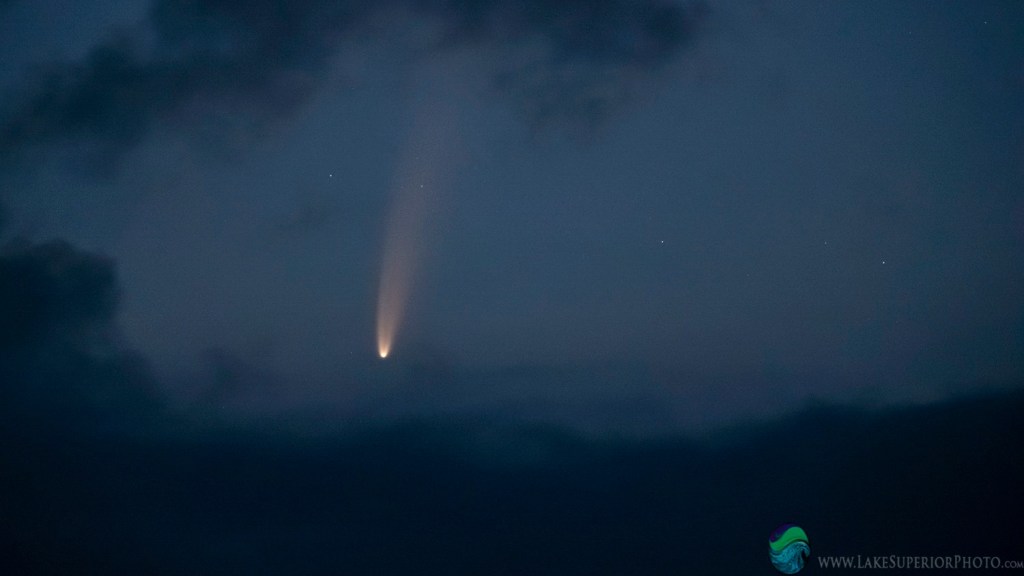
Comet Neowise by Lake Superior Photo

Shawn of Lake Superior Photo took this photo of Comet Neowise peeking through the clouds and fog yesterday morning. She shares that it’s visible to the naked eye & you can catch it the next few days in the northeast before sunrise!! EarthSky explains how to see Comet Neowise:

We still have to wait for another very bright comet, what astronomers call a great comet. There’s no strict definition for great comet, but most agree that Hale-Bopp – widely seen by people in 1997 – was one. Lesser comets are moderately frequent, though, and, right now, there’s a nice binocular comet in the dawn sky. Some skilled observers have reported that – once you spot it with binoculars – you can remove them and see the comet with the unaided eye. Using binoculars or other optical aid is a must, though, if you want to see this comet’s split tail. The comet is called C/2020 F3 (NEOWISE).

Comet C/2020 F3 (NEOWISE) is up at dawn now; it will be highest in the dawn sky around July 11. Then it will gradually approach the horizon each day. By mid July (around July 12-15), the comet will become visible at dusk (just after sunset), low in the northwest horizon.

If the comet remains relatively bright, it might be easier to see in the second half of July during evening dusk, because, at that time, it will appear somewhat higher in the sky.

You can view the photo on the Lake Superior Photo Facebook and view & purchase work at LakeSuperiorPhoto.com.

Support Michigan in Pictures with Patreon

Michigan’s 2020 Firework Shows Take a Step Back

Bay City's 'Big Show' - focus pulling by Tom Clark
Bay City’s ‘Big Show’ – focus pulling by Tom Clark

Few things in our normal lives have been untouched by the coronavirus pandemic, and public fireworks displays are no exception. Instead of the normal pages & pages of options, MichiganFireworks.com lists just a couple dozen 2020 shows still happening.

Tom took this photo at the Bay City Fireworks Festival back in 2018. He writes that “Focus Pulling is a technique of adjusting focus from out of focus to tack sharp during a firework explosion over 1 to 3 seconds. similar physical operation as zooming during exposure only you use the manual focus ring instead of the zoom ring.”

Pretty sweet effect! See more at www.tom-clark.net/fireworks!

Support Michigan in Pictures with Patreon

Broken Barn and the Galaxy

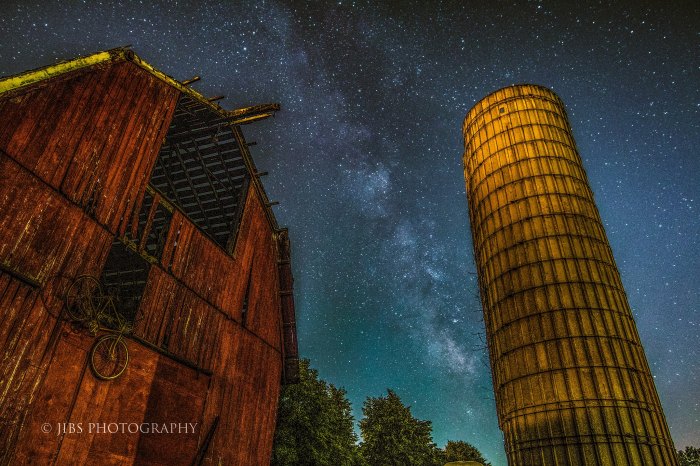
Broken Barn and the Galaxy by Jibu John

Broken Barn and the Galaxy by Jibu John

This photo is from July of 2017. See more in Jibu John’s showcase on Flickr!

Support Michigan in Pictures with Patreon