Detroit’s Penobscot Building – leapable in a single bound?

...leap tall buildings in a single bound. by tEdGuY49

…leap tall buildings in a single bound by tEdGuY49

Narrator: Faster than a speeding bullet. More powerful than a locomotive. Able to leap tall buildings in a single bound… (more)

The plan was to do something on Detroit’s Penobscot Building next week or so … apparently Ted didn’t get the message. Ah well. It looks like May is Detroit Architecture Month on Michigan in Pictures.

To bring things full circle, here’s the intro to the 50s classic Adventures of Superman. Ted just let me know that the intro to Superman was voiced by Bill Kennedy of Bill Kennedy at the Movies fame (on CKLW and later WKBD). Also see this great Detroit News feature The Stars who turned Detroiters into couch potatoes.

Penobscot Building information now here.

David Stott Building, Detroit, in Lego and in fact

The David Stott Building - Lego VersionThe David Stott Building - Actual Version

David Stott Building, Detroit by DecoJim & The Stott by detroitsky

On David Stott Building at MOC Pages, Jim Garrett writes:

This MOC represents the David Stott building, an Art Deco skyscraper that was built in Detroit during 1929 at 1150 Griswold Street. The design of the original building appears to have been influenced by Eliel Saarinen’s 2nd place entry in the 1922 Chicago Tribune building design contest. The David Stott was designed by architects Donaldson and Meier. The building is named after a Detroit businessman who owned a mill and was a boardmember of several other companies. The building remains one of Detroit’s 10 tallest skyscrapers to this day.

Follow that link to MOC Pages for all the details on Jim’s nearly 8′ tall, 54 lb. creation and check out Jim’s Lego Architecture set for more views of this and other skyscrapers.

Wikipedia’s page on the 37-story David Stott is pretty sparse, as is the Stott @ Skyscraper Page. Emporis says the Stott is Detroit’s 13th tallest building. Model D rates the structure #7 on its Top 10 Downtown Buildings of Detroit article and says that the height seems almost exaggerated to be well over 500 feet tall, because of how thin the tower appears and how the setbacks which begin on the buildings 23rd floor, seem to gracefully go on forever.

Here’s a Google map of the location of the David Stott Building (1150 Griswold – at the corner of Griswold & State). Geoff George has a photo of the David Stott mapped as well. You can get more views of the David Stott Building on Flickr.

The Mackinac Bridge: Making Michigan, Michigan

Mackinac Bridge by rdmegr

Mackinac Bridge by rdmegr

The photo by rdmegr was taken from high above the Straits of Mackinac, the name for the narrow passage between the Lower and Upper Peninsulas of Michigan. Lake Michigan is on the left and Lake Huron, the right with Mackinaw City (with a “w”) and the Lower Peninsula in the foreground and St. Ignace and the UP in the distance. It’s part of his Daytrip to Mackinac set of photos. Another photo from his flight to Mackinac of a freighter, the North Manitou Shoal Light and South Manitou Island was also blogged to Michigan in Pictures for general coolness and the fact that I heard his plane fly over my house.

I also have a confession to make: For months, I have been scared of the Mackinac Bridge.

This is distinct from the uneasiness that my mild phobia of falling off the Mackinac Bridge gives me when I drive over it.

Michigan’s Mackinac Bridge - 1957 - 2007I have been scared because 2007 is the 50th Anniversary of the Mackinac Bridge. To me, other than the lake-etched outline of our state, there is no greater symbol of Michigan than the Mighty Mac.

5 miles long, 552 feet tall in nearly 300 feet of water, the Mackinac Bridge has seen over 120 million crossings required 3 years, over 11,000 people and 4 million tons of concrete and steel to build. (more facts)

And that’s only the barest glimmer of the story that needs to be told. From its conception in the 1800s, through the difficult construction, all the way up to the people who cross it for business or pleasure every day with hardly a pause, the Bridge is an essential part of what joins Michigan’s two peninsulas as one state.

If you have some links to share, please add them in the comments. We’ll be telling the story of the Mackinac Bridge piece by piece here and on Absolute Michigan, and we’ll post links to all the photos, stories and videos on The Mackinac Bridge page at Absolute Michigan. (look for the button!)

The Mackinac Bridge

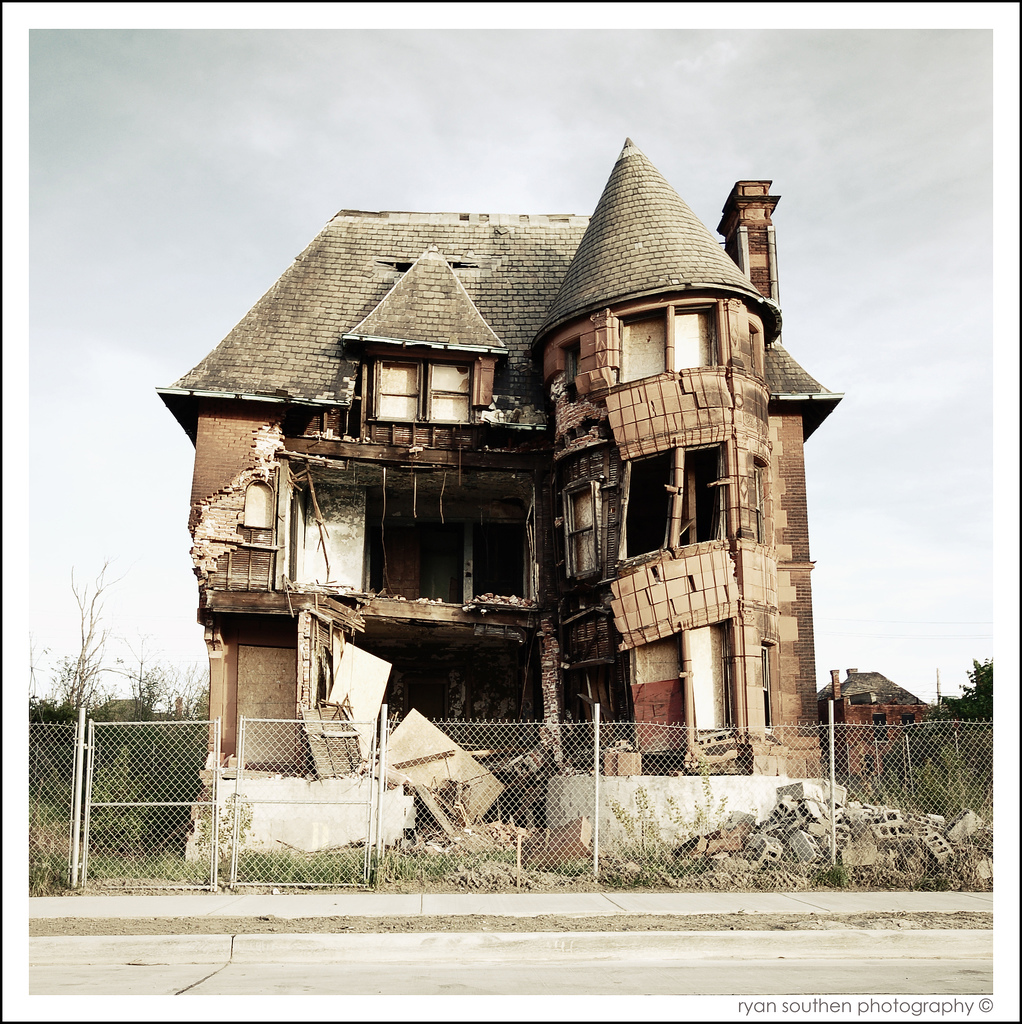
slumpy … the William Livingstone Mansion in Detroit’s Brush Park

Slumpy

slumpy, photo by SOUTHEN

Ryan writes: This is a house in the Brush Park neighborhood in Detroit. A few years ago the home was relocated to the spot it currently sits, but was done so poorly and now sags in the middle. Because of its sag this unique home as been dubbed “Slumpy” by people in Detroit. Its sad and only a matter of time before the home collapses.

Through the magic of FlickrVision, I have been watching Slumpy slump its way toward becoming a pile of rubble for a couple of years. Mac from Detroit BikeBlog (and also Bobby Alcott) pointed out this YouTube video of the front face of the mansion falling off (PG for language). UPDATE! Here’s an even better video (2nd one down). With Slumpy now one step closer to the ultimate end, I thought it would be a good time to dig for a little of the history.

The best I found is at Detroit 1701’s page on the William Livingstone Residence which says:

A prosperous family in Detroit in the 1890s likely wanted to build a home in one of the city’s most elegant neighborhoods. The two most prestigious, arguably, were Brush Park with its numerous mansions or Woodward Avenue where David Whitney and Colonel Hecker had built their castle-like mansion. William Livingstone selected Eliot Street in Brush Park and then employed a very young Albert Kahn who was working for the George Mason-Zachariah Rice firm. When he obtained this commission – presumably with Mason’s help; Kahn was only 22 or 23 years old and had just returned from spending 1891 in Europe studying the classical architecture of the Old World.

Albert Kahn designed in a French Renaissance mode for the home you see, perhaps, reflecting the time he spent sketching the best Gallic architecture. Currently, it takes a great deal of imagination to understand what this once-impressive home looked like in 1893 when Kahn completed it. You can see an interesting array of windows, an appealing tower with its conical roof along with an impressive entryway. This residence was originally built about one block to the west of its present location to the west of John R. The Red Cross intended to demolish this home for their new building. Preservationists succeeded in successfully moving the Livingstone Home about one block to the east.

Wikipedia has a list of buildings designed by Albert Kahn and more information about the architect. They note that as of 2006, Kahn had around 60 buildings listed on the National Register of Historic Places.

Slumptacular Links

Connecting the dots on the Grand Rapids skyline

Grand Rapids skyline

Grand Rapids skyline, photo by sparky05.

Web technology like tagging and social networks are increasing our ability to relate our photos to real world data and to relate to each other through our photos.

A great example of this can be found in the ways in which photos of Grand Rapids are woven together. Using Flickr, you can assign locations to your photos. Here’s a photo map of downtown Grand Rapids featurign pictures taken by Sparky and others.

Maps aren’t the only way to connect with photographers (and photographs) of Grand Rapids. Check out the Grand Rapids, Michigan Group on Flickr. Two other good spots are the Grand Rapids Photo Blog and the Grand Rapids forum on UrbanPlanet.org.

Building buffs will also want to head over to the Skyscraper Page for buildings of Grand Rapids. It gives details of all the buildings (including those under construction), drawings of the individual buildings and a lineup of Grand Rapids buildings by height.

All of this may seem like overkill, but consider how incredibly useful this might be to a company that was scouting Grand Rapids (or your city) as a potential location.

Timber Cruising and Hulbert Lake

Hulbert Lake

Hulbert Lake, photo by Joslynan.

Josie took this photo in August of 2006 and you can also check out this satellite view of Hulbert Lake and the UP.

Exploring the North’s page on Hulbert Lake says that the lake was also named Lake Glimmerglass by William Hulbert. The page tells an interesting story of William’s grandfather, Francis, who was a “timber cruiser” and raced a fellow cruiser to file for title to the lake in Marquette. He won the race.

When Pine Was King (excerpted from Larry B. Massie’s “Voyages into Michigan’s Past) tells a little more of timber cruising:

The logging cycle began with the timber cruiser. Armed with a map and compass he would tramp the wilderness for weeks seeking prime stands of white pine located near a stream, then race to the nearest U.S. land office to register the find.

American Memory: Pointe aux Barques in Lake Huron

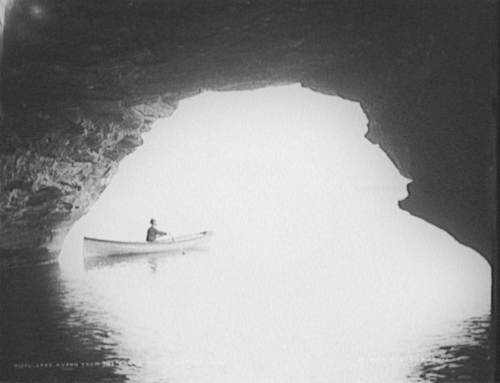
Lake Huron from the caves, Pointe aux Barques.

Lake Huron from the caves, Pointe aux Barques

The United States Library of Congress is a shining example of why we need government: to perform the vital work of preserving our heritage. One of the ways you can experience this preserved heritage is through American Memory from the Library of Congress. According to the mission, American Memory provides free and open access through the Internet to written and spoken words, sound recordings, still and moving images, prints, maps, and sheet music that document the American experience. It is a digital record of American history and creativity.

Today’s selection is from a gallery of photos from the collection of the Detroit Publishing Co. taken on and around Lake Huron near Pointe aux Barques and Port Austin in Huron County. It’s a gallery of 20 photos of natural wonders like Turnip Rock and structures such as the Port Austin Reef Light (if that link doesn’t work for you, try the Pointe Aux Barques link on this page).

You can get some great present-day photos of the shoreline at Port Austin Kayak Rental … either in their gallery or by renting a kayak and taking your own! If you have taken any photos of the area, please feel welcome to post links to them in the comments! Port Austin Kayaks also helpfully provided a map link that lets us give you this cool satellite view of the Port Austin shoreline! (I believe that point at the western edge is where Turnip Rock is)

Library of Congress LC-D4-12361

Updated Oct 2, 2008: Check out modern day photos in Kayaking Point Aux Barques!

time traveling in downtown detroit

time traveling

time traveling, photo by paulhitz.

With a little help from Ye Olde Photoshoppe, Paul takes us:

back in a time when things were simple … a few Detroit Classics in this one:

Why stop at time traveling? You can also zoom on the area via Google maps.

A Holga, Lake Erie and Sterling State Park

Lake Erie

Holga: Lake Erie, photo by Matt Callow.

I wavered back and forth between this one and Matt’s other photo of ice on Lake Erie. The photo was taken at Sterling State Park between Monroe & Detroit Beach, and Matt has helpfully placed it on a map.

Wikipedia says that William C. Sterling State Park is:

…the only Michigan state park located on the shores of Lake Erie. The park encompasses 1,300 acres. The park sits just north of where the River Raisin empties into the lake. The park boasts many lagoons and marshes, providing good habitat for a variety of wildlife and bird life. The park is situated in Monroe County just south of Detroit Beach/ Sandy Creek and north of the city of Monroe. It is the fourth busiest state park in the state. The park is located less than a mile from Interstate 75, which provides easy access from the neighboring areas of Detroit and Toledo. The main attractions at the park include the beach, a boat launch, and shore fishing. Over two miles of asphalt surface are available for bike riding. Hiking trails are also available.

A visit to Cranbrook House and Gardens

Untitled, photo by Rhonda_Marie.

Last weekend, the Exposure.Detroit group on Flickr held a photography meetup at Cranbrook. Here is a link to many more great photos taken at Cranbrook.

Cranbrook House and Gardens in Bloomfield Hills is the heart of the over 300-acre National Historic Landmark Cranbrook campus. The English Arts and Crafts-style Cranbrook House was designed by Detroit architect Albert Kahn in 1908 for Detroit News publisher George Gough Booth and Ellen Scripps Booth. The home is the oldest surviving manor in the metro Detroit area. According to the Cranbrook House and Gardens site:

The Booths commissioned the finest artisans, craftsmen and studios of the period to furnish the house with handcrafted furniture, tapestries, tiles, stained and leaded glass, and other works of fine and decorative art.

The 40 acres of gardens that surround Cranbrook House were originally designed by George Booth to entice visitors to savor the serenity of the spring and summer months. From the symmetry of the Sunken Garden to the scent of the herbaceous garden to the casual beauty of the bog garden, there is something to capture everyone’s interest. Sculpture, fountains and architectural fragments enhance the setting with spacious lawns, specimen trees, and a lake stretching out beyond the fieldstone walls.

Also see Cranbrook’s History in the Cranbrook Archives and How one man’s bad luck paved way for creation of Cranbrook from the Detroit News Rearview Mirror. Also see this map of the Cranbrook area with geotagged photos.