The first Capitol Building in Michigan was here

The first Capitol Building in Michigan was here

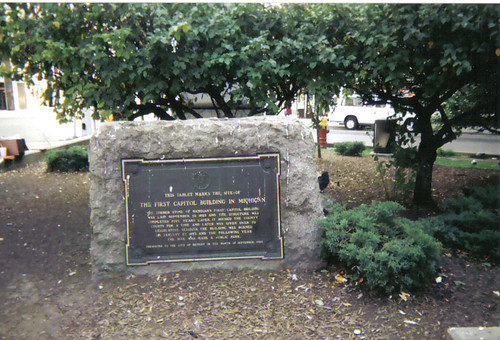
The first Capitol Building in Michigan was here, photo by femaletrumpet02.

Lauren writes: Here is the historical marker for the first capitol building in the state of Michigan, hence the name for Capitol Park.

January 26 is Michigan’s Statehood Day, our state’s birthday – 171 years since the day Michigan joined the Union as the nation’s 26th state on January 26, 1837. If you’re in Lansing, you might drop by the Michigan Historical Museum for the Statehood Day Celebration. There’s a lot of special activities and it’s the one time of year that Michigan’s first constitution is displayed for the public. (pdf of the text of Michigan’s Constitution)

I spent a lot of time looking for some grand online commemoration of Michigan’s founding, but the site of the state’s first capitol isn’t even an official state historic marker and Capitol Park appears to be an afterthought in the annals of our state’s history.

Anyway, Happy Birthday, Michigan. I love you, pigeon poop and all.

Another (Michigan) Roadside Attraction

Paul Bunyan

Paul Bunyan, photo by I am Jacques Strappe.

The Michigan Historical Museum is planning an exhibit called Michigan’s Roadside Attractions, set to run from January to June of 2009. They are looking for stories, pictures and artifacts of the unique places – open or long shuttered – that folks visit on the way from someplace to someplace else. Michigan Historical Museum System Director Phillip C. Kwiatkowski says:

We want to hear what made you stop at these roadside attractions – places like the Mystery Spot in St. Ignace, Deer Forest in Coloma, Windmill Island in Holland and the multiple locations where Paul Bunyan has been spotted – and to see the photos you took and the souvenirs that you kept. Our biggest need is your treasured mementoes, from miniature Paul Bunyan statues and plastic purses to dinosaurs, seashells and even ceramic doll dish sets.

If you can help, please contact Eve Weipert, curator of collections, at (517) 373-1509 or weiperte@michigan.gov. Most artifacts used in the exhibit will be considered on loan and will be returned after the exhibit ends. The museum has an established review process that is utilized prior to acceptance of loans or permanent donations. Artifacts are needed by April 1, 2008 to allow time to complete the exhibit storyline around the available artifacts.

This photo by Marjorie is part of her Roadside Curiosities set (slideshow) and it’s available “Bunyan-sized” for your desktop wallpaper.

If you’re interested in Michigan’s roadside attractions, here’s some “roadside” photos from the Absolute Michigan pool, Michigan Tourist Traps from WaterWinterWonderland.com, the “roadside” tag on Michigan in Pictures, this Absolute Michigan “Weird Wednesday” featuring Domke’s Dinosaur Gardens and of course, Michigan’s legendary Big Boy Graveyard.

If you have links or memories to share, post them in the comments!

Michigan Week Youth Photo Contest

2007 Michigan Week Youth Photo Contest

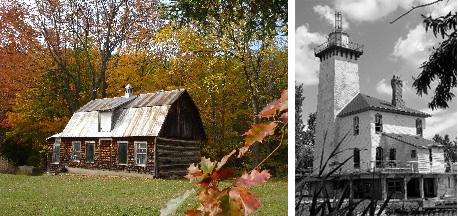
The photos above are two of the winners of the 2007 Michigan Week Youth Photo Contest: Bufka Shed at Sleeping Bear Dunes National Lakeshore taken by Kyle Helwig of Leelanau County and Saginaw River Rear Range Lighthouse taken by Cody Janczewski of Ogemaw County. You can click the photos above to see all the state and regional winners and runners up.

Every year, Michigan State University Extension’s 4-H Youth Development, the Michigan Department of History, Arts and Libraries and Michigan History for Kids magazine (with additional financial support from the Michigan Barn Preservation Network) sponsor the Michigan Week Youth Photo Contest. The contest is for photographers between the ages of 9 and 19 and challenges photographers to take a photo of their favorite Michigan historic site. The deadline for photo submission is Feb. 15, 2008.

If you’re looking for historical sites that would qualify, check out the Michigan State Historic Preservation Office’s Historic Sites Online website.

The Copper Miner’s Strike of 1913 and the tragedy at Calumet’s Italian Hall

Copper Miners outside Dunn's Bar

dunns 6th calumet, photo by Ztef

I usually try to make Michigan in Pictures a happy place to be because there’s enough unhappy things out there. Every so often, however, I think there are stories that warrant a look and rememberance if only to say: “Let’s make darn sure this never, ever happens again.”

Ztef captioned the above photo rather sparsely with Copper miners strike outside of Dunn’s bar on 6th Street in Calumet, Michigan – 1913, but he has provided a link to Calumet: The Copper Miner Strike of 1913. This page offers a very detailed and readable account (complete with some great old photos) of the labor troubles in Keweenaw during the early part of 20th Century from the perspective of the Zawada family, Poles who worked in the copper mines for the mining giant Calumet & Hecla. Of this photo it says:

Strikers outside of Dunn’s Bar, a favourite among miners. Just next door to Dunn’s was the No. 203 local WFM office (Western Federation of Miners). The sign on the left reads: “Something just as good Miners ask for bread, Jim [MacNaughton, C&H General Manager] offers lead”. The sign in the middle reads: “One man machine Our Agitator”. The sign on the right reads: “We demand higher wages and better working conditions”. The men in front are holding copies of the Miner’s Bulletin, but the headlines are not clear.

As you can read at the link above, the strike was characterized by escalating violence, calling in of the National Guard and even murder. The chaos culminated with what has been called a Disaster, Tragedy and even Massacre at Calumet’s Italian Hall. Copper Country Reflections’ Italian Hall Tragedy page at Pasty.com explains:

By the end of December, the miner’s strike had been waged for 5 long months, with no end in sight. The mining companies and their supporters were holding firm in their resistance to the WFM, while the union was still somewhat solid in its position.

To temporarily set aside their cares, a group of union members planned a Christmas eve celebration for their children at the Italian Hall on Seventh Street in Calumet. I can only assume that the activities that evening must have been the most fun these children had since the start of the strike. Unfortunately, the excitement turned to tragedy as someone, his identity never learned, cried FIRE. As the children and adults panicked, many worked their way towards the stairwell. The first unlucky souls quickly realized the doors at the bottom would not open. Were they locked? Was somebody holding them closed?

It is hard to comprehend, but 73 men, women and children died in that staircase. Some were crushed, others died from suffocation. Can you imagine the shock of the rescuers when they finally pried open the doors? As they pulled bodies up and out of the staircase?

The page above also includes photos that are definitely not for the faint of heart. If you’d like to explore further, there’s more information and photos at the Italian Hall 1913 Massacre site and you can see a photo of the Michigan historical marker & memorial at the site of Italian Hall in Calumet.

One thing you definitely should do is watch the moving accounts of survivors of the tragedy at the December 2007 update from the 1913 Massacre Film Project. The movie project has been going for several years and it looks like it will be very good.

The Absolute Michigan map of Michigan has the location of Italian Hall in Calumet.

The Heidelberg Project in Detroit

More from the Heidelberg Project

More from the Heidelberg Project, photo by DetroitDerek.

I have been planning to write something about The Heidelberg Project in Detroit for quite a while now. This morning, I read an unsettling report about fires at the project from Derek that tipped my hand.

At heidelberg.org you can learn all about this amazing project:

The Heidelberg Project, bearing the name of the street on which it exists, was started in 1986 by Tyree Guyton. He was assisted by his grandfather, Sam (Grandpa) Mackey (deceased), and his former wife, Karen Guyton. Tyree was raised on Heidelberg Street and, at the age of 12, witnessed the tragic effect of the Detroit riots – from which he claims the City of Detroit never recovered. Though once racially integrated, many neighborhoods have become segregated urban ghettos characterized by poverty, abandonment, and despair

Armed with a paintbrush, a broom, and neighborhood children, Guyton, Karen, and Grandpa began by cleaning up vacant lots on Heidelberg and Elba Streets. From the refuse they collected, Guyton began to transform the street into a massive art environment. Vacant lots literally became “lots of art” and abandoned houses became “gigantic art sculptures.” Guyton not only transformed vacant houses and lots, he integrated the street, sidewalks, and trees into his mammoth installation and called his work on Heidelberg Street, the Heidelberg Project.

I don’t think there’s any way that you can get a sense of this from one photo. Fortunately Derek has more photos from the Project (slideshow) and you can see a whole lot more photos of the Heidelberg Project on Flickr including those in the Heidelberg Project pool.

Be sure to also check out the video of Tyree Guyton explaining the Heidelberg Project and the new book from Wayne State University Press, Connecting the Dots: Tyree Guyton’s Heidelberg Project.

Fist of a Champion – Detroit’s Monument to Joe Louis

Joe Louis 2

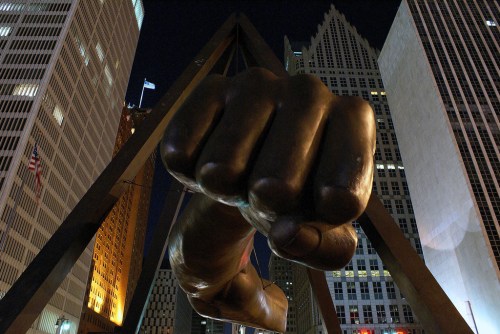
Joe Louis 2, photo by buckshot.jones.

Scott writes I simply love this piece of art work. It says so much about the heart and soul, the toughness, about the town and the people who live here and have built this area. Joe Louis Barrow, aka “The Brown Bomber” is one of the all-time great boxers. The 24 x 24 x 11.5 feet Monument to Joe Louis was commissioned by Time Inc. for the City of Detroit to honor Joe Louis. It was created by sculptor Robert Graham and installed at Jefferson Avenue at Woodward, Detroit on October 16, 1986.

Robert Graham’s page on the Joe Louis Memorial says:

The monument is a 24-foot long arm and fist held in balanced suspension from a pyramidal support of bronze poles. Weighing approximately 8,000 lb., it rises 24 feet above a major downtown intersection.

The initial arm was modeled in clay at 14 inches in length. With the aid of a computer, a full-scale steel armature, 24 feet in length, was made and wrapped with wire and covered with clay. The final clay model was divided into eight sections and cast in bronze, then assembled. The pyramid structure was fabricated out of steel, and faced with bronze plates. A tribute to Joe Louis is inscribed on the arm.

Detroit Yes writes in Downtown Montage that he may be the only person in Detroit (other than Scott) who likes the Fist:

So great was Joe Louis that is difficult to measure the historical contribution of this immense figure who, without a close second, is by far the greatest sports figure to ever arise from Detroit and assume center stage on the world theater. It was he who helped shatter the Nazi myth of racial superiority with his dramatic defeat of German champion Max Schmeling during the rise of Nazism. In doing so and then serving his country nobly in the segregated army of World War II, he laid bare the disgraceful hypocrisy that denied Afro American athletes access to the major leagues of American sport, not to mention all Afro Americans who were and are denied the basic birthrights of American citizenship.

He did this with his fists and determination. So it is fitting that he is honored with a place at the center of his hometown with an artwork as powerful and controversial as he was.

You can get a birds eye view of the Joe Louis Memorial on the Absolute Michigan map of Michigan. Also see Monuments of Detroit from the Detroit News, a slideshow of photos of the Fist and a video look at the Joe Louis Fist Statue. For more about Joe Louis, Wikipedia’s Joe Louis entry and the Official site of the Joe Louis Estate.

Fall Color Tours: Lansing – Grand Ledge – Hastings – Battle Creek – Eaton Rapids

maplepath by Aunt Owwee

maplepath, photo by Aunt Owwee

Our next fall color tour from Travel Michigan, Lansing – Grand Ledge – Hastings – Battle Creek – Eaton Rapids, starts where the above photo was taken: at the Fenner Nature Center in Lansing (once known as the Fenner Arboretum). The park is named after biologist Carl G. Fenner and has 130 acres with 4 miles of trails winding through maple groves, pine forests, swamp forests, old fields and 3 different ponds. This weekend (Oct 20 & 21) they’re having an Apple Butter Festival. Aunt Owwee (Shirl) has a cool four seasons view from here and lot more great shots of autumn in Michigan.

If you’ve got the nature center bug, you can stop at the Woldumar Nature Center, located along the Grand River not far southwest of Lansing. From there, head out M-43 to Grand Ledge. Fitzgerald Park aka “The Ledges” are absolutely gorgeous in the fall, as evidenced by this photo from Rein Nomm of Fall at the Ledges that appeared last year on Michigan in Pictures. Not convinced? Search fall at Grand Ledge on Flickr. Last weekend, the city of Grand Ledge held their annual Color Cruise, but there’s still plenty of color to be found.

Thornapple River by hansendmThen it’s on to Hastings and Historic Charlton Park, a re-creation of a 19th century town. The structures are open only Memorial Day to Labor Day but you can certainly enjoy strolling along the river. For a little more exercise, jump on the non-motorized vehicle only Paul Henry – Thornapple Trail (see photos of the trail on Flickr). When complete, the trail will be a 42-mile route from Grand Rapids to Vermontville. The photo to the right of the Thornapple River was taken by hansendm.

The it’s on to Gull Lake and the W.K. Kellogg Bird Sanctuary. The sanctuary is one of the North America’s pioneer wildlife conservation centers and offers a chance to see birds in the wild, bird displays and birds of prey enclosures featuring rare and common raptors including a bald eagle, red-tailed hawks and eastern screech owl.

Travel Michigan suggests a possible detour to the Fort Custer Recreation Area, located between Battle Creek and Kalamazoo. It features three lakes, the Kalamazoo River and an excellent trail system that includes 16 miles of mountain bike trails. The 3000+ acre area was farmland that was acquired by the federal government to establish Camp Custer, an induction and military training center for the US Army during WWII.

If it’s raining or all this outdoor stuff doesn’t sound fun, consider stopping at the Gilmore Car Museum in Hickory Corners which features almost 200 vehicles spanning over 100 years of automotive heritage from a 1899 Locomobile to the muscle cars of the 60s and 70s.

Kalamazoo river from the Nature Center bridge by cathieContinuing south, we come to the city of Battle Creek where recommended stops include the Sojourner Truth Monument (check out this set of photos of the Monument), Binder Park Zoo, the Leila Arboretum and Children’s Garden and the Battle Creek Linear Park. The park is a walkable, bikeable and billed as “the world’s largest classroom,” featuring signs that tell about plant, animal, cultural and historical points-of-interest along the park.

If you’re hungry as you head out on Old 27, consider Cornwell’s Turkey House aka Turkeyville USA. A bit further south is the town of Marshall. In addition to being a shopping mecca, Marshall’s downtown is designated as a National Historic Landmark District and features a wealth of historic attractions including the American Museum of Magic.

The photo to the right is of the Kalamazoo river from the Nature Center bridge by cathie and it’s just one of the places you can stop as you ease on down the road back to Lansing through the towns of Albion, Springport & Eaton Rapids. They recommend a stop at The English Inn of Eaton Rapids for dinner. Having eaten there before, I can only say “got room for another?”

Just so it’s clear, these fall color tour entries are produced by Absolute Michigan & Michigan in Pictures using the great information compiled in Travel Michigan’s Fall Color Tours as a starting point. We’re trying to add to what they’ve put together – not rip them off! As always, if you have links to information or photos that we missed, comments or reports, post them in the comments below!

Don’t miss our Michigan Fall Wallpaper series and see more of Travel Michigan’s Fall Color Tours.

Lith Print: Ghost Forest

Ghost Forest

Lith Print: Ghost Forest, photo by Matt Callow.

Holga, Tri-X, lith print.

You can read more about the Sleeping Bear Dunes Ghost Forest, check out a slideshow of photos from the Sleeping Bear Dunes National Lakeshore taken during Matt’s time as Glen Arbor Art Association’s Artist-in-Residence and read the Michigan in Pictures photographer profile of Matt Callow.

There’s a ton of information about Lith printing at lithprint.com.

The Annual Labor Day Mackinac Bridge Walk

The 2010 Mackinac Bridge Walk takes place on Monday, September 6, 2010!

2000 Mackinac Bridge Walk
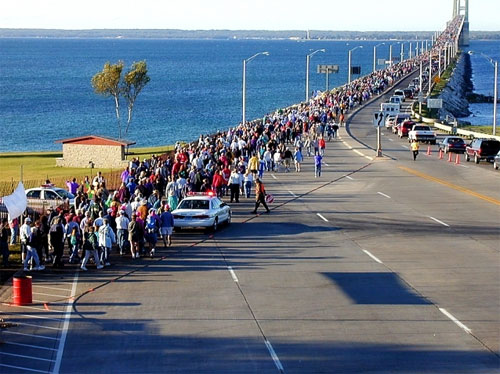
2000 Mackinac Bridge Walk, photos courtesy Michigan Department of Transportation & Mackinac Bridge Authority

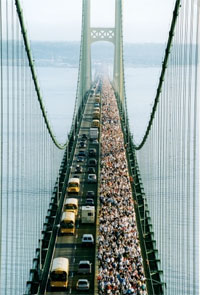
The annual Mackinac Bridge Walk has been held every year on Labor Day since the Bridge opened in 1957, so, like the Mackinac Bridge itself, The Bridge Walk is celebrating its 50th anniversary.

Walkers in the Mackinac Bridge Walk from the tower!Strangely enough, Wikipedia seems to have the most historical information on the walk (which is not much). They say that the first walk took place in the early morning hours of Labor Day, 1958. and that just 68 people took that first 5 mile walk across the Mighty Mac. In the early years, it seems that the walk was sparsely attended and viewed as an annoyance until the governor was brought in to lead the walk. The walk averages 50,000 to 65,000 attendees and the record is estimated to be 85,000 when George H. W. Bush led the walk in 1992. Will we break the record this year? Seems like we should, but I wonder.

The Governor’s party leads the way at 7 AM (I think) with registered and pre-qualified joggers (details from the Governor’s Council on Physical Fitness). Important things to note (according to the official site) are that traffic still moves across the bridge during the event, that it starts on the St. Ignace side, that they really recommend you figure your return transport out, that it’s FREE (my capitalization) and that there are NO RESTROOMS ON THE BRIDGE (their capitalization).

The Michigan Department of Transportation has a photo gallery from past Mackinac Bridge Walks. A photographer named Chuck contributed one of his photos from the bridge walk to Wikimedia, and he has a nice gallery of Mackinac Bridge Walk photos. A search of Flickr finds some bridge walk pics as well (hopefully more after this year’s walk!). Do you have more links? Post ’em in the comments and please share your story/photos if you walk this year!

The Mackinac Bridge

I should add that on September 16 from 7:00 – 7:30 AM, there will be a “Bike Across the Mighty Mac” event sponsored by Mackinaw City Chamber of Commerce. If you’re up in the area, there’s also a Truck Parade of Lights from 8-9 PM on September 15th.

Tiger Stadium, in pictures

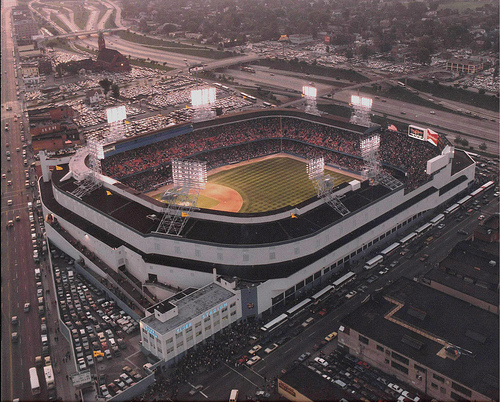
Aerial View of Tiger Stadium

Tiger Stadium #1, found by m7k7k7

Many folks in Michigan have a piece of their heart stored at the Corner of Michigan & Trumbull. Wikipedia’s Tiger Stadium entry says the ballpark located in the Corktown neighborhood of Detroit hosted the Detroit Tigers Major League Baseball team from April 20, 1912 when it opened as Navin Field, through its expansion in 1938 when it was renamed Briggs Stadium (and began hosting the Detroit Lions as well) through 1961 when John Fetzer took control and renamed it Tiger Stadium. It saw two World Series championships, 1968 and 1984 and was the home of the Tigers until Comerica Park opened in 2000. It was declared a State of Michigan Historic Site in 1975 and has been listed on the National Register of Historic Places since 1989.

And it’s scheduled for demolition in October of 2007.

From honorary bat boys spending a few moments with a player to huge and cheering crowds, this ballpark has made millions of memories.

Now it waits for the wrecking ball, slowly falling to pieces. I don’t think that too many want to remove the Tigers from their palatial new home, but it would (in my opinion at least) be a wonderful thing if Ernie Harwell and his group could succeed in preserving a scaled-down park at the Corner so none of us have to say goodbye to an old friend (and maybe The Last Strike at Tiger Stadium wouldn’t actually be the last).

Here’s a whole lot more photos in the Tiger Stadium group on Flickr. If you have any photos (or memories) to add, post a comment below!

Read Ernie Harwell’s plan for Tiger Stadium on Absolute Michigan.