Sault Ste. Marie International Railroad Bridge

international railroad bridge, sault ste. marie, ontario / michigan

international railroad bridge, sault ste. marie, ontario / michigan, photo by twurdemann

The Library of Congress page on the Sault Ste. Marie International Railroad Bridge that spans the Soo Locks from Michigan to Canada at St. Marys Falls explains that:

The Sault Ste. Marie International Railroad Bridge has nine camelback truss spans crossing the St. Marys River with bascule and vertical lift bridge components crossing the American Locks at the St. Marys Falls Canal. It is the only bridge in the United States known to include these three types of spans in a single structure to use an interlocking mechanism to connect the leaves of the double-leaf bascule span.

It is Michigan’s most significant railroad bridge from an engineering history standpoint and is eligible for listing in the National Register of Historic Places.

Click through for some great old photos of the bridge and explore the various sections through Historic Bridges.

Check this photo out on black and see more great shots in twurdemann’s Sault Ste. Marie 2012-2013 slideshow.

More Michigan bridges on Michigan in Pictures.

New owner for Irish Hills Towers

Irish Hills Towers from Route 12 (View 1)

Irish Hills Towers from Route 12 (View 1), photo by DarrylW4

The Adrian Daily Telegram reports that ownership of the Irish Hills Towers has formally been transfered to the Irish Hills Historical Society, a 501(c)(3) nonprofit. The towers have been stabilized and are being evaluated, and it appears that the IHHS would need about $300,000 to restore this attraction. Keep up with their progress at the Irish Hills Historical Society Facebook.

This page on the Irish Hills Towers notes that the top of the towers is 1400 feet above sea level, which makes them the highest point in southeastern Michigan. On a clear day (if they were open) you could see for seven miles with a ten lakes visible.  Michigan in Pictures has more shots of these iconic landmarks including the history of the towers and a crazy cool photo by Matt Callow.

Darren took the photo and suggests that he’d like to see the towers restored and converted to a museum for Michigan’s Roadside Attractions. Check it out on black and see more in his Irish Hills Towers slideshow.

Happy 101st Birthday, Tiger Stadium

Tigers at night

Tigers at night, photo by baklein62

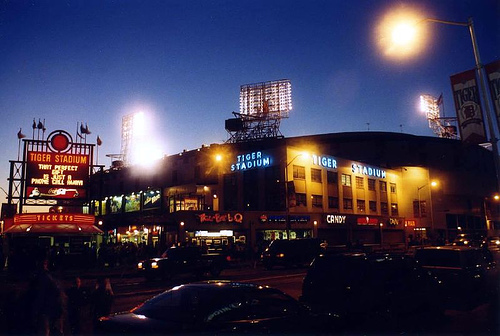
101 years ago today on April 20, 1912, Tiger Stadium opened at the corner of Michigan & Trumbull in Detroit’s Corktown Neighborhood. Last year Eric Adelson of Yahoo Sports observed that this milestone passed largely unmarked:

It was 100 years ago this weekend. Ty Cobb scored the first run by stealing home. From that day until 1999, this very spot rumbled with din and greatness. Pretty much every legend that played in Fenway in the 20th century also played here. Lou Gehrig sat himself down for the first time in 2,130 games here, ending his incredible ironman streak. Babe Ruth hit his 700th home run here. Reggie Jackson hit one into the right field light tower here during the ’71 All-Star game. The Tigers won World Series titles here in 1968 and again in 1984, with Kirk Gibson launching a late-inning home run off Goose Gossage that no Tigers fan alive to see it will ever forget. Fair to say this was the most exciting place in the history of Michigan.

And now there’s hardly a trace. Fans committed to honoring the old stadium in some form maintain a home plate, a pitcher’s mound, two chalk lines for base paths and two benches where the dugouts used to be. The 125-foot flagpole from the old center field is still standing.

While the old ballpark’s birthday is definitely passing unmarked again this year, mLive hadan article about the uncertain future of the site a couple of weeks ago. If you’d like to do a little remembering, head over to 100 years at Tiger Stadium on Absolute Michigan for a whole lot more about this beloved ballpark and links to videos including the intro to the DVD Michigan & Trumbull featuring Ernie Harwell. (a 2 1/2 minute stroll through Tiger Stadium)

Check Barney’s photo out on black and see a whole lot more in his great Baseball as Art slideshow.

Lots more Detroit Tigers pictures on Michigan in Pictures!

Holland Harbor’s Big Red Lighthouse and the Red Right Return

Big Red

Big Red, photo by Rick Lanting

Sometimes I see photos of certain places so much that I figure I’ve said all there is to say about them. Such was the case with one of one of Michigan’s most iconic lighthouses. I realized that although I’d seen hundreds of photos, I had no idea how “Big Red” in Holland got its name. Terry Pepper’s Seeing the Light tells the story of the Holland Harbor Light from the construction of a timber frame beacon on the south pier in 1870 up until the 1930s when:

The Holland Lights were electrified in 1932. Equipped with a 5,000 candlepower incandescent electric bulb, the Fourth Order lens was now visible for a distance of 15 miles. The old steam-operated ten-inch fog whistle was removed from the fog signal building the following year, and replaced with an air operated whistle powered by an electric motor-driven compressor. In 1936, a square tower was erected at the west end of the fog signal building roof peak, and capped with an octagonal cast iron lantern, the lens from the pierhead beacon moved into the new lantern. The steel pierhead beacon was then removed from the pier and shipped to Calumet, where it was placed at the south end of the breakwater.

A Coast Guard crew arrived in Holland in 1956, and gave the combined fog signal building and lighthouse a fresh coat of bright red paint in order to conform to its “Red Right Return” standard, which called for all aids to navigation located on the right side of a harbor entrance to be red in coloration. Local residents thus began referring to the fifty year old structure as “Big Red,” a name which has stuck through the years. The Fourth Order lens was subsequently removed from the fog signal lantern in the late 1960’s, and replaced with a 250 mm Tidelands Signal acrylic optic.

Much more including photos at Seeing the Light.

Check this out Big Red big and see more in Rick’s Lighthouses or Hipstamatic slideshows.

Many more Michigan lighthouses on Michigan in Pictures!

Castle Rock, a Natural Lookout

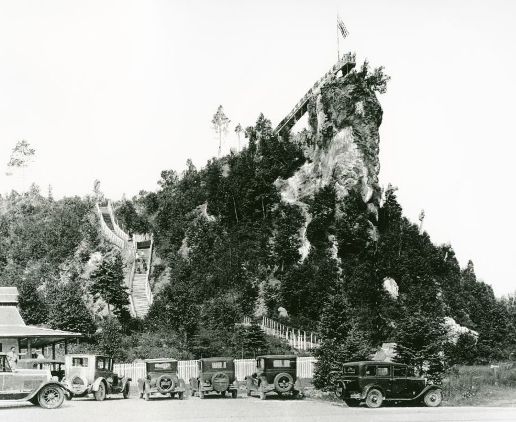
Castle Rock, circa late 1920s or early 1930s, photo courtesy Seeking Michigan

This morning I saw a photo of Castle Rock in the Absolute Michigan group on Flickr that made me wonder about the history of this iconic UP tourist stop. Bob Garrett of the Archives of Michigan has the story in A Natural Lookout at Seeking Michigan:

The Upper Peninsula contains a wealth of great scenery. One might wish to climb to a high point and “take it all in.” Fortunately, nature sometimes provides a natural lookout. One such lookout is Castle Rock.

Castle Rock is located near St. Ignace, on the Upper Peninsula side of the Straits of Mackinac. The Rock is a natural limestone tower, standing nearly two hundred feet above lake level. Wind and water erosion have shaped it into a sort of “castle.” Visitors who climb the 170 steps to the top will receive a stunning view. Looking left to right, one can see St. Martin Island, Marquette Island in Les Cherneaux (on a clear day), the town of St. Ignace, ferries coming to and from Mackinac Island and the top of the Mackinac Bridge.

Castle Rock had been an ancient lookout of the Ojibway tribe, who often called it “Pontiac’s Lookout.” A company named Norton and Lund purchased the site around 1927. Norton and Lund built a stairway to the top of the Rock, opened a souvenir stand and made cabins available for tourists.

Shortly thereafter (Sources differ on the date.), a St. Ignace photographer and businessman named Charles Clarence Eby (1890-1961) bought the property. Eby hoped to increase tourism, and he used his photography skills toward that end. He launched a high volume postcard business, and his postcards and other promotional material drew people to the Upper Peninsula and the St. Ignace area.

Around 1958, statues of the mythical lumberjack Paul Bunyan and his blue ox, Babe, were built at the foot of the stairs. These were handcrafted by Calvin Tamlyn, who was Eby’s son in law. They still greet visitors today.

Castle Rock can be found north of St. Ignace, along I-75. Take exit 348, and you’ll be there. For more information, see the Castle Rock Web site.

You can head over to Seeking Michigan for more including some books in Michigan libraries, a photo of Paul & Babe and also a stereoscopic pic from the 20s. There’s a little more info on Wikipedia, including a panorama of the view from the top of the rock.

Seeking Michigan is the web site of the Archives of Michigan and it’s packed full of articles like this in their Look section and also an extensive & searchable Michigan photo archive.

More roadside attractions on Michigan in Pictures.

The Mighty Mac

The Mighty Mac

The Mighty Mac, photo by mi_kirk

In  6+ years as the author of Michigan in Pictures, it’s safe to say that I’ve seen more photos of the Mackinac Bridge than most people. That said, this is certainly one of the best photos of the Mighty Mac I’ve ever seen.

Since I’m expected to offer a little more, how about this History Channel video about the Mighty Mac or (if you don’t mind the lack of audio) this sweet collection of vintage clips of the days before the bridge at the Straits of Mackinac and the building of the Mackinac Bridge.

Check it out bigger and see more in Kirk’s Michigan slideshow.

Lots more about the Mighty Mac and other Michigan bridges on Michigan in Pictures.

At the Corner: 100 Years at Tiger Stadium

at the corner

at the corner, photo by 1ManWithACamera

“It was the most famous address in Michigan. Not the number, but everyone knows the location. The corner of Michigan and Trumbull was a connection for everyone all over Michigan to the city of Detroit”
~Charley Marcuse, former hot dog vendor at Tiger Stadium

The above is a quotation from a heartbreaking feature on the 100th anniversary of Tiger Stadium that we are linking to today from 100 years at Tiger Stadium on Absolute Michigan. It’s chock full of great links, photos and a video narrated by Jeff Daniels and featuring Tiger greats Al Kaline, George Kell and Ernie Harwell.

The feature was especially heartbreaking for me as I was as guilty as most of the rest of the media that let this historic milestone pass unmarked. Don’t get me wrong – I think Comerica Park is a fantastic place to play baseball and a fitting home for the Tigers. To me, the shame lies in the manner in which one of the finest ballparks in all of baseball was cast aside by a city that seemed more interested in squeezing one last dime from the stadium at Michigan & Trumbull than celebrating and honoring her rich legacy.

Check this out bigger and in Larry’s great Detroit Tigers and their ballparks slideshow.

Much more on Tiger Stadium and the Detroit Tigers at Michigan in Pictures.

We’ve got you covered

DSC02766_tonemapped

DSC02766_tonemapped, photo by ansonredford.

I thought I’d feature a photo from our Michigan Cover Photos Group. You can add pics to it if you want to have them featured on our Michigan in Pictures Facebook and also the Absolute Michigan Facebook.

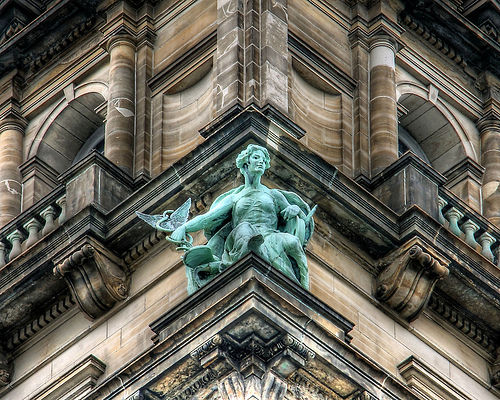
Recently we featured Donald’s photo of one of the sculptures on the Wayne County Courthouse. This is one of four that depict Law, Commerce, Agriculture, and Mechanics. They were executed by sculptor J. Massey Rhind.

Check it out background bigtacular and see some more including an amazing HDR of the courrthouse in Donald’s slideshow.

Petit Portal and the geology of Pictured Rocks

DSC00824_tonemapped

DSC00824_tonemapped, photo by ansonredford.

While Petit Portal – also called Petit Arch and Arch Rock by some – is often confused with the partially caved in Grand Portal, it’s a smaller and as yet intact formation. You can read about some of these from the Pictured Rocks National Lakeshore website. The two arches (and many cave structures) are formed by the powerful action of Lake Superior waves on the soft sandstone that underlies the harder layers above.

You can read more about the geology of Pictured Rocks from Oh Ranger! (a cool site I just found today) and also this PDF on geology from the Lakeshore. If you want to see them up close, the boat tours from Munising are worth every penny.

Donald took this 5 years ago. Check it out background bigtacular and in his stunning Pictured Rocks Nat’l Lakeshore slideshow which includes some jaw-dropping shots of Chapel Rock and even a look from inside Petit Portal.

Much more on the Pictured Rocks on Michigan in Pictures.

A long shot in Vehicle City

A long shot

A long shot, photo by flintstoner.

Editor’s note: Midway through writing this post, I realized that I had blogged about the Vehicle City arches four years ago. I figured that if I had forgotten, most of you probably would have forgotten too or never seen it, so here you go.

Last week Governor Rick Snyder appointed Michael Brown as Emergency Manager for Flint. You can read all about that (including some interviews) on Absolute Michigan.

When I was looking at photos for that feature, this one with all the arches on Saginaw street caught my eye so I decided to learn a little more about them. Flinn’s Journal (which is a really cool site by the way that has a dynamic Facebook page) has a column on the Flint Arches that explains:

On November 29, 2003, a part of downtown Flint’s past officially returned to become part of Flint’s present and future when the replicated Flint Vehicle City arches were dedicated and lit for the first time. The arches are reminders of Flint’s glorious past as “The Vehicle City” as the city faces an uncertain future.

The vehicles which were made in Flint when the original arches were built were horse-drawn carriages. The leading maker of horse-drawn carriages in Flint was the Durant-Dort Carriage Company which was co-founded by William C. Durant and J. Dallas Dort and was in business from 1886 to 1917. Both men would also start companies which made horseless carriages. Dort founded the Dort Motor Car Company which was in business from 1915 to 1923. Dort Highway was named in his honor. Durant took over the then-small Buick Motor Company in 1904 and made it the leading motorcar company in 1908, the year that Durant founded Buick’s parent company General Motors Corporation. The first arches were erected in 1899 and built by Genesee Iron Works.

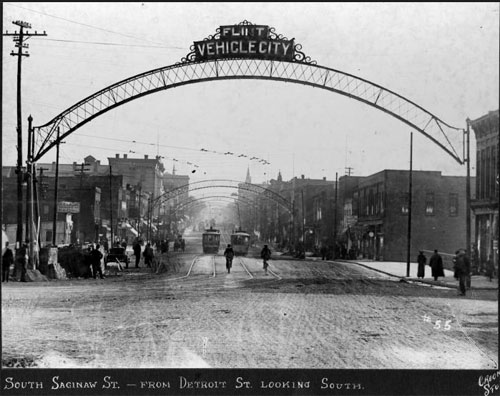
The arches were each fitted with 50 light bulbs which were illuminated at night. The arches replaced gas lighting. To celebrate Flint’s Golden Jubilee in 1905, an additional arch was erected near the point where Saginaw Street and Detroit Street (now M.L. King Ave.) split off north of the bridge over the Flint River. This arch was topped off by an illuminated sign saying “FLINT VEHICLE CITY”. For the Christmas holiday season, the regular light bulbs were replaced by multicolored light bulbs.

Click above to read more and see some photos. The arches were fabricated by Bristol Steel of Davison Michigan – check their site for photos and video of the installation. You can see some cool old photos at the Flint Vehicle City Arches site too.

Check this out background bigtacular and in flintstoner’s Flickriver.

Below is a photo by Arthur Crooks from the excellent Making of Modern Michigan gallery showing the Vehicle City Arch erected in 1905 as part of the City’s 50th anniversary. The caption of the photo says “South Saginaw St from Detroit Street looking South” while the description says it’s on Saginaw Street looking north. Can anyone clarify this?