Cass Gilbert, controversy and the James Scott Memorial Fountain

Rising Above

Rising Above, photo by Tom Hughes

“Mr. Scott never did anything for Detroit in his lifetime and he never had a thought that was good for the city.”
~ J.L. Hudson

Sometimes when you peer into history, you see things you didn’t expect, and that’s definitely the case with today’s subject. The Cass Gilbert Society’s page on the James Scott Memorial Fountain on Belle Isle explains that the fountain was completed in 1925, designed by noted architect Cass Gilbert (designer of the US Supreme Court Building in DC), and executed by sculptor Herbert Adams

The fountain was the result of a bequest from millionaire playboy James Scott, a figure of much controversy in Detroit at the turn of the century. Detroit’s fountain of mirth  from the excellent Rearview Mirror series in the Detroit News (removed, but see The Wayback Machine) tells of the opposition from prominent citizens and clergy like J.L. Hudson and Bishop Williams that a playboy, loafer, gambler and vindictive practical joker like Scott be memorialized solely because he was able to plunk down a vast sum for his own monument. While public opinion kept the project scuttled for years after Scott’s death, influential Alderman David Heineman and others took up the charge, likely seeing how a vastly expensive fountain could enhance Detroit’s island park.

Speaking to reporters gathered in the office of Mayor Philip Breitmeyer, Heineman said: “I can look around this office and see pictures of men who played poker with Jim Scott. I say the bequest should be accepted.” He also recalled that “Jim always liked Belle Isle and loved to see the children there.”

The mayor agreed with Heineman. “I don’t believe the city has a right to insult any of her citizens by refusing a gift for such a good cause,” he said.

In the end, their view prevailed. It took more than 15 years, but Breitmeyer lived to attend the fountain’s dedication in 1925. Cass Gilbert, the New York architect who planned the Detroit Public Library, won a competition for design of the glistening white memorial at the lower end of the city’s pleasure island.

Read on at archive.org and see Wikipedia for more on Belle Isle.

Tom took this shot on Sunday. See it bigger and see more including a detail view in his slideshow.

EDITOR’S NOTE: This post previously appeared but sadly the photo was deleted by the owner. It’s one of my favorites so I re-blogged it!

More black & white photography and more Belle Isle on Michigan in Pictures!
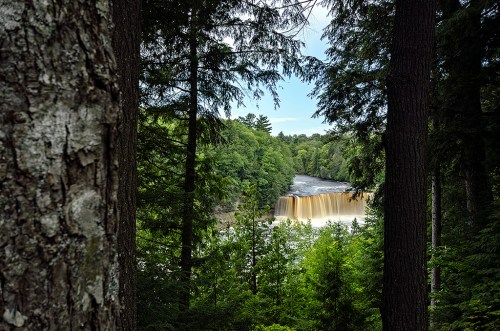
Slice of Wonder

Upper Tahquamenon

Upper Tahquamenon, photo by Jasondoubleuel

Jason shared this shot of one of my favorite views in Michigan, the Upper Tahquamenon Falls, in the Michigan Cover Photos Group. It’s the new cover photo for the Michigan in Pictures Facebook page and (in my opinion) looks just about perfect.

View his photo bigger and see more in his Summer slideshow!

Much more about the Tahquamenon Falls on Michigan in Pictures.

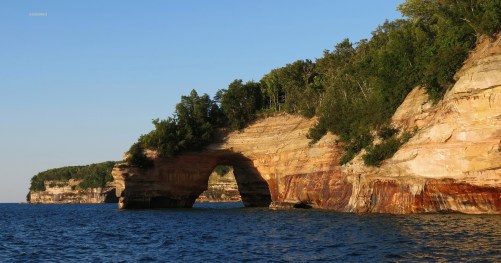
Lovers Leap in the Pictured Rocks

Lovers Leap in the Pictured Rocks

Lover’s Leap, photo by siskokid

Pictured Rocks Tours say legend has it that an Indian couple displayed their love for one another by jumping off the top of this rock arch together. They stress that the water at the base is only a few feet deep, so don’t try it!

While Myths and Legends of our Own Land  by Charles M. Skinner (online e-book from Project Gutenberg here) doesn’t have a story about this Lovers’ Leap, Skinner does detail three tales from Mackinac Island in his chapter on Lovers Leaps that says (in part):

So few States in this country—and so few countries, if it comes to that—are without a lover’s leap that the very name has come to be a by-word. In most of these places the disappointed ones seem to have gone to elaborate and unusual pains to commit suicide, neglecting many easy and equally appropriate methods. But while in some cases the legend has been made to fit the place, there is no doubt that in many instances the story antedated the arrival of the white men…

When we say that the real name of Lover’s Leap in Mackinac is Mechenemockenungoqua, we trust that it will not be repeated. It has its legend, however, as well as its name, for an Ojibway girl stood on this spire of rock, watching for her lover after a battle had been fought and her people were returning. Eagerly she scanned the faces of the braves as their war-canoes swept by, but the face she looked for was not among them. Her lover was at that moment tied to a tree, with an arrow in his heart. As she looked at the boats a vision of his fate revealed itself, and the dead man, floating toward her, beckoned. Her death-song sounded in the ears of the men, but before they could reach her she had gone swiftly to the verge, her hands extended, her eyes on vacancy, and her spirit had met her lover’s.

From this very rock, in olden time, leaped the red Eve when the red Adam had been driven away by a devil who had fallen in love with her. Adam, who was paddling by the shore, saw she was about to fall, rushed forward, caught her, and saved her life. The law of gravitation in those days did not act with such distressing promptitude as now. Manitou, hearing of these doings, restored them to the island and banished the devil, who fell to a world of evil spirits underground, where he became the father of the white race, and has ever since persecuted the Indians by proxy.

Read on for more. It’s a great book – I highly recommend it!

Jim shot this last summer. Check his photo out bigger and see more in his Pictured Rocks slideshow.

Much (much) more from the Pictured Rocks National Lakeshore on Michigan in Pictures. I also want to stress that while the price tag on the boat tour might give you pause, this is hands-down the best boat tour I’ve ever done and gives you a view of the Michigan natural wonder that is the Pictured Rocks National Lakeshore that will stay with you forever.

Michigan Nut’s 2015 Calendar

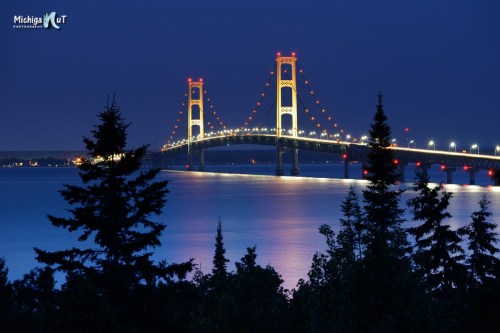
Moonlit-on-the-Mighty-Mac

Moonlit on the Mighty Mac, photo by John McCormick/Michigan Nut Photography

If you’ve been following Michigan in Pictures for any length of time, you’re probably familiar with the work of John McCormick aka Michigan Nut.

John has just released his 2015 Michigan Wild & Scenic Wall Calendar, and you can get it for just $15. As an added bonus, if you head over to like his post about it on Facebook, you have a chance to win a free one!

The photo above of the Mackinac Bridge is not only the cover of the calendar, it’s also the photo for June. View (and purchase) John’s photo bigger at MichiganNutPhotography.com, see more in his Michigan Bridges Gallery and definitely follow Michigan Nut Photography on Facebook for a regular dose of photographic awesome from the Great Lakes State!

There’s lots more from John on Michigan in Pictures too!!


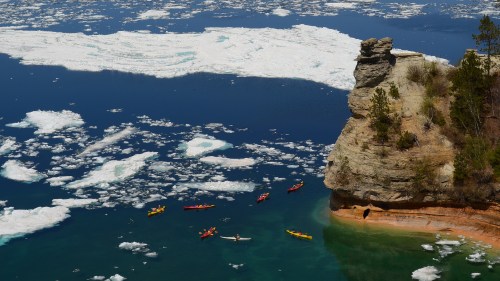
Miners Castle, with ice and kayaks

Miners Castle, with ice and kayaks

Miners Castle, with ice and kayaks, photo by Ann Fisher

The Washington Post has a feature on Lake Superior’s stubborn ice cover:

As of Memorial Day, ice covered 4.5 percent of Lake Superior according to NOAA, and 1.7 percent of the Great Lakes overall (though Superior is the only lake with remaining ice). The recent Great Lakes ice cover is unrivaled in records dating back to the early 1970s.

Ice cover the Great Lakes has been way above normal and, at times record-setting, for months.

In early March this year, the Great Lakes ice extent reached 94.19%, the second most on record for any month, dating back to 1973 in NOAA’s dataset, and most on record so late in the season. In late April, ice still covered nearly one-third of the Great Lakes, the most on record by a large margin so late into spring.

Click through for some photos of people enjoying the ice.

Ann took this last weekend at Miners Castle in the Pictured Rocks National Lakeshore. How cold is that water right now? Michigan Sea Grant’s Coastwatch for the central UP shore of Lake Superior recorded a balmy 36.7 degrees on May 25th!!

View Ann’s photo big as Lake Superior and see more in her 2014 U.P. slideshow.

There’s more Miners Castle and more Lake Superior wallpaper on Michigan in Pictures.

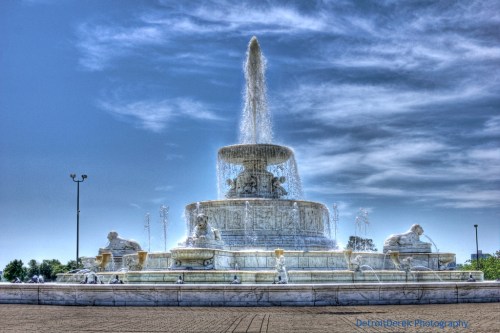
The Wizard of Belle Isle’s Scott Fountain


A Cheat, A Liar, a Cad, But A Damn Fine Fountain, photo by Derek Farr

A Cheat, A Liar, a Cad, But A Damn Fine Fountain, photo by Derek Farr

Sherri Welch has a great feature (with video) in Crain’s Detroit entitled Underneath Belle Isle with the Wizard of Scott Fountain:

Far, far below Belle Isle, in a domed-ceiling building few know exist, Robert Carpenter keeps watch, switching levers, hitting buttons and adjusting valves like a modern-day Wizard of Oz.

But his motions aren’t designed to produce an apparition.

They’re focused on producing a plume of water that jets 20, 30, 40, 50 feet or higher into the air, along with countless other smaller bursts of water.

Carpenter is the unofficial caretaker of Belle Isle’s massive, antique James Scott Memorial Fountain.

It’s not a paying gig for him, but, truly, a labor of love.

Carpenter and his team did, restoring the pearly sheen to its marble basin, sculpted faces, animals and all five tiers.

Being the engineer he is, Carpenter couldn’t stop there.

He began scrutinizing the antique valves, pipes and drains, practically living in the domed structure under the fountain as he prepared it for operation through maintenance that included gingerly flushing its corroded, cast iron pipes and rushing to clean the resulting red water from the fountain’s marble bowl.

Read on for more at Crain’s and definitely check out the video – very cool to see what’s below this beautiful Michigan landmark!

Derek is one of my favorite Detroit photographers, and if you like his photos you can head over to his Flickr page for information about how to get them. In addition to taking great pictures, he often includes a brief story of the subject as is the case with this photo:

A Cheat, A Liar, a Cad, But A Damn Fine Fountain

Not exactly loved by all during his time on this planet, James Scott inherited a fortune from his real-estate-baron Father. He attempted to spend the majority of it during his lifetime, Building a large house ( it wasn’t large enough, he wanted his neighbors house as well. The neighbor declined so James built a huge addition to the front and top of his house, blocking out the sun for 3/4 of the day to get back at him ) , throwing large Gambling Parties oblivious to the amount he may have lost, suing any business partners ( or competitors ) that attempted to move in on what James thought should be his. He was described even by his friends as vindictive.

When he died in 1910 he left his sizeable fortune to the city under the specification that a memorial be created to honor him. It took 10 years for the city to agree to use the money for this purpose, and another 5 to complete this fountain – located on Belle Isle in Detroit. It was designed by Cass Gilbert and completed in 1925.

View Derek’s Scott Fountain photos or settle back for more fountain and more Belle Isle in his Belle Isle slideshow.

There’s more Belle Isle and more sculpture on Michigan in Pictures.

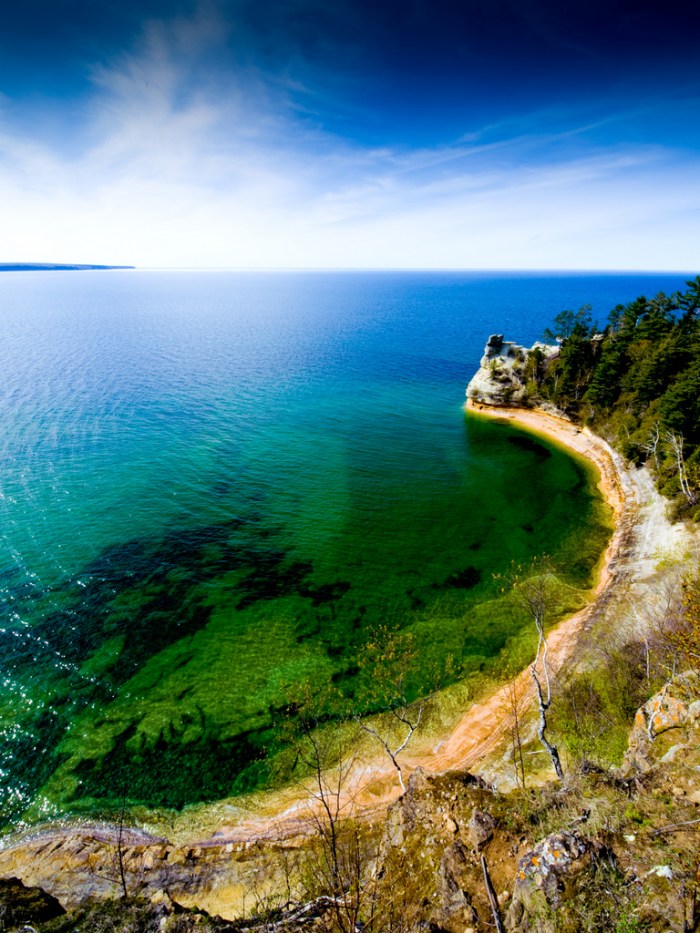
Pictured Blue: Miner’s Castle in the Pictured Rocks National Lakeshore

Pictured Blue

Pictured Blue, photo by Kiiraaan

View this jaw-dropping photo of Miner’s Castle bigger and see more in Kiran’s Landscape slideshow.

The Pictured Rocks National Lakeshore’s Geology Field Notes page has this barely comprehensible stuff to say about Miner’s Castle:

The Miners Castle Member is a soft, crumbly, quartz sandstone (with abundant garnet content) about 140 feet thick; its complete section is exposed in the Pictured Rocks Cliffs between Sand Point and Miners Castle. Sediments of this member are generally poorly sorted.

Capping the easily eroded Miners Castle Member of the Munising Formation in the western half of Pictured Rocks, is the resistant Early Ordovician (480-500 million years old) Au Train formation. The Au Train Formation is a light brown to white dolomitic sandstone that forms the resistant cap to the underlying softer sandstones. The numerous falls in Pictured Rocks National Lakeshore are the result of this caprock.

Read on for much more about the geology of Pictured Rocks. Erosion is indeed a factor with one of the most visible instances being April 13, 2006, when one of the pillars of Miner’s Castle collapsed.

You can see more of Pictured Rocks from Absolute Michigan and at the Pictured Rocks National Lakeshore web site.

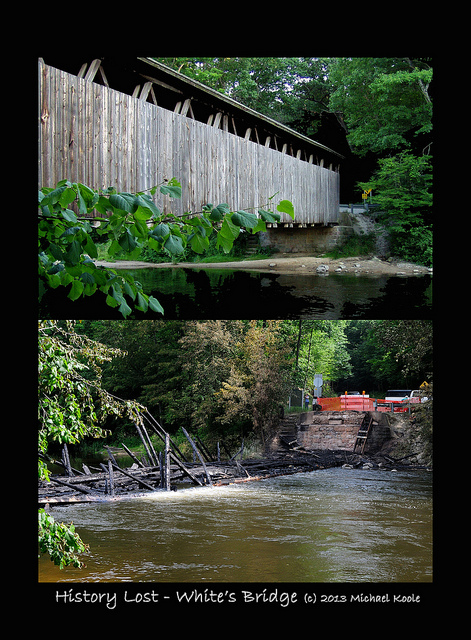
History Lost at White’s Covered Bridge

History Lost

History Lost. photo by Michael Koole – Vision Three Images

Today’s photographer, Michael Koole wrote to let me know that last Sunday (July 7, 2013) the oldest continuously operating covered bridge in Michigan burned and collapsed into the Flat River. Arson is suspected, and you can also see mLive’s coverage and history of the bridge. Michael noted that it was one of less than a dozen in Michigan (see also this page) and the oldest covered bridge still in use in Michigan.

The West Michigan Tourism Association says White’s Covered Bridge:

…was the third bridge built across Flat River at or near the same site, originally called White’s Crossing in honor of a prominent pioneer family. The first was a primitive log-corduroy bridge built in 1840. A second bridge, built around 1856 for a mere $250, was demolished by an ice jam in the spring of 1869. Residents of nearby Smyrna decided they must erect a more substantial structure, despite having no means of immediate payment. The current White’s Covered Bridge was built in 1869.

Jared N. Bresee, who built the covered bridge at Fallasburg, along with Joseph H. Walker, were contracted to build the 120- foot long bridge for a deferred payment of $1000 due in 1870, plus $700 due in 1871. They planked the floor with second-hand lumber in an effort to finish the job quickly. When the townspeople discovered auger holes in the planks, they deducted $25 from the first payment. The bridge was built in just 84 days with only man, ox and horse power.

White’s Bridge is a frame structure with a gable roof. Its construction is of the through-truss type, and the trusses are completely sheeted over with rough pine boards. The floor is 14 feet wide and 116.5 feet long. All of the truss members and dimension lumber are hand hewn and secured with wooden pegs. The sheeting and roof boards are fastened to the rafters with hand cut nails. The abutments are made of local fieldstone. After repair of the abutments in the fall of 1955, White’s Bridge was reopened to automobile traffic.

Except for occasional siding replacement and a new cedar shingle roof, White’s Bridge is much the same today as it was a century ago. It is built with the Brown truss, a type of construction which enjoyed a brief popularity, only in Michigan.

Invented and patented in 1857 by Josiah Brown of Buffalo, New York, the Brown truss resembles the Howe arrangement of “X” bracing and counter bracing, but uses lighter and less timber. It contains no upright members and no iron except for bolt connectors at the timber intersections. Bresee and Walker used the Brown truss successfully in at least four covered bridges in Michigan, three of which are still in existence.

White’s Covered Bridge was listed with the Michigan State Register on February 17, 1965 and awarded a Michigan Historical Marker on July 2, 1965.

See this photo bigger and see more in Michael’s Bridges slideshow.

Michigan in Pictures has profiled a few of Michigan’s remaining covered bridges – they are filed (predictably) under bridge.

A birthday card from the Grand Hotel

View from West Bluff of The Grand Hotel

View from West Bluff of The Grand Hotel, photo by MI photographer

126 years ago today on July 10, 1887, The Grand Hotel opened for business on Mackinac Island. In honor of Michigan’s most famous hotel, here’s a seldom seen view.

Check it out bigger and see more in MI photographer’s Mackinac Island slideshow.

PS: The lighthouse you can see in the distance is Round Island Lighthouse – click the link to get closer with Michigan in Pictures.

Turnip Rock in Lake Huron

Turnip Rock

Turnip Rock, photo by SimsShots Photography

A page about the Point Aux Barques – Turnip Rock geocache had the best information I found about this Lake Huron Landmark. The author explains:

This cache is accessible by a kayak, canoe, jet ski or boat on Lake Huron. Port Austin is the closest harbor which is approximately three miles west. The land around this feature is a gated community. I must stress that this cache is only accessible by a water craft via Lake Huron. If you are not comfortable navigating the waters of Lake Huron, do not attempt to do this cache. Lake Huron can be dangerous at times for small water craft such as kayaks or canoes.

…Everyone that received their grade school education in Michigan learned that glaciers pushed their way over Michigan several times. The result is glacial drift averaging 200 to 300 feet deep covering on top of the bedrock. The thickness of drift has measured over 1,000 feet in a few Michigan locations. Rarely can we see exposed bedrock that has been sculptured by non glacier forces. This is one of the locations in southern Michigan where the sandstone bedrock is exposed at the surface. The amount of shoreline that has exposed sandstone is about one mile, but a lot of beauty has been sculptured in the stone.

The locals call the main structure here “Turnip Rock”, because of it’s shape. Geologists call it a “Sea Stack”. A definition of a sea stack is an isolated pillar-like rocky island or mass near a cliff shore, detached from a headland by wave erosion assisted by weathering. Waves force air and small pieces of rock into small cracks, future opening them. The cracks then gradually get larger and turn into a small cave. When the cave wears through the headland, an arch forms. Further erosion causes the arch to collapse. This causes a pillar of hard rock standing away from the coast. Generally occurring in sedimentary rocks, sea stacks can occur in any rock type.

Read on for more and also see the Atlas Obscura entry for Turnip Rock has a map and photos. Michigan in Pictures favorite Lars Jensen has some great photos of Turnip Rock as well, and you should definitely check out Jason Glazer’s panoramic photos of Turnip Rock.

Check this out background big and see more in Rob’s Landmarks slideshow.

More Michigan landmarks on Michigan in Pictures.