

Ladies & gentlemen, the tEdGuY49 pHoToGrApHy show.

great lake – dredging, photo by j image.
Jim captured folks working at one of the many under-appreciated tasks in the world: dredging our harbors. As a lifelong resident of a coastal village, I anticipated the arrival of the dredging crew as a sign that summer was on the way. The US Army Corps of Engineers Detroit District explains why dredging is necessary on the Great Lakes:
Nearly all Federal harbors on the Great Lakes are located at the mouth of a river or along a coastline, utilizing natural or dredged navigation channels. Lake and river currents transport sand and silt eroded from the coastline and watershed. Some of this material may become deposited in navigation channels. Dredging is necessary to allow for safe commercial navigation and recreational boating. These natural processes would eventually lead to the filling of our harbors and waterways with rock, sand, mud, or clay. Harbors and major rivers, so vital to commercial, recreational and defense activities, would eventually fill in, leading to vessel delays and grounding. Today’s ore carriers, container ships, oil tankers and Coast Guard vessels need deep channels and docking facilities to move freely. Dredging is necessary to maintain Americas waterborne commerce and defense capability.
In addition, many recreational harbors need to be dredged regularly to remain open for small craft.
The page also explains something called “Beach Nourishment”, which I thought was a pretty unique term. Here’s a few dredging photos from the Absolute Michigan pool (slideshow)

In the Michigan Immense Public Park, photo by Andy McFarlane
Welcome to a “Soapbox Saturday” on Michigan in Pictures, where your host takes you a little ways past “ain’t it cool” towards “ain’t it a shame.” Don’t worry though – it’s still cool. If it doesn’t seem cool – please click the photo above. I figured that since I was going to be sharing some personal feelings, I probably should use one of my own photos. This photo of my daughter exploring something on the Lake Michigan beach was taken a few years ago at the base of Pyramid Point in the Sleeping Bear Dunes National Lakeshore. I had posted it in gratitude to the Michigan Supreme Court for upholding our right to walk the Great Lakes shore.
Flash forward to the present day when Michigan’s regulators appear poised to permit the first metallic sulfide mine in Michigan. Several years ago, my friend Dick Huey and a few others started a group called Save the Wild UP when Kennecott Minerals, a subsidiary of mining giant Rio Tinto (one of the world’s largest polluters), began the process of securing a permit for a sulfide mine north of Marquette. The proposed mine is located directly under the Salmon-Trout River on the wild and beautiful Yellow Dog Plains. This is state land, our land, and the Salmon-Trout flows just a few miles through it and then empties into Lake Superior. Over that time I’ve been working for them to maintain their web site and have learned a thing or two about “acid mining”.
Iron and copper mining are things that helped forge the character of the Upper Peninsula. You can think of traditional mining as picking the chocolate chips out of a cookie. Sulfide mining is like getting the sugar out of a cookie – a chemical rather than mechanical process that yields a dust as a by-product. If this dust mixes with water and air, it forms sulfuric acid aka battery acid. There has never been a sulfide mine with the potential to pollute ground or surface water that failed to do so. Sulfide mining has polluted 40% of the watersheds in the West, and you can read more of the facts about metallic sulfide mining at Save the Wild UP (has a nice video if you prefer).
 A process with 100% failure rate of protecting water located directly under a pristine river that flows into the largest body of freshwater in the world seems like a bad idea. When you realize that they also plan to blow the sulfide dust into the air and that there are hundreds of other prospected sites waiting in the wings, it becomes terrifying. Michigan and the UP have a lot of challenges right now, but something we do have going for us is our water and wild places and the tourism dollars and jobs they generate. The picture to the right is a result of sulfide mining from Sudbury, Ontario. Multiply that across Michigan’s Upper Peninsula and consider how many thousands of tourism jobs and millions of tourism and tax dollars might be lost.
One of the people who has considered this is a wonderful musician named Daisy May. She has donated a song called A Letter from Downstream to Save the Wild UP and I hope you take the time to listen to it and see the photos that folks have shared about what Michigan’s water means to them.
If you’re a Flickr member, consider adding a photo to the Downstream group.

_DSC0179_8x8_toned, photo by kcephoto.
Healing Our Waters – Great Lakes Coalition is looking for stories (500 words or less) and photos about people and the lakes that fill folks with laughter, sadness, nostalgia, or wonder, and maybe even inspire us to think about the Great Lakes in a new way.
The story categories are Fishing, Camping and General and there’s also a photo category. In addition to grand prizes with two outdoor adventure packages (kayak, tent and sleeping bag and two photography packages including a digital camera) there will be monthly prizes (backpacks, fishing gear, digital cameras) for children, high school student and adult age groups.
The contest runs through August 20, and you can get all the details and view some of the submissions at healthylakes.org.

You can see Chicago from 42 miles away! by TRVentura
This summer, Absolute Michigan will be taking a tour of Michigan’s shoreline, looking at the heritage and attractions of the communities along Michigan’s Great Lakes shoreline.
Michigan in Pictures will be going along, trying to point out some of the beauty along the way.
We’d really like it if you’d help us by telling us what not to miss. If we do miss something – and with 3000+ miles of coastline, that’s pretty likely – then please feel welcome to post a comment or a link at the place where we missed it.
And if you want to climb in the car (or on the bike or in the kayak) and join the tour and let us know what you found, well that would be very cool too.
The above photo was taken at the beach in Michiana, Michigan (and Yahoo/Flickr geotagged photo map). I’m always a little surprised to find that you can’t see the state line from space.

36,000 feet over Michigan, photo by bksecretphoto.
Landon Michaelson writes: One of my favorite shots out the airline window. I liked the clear day, the curvature of the earth, the black sky and the cloud layers beneath. Pocket digital several years ago (still easier to use than my DSLR in-flight) and of course I always request a window seat.
Landon is an East Wenatchee, WA based photographer whose work can be found by clicking the photo above or visiting Best Kept Secret Photography.
Last night I attended the Northern Michigan Environmental Action Council’s annual celebration of work on the behalf of the environment in our region. The even is timed as a lead-in to Earth Day and featured a ton of talking and pictures showcasing Michigan’s incredible natural bounty. Facts like “Michigan is the second most agriculturally diverse state in the country.”, the very funny and very compelling wombat video (highly recommended) and all the pictures showing land the Grand Traverse Regional Land Conservancy has preserved for enjoyment and habitat or is helping to remain in farming and forestry forever.
The GTRLC’s Glen Chown delivered the keynote. One of his themes was that not only has the preservation and promotion of our natural and cultural heritage has proven to be good business in northwest lower Michigan, it also likely holds part of the answer to Michigan’s need for a new economic engine. Glen also related the observations of Michigan astronaut Jerry Linenger of Michigan from much higher window seat. Linengar has logged more hours in space than almost anyone and had ample time to marvel at the beauty of Michigan’s spectacular coastline, green forests and rich farms.
I imagine that he also felt how deep and cold the black is that lies just miles away from the only planet we have.
Have a very happy Earth Day, Michigan. I hope you get a chance to hike a Michigan trail, walk a Michigan beach and otherwise enjoy this magical place.

Provided by the SeaWiFS Project, NASA/Goddard Space Flight Center, and ORBIMAGE (via Wikimedia)
I am not even going to tell you how long I agonized over the perfect photo with which to mark World Water Day. Water is one of the things that defines Michigan above all others. Industries may come and go, but (assuming we can take care of it) Michigan’s water is forever.
Here’s hoping…

The Salmon Trout River on the Yellow Dog Plains, photo by savethewildup.
Somewhere there are lines, and I’m pretty sure that today I will cross a few. Over the life of this blog, I have stayed away from things that have sides, because sides too often divide us and this blog is really all about loving Michigan.
In my day job, I build web sites. A short while ago, I and some really talented people put together a new site for some people that have spent the last few years at a hard and lonely task: speaking up and standing up for Michigan’s rivers and lakes against the terrible risks posed by metallic sulfide mining and acid mine drainage. 
They have been focused on the Salmon Trout River on the Yellow Dog Plains, but that is just the first of many that will follow. To be very clear: There has never been a metallic sulfide mine that has failed to pollute its watershed. You can read more from Save the Wild UP … and scroll down for a special treat featuring tons more photos and music from Greg Brown’s upcoming CD, Yellow Dog.
More photos of the beauty of the Yellow Dog Plains and Salmon Trout River can be seen at Save the Wild UP’s web site.
If you are a photographer who loves Michigan’s water and wild, please consider making them available to be used in fighting metallic sulfide mining and other threats to Michigan’s legacy of unspoiled water and add them to the Save the Wild UP photo pool.

Holga: Lake Erie, photo by Matt Callow.
I wavered back and forth between this one and Matt’s other photo of ice on Lake Erie. The photo was taken at Sterling State Park between Monroe & Detroit Beach, and Matt has helpfully placed it on a map.
Wikipedia says that William C. Sterling State Park is:
…the only Michigan state park located on the shores of Lake Erie. The park encompasses 1,300 acres. The park sits just north of where the River Raisin empties into the lake. The park boasts many lagoons and marshes, providing good habitat for a variety of wildlife and bird life. The park is situated in Monroe County just south of Detroit Beach/ Sandy Creek and north of the city of Monroe. It is the fourth busiest state park in the state. The park is located less than a mile from Interstate 75, which provides easy access from the neighboring areas of Detroit and Toledo. The main attractions at the park include the beach, a boat launch, and shore fishing. Over two miles of asphalt surface are available for bike riding. Hiking trails are also available.
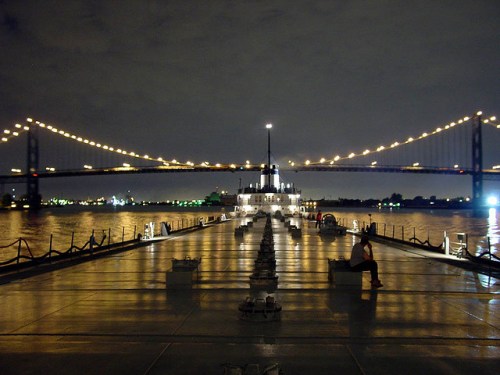
Quiet Night on the Detroit River, photo by theempirebuilder.
The latest entry into the Small World Files is today’s photo of the 100 year old Southdown Challenger upbound on the Detroit River just above the Ambassador Bridge. Mac of Detroit Bike Blog wondered if I’d seen these photos. I hadn’t and spent a good long while poring through this amazing set of Southdown/St. Mary’s Challenger photos that takes you all across the Great Lakes, under the Mackinac Bridge and even belowdecks.

A few recent ones were taken on Leelanau County’s Suttons Bay. I mentioned that the hill in one of them looked like the hill on a site we had designed for a housing development. Wade, the photographer, said “I’m sure you are right. In fact, in the link you sent, the Challenger is in the 5th row from the top on the far left side.”
Anyway, check out this amazing gallery of photos and also head over to Boatnerd.com to read the equally amazing history of the St. Mary’s Challenger, which was built in 1906 in Detroit and has gone through a dizzying array of names and circumstances in the century that followed. Seriously, there should be a movie or something about this ship.
 Michigan in Pictures