Wolves almost gone from Isle Royale

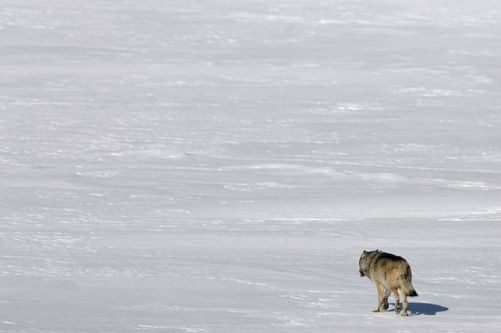
Isle Royale Wolf

The Urge, photo by isleroyalewolf.org

Last weekend the Freep reported that the delicate biosphere that characterized Isle Royale National Park is about to fall apart. The wolf count is down from nine last year to only three, and Michigan Tech ecologist John Vucetich says he wouldn’t be surprised if none remain next winter.

“What’s really important here is not the presence of wolves, per se,” Vucetich said. “But the wolves need to be able to perform their ecological function — predation. Predation has been essentially nil for the past four years now.”

That’s led to a 22% increase in the moose population for each of the past four years, he said, taking the island population from 500 to 1,200 moose. An individual moose consumes up to 40 pounds of vegetation a day.

“One of the most basic lessons we know in ecology, wherever creatures like moose live, you have to have a top predator,” he said. “If you don’t, the herbivore can cause a great deal of harm to the vegetation.”

… Vucetich and his colleague at Michigan Tech, Rolf Peterson, both support a “genetic rescue” of the island’s wolf population — bringing in wolves from elsewhere to bolster island wolves and help facilitate breeding. The U.S. Forest Service is studying the concept, but that process may take years. If the remaining wolf population doesn’t survive, and the Forest Service ultimately approves of the plan, it may mean creating a whole new pack on the island.

I think that this poses very interesting questions about our role in the ecosystems we seek to preserve. Are we to watch what happens and not interfere like a kid watching an ant farm or a Star Fleet team, or do we accept the responsibility of our decision to preserve and seek to maintain the natural balances and populations? As our climate changes, we will no doubt be called to make these decisions more and more frequently as flora and fauna lose the ability to survive in the places we have set aside for them.

This photo was the first in a series of 40 shared last fall in “Thinking Like an Island” from the Wolves & Moose of Isle Royale. They wrote:

THE URGE. Walk 40 miles in two days searching for a lover that may not even exist. Return home to parents and siblings the next day. The life of a dispersing wolf, unsatisfied.

It’s a great series featuring images by George Desort, Rolf Peterson, John Vucetich, and Brian Rajdl along with text by John Vucetich and Michael Paul Nelson. Click to see this photo bigger on Facebook and then use your left arrow to page through them.

Definitely visit isleroyalewolf.org for lots more about the predator/prey balance of one of Michigan’s most fascinating places.
Michigan Moose Numbers Declining

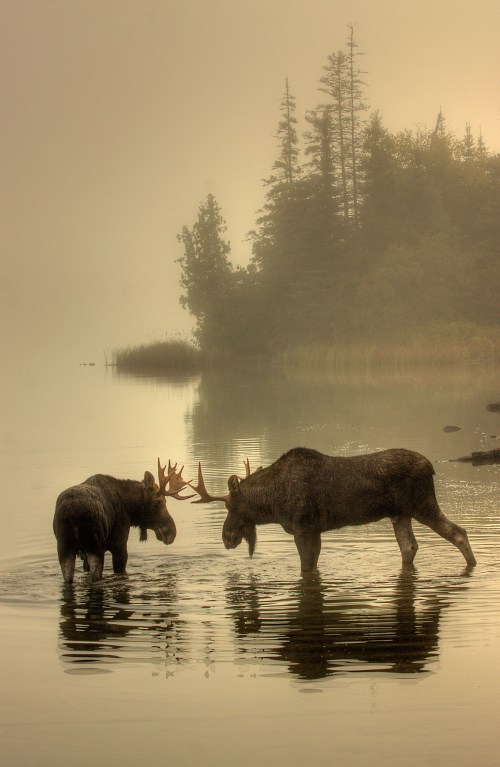
Moose Point Face-off

Moose Point Face-off, photo by Carl TerHaar

The Detroit Free Press reported that Michigan moose numbers are down:

The moose population in Michigan’s western Upper Peninsula appears to have dropped over the past two years and experts warn that a warming climate could be cause for concern for the species’ future in the state.

The latest biennial survey by the Department of Natural Resources produced an estimate of 323 moose in their primary Michigan range, which includes Baraga, Iron and Marquette counties. If correct, that would be a decline there of about 28 percent from 2013, when the estimate was 451.

…Even so, surveys since 1997 turned up regular population increases of about 10 percent. Beginning in 2009, the growth rate slowed to about 2 percent.

Now it appears to be dropping.

“It might not happen in our lifetime, or our children’s, but we have to face the possibility that there might not be a wild moose population in Michigan,” Chad Stewart (deer, elk and moose management specialist with the DNR) said.

Scientists are not certain what caused the apparent decline over the past two years, he said. Bitter cold and heavy snow the past two winters is one possible culprit. Also, wolves increasingly may be targeting moose because of falling deer numbers, although Stewart said there’s no hard evidence of that.

But in the long term, a warming climate may be the moose’s biggest enemy. Blood-sucking ticks thrive under such conditions. Thousands can attach themselves to a single moose and weaken the hulking beast.

More at the Freep.

View Carl’s photo big as a moose and see more in his massive Isle Royale National Park slideshow.

More Michigan moose information & photos on Michigan in Pictures

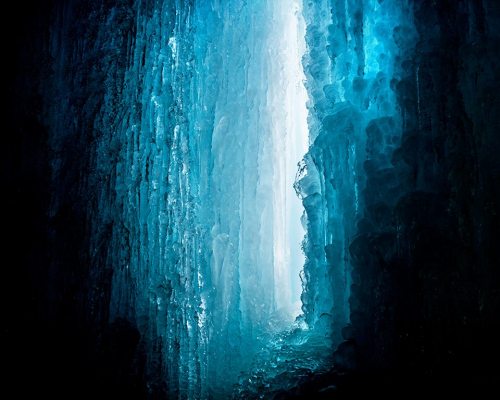
Ice curtains at Grand Island

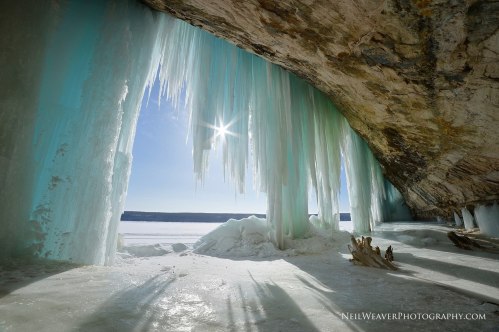
Ice Curtains at Grand Island

Grand Island Ice Curtains, photo by Neil Weaver Photography

Neil says that seeing these in person was such an awesome experience. View the photo background bigtacular on his Facebook page, purchase a print right here, and check out lots more icy goodness at neilweaverphotography.com.

Except for a tiny sliver, the entirety of this Lake Superior island just off Munising is open for public access as the Grand Island National Recreation Area​. You will definitely want to check with locals regarding ice conditions. With a warming week of weather ahead, this is probably something to put on your 2016 agenda.

More winter wallpaper on Michigan in Pictures!

#TBT Fortress of Solitude Edition at the Grand Island Ice Caves

Grand Island Ice Cave

Grand Island ice cave, Winter 2012/13, photo by Ash W Photography

A cool site that really gives you to tools to have a lot of fun in the Upper Peninsula is Things to Do in the U.P. #64 is visiting the Grand Island Ice Caves. After providing very detailed tips & information about how to get to these spectacular formations on Lake Superior off Munising, Brian Marticcui writes (in part):

For an intimate look at nature’s awesome power, sidle up to one of the columns and peer into its core. Expecting a solid tower of frozen water? Not a chance. These columns, especially the newer and/or sun-exposed ones, are actually made up of tiny beads and icicle-like formations separated by vertical channels that allow water to pass through them. It’s one of those mind-numbingly complex natural things that’s simultaneously random and orderly – kind of like a geode, but mostly frozen and not quite as colorful.

Inside, things are a bit more stable – and a whole lot more interesting, if that’s possible. For starters, many of the “entrances” to the caves are little more than elevated holes between solid ice columns. Depending on how the caves have set during the weeks leading up to your visit, you may have to scramble up a mound and squeeze yourself through an opening to actually gain access. (Clip-on crampons might be a good idea.)

Once you get in, be careful, both for your own physical safety and for the integrity of the caves themselves. The floors are often mirror-smooth, making regular walking a major challenge. Meanwhile, the ceilings can be low and/or spiky, and some of the most intricate formations – the fuzzy, mold-like bits of “shaved” ice that project from the bare rock of the walls and ceilings – are extremely fragile. Don’t be the guy or girl who ruins a particularly awesome formation for everyone else – those things don’t reform in their original states.

Since the caves’ outer walls aren’t comprised of a single, solid curtain, and blockages abound, you’ll have to enter and exit several times to get the full measure of their interior spaces. Be careful each time you do; in particular, don’t lean on any dubious-looking columns. Ice is heavy, and you’ll probably see the chilling remains of spectacular collapses. You don’t want to be under an unsafe formation when it goes.

Read on for much more and also follow Jesse’s Things to Do in the U.P. on Facebook.

Ash took this shot at Grand Island’s ice caves a couple of years ago. View it bigger on Facebook and see more of her work in her Upper Peninsula of Michigan gallery at ashwphotography.com.

PS: If you’re in the Marquette area, Ash be displaying February 17 through the end of March at Sweet Water Cafe in Marquette from Feb 17th to the end of March, just a few doors down from Zero Degrees Artist Cooperative where she has her work.

PPS: For a little discussion on current conditions on the crossing to Grand Island, see this thread on Facebook, and before you go be sure to talk to someone who knows something about it. Feel welcome to use that advice for anything that’s possibly dangerous that you know little about.

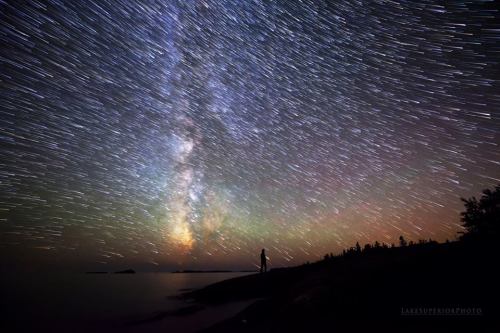
Space Weather and Starbreeze

Isle Royale Star Breeze

Isle Royale starbreeze, photo by Shawn Malone/Lake Superior Photo

If you’re a watcher of the northern lights or want to be, NOAA’s Space Weather Projection Center at spaceweather.gov is a resource you should be aware of. It’s packed full of all kinds of data on what’s happening on the sun and how that impacts us here on earth.

Yesterday they updated to an all-new site that I encourage you to check out. The coolest things I found so far are the Space Weather Enthusiast Dashboard and the 30 minute aurora forecast, a seriously awesome visualization of aurora potential. Be sure to subscribe to their space weather alerts for tips on when the aurora borealis might be visible!

Shawn says that the stars were screaming that night at Isle Royale National Park. View her photo bigger on the Lake Superior Photo Facebook, and if you like you can purchase the photo right here. And speaking of northern lights, be sure to click for a time-lapse of the aurora over Isle Royale with a very cool soundtrack she recorded of loons on the island.

More northern lights and more Isle Royale on Michigan in Pictures.

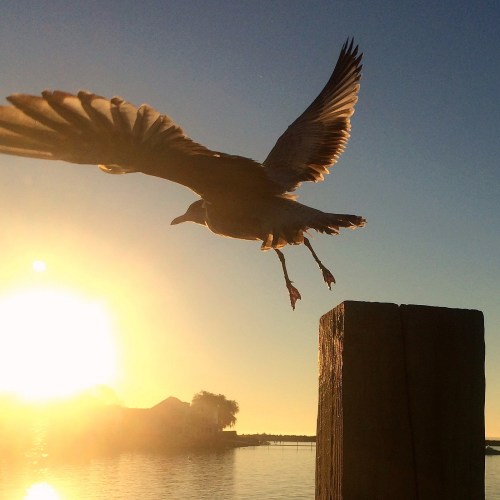
Sunrise Flight

Sunrise Flight

Sunrise Flight, photo by ptpomber

Safe & quick flights … and travels of any kind this weekend. Speaking of flight, if anyone can identify the bird from yesterday, that would be great!

View ptpomber’s photo bigger and see more from Mackinac Island including some very cool winter shots in his slideshow.

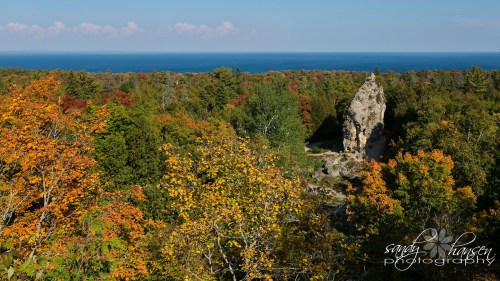
Fall at Sugar Loaf Rock on Mackinac Island

Sugar Loaf Rock Mackinac Island

The Rock, photo by Sandy Hansen Photography

Here’s a color check-in from last week on Mackinac Island. The Mackinac Island State Park Commission says the following about Sugar Loaf rock romation:

Sugar Loaf, a 75 foot tall limestone stack, is the largest rock formation on Mackinac Island. When glacial Lake Algonquin covered much of the Island 11,000 years ago, Sugar Loaf was connected to the nearby bluff face (today called Point Lookout). Wave action slowly washed away the softer limestone between the stack and the bluff, leaving Sugar Loaf as a stand-alone feature. High water levels during the Lake Algonquin period left only the top of Sugar Loaf exposed, as evidenced by the small cave cut into the north face of the formation by wave action. This cave was originally on the shoreline of the lake.

As with other geological features on the Island, numerous Native American legends have been passed down relating to the origin of Sugar Loaf. One story relates that a young man asked the spirits for eternal life. In response, they turned him to stone, creating Sugar Loaf.

View Sandy’s photo bigger and see more of her Mackinac Island photos.

Also check out Arch Rock and the Devil’s Kitchen on Michigan in Pictures.

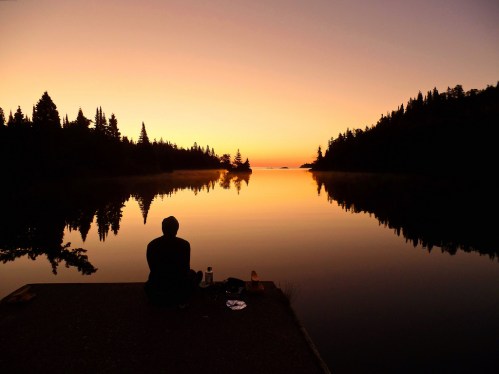
Morning coffee at Chippewa Harbor

Chippewa Harbor Isle Royale

Morning coffee at Chippewa Harbor, photo by Brent West

Hard to imagine a more beautiful spot to enjoy your morning joe than Chippewa Harbor at Isle Royale National Park.

You can view Brent’s photo bigger and click for a couple more of his Isle Royale shots.

Lots more from Isle Royale on Michigan in Pictures.

Grand Island’s North Shore

Remote Lake Superior by Lake Superior Photo

Grand Island, North Side, photo by Lake Superior Photo

The Grand Island National Recreation Area is located on Grand Island off the coast of the U.P. just west of Munising. The island is accessible by private boat or ferry and features cliffs like those in the Pictured Rocks, with some as high as 300 feet! There’s a hiking/biking trail around the island, but Shawn says this location is probably only accessible by boat.

You really should check this shot out background bigtacular on Facebook. There’s lots more great pics in Lake Superior Photo’s amazing gallery too. Do yourself a favor and follow Shawn & Lake Superior Photo if you’re not already and purchase prints online or in her gallery & studio in downtown Marquette!

More summer wallpaper on Michigan in Pictures.


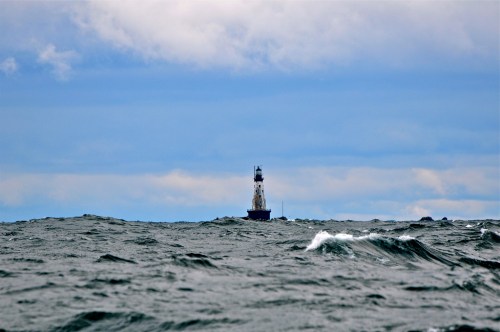
Rock of Ages Lighthouse is Michigan’s tallest

Rock of Ages Lighthouse

Rock of Ages Lighthouse, photo by Dave

I was looking for something on Michigan in Pictures and came across a series of “Michigan’s Tallest” posts that I did a couple of years ago. I thought it made sense to add to that list, so – according to Wikipedia’s list of the tallest lighthouse towers in the United States – measuring in at 130′ tall, Rock of Ages is Michigan’s tallest lighthouse.

It’s also the tallest lighthouse on the Great Lakes and on his Rock of Ages Light page at Seeing the Light, Terry Pepper writes (in part):

Consisting of a strip of exposed rock 50 feet wide and 210 feet long, with it highest point some sixteen feet above the water, Rock of Ages lies two and a half miles off the western end of Isle Royale. While the 205-foot wooden sidewheel steamer CUMBERLAND had been the rock’s only victim in over a half century of Superior navigation, changing navigation patterns in the final decade of the nineteenth century suddenly made Rock of Ages a critical impediment to safe navigation on the big lake.

As Duluth grew to preeminence as the lake’s major shipping port, a growing number of mariners were choosing to set a course along the northern shore during Superior’s violent storms in order to avoid the uncertain and changeable conditions of open water. With Rock of Ages lurking directly in the path of vessels choosing this course, a cry arose in the maritime community for the establishment of a Light on Rock of Ages.

…On completion, the tower stood eight stories in height, and offered relatively large and comfortable quarters for the complement of four keepers assigned to the station. A steam heating plant located in the upper cellar provided heat to cast iron radiators in all rooms, and the first deck was home to the fog signal plant and hoisting engines for the pillar crane located at the edge of the pier level. This crane was used both for raising supplies delivered by the lighthouse tenders at the wharf and for raising the keeper’s boat for storage on the safety of the pier deck. An office and common room made up the second deck, and a mess room and kitchen the third. The Keeper and First Assistant’s quarters were located on the fourth deck, with the Second and Third Assistants quarters immediately above on the Fifth deck. A service room and watch room comprised the sixth and seventh decks, leaving the huge lantern capping the structure above.

Much more at Seeing the Light including an aerial photo of this lonely location. Terry has a listing of verified tower heights for anyone who’s interested too.

About the photo, Dave writes: Photo taken from the back of Voyageur II heading into Windigo with 7 foot waves at 300mm. Yeah I almost got sea sick from taking these.

View his photo bigger and see more in his Lighthouses of Michigan slideshow.

More lighthouses on Michigan in Pictures.