The Wonderful Wizard of … West Michigan?

2019 Holland Michigan by Erik

2019 Holland Michigan by Erik

“The Wonderful Wizard of Oz was written solely to pleasure the children of to-day. It aspires to being a modernized fairy tale, in which the wonderment and joy are retained and heart-aches and nightmares are left out.”
The Wonderful Wizard of Oz
L. Frank Baum, 1900

L. Frank Baum was born 144 years ago today, and this Sunday marks the 110th anniversary of the publication of his classic fairy tale, the Wonderful Wizard of Oz. The Holland Sentinel’s excellent article L. Frank Baum and the Macatawa Goose Man: Celebrating the origins of “The Wizard of Oz” explores the author’s connection to West Michigan, saying in part:

He was named after his uncle, Lyman Spalding Baum, but never liked Lyman and always was known as Frank to family and friends. As an actor and playwright, he was Louis F. Baum. As a newspaper editor, L.F. Baum, and as the children’s book author most famously known for “The Wonderful Wizard of Oz,” he was known as L. Frank Baum. But to the folks in Macatawa, he was simply known as “The Goose Man.”

…In 1899, Baum published “Father Goose: His Book.” The collection of children’s poems exploded in popularity and provided Baum with wealth and prestige for the first time in his life, his great-grandson, Bob Baum, recalled.

The author used the profits from his book to rent a large, multi-story Victorian summer home nestled on the southern end of the Macatawa peninsula on Lake Michigan. The home, which he eventually purchased, came to be known as the Sign of the Goose, an ever-present reminder of the fame that came along with “Father Goose.”

“The Wonderful Wizard of Oz” supposedly was written in Chicago, but some of the forest scenes look just like the pathways that run through the dunes, the younger Baum said.

He assumes Macatawa was where part of the book had been worked on or written, as Baum might have found inspiration from the castle in Castle Park for the yellow brick road, some say, or even based some of the characters in the book on personalities he encountered in the small lakeshore community.

“Especially in the Oz stories, a lot of characters and situations that we may not recognize … he drew lots of inspiration from Macatawa for the book.”

According to an undated newspaper article detailing one reporter’s visit to the Sign of the Goose, Baum not only was popular and well-known among the adults in the area, but children were quite fond of him as he allowed them into his home to read fairy tales, which occupied one of the shelves of his large bookcase.

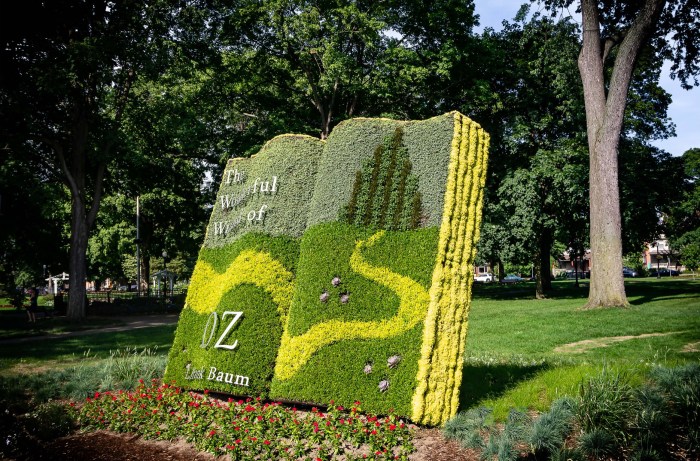
The Holland Oz Project launched last summer with the installation of this floral living mosaic book, a yellow brick road, and colorful landscaping in Centennial Park with bronze sculptures on the grounds of the Herrick Library across the street. A funding campaign to support the project uses personalized engraved yellow bricks for placement along the yellow brick road.

To learn more about the Oz Project, visit their website or call the Holland Area Visitors Bureau at 616.394.0000.

You can see more in Erik’s Holland 2019 gallery on Flickr.

Support Michigan in Pictures with Patreon

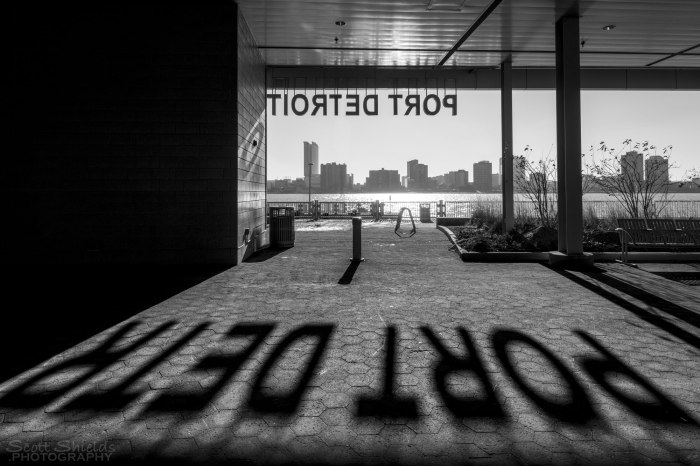
The Port of Detroit

Letters in Port Detroit by Scott Shields

Letters in Port Detroit by Scott Shields

The Port of Detroit is located along the west side of the Detroit River and is the largest seaport in the state of Michigan:

The port consists of multiple marine terminals handling general, liquid, and bulk cargo as well as passengers. The Port of Detroit’s single most valuable commodity is steel, and the largest commodity handled by tonnage is ore. Other important commodities handled at the port include stone, coal and cement.

…Each year, the Port Authority oversees millions of tons of cargo at 29 private and public sector terminal facilities in the Port of Detroit. International and domestic high-grade steel products, coal, iron ore, cement, aggregate and other road building commodities are shipped in and out of Detroit’s port. It is the third largest steel-handling port in the nation.

More at the Port of Detroit website.

Scott shared this photo back in April in one of my favorite Facebook groups, Detroit’s Urban Beauty. Click to view it in the group & see more of his work on his Facebook page.

Support Michigan in Pictures with Patreon

Earth Day at 50

Untitled by Brooke Pennington

Untitled by Brooke Pennington

Happy 50th Earth Day everyone! It’s without a doubt the weirdest one on record, but I thought you might be interested in the Michigan roots of Earth Day, at the University of Michigan to be precise. James Tobin of Michigan Today shares the story of the Teach-In on the Environment that UM held in March of 1970 because Earth Day fell right in the middle of exams. Students and teachers formed a group called Environmental Action for Survival (ENACT) and booked Democratic front-runner Senator Edmund Muskie, Ralph Nader and biologist Dr. Barry Commoner.

Michigan’s Teach-In on the Environment was not the first Earth Day. It was the huge and spectacularly successful prototype of the first Earth Day, which happened five weeks later—“the most famous little-known event,” one historian has written, “in modern American history.”

…The crowd in Crisler Arena overflowed into the parking lots. Workshops and rallies were swarmed by Michigan students, schoolkids, retirees, and PTA parents. When it was over, the New York Times said Michigan’s Teach-In on the Environment had been “by any reckoning…one of the most extraordinary ‘happenings’ ever to hit the great American heartland: Four solid days of soul-searching, by thousands of people, young and old, about ecological exigencies confronting the human race.”

Measured against the extreme rhetoric and violent protests that set the tone of the era, it was an earnest, even quiet, event. A few speakers were heckled and a few showy demonstrations drew heavy media attention—the “trial and execution” of a 1959 Ford on the Diag; the dumping of 10,000 non-returnable pop cans at a Coca-Cola bottling plant (afterward students picked up the cans and threw them away, an irony not lost on reporters); the smearing of tar and feathers on a building where an oil company was interviewing job prospects.

Read the rest right here. & dig into 2020 online events at earthday.org.

Check out Brooke’s Spring photo album on Flickr for more!

Support Michigan in Pictures with Patreon

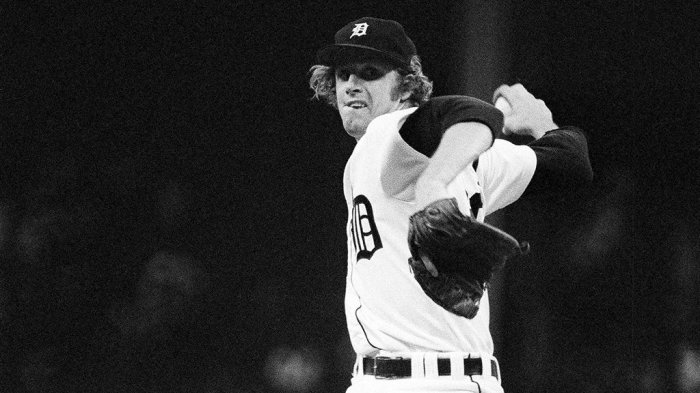
Remembering Mark “The Bird” Fidrych

Mark “The Bird” Fidrych courtesy Mark Fidrych Foundation

Mark Fidrych reminded you of your childhood, no matter how old you were when he pitched. This was his charm, his curse, his legacy. He personified athletic innocence.
-Michael Rosenberg, Detroit Free Press

I’m a lifelong Detroit Tiger fan & without question one of the most magical summers was the summer of ’76 when The Bird tore up the majors with his talking to the ball, mound grooming antics en route to a 19-9 season, winning AL Rookie of the Year honors (and finishing runner-up for the Cy Young), and leading the league in ERA.
 
He died unexpectedly 11 years ago today, and it still hurts to lose a bright light light like him so young. My dad had a Michigan sports show on TV that year, and I actually got to meet Mark. I don’t remember what he said to me, but I do remember how clear & in the moment he was and above all, what a truly nice human being he was.

More about this weird and wonderful character can be found at BaseballReference.com’s page for Mark Steven Fidrych and definitely watch this interview with Fydrich for a look at this Detroit Tiger original!

Support Michigan in Pictures with Patreon

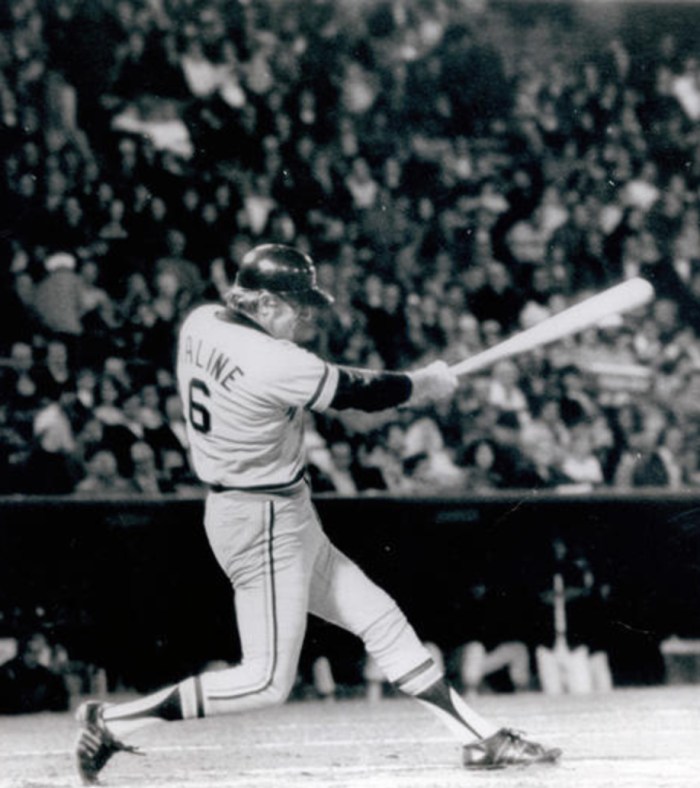
Remembering Mr. Tiger, Al Kaline

Detroit Tigers Al Kaline takes a swing

Al Kaline takes a swing courtesy Baseball Hall of Fame

“I owe everything to baseball. Without it, I’d probably be a bum.”
-Al Kaline

Yesterday, the Detroit Tigers Detroit Tigers and all of us lost #6 Al Kaline. From his playing days in the 50s & 60s to a broadcasting career that spanned decades, “Mr. Tiger” was a fixture, bringing dedication and a simple love of the game in good times and bad.

The National Baseball Hall of Fame entry for Al Kaline says in part:

The 18-year-old Kaline came to the Tigers in 1953 directly from high school, having never spent a day in the minors, and by the next season established himself as one of the game’s bright new talents. By 1955, at age 20, he became the youngest player to win a batting title when he hit .340. That same year the youngster became only the fourth American League player to hit two home runs in a single inning.

Offensive consistency became Kaline’s hallmark over the years, hitting at least 20 home runs and batting .300 or better nine times each. A superb defensive outfielder with a strong throwing arm, he also collected 10 Gold Glove awards. In the 1968 World Series, Kaline’s only appearance in the Fall Classic, he batted .379, hit two home runs and drove in eight to help Detroit knock off the St. Louis Cardinals in seven games.

“You almost have to watch him play every day to appreciate what he does,” said veteran pitcher and former Tigers teammate Johnny Podres. “You hear about him, sure, but you really can’t understand until you see him. He just never makes a mistake.”

By the time Kaline’s 22-year big league career ended in 1974, the lifelong Tiger and 18-time All-Star had collected 3,007 hits, 399 home runs and a .297 career batting average.

“People ask me, was it my goal to play in the majors for 20 years? Was it my goal to get 3,000 hits someday? Lord knows, I didn’t have any goals,” Kaline once said. “I tell them, ‘My only desire was to be a baseball player.’”

Read more in the Hall of Fame and please share memories or links to articles you enjoyed in the comments!

Support Michigan in Pictures with Patreon

Happy Birthday, Dianna Ross!

Diana Ross, 1976 by Motown Records

Diana Ross, 1976 by Motown Records/Wikimedia Commons

Today is the birthday of Detroit-born Motown singer, actress, record producer, and all around legend Diana Ross. The Black PR Wire Power news release in honor of her birthday says:

Born and raised in Detroit, Michigan, Ross rose to fame as the lead singer of the vocal group, The Supremes, who during the 1960s became Motown’s most successful act, and are the best-charting female group in US history, as well as one of the world’s best-selling girl groups of all time. The group released a record-setting twelve number one hit singles on the U.S. Billboard Hot 100, including “Where Did Our Love Go”, “Baby Love”, “Come See About Me”, “Stop! In the Name of Love”, “You Can’t Hurry Love”, “You Keep Me Hangin’ On”, “Love Child”, and “Someday We’ll Be Together”.

Following her departure from the Supremes in 1970, Ross released her eponymous debut solo album that same year, featuring the No. 1 Pop hit “Ain’t No Mountain High Enough.” She later released the album “Touch Me in the Morning” in 1973; its title track was her second solo No. 1 hit. She continued a successful solo career through the 1970s, which included hit albums like Mahogany and Diana Ross and their No. 1 hit singles, “Theme from Mahogany” and “Love Hangover”, respectively. Her 1980 album “Diana” produced another No. 1 single, “Upside Down”, as well as the international hit “I’m Coming Out.” Her final single with Motown during her initial run with the company achieved her sixth and final U.S. number one Pop hit, the duet “Endless Love” featuring Lionel Richie, whose solo career was launched with its success.

Ross has also ventured into acting, with a Golden Globe Award-winning and Academy Award–nominated performance in the film “Lady Sings the Blues” (1972); she recorded its soundtrack, which became a number one hit. She also starred in two other feature films, “Mahogany” (1975) and “The Wiz” (1978), later acting in the television films “Out of Darkness” (1994), for which she also was nominated for a Golden Globe Award, and Double Platinum (1999).

She is the only female artist to have number one singles as a solo artist; as the other half of a duet (Lionel Richie); as a member of a trio; and as an ensemble member (We are the World-USA for Africa). In 1976, Ross was named the “Female Entertainer of the Century” by Billboard magazine. In 1993, the Guinness Book of World Records declared her the most successful female music artist in history, due to her success in the United States and United Kingdom for having more hits than any female artist in the charts, with a career total of 70 hit singles with her work with the Supremes and as a solo artist. She had a top 10 UK hit in every one of the last five decades, and sang lead on a top 75 hit single at least once every year from 1964 to 1996 in the UK, a period of 33 consecutive years and a record for any performer.

In 1988, Ross was inducted to the Rock and Roll Hall of Fame as a member of the Supremes, alongside Mary Wilson and Florence Ballard. She was the recipient of the Kennedy Center Honors in 2007, the Grammy Lifetime Achievement Award in 2012, and the Presidential Medal of Freedom in 2016.

Dig into the Supremes at Motown Museum!

Window Cake

Window Cake by Peter Kelly

Window Cake by Peter Kelly

For some of us, social distancing has been a thing for weeks, but with Governor Whitmer’s executive order yesterday restricting non-essential travel, a lot more of us will be making window cake for the next three weeks. Stay safe everyone!

You can see more in Peter’s The Henry Ford set on Flickr & see lots more portraits on Michigan in Pictures.

Wildfire in the Sky

Sleeping Bear Bay Northern Lights, photo by Kenneth Snyder

Here’s a feature via Leelanau.com

A Conflagration of Storms from his online book The 23rd Cycle, Dr. Sten Odenwald tells of the evening of March 13, 1989 when a massive wave of solar energy struck our atmosphere, creating one of the most impressive northern lights displays of the modern era.

Alaskan and Scandinavian observers were treated to a spectacular auroral display that night. Intense colors from the rare Great Aurora painted the skies around the world in vivid shapes that moved like legendary dragons. Ghostly celestial armies battled from sunset to midnight. Newspapers that reported this event considered the aurora, itself, to be the most newsworthy aspect of the storm. Seen as far south as Florida and Cuba, the vast majority of people in the Northern Hemisphere had never seen such a spectacle. Some even worried that a nuclear first-strike might be in progress.

Luke Pontin, a charter boat operator in the Florida Keys, described the colors in reddish hues as they reflected from the warm Caribbean waters. In Salt Lake City, Raymond Niesporek nearly lost his fish while starring transfixed at the northern display. He had no idea what it was until he returned home and heard about the rare aurora over Utah from the evening news. Although most of the Midwest was clouded over, in Austin Texas, Meteorologist Rich Knight at KXAN had to deal with hundreds of callers asking about what they were seeing. The first thing on many people’s mind was the Space Shuttle Discovery (STS29) which had been launched on March 13 at 9:57 AM. Had it exploded? Was it coming apart and raining down over the Earth? Millions marveled at the beautiful celestial spectacle, and solar physicists delighted in the new data it brought to them, but many more were not so happy about it.

Silently, the storm had impacted the magnetic field of the Earth and caused a powerful jet stream of current to flow 1000 miles above the ground. Like a drunken serpent, its coils gyrated and swooped downwards in latitude, deep into North America. As midnight came and went, invisible electromagnetic forces were staging their own pitched battle in a vast arena bounded by the sky above and the rocky subterranean reaches of the Earth. A river of charged particles and electrons in the ionosphere flowed from west to east, inducing powerful electrical currents in the ground that surged into many natural nooks and crannies. There, beneath the surface, natural rock resistance murdered them quietly in the night. Nature has its own effective defenses for these currents, but human technology was not so fortunate on this particular night. The currents eventually found harbor in the electrical systems of Great Britain, the United States and Canada.

Read on for much more about how our electrical grid can be brought to its knees by the power behind the beauty of the northern lights and get much more in the 23rd Cycle.

Kenneth took this photo back in July of 2012. See more great pics in his Sleeping Bear Dunes album & also check out many more northern lights photos in the Leelanau.com group on Flickr!

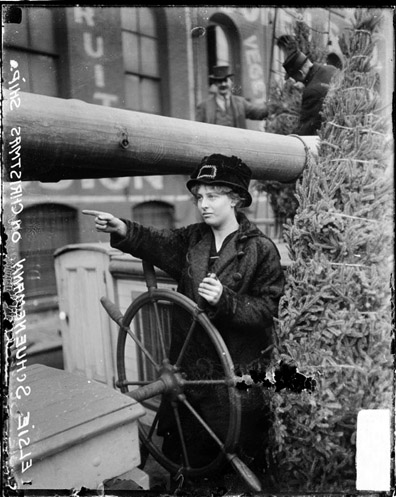
The Christmas Tree Ships

an oldie but a goodie for #TBT!

elsie-schuenemann-christmas-tree-ship

Above is a portrait of Elsie Schuenemann at the wheel of the Christmas Ship, near the Clark Street Bridge on the Chicago River in the Loop community area of Chicago, Illinois. The boat carried Christmas trees to Chicago from Michigan. Her father, Captain H. Schuenemann, died when the Rouse Simmons, a ship carrying Christmas trees, sank in 1912.

The trees behind her likely came from the woods of Escanaba. Though the story of Barbara Schuenemann and her three daughters carrying on the tradition of the Christmas Tree Ships has perhaps been a little over-romanticized, there can be little doubt that the Schuenemann family and the many others who participated in the difficult trade of hauling Christmas trees south as the storms of winter closed in were heroes cut from a cloth that isn’t found too often today.

If you’d like to read more about all the Christmas tree ships (there were many more than just the famous Rouse Simmons) I recommend Christmas Tree Ships from Fred Neuschel. He has also written a book called Lives and Legends of the Christmas Tree Ships (available from UM Press). The National Archive also has The Christmas Tree Ship: Captain Herman E. Schuenemann and the Schooner Rouse Simmons that details the Schuenemann’s story.

You can also see Rich Evenhouse’s cool video of diving the Rouse Simmons.

Walking on the Moon: The Apollo Capsule in Grand Rapids

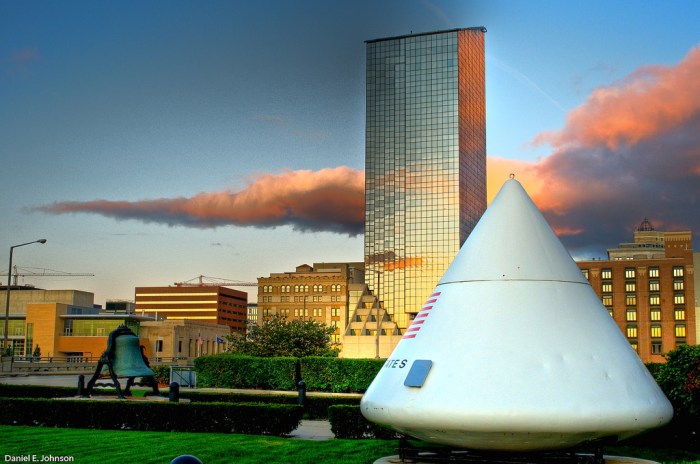
Now That Was Just Weird by Daniel E Johnson

July 20th is 49th anniversary of our first steps on the moon. The Mix 95.7 Grand Rapids tells the story of the Apollo capsule in front of the Grand Rapids Public Museum:

It turns out that the capsule is an actual Apollo Capsule, but it wasn’t a capsule that sat atop an Apollo Rocket. The capsule was made for training astronauts. But don’t let that news get you down, the capsule still has quite the history to it!

This type of capsule is known as a “Boilerplate” … built, along with dozens of other capsules, in the 1960s to test various systems on the Apollo Rockets. 

BP-1227 was lost at sea in early 1970 during a routine training drill to recover the Apollo boilerplate capsule by UK-based naval units. Later that same year, the capsule that was lost was miraculously recovered by a Russian “fishing vessel.” Many believe that the fishing vessel was actually a spy boat that was tracking the capsule as part of an intelligence operation.

The capsule was taken back to Russia and in late 1970 the Russians invited the Americans to recover their capsule. On September 8th, 1970 the US Navy Icebreaker, Southwind, made a stop in Murmansk to recover BP-1227. This was the first visit to a Soviet port by a US military vessel since World War II.

After the capsule was returned, the Smithsonian Institution spent the next several years restoring BP-1227 before it was eventually given on loan to the City of Grand Rapids in 1976. The boilerplate capsule was dedicated to the people of Grand Rapids on December 31, 1976. Students from local high schools filled BP-1227 with everyday items from their lives to form a time capsule. The time capsule was sealed on the last day of our nation’s Bicentennial year and it is to be opened on July 4th, 2076, as our nation celebrates its Tricentennial.

Read on for more. About the photo, Daniel wrote: We had a huge, odd cloud float over Grand Rapids today. Wednesday October 1st, 2008. HDR from one exposure shot in raw and split out three times , re-compiled in Photomatix.

See more in his HDR gallery.