Spring Beauties say welcome spring!

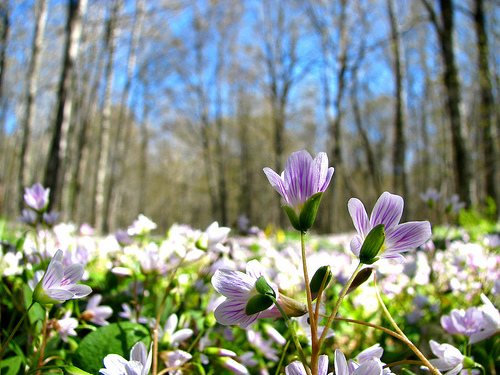
tinyflowers_vista

tinyflowers_vista, photo by CreateWithKim

Wikipedia’s entry for the season of Spring says that the  vernal equinox, the point when the earth is straight on its axis and the sun passes directly over the equator. That put the official start of spring at 1:14 AM EST this morning. As the northern hemisphere tilts sunward, temperatures begin to warm and all kinds of good stuff starts growing and popping. A few of my personal favorites are daffodils, crocuses and yes, spring beauties. Yours?

According to the University of Michigan Herbarium, Michigan is home to two native species of ClaytoniaClaytonia caroliniana and Claytonia virginica:

The two native species of Claytonia only rarely grow side by side in the same forests in Michigan. When they do, C. virginica reaches the peak of its flowering later by at most a few days than C. caroliniana. The vegetative parts of both turn yellowish after a short flowering and fruiting season in the spring, and soon the plants are no longer seen above ground in forests which may have been carpeted with them a month previously. Both native species are extremely variable in leaf shape and size as well as in other characters, such as the aberrant presence of extra leaves on the stem. The petals are usually pale pink with deeper colored veins, but the ground color ranges from white to very deep pink; the corolla may be as much as 27 mm broad.

The photo above looks like virginica, but Kim shot this on the Pictured Rocks National Lakeshore and the Herbarium doesn’t list Alger as one of the counties it is found in.

Check this photo out bigger and in her Mostly Wildflowers slideshow.
Set your backgrounds for spring

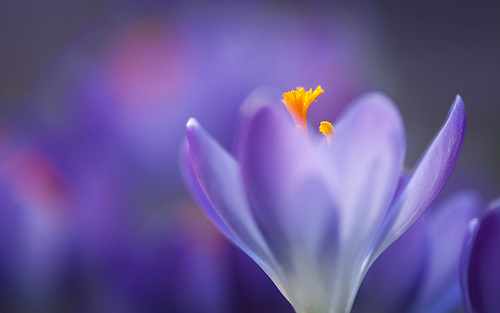
Macro Crocus

Macro Crocus, photo by MightyBoyBrian.

Brian shot this on yesterday’s toasty-warm and not very March-like Sunday and writes:

Go ahead, set your background. I declare that it’s spring. The flowers think so and I do too.

I was slithering around on the ground with my new macro lens (EF format vs EF-S with canon full-frame) to get up in close with this patch of crocuses.

Here’s a tip: instead of a typical green or brown backgound, position yourself so that other flowers are in the background of the scene giving their color to the awesomeness.

Good advice, Brian, and with highs predicted for Wednesday in the SEVENTIES around Michigan, you might need to find us a strawberry so we can go directly to summer…

Check his photo out background big or settle back for his bokeh slideshow.

Trees such as these … Happy Birthday Dr. Seuss

Explosions in the sky

Explosions in the sky, photo by MightyBoyBrian.

He was shortish. And oldish. And brownish. And mossy.
And he spoke with a voice that was sharpish and bossy.
“Mister!” he said with a sawdusty sneeze,
“I am the Lorax. I speak for the trees.
~The Once-ler

Today is the birthday of Theodor Seuss Geisel aka Dr. Seuss. Geisel was the author of 46 children’s books and had such an impact on the genre that his birthday has been adopted as National Read Across America Day. Here’s hoping you can read something wonderful to the special young people in your life today!

While the new movie The Lorax based his book is drawing fire from both the right and the left, there’s little doubt that few people have had the kind of impact on children’s literature that he did.

You can see the Lorax trailer at the link above, and you might also want to check out the TV special from 1974 which featured voices of Eddie Albert and Bob Holt and originally included a hummingfish bashing Lake Erie with the line “I hear things are just as dreary down in Lake Erie”. In a nearly Michigan connection, twenty years later two research associates from the Ohio Sea Grant Program wrote to Seuss about the clean-up of Lake Erie and got the line removed from the book. Also see the full text of the Lorax and check out a whole world of Seussian fun at Seussville.com.

About the photo, Brian asks “What does it look like to you?” To me, it was Truffula trees. Check them out background bigtacular and in Brian’s Top 30 slideshow.

February Daffodils

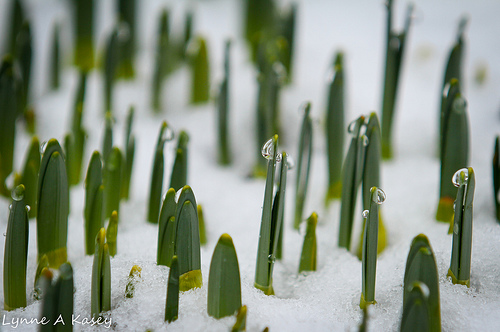
daffodils3

daffodils3, photo by mozy54

Mozy54 writes: February 21…snow, rain, daffodils. Been a strange winter. Not much to add to that except “and how.”

Click to see it bigger and check out her slideshow.

A Flower a Day for January: Cranesbill

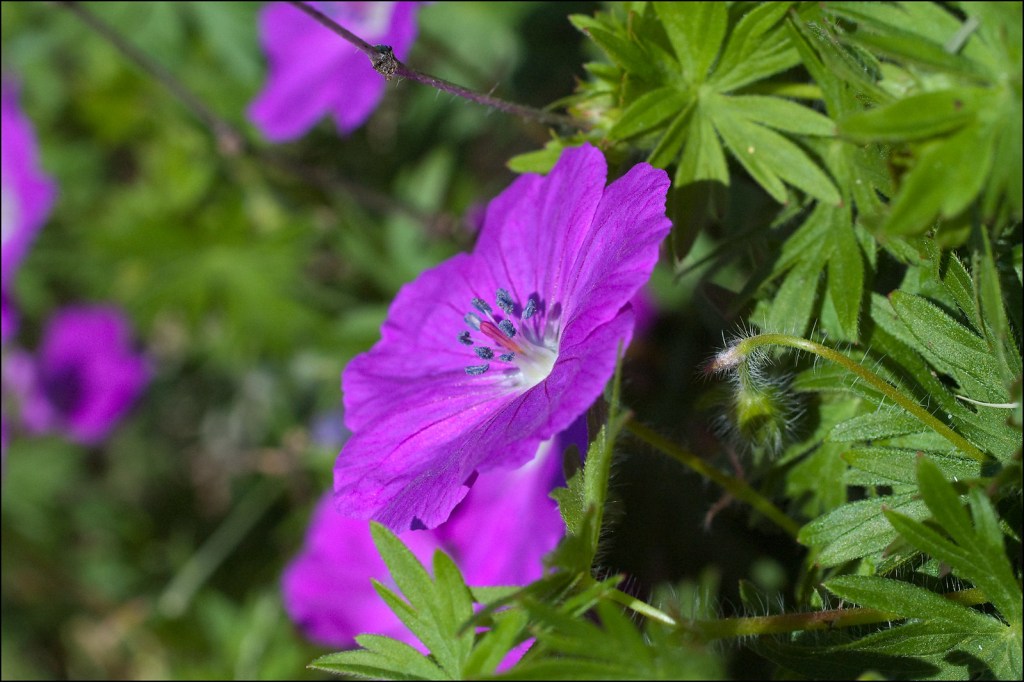
Cranesbill, photo by joeldinda.

Because we need flowers in January.
~Joel Dinda

One of my favorite things about Michigan in Pictures is that sometimes I learn things that I really am not intending to learn. Such is the case today when I picked my favorite of Joel’s photos to highlight this year’s edition of his perennial feature, A Flower a Day for January. Joel started this in January of 2006, and every day he posts another flower to his flickr photostream.

The Wikipedia entry for Geranium sanguineum explains that it’s the county flower of Northumberland, commonly called Bloody Cranesbill or Bloody Geranium. The Geranium entry says that the genus name is derived from the Greek géranos meaning crane) and has a note:

The genus name is derived from the Greek γέρανος, géranos (meaning crane). The English name “cranesbill” derives from the appearance of the fruit capsule of some of the species. Species in the Geranium genus have a distinctive mechanism for seed dispersal. This consists of a beak-like column which springs open when ripe and casts the seeds some distance. The fruit capsule consists of five cells each containing one seed, joined to a column produced from the centre of the old flower. The common name cranesbill comes from the shape of the un-sprung column, which in some species is long and looks like the bill of a crane. Many species in this genus do not have a long beak-like column.

…Confusingly, “geranium” is also the common name of members of the genus Pelargonium (commonly known as ‘storksbill’ in distinction from ‘cranesbill’), which are also in the Geraniaceae family. Linnaeus (Swedish botanist Carl Linnaeus) originally included all the species in one genus, Geranium, but they were later separated into two genera by Charles L’Héritier in 1789.

Check this out background bigtacular More Flower a Day posts on Michigan in Pictures & see more in Joel’s 137 photo and growing A Flower a Day for January (x5) slideshow.

Support Michigan in Pictures with Patreon

frose

Taken today 11/17/2011 This Rose just started to open in my backyard 2 days ago, must like cold weather. Boyne City, Michigan

Taken today 11/17/2011 This Rose just started to open in my backyard 2 days ago, must like cold weather. Boyne City, Michigan, photo by rickrjw.

Couldn’t resist. Stay warm!

Check it out background big and in Rick’s Flowers slideshow.


Trout Lily Trio

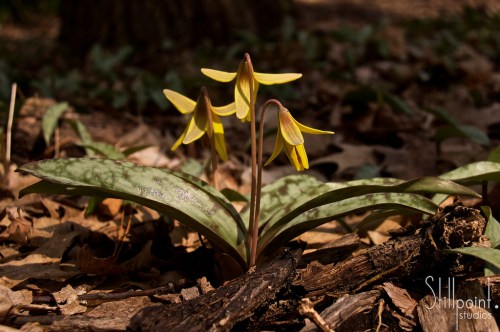
Trio

Trio, photo by sheSaid@purpleHouseonPearl.com

I saw today’s photo of a trout lily and it reminded me of the spectacular trout lilies mixed in with spring beauties that I saw this weekend in the Pictured Rocks National Lakeshore near Grand Marais. I wondered if I’d ever posted a blog about it to Michigan in Pictures. The answer was yes, but the photographer removed their photo, so it seemed to me that a mulligan was in order!

This great Wild About Gardening feature on the trout lily (Erythronium americanum) says that the name is is derived from the resemblance of its mottled leaves to the coloring on brook trout. This 4-10″ tall wildflower is one of the earliest to bloom in Michigan and is also known as Adder’s Tongue and Dogtooth Violet:

This is a plant that relies more on the spreading abilities of its underground root system (corms) than on seed production from its flowers. In fact, it takes a few years for a plant to be mature enough to produce a flower and seeds. Trout lilies have recruited the help of ants, who eat a nutritious appendage attached to each seed and leave the rest to germinate. If you wish to propagate your trout lilies from seed, you will want to follow nature’s lead, at least as far as temperature is concerned. Keep your seeds moist and give them a few months of warm followed by a few months of cold, similar to the seeds falling on the ground at the beginning of summer and receiving the summer warmth and winter cold before sprouting the following spring. Wildflowers sometimes stagger their germination over several years, so you might want to sow a few extra seeds to avoid disappointment.

These plants will naturally spread by forming vast colonies. Some wild colonies are reputed to be as old as the trees around them — two or three hundred years! Despite its ability to spread, the trout lily is not considered an aggressive spreader but rather a delight to have in one’s garden.

Check this out bigger and in

Local Blossoms, Local Bucks

Cherry blossoms . . . .

Cherry blossoms . . . ., photo by Dr. Farnsworth.

Over on Absolute Michigan today we’re featuring the new Taste the Local Difference guide. This year they are encouraging folks to sign up to Spend $10 on Local Food – a small step that can make a big difference in Michigan’s economy.

Sustainable Table explains:

Buying locally or directly from farmers can dramatically increase a farmer’s income. The Maine Organic Farmers and Gardener’s Association published a study (pdf) that demonstrates what would happen if consumers shifted 1% of their purchasing power to buy locally grown products: farmers would see a gain of 5% in their income. Even better, buying direct from a farmer sends 90% of those food dollars back to the farm. Increasing farm income means more money can be spent locally by the farmer to run their business and home, helping keep the local economy alive.

Annually, Americans consume more than $600 billion in food. In most communities today food is purchased entirely at a grocery store or market, with only about 7% of local food dollars staying in the community. The other 93% of the modern food dollar travels to pay processors, packagers, distributors, wholesalers, truckers and the rest of the infrastructure that a global food system demands, a stark comparison to 40% in 1910 by contrast, 40% of food dollars spend remained in the local economy. When more food dollars stay in the community, through buying local, they are transformed into thriving main streets and local jobs.

Check this out background big and in Dale’s slideshow.

When lilacs last in the dooryard bloom’d

Lilacs

Lilacs, photo by Ann279.

When lilacs last in the dooryard bloom’d,
And the great star early droop’d in the western sky in the night,
I mourn’d, and yet shall mourn with ever-returning spring.
~Walt Whitman (read the complete poem)

Check this out background big and in Anne’s slideshow.

May is Blossom Time in Michigan!

Traverse MI 1950s East Grand Travese Bay Cherry Blossoms Photo by Phil Balyeat Avery Card 58253 S1155661 National Cherry Festival Postmark 1961

Traverse MI 1950s East Grand Travese Bay Cherry Blossoms Photo by Phil Balyeat Avery Card 58253 S1155661 National Cherry Festival Postmark 1961, photo by UpNorth Memories – Donald (Don) Harrison.

The annual National Cherry Festival got its start around 1910, as cherry growers in the Grand Traverse area began to hold informal “blessing of the blossoms” ceremonies each year at blossom time in May. Businesses jumped on the bandwagon (cherry truck?) in 1925 for the formalized “Blessing of the Blossoms Festival” which was such a big deal that in 1930 they expanded to 3 days and in 1930 President Herbert Hoover attended the opening. The next year the Cherry Festival was declared a national affair and in 1933 they moved it to summer.

Although it’s now a summertime affair (July 2-9, 2011), the wineries on the Old Mission Peninsula hold an annual Blossom Days celebration (May 14 & 15 this year). My informal read of the cherry blossoms here says that tart cherry blossoms will be in full swing with sweets kicking off.

Apparently in 1906 there was some sort of spiritual attraction of orchards, because to the south in Benton Harbor, the Reverend W. J. Cady of the First Congregational Church in Benton Harbor was the first to urge his parishioners to drive through the orchards and view the fruit blossoms. Cady termed them “symbols of life renewed” and his sermon is credited with the birth of the Blossomtime Festival. Now the Blossomtime Festival in St. Joseph/Benton Harbor is shared between the oldest and largest multi-community festival in the state of Michigan. Join them this Saturday (May 7) for the Grand Floral Parade and more!

Check this photo out big as a cherry orchard, in Don’s slideshow and see another cool old orchard photo right here.