Viewing the Geminid Meteor Shower

IMG_2549mod - Aurora Borealis

IMG_2549mod – Aurora Borealis, photo by something28

UPDATED FOR 2013! via EarthSky:

The peak night of the 2013 Geminid meteor shower is expected to be from late evening tonight (Friday, December 13) until dawn tomorrow (December 14). The meteors will be flying, but will you see them in the bright light of the waxing gibbous moon? The brighter ones, yes, and the Geminids do tend to be bright. If you want a moonless sky, your best bet on this night is to watch in the narrow window between moonset and dawn on Saturday.

Welcome to the “Spot the Geminid Meteor” edition of Michigan in Pictures! EarthSky’s Meteor Shower Guide for 2012 says that the last meteor shower of 2012 will be the Geminids, peaking late night December 13 until dawn December 14:

The final major meteor shower of every year (unless one surprises us!) is always the December Geminid shower, often producing 50 or more meteors per hour. It is a beloved shower, because, as a general rule, it’s either the August Perseids or the December Geminids that give us the most prolific display of the year. Best of all, the new moon guarantees a dark sky on the peak night of the Geminid shower (mid-evening December 13 until dawn December 14). But the nights on either side of the peak date should be good as well. Unlike many meteor showers, you can start watching the Geminids by 9 or 10 p.m. local time. The peak might be around 2 a.m. local time on these nights, because that’s when the shower’s radiant point is highest in the sky as seen around the world. With no moon to ruin the show, 2012 presents a most favorable year for watching the grand finale of the meteor showers. Best viewing of the Geminids will probably be from about 1 a.m. to 3 a.m. on December 14.

Click through for some meteor viewing tips and here’s hoping for another Aurora Borealis/Geminid combo!

Paul shot this north of Lansing in December 2006 when the Geminid shower was complimented by a fantastic Northern Lights display! Can you see the meteor a little right of center? Click to view on black, see more in his The Night Sky slideshow or view all 80 photos from the evening in his December 14, 2006 gallery.

There’s lots more meteors & northern lights on Michigan in Pictures!

Eli & Edy Broad Art Museum at Michigan State University

Art Museum Night

Art Museum Night, photo by AaronSnyderPhoto

The Eli & Edy Broad Art Museum at Michigan State University opened in early November. The museum features the historical collection from the Kresge Art Museum. They explain that:

This collection, which spans cultural production from ancient Greece and Rome and pre-Columbian cultures through Medieval and Renaissance art to the modern and contemporary will enable the Broad MSU to explore the art of our time through the long lens of art history. Highlights of the museum’s collection include: Greek and Roman antiquities; medieval and Renaissance illuminations; Old Master paintings; 19th century American paintings; 20th century sculpture by artists such as Alexander Calder and Jenny Holzer; and works by contemporary artists such as Chuck Close and Ann Hamilton. Collection growth and new acquisitions will focus on modern and contemporary works (post 1945).

You can search the collection at collections.artmuseum.msu.edu. The museum was designed by architect Zaha Hadid who has a fantastic photo gallery of the latest addition to MSU’s campus. You might also enjoy their virtual tours.

Check this out background big and see more including another angle in Aaron’s MSU Landscape slideshow.

More Michigan museums on Michigan in Pictures!

Lake Michigan

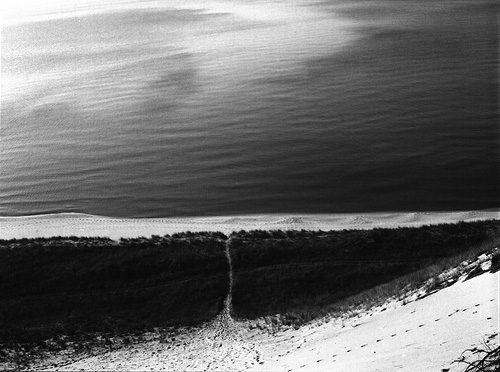
Lake Michigan

Lake Michigan, photo by karstenphoto

Check this out background bigtacular and see more in Steve’s Film! slideshow.

More black & white photography and more Lake Michigan from Michigan in Pictures.

Cheboygan Crib Light with Northern Lights

Cheboygan Crib Light

Cheboygan Crib Light, photo by yooper1949

Terry Pepper’s Seeing the Light says that the plan for the Cheboygan Crib Light that was drawn-up by the District Engineer called for a round crib with an octagonal cast iron pierhead beacon centered upon it.

Work began with the construction of a wooden crib onshore in Cheboygan, which was then lowered into the water and towed out to the specified location at the entrance to the dredged river channel. Sunk in place with the addition of crushed rock, an upper level consisting of oak timber framework was then constructed atop the crib, with a basement oil storage room beneath the location in which the tower was to be installed. The deck of this superstructure was then leveled at a height of eleven feet above the water, planked with timber and fitted with a circular oak ring centered over the oil storage room to serve as an anchoring foundation for the cast iron tower itself.

…One can only imagine the drudgery involved for the keepers who manned this station. Every afternoon he would have to leave the safety of the dwelling in Cheboygan and row the 1/4 mile out to the light in whatever weather the lake was dishing-up that day. On arrival at the crib, he would carefully secure his boat at the foot of the crib, and then gingerly step from the heaving boat onto the eleven foot ladder, climbing up to the deck while simultaneously carrying any supplies needed for the night. The lamp would illuminated at dusk, and the keeper would then sit in the solitude of the tower, huddled close to the stove to keep warm on cold nights during the late season, making frequent climbs to the lantern to adjust the light by trimming the wick, winding the occulting mechanism and adding fuel to the lamp. As dawn finally raised its head across the Straits of Mackinac, the lamp would be extinguished, and the illuminating apparatus, lens and lantern would be cleaned in preparation for illumination later that day. The keeper would then row the ¼ mile back to shore to get some sleep, knowing that he would have to back out on the crib to repeat the cycle a few short hours later.

Sounds like a wonderful job. Read lots more about the light from Terry Pepper.

If I were looking for northern lights, I might follow Carl around. He shot this on November 30th. See it background bigtacular and see more in Carl’s Northern Lights slideshow.

Want more lighthouses or northern lights? We have both on Michigan in Pictures…

How Miners Falls got their name

Winter at Miners Falls

Winter at Miners Falls, photo by gkretovic

The Pictured Rocks National Lakeshore explains that Miners Falls is about five miles north of Alger County Road H-58 off Miners Castle Road. It’s a short hike of just over a mile round-trip from the parking area and Miners Castle.

I always wondered about the whole “miner” thing with Miners River/Falls/Castle.  The Miners Falls Trail Guide explains that:

Visited by passing English geologists in 1771-1772, the nearby Miners River was named by employees of Alexander Henry during one of his exploratory trips on Lake Superior. At that time, indicators or “leaders” were used to locate mineral deposits. Discolored water oozing from bedrock was one such leader found in the Miners Basin, although no minerals were ever extracted from this area.

Who was Alexander Henry you ask? Wikipedia explains:

Alexander Henry ‘The Elder’ (August 1739 – 4 April 1824) was one of the leading pioneers of the British-Canadian fur trade following the British Conquest of New France; a partner in the North West Company, and a founding member and vice-chairman of the Beaver Club. In 1763-64, he lived and hunted with Wawatam of the Ojibwa, who had adopted him as a brother. “Blessed with as many lives as a cat,” his time with the Ojibwa and subsequent explorations are retold in his Travels and Adventures in Canada and the Indian Territories between the years 1760 and 1776 (published New York, 1809), which he dedicated to his friend Sir Joseph Banks. The book is considered an adventure classic and one of the best descriptions of Native Indian life at this time.

An “easy and dignified” raconteur, in 1776 Henry was invited to give an account of his journeys at the Royal Society in London and at Versailles to Queen Marie Antoinette. In the 1780s, Henry introduced John Jacob Astor into the Canadian fur trade and subsequently Astor would stay as Henry’s guest during his annual visits to Montreal.

You can read Henry’s Travels and Adventures in Canada online from Google Books. Also see the GoWaterfalling page on Miner’s Falls.

See it on black and see more in Greg’s great slideshow which includes a shot of a UP moose! From the Small World Files, Greg took this photo on November 27th. On the 28th, John McCormick was also there and also shared his shot on the Absolute Michigan group on Flickr!

More from Pictured Rocks National Lakeshore on Michigan in Pictures.

Back into the Woods Day, 2012

Sandstone Creek Ravine

Sandstone Creek Ravine, photo by joeldinda

The hardest 15 days for the year for the non-hunting lover of the outdoors in Michigan are November 15-30th. I think of December 1st as a mini-holiday. Call it “Back into the Woods Day” and celebrate as you will.

Joel’s photo is from Fitzgerald Park aka “The Ledges”, an amazing park along the Grand River near the town of Grand Ledge. Check this out background bigtacular and see more in his Into the Woods slideshow.

Michigan Architect Minoru Yamasaki

Roofline: DeRoy Auditorium, Wayne State University--Detroit MI

Roofline: DeRoy Auditorium, Wayne State University–Detroit MI, photo by pinehurst19475

“When people go into good buildings there should be serenity and delight.”
~Minoru Yamasaki

Minoru Yamasaki  (December 1, 1912 – February 7, 1986) was an American architect best known for his design of the Twin Towers of the World Trade Center who ended up making his home in Michigan.

The Detroit News has a feature titled world-class architect Minoru Yamasaki that gives a good overview of the architect and his somewhat tumultuous life, and you should also read the Seeking Michigan feature on Yamasaki and his Michigan architectural practiceMichigan Modern has a list of Yamasaki designed buildings in Michigan as well.

Check this out background bigtacular and see more in Anthony Lockhart’s Wayne State and the Cultural Center slideshow.

More architecture on Michigan in Pictures.

November 28th: Full Beaver Moon in 2012 and sungrazing Comet ISON in 2013!

I can see a Church by Moonlight

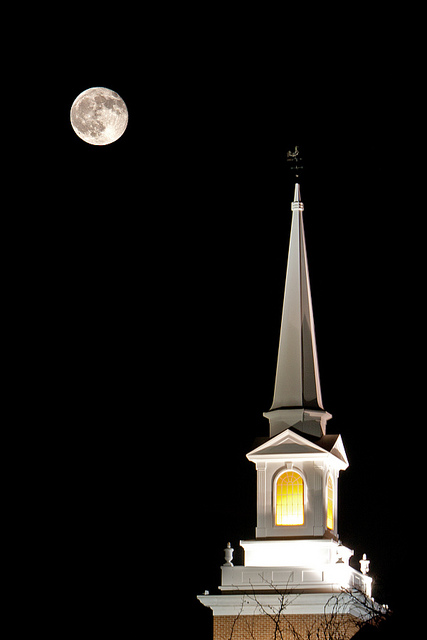
I can see a Church by Moonlight, photo by Kevin’s Stuff

November’s moon will be full tonight, November 28th. Known as the Beaver Moon or the Frosty Moon in colonial times, November’s full moon was named the White Moon by Chinese, Dark Moon by the Celts, Snow Moon in Medieval England and the Moon When Horns Are Broken Off by the Sioux.

You’ll want to circle November 28th on your calendar because on November 28, 2013, Comet ISON will have a close encounter with the Sun and potentially be one of the biggest acts to hit the celestial stage in quite a while. The comet is what is known as a sungrazing comet, one that passes extremely close to the surface of the sun. Many sungrazers are incinerated by the passage, but those that don’t can put on a great show. SPACE.com says that although there’s no guarantee, Comet ISON could produce an incredible display:

The most exciting aspect of this new comet concerns its preliminary orbit, which bears a striking resemblance to that of the “Great Comet of 1680.” That comet put on a dazzling show; it was glimpsed in daylight and later, as it moved away from the sun, it threw off a brilliantly long tail that stretched up from the western twilight sky after sunset like a narrow searchlight beam for some 70 degrees of arc. (A person’s clenched fist, held at arm’s length, covers roughly 10 degrees of sky.)

The fact that the orbits are so similar seems to suggest Comet ISON and the Great Comet of 1680 could related or perhaps even the same object.

Comet ISON will be barely visible to the unaided eye when it is in the predawn night sky, positioned against the stars of Leo in October 2013.

On Oct. 16 it will be passing very near both Mars and the bright star Regulus — both can be used as benchmarks to sighting the comet. In November, it could be as bright as third-magnitude when it passes very close to the bright first-magnitude star Spica in Virgo.

The few days surrounding the comet’s closest approach to the sun on Nov. 28, 2013, are likely to be most interesting. It will whirl rapidly around the sun in a hairpin-like curve and perhaps becomes a dazzlingly bright (negative-magnitude) object.

The comet will then whirl north after perihelion and become visible during December both in the evening sky after sunset and in the morning sky before sunrise. Just how bright it will be and how long the tail may get during this time frame is anybody’s guess, but there is hope that it could evolve into a memorable celestial showpiece.

You don’t have to wait until November as comet C/2011 L4 is due to make a close approach to the sun in March of 2013!

See Kevin’s photo on black and see more in his great Astronomy in 2011 slideshow.

More of Michigan’s moon on Michigan in Pictures!

Langely Covered Bridge is Michigan’s longest

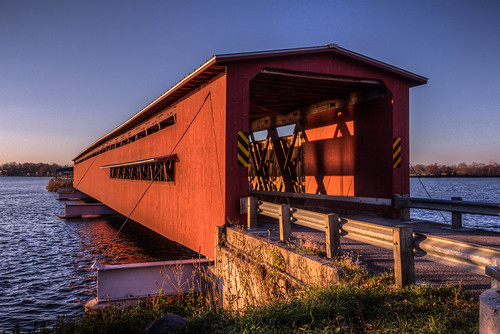
Langley Covered Bridge, Centreville, Michigan

Langley Covered Bridge, Centreville, Michigan, photo by bill.d

Bill writes this of the Langely Covered Bridge over the St. Joseph River, a Michigan Registered Historic Site:

This is the longest of Michigan’s few remaining covered bridges. It is 282 feet long with three, 94-foot spans of the Howe-truss construction. The bridge was built in 1887 by Pierce (?) Bodner of Parkville, using the best quality white pine for the frame timbers. The bridge’s name honors a pioneer Centreville family. When the Sturgis Dam was built in 1910, the Langley Bridge had to be raised eight feet. In 1950-51 extensive repairs and replacement of parts on the bridge were carried out by the St. Joseph County Road Commission to preserve for the future this historic link with a bygone era.

Personal note – the bridge is only one lane wide. Drivers take turns crossing the bridge, but this is a part of Michigan that doesn’t see much traffic anyway, so the wait is seldom long. The speed limit on the bridge is 15 mph.

Wikipedia’s entry on the Langley Covered Bridge adds that it was named for Thomas W. Langley and his family, the first settlers who helped establish the village of Centreville in St. Joseph County in the mid-19th century.

Check it out as big as a bridge and see more in Bill’s Michigan: Saint Joseph County slideshow.

More Michigan bridges on Michigan in Pictures!

The Iron River Meteorite and the Meteorites of Michigan

Meteor-Over-Marquette

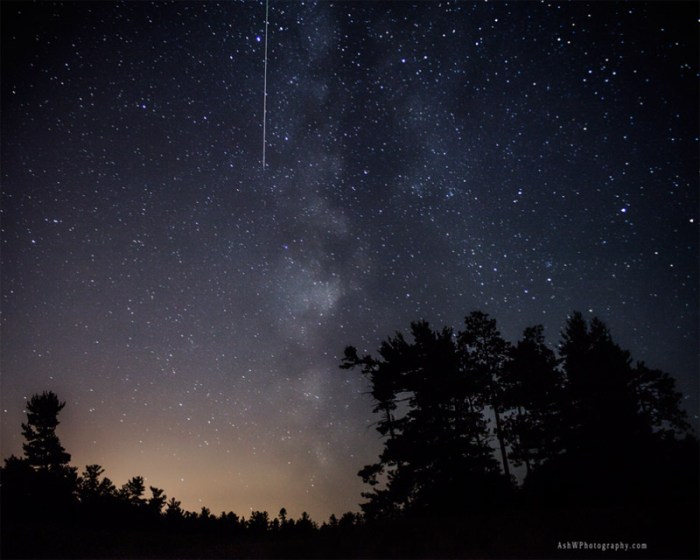
Meteor over Marquette, photo by Ash W Photography

Recently in Peter Peterson and the Iron River Meteorite on Yooper Steez, Alice Rossignol remembered a day in 1889:

…when a six-year old boy named Peter Peterson (yes, this was actually his name) was helping his father clear rocks from a field near Iron River.

Things were proceeding as usual (I’m assuming) when little Peter noticed that one rock was much heavier than others of the same size. He showed the 3.13-pound whopper to his father who told him to toss it like the others.

But Peter, being a six-year old boy, kept it.

According to Von Del Chamberlain, a former MSU professor who recounts this story here, the rock was later identified as a meteorite, a fact which he later confirmed.

How rare are confirmed meteorites? There have only been 10 verified in Michigan, and this meteorite is currently the only verified meteorite in the Upper Peninsula. Read on for more about this story and some meteorwrongs (mis-identified meteorites) and dig into Prof. Del Chamberlain’s account for the scientific lowdown and how it ended up in Chamberlain’s hands almost 80 years later. You can also read the entirety of Chamberlain’s publication Meteorites of Michigan online.

Ashley took this photo in August 2012 during the Perseid meteor shower. Check it out big as the sky and in her Nature Gallery.

More meteors on Michigan in Pictures. If you’re wanting to see some, the Geminids are on tap for the night of December 13th!