Capturing Comet PANSTARRS

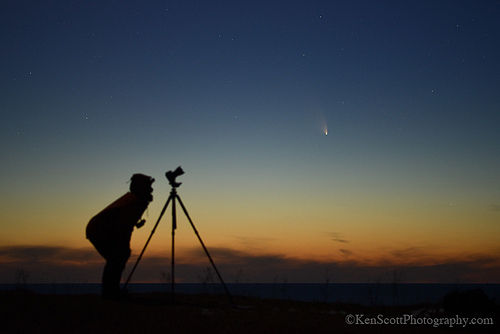
Comet Pan-Starrs ... 3-17-13

Comet Pan-Starrs … 3-17-13, photo by Ken Scott

EarthSky.org is a fantastic site for all things astronomical, and their post detailing everything you need to know about Comet PANSTARRS has great info on the first of 2013 major comets. The comet was discovered by the PANSTARRS telescope in Hawaii and they explain that:

Comet PANSTARRS is still visible through binoculars in the Northern Hemisphere, if you know right where to look. Note where the sun sets in the west. Some 60 to 75 minutes after sundown, seek for the comet about two to three binocular fields to the right, or upper right, of the sunset point on the horizon. Comet PANSTARRS now sets at nightfall or very early evening at mid-northern latitudes. From here on out, the comet will dim a bit day by day, while the waxing moon will brighten daily. So it’s hard to say how much longer Comet PANSTARRS will be readily visible through binoculars. Each day, Comet PANSTARRS goes a few degrees northward (to the right) on the sky’s dome, toward the constellation Cassiopeia the Queen.

…No matter how bright it gets in March, the comet will surely fade as April arrives, as it moves away from the sun and back out into the depths of space. But it will be located far to the north on the sky’s dome and will be circumpolar for northerly latitudes in the Northern Hemisphere. That means it might be visible somewhere in the northern sky throughout the night for northern observers. What’s more, the comet will be near in the sky to another beautiful and fuzzy object in our night sky, the Andromeda Galaxy (M31), the nearest large spiral galaxy to our Milky Way. If the comet truly is bright then, and if it still has a substantial tail, it’ll be an awesome photo opportunity!

Read on for more and also check out the michpics post on Comet ISON which has the possibility of  being so bright that you can see it in the daytime!

Ken shot this last weekend. You can see it on black, check out the sunset he captured before this and see more great work in his Night Sky slideshow. If you’re looking to purchase this or other shots, definitely head over to KenScottPhotography.com!

More nighttime photography on Michigan in Pictures.

crashing to Earth

crashing to Earth

crashing to Earth, photo by .brianday

Brian suggests the Cinematic Orchestra’s Outer Space to accompany this photo. View it on black and might I suggest queuing up the song above and digging into his Gray Matter slideshow.

More amazing work from Brian Day on Michigan in Pictures.

Four Silo Barn

DSC02860_1_2_3_tonemapped

DSC02860_1_2_3_tonemapped, photo by ansonredford

Donald writes that he’s never seen a quad-silo barn before he came across this one – me neither!!

Check this out big as a barn and see several more looks at this barn in his Barns & Silos slideshow.

More barns on Michigan in Pictures.

Miners Castle in Winter

Ice Cove

Ice Cove, photo by Rudy Malmquist

Since I’m up in the Pictured Rocks, I thought it would be a good time to share this video of Lake Superior waves at Pictured Rocks in winter by Lars Jensen.

Check this out background bigtacular and see more in Rudy’s UP Winter 2010 slideshow.

More from the Pictured Rocks National Lakeshore on Michigan in Pictures including a feature from Lars on Miners Castle from the winter of 2006!

Grand Marais, Michigan

Grand Marais Harbor Outer Light Station

Grand Marais Harbor Outer Light Station, photo by Gary of the North

The Michigan Historical Marker at Grand Marais reads:

Grand Marais, which is among Michigan’s oldest place names, received its name from French explorers, missionaries and traders who passed here in the 1600s. “Marais” in this case was a term used by the voyaguers to designate a harbor of refuge. In the 1800s Lewis Cass, Henry Schoolcraft and Douglass Houghton also found the sheltering harbor a welcome stopping place. Grand Marais’s permanent settlement dates from the 1860s with the establishment of fishing and lumbering. At the turn of the century Grand Marais was a boom town served by a railroad from the south. Its mills turned out millions of board feet annually. Lumbering declined around 1910, and Grand Marais became almost a ghost town, but the fishing industry continued. Many shipping disasters have occurred at or near the harbor of refuge, which has been served by the Coast Guard since 1899. In 1942 the first radar station in Michigan was built in Grand Marais. Fishing, lumbering and tourism now give Grand Marais its livelihood.

Check this out big as Lake Superior and see more in Gary’s slideshow.

More Grand Marais on Michigan in Pictures!

Holland Harbor’s Big Red Lighthouse and the Red Right Return

Big Red

Big Red, photo by Rick Lanting

Sometimes I see photos of certain places so much that I figure I’ve said all there is to say about them. Such was the case with one of one of Michigan’s most iconic lighthouses. I realized that although I’d seen hundreds of photos, I had no idea how “Big Red” in Holland got its name. Terry Pepper’s Seeing the Light tells the story of the Holland Harbor Light from the construction of a timber frame beacon on the south pier in 1870 up until the 1930s when:

The Holland Lights were electrified in 1932. Equipped with a 5,000 candlepower incandescent electric bulb, the Fourth Order lens was now visible for a distance of 15 miles. The old steam-operated ten-inch fog whistle was removed from the fog signal building the following year, and replaced with an air operated whistle powered by an electric motor-driven compressor. In 1936, a square tower was erected at the west end of the fog signal building roof peak, and capped with an octagonal cast iron lantern, the lens from the pierhead beacon moved into the new lantern. The steel pierhead beacon was then removed from the pier and shipped to Calumet, where it was placed at the south end of the breakwater.

A Coast Guard crew arrived in Holland in 1956, and gave the combined fog signal building and lighthouse a fresh coat of bright red paint in order to conform to its “Red Right Return” standard, which called for all aids to navigation located on the right side of a harbor entrance to be red in coloration. Local residents thus began referring to the fifty year old structure as “Big Red,” a name which has stuck through the years. The Fourth Order lens was subsequently removed from the fog signal lantern in the late 1960’s, and replaced with a 250 mm Tidelands Signal acrylic optic.

Much more including photos at Seeing the Light.

Check this out Big Red big and see more in Rick’s Lighthouses or Hipstamatic slideshows.

Many more Michigan lighthouses on Michigan in Pictures!

Bonanza Falls on the Big Iron River

"Bonanza Falls" - (Big Iron River) Silver City, Michigan

“Bonanza Falls” – (Big Iron River) Silver City , Michigan, photo by Michigan Nut

The photo is of Bonanza Falls, about which Go Waterfalling says:

Bonanza Falls is a wide, low falls on the Big Iron River. The falls is at most 10 feet high, but in the spring the falls is 100 feet wide. In summer it is broken up into a number of segments. The bedrock here is tilted back against the flow of the river, creating many obstacles for the water to overcome.

Bonanza Falls is located about a mile south of Silver City along Route 64. This is a sign on west side of the highway visible as you head south for Bonanza Falls. A short gravel road leads to the river. The “Bonanza” refers to the mining boom times of the 1800’s.

Check this out on black, check out a long exposure and see many more in John’s Michigan Waterfalls slideshow.

Many more Michigan waterfalls on Michigan in Pictures.

La Marche du Nain Rouge

Ms Nain Rouge

Detroit MI, photo by billyvoo

Over 300 years ago, around the same time the city of Detroit was founded, an evil was discovered in and around the city. An evil that has plagued the people and the city, and even wrecked havoc upon the founder of Detroit, Antoine de la Mothe Cadillac. This ‘evil’ was said to have been a Nain Rouge, other wise known as the “red dwarf of Detroit.”
~La Marche du Nain Rouge

La Marche du Nain Rouge is held every year on the Sunday following the spring equinox. That’s Sunday March 24, 2013, and they explain:

La Marche du Nain Rouge is an annual Detroit tradition that purportedly dates back to shortly after the city’s founding by the French in 1701. Annually held on the Sunday closest to the Vernal (Spring) Equinox, it is parade and street theater similar in sensibility to Mardi Gras and other Carnival celebrations. However the impetus for La Marche is different.

La Marche drives Le Nain Rouge (The Red Dwarf) out of Detroit, preventing its evil spirit from plaguing the people of the city for the rest of the year. By forcing Le Nain Rouge from the city (and into the spirit plane), Le Nain is banished, transforming Detroiters’ fears and doubts into the hopes of new life and the coming Spring season.

Tradition holds that a citizen of Detroit dresses up as Le Nain Rouge, temporarily embodying its spirit, wearing a mask to conceal identity. As Le Nain Rouge, this person accepts responsibility for leading people through the streets of Detroit to La Marche’s final destination.

Read on for more including pictures and definitely head over to Absolute Michigan to learn much more about one of Michigan’s spookiest stories, Nain Rouge: The Red Dwarf of Detroit.

Billy took this in March of 2011 at the 300th anniversary of La Marche. See it bigger and see more in his La Marche du Nain Rouge slideshow and also check out billyvoo.com.

More portraits on Michigan in Pictures.

Spring Tease: Winter Aconite & Snowdrop

Spring Tease

Spring Tease, photo by MichaelinA2

I was thinking there had been entirely too much ice on Michigan in Pictures this week. Thankfully Michael shared this photo in the Absolute Michigan pool, saying:

NE Ann Arbor ~ At 41F. our first break towards Spring… Winter Aconite (yellow flowers) and Snow Drops (white flowers)

Wikipedia explains that Eranthis (winter aconite) is a genus of eight species of flowering plants in the Buttercup family:

They are herbaceous perennials growing to 10–15 cm (4–6 in) tall. The flowers are yellow (white in E. albiflora and E. pinnatifida), and among the first to appear in spring, as early as January in mild climates, though later where winter snowpack persists; they are frost-tolerant and readily survive fresh snow cover unharmed. The leaves only expand fully when the flowers are nearly finished; they are peltate, 5-8 cm diameter, with several notches, and only last for 2-3 months before dying down during the late spring.
Species in this genus are spring ephemerals, growing on forest floors and using the sunshine available below the canopy of deciduous trees before the leaves come out; the leaves die off when the shade from tree canopies becomes dense, or, in dry areas, when summer drought reduces water availability.

There is (of course) a detailed Wikipedia entry for Galanthus (Snowdrop), but I found Plant Focus: Snowdrops by George Papadelis at The Michigan Gardener to be full of great information. He begins:

The very first bulb to cheerfully announce spring is the snowdrop. As the last winter snow melts, carpets of delicate white flowers emerge through last year’s fallen leaves. Snowdrops will reliably return year after year despite Mother Nature’s most challenging winters. The botanical name, Galanthus, comes from the Greek words Gala meaning “milk” and anthos meaning “flower.” They will thrive in the rich, moist soil usually found in the shade provided by deciduous trees. Few bulbs can tolerate shade, but snowdrops develop in the winter sun well before the leaves of trees and shrubs have expanded. Their flowers last for several weeks beginning in early March and persisting through the cool days of spring in early April. Once planted, Galanthus require no maintenance.

One of the most treasured features of this easy-to-grow perennial is its ability to propagate on its own and develop into large masses. It is this trait that gives snowdrops the label “good naturalizer.” Many other popular bulbs such as tulips, hyacinths, and alliums flower beautifully the first few seasons, but eventually weaken and disappear. Galanthus may be left undisturbed for years to form large, densely packed colonies.

Read on for much more including planting tips for Michigan and a bunch of photos.

Check this out on black and see more in Michael’s slideshow.

More flowers and by gosh more SPRING on Michigan in Pictures.

Ice Field

ice field

ice field, photo by northernlightphotograph

Check this out on black, see more from Tim on Michigan in Pictures and definitely check out his 2013 Winter Ice slideshow.