Sault Ste. Marie International Railroad Bridge

international railroad bridge, sault ste. marie, ontario / michigan

international railroad bridge, sault ste. marie, ontario / michigan, photo by twurdemann

The Library of Congress page on the Sault Ste. Marie International Railroad Bridge that spans the Soo Locks from Michigan to Canada at St. Marys Falls explains that:

The Sault Ste. Marie International Railroad Bridge has nine camelback truss spans crossing the St. Marys River with bascule and vertical lift bridge components crossing the American Locks at the St. Marys Falls Canal. It is the only bridge in the United States known to include these three types of spans in a single structure to use an interlocking mechanism to connect the leaves of the double-leaf bascule span.

It is Michigan’s most significant railroad bridge from an engineering history standpoint and is eligible for listing in the National Register of Historic Places.

Click through for some great old photos of the bridge and explore the various sections through Historic Bridges.

Check this photo out on black and see more great shots in twurdemann’s Sault Ste. Marie 2012-2013 slideshow.

More Michigan bridges on Michigan in Pictures.

Over the Moon with a Sandhill Crane

Over the moon

Over the moon, photo by TBPICKS

The 1896 book Myths and Legends of our Own Land by Charles M. Skinner relates a rather gruesome version of the tale of the origin of Whitefish, which this photo reminded me of.

An Indian who lived far in the north was so devoted to the chase that he was never at home for the whole of a day, to the sorrow of his two boys, who liked nothing so much as to sport with him and to be allowed to practise with his weapons. Their mother told them that on no account were they to speak to him of the young man who visited the lodge while their father was away, and it was not until they were well grown and knew what the duty of wives should be that they resolved to disobey her. The hunter struck the woman dead when he learned of her perfidy. So greatly did her spirit trouble them, however, that they could no longer abide in their old home in peace and comfort, and they left the country and journeyed southward until they came to the Sault Sainte Marie.

As they stood beside the falls a head came rolling toward them on the earth—the head of the dead woman. At that moment, too, a crane was seen riding on the surface of the water, whirling about in its strongest eddies, and when one of the boys called to it, “O Grandfather, we are persecuted by a spirit; take us across the falls,” the crane flew to them. “Cling to my back and do not touch my head,” it said to them, and landed them safely on the farther shore.

But now the head screamed, “Come, grandfather, and carry me over, for I have lost my children and am sorely distressed,” and the bird flew to her likewise. “Be careful not to touch my head,” it said. The head promised obedience, but succumbed to curiosity when half-way over and touched the bird’s head to see what was the matter with him. With a lurch the crane flung off his burden and it fell into the rapids. As it swept down, bumping against the rocks, the brains were pounded out and strewn over the water. “You were useless in life,” cried the crane. “You shall not be so in death. Become fish!” And the bits of brain changed to roe that presently hatched to a delicate white fish, the flesh whereof is esteemed by Indians of the lakes, and white men, likewise. The family pitched a lodge near the spot and took the crane as their totem or name-mark. Many of their descendants bear it to this day.

The version I read in one of my all-time favorite books, Lore of the Great Turtle : Indian Legends of Mackinac Retold by Dirk Gringhuis is pretty dark as well. Michigan in Pictures has a post with all the information about Sandhill Cranes in Michigan, and you can also check out Sandhill Crane (Grus canadensis) from the Michigan DNR.

View this out on black and see more in Todd’s slideshow.

More birds on Michigan in Pictures.

Cherry Blossom Season all across Michigan

Cherry Blossoms II

Cherry Blossoms II, photo by leelanau2010

A run of warm weather has the cherry trees in Michigan ready to blossom. Due to their pent up demand to bloom, we should see blossoms all across the state this weekend. Up here in the “Cherry Capital of the World” near Traverse City, we saw leaves pushing out over the weekend and the first buds are getting ready to burst. The same is true in Southwest Michigan.

Even better news is that despite a little flirting with the 30s expected for the coming weekend, we aren’t likely to see full-on frost in 2013. This is a welcome change from 2012 when Michigan saw near total losses across a broad range of fruit crops due to our “summer in March.”

Check David’s photo out background bigtacular and see more in his Spring 2008 in Leelanau slideshow.

More blossoms and also more spring wallpaper on Michigan in Pictures.

Sign of spring #77: Trillium in the Woods!

Trillium

Trillium, photo by karstenphoto

One of the many signs of spring in Michigan is the appearance of the endangered trillium flower in the woods. In Plant Focus: Trillium, George Papadelis of the Michigan Gardener writes that for hundreds of years, this plant and its name have been used to symbolize purity, simplicity, elegance, and beauty.

In Ohio, where all 88 counties have masses of wild trillium, it was selected as the state’s official wildflower. Its flowers have twice graced a U.S. postage stamp. Even our Canadian friends across the bridge have declared white trillium (Trillium grandiflorum) the official provincial flower of Ontario. Other parts of the world share our passionate admiration for this plant. In Europe, where trilliums are not found in nature, gardeners dedicate vast amounts of time and money acquiring them, especially rare species. In Japan, a cult-like interest has developed towards trillium.

The most readily available species is Trillium grandiflorum or white wake-robin. This has large, pure white flowers up to 5 inches across. These develop in great abundance throughout the northeastern U.S. Its flowers usually fade to a dull pink and sometimes red. Trillium erectum is a much more diverse species with flowers ranging from red to purple to yellow-green and beige. It also grows wild in the Northeast and Michigan. Trillium luteum is the most common yellow species. It originates from areas around eastern Tennessee. One of its most notable features is the beautiful dark green leaves decorated with pale green markings. The flowers are relatively small. Trillium recurvatum bears maroon-purple to clear yellow flowers with strongly curved petals.

Read on for information about how to legally grow trillium.

Check this out background bigtacular, check out his Spring slideshow and see more from Steve on Michigan in Pictures.

More spring wallpaper

The Ghost Bike

The Ghost Bike Commemorating Curt Dombecky, 4/23/1948-7/14/2012

The Ghost Bike Commemorating Curt Dombecky, 4/23/1948-7/14/2012, photo by joeldinda

This is a somber reminder as the weather warms and bikers return to the roads that hurrying or texting or lack of attention can result in tragedy. Ghostbikes.org explains:

Ghost Bikes are small and somber memorials for bicyclists who are killed or hit on the street. A bicycle is painted all white and locked to a street sign near the crash site, accompanied by a small plaque. They serve as reminders of the tragedy that took place on an otherwise anonymous street corner, and as quiet statements in support of cyclists’ right to safe travel.

The first ghost bikes were created in St. Louis, Missouri in 2003. Currently there are over 500 ghost bikes that have since appeared in over 180 locations throughout the world. For those who create and install the memorials, the death of a fellow bicyclist hits home. We all travel the same unsafe streets and face the same risks; it could just as easily be any one of us. Each time we say we hope to never have to do it again — but we remain committed to making these memorials as long as they are needed.

View Joel’s photo background big and see more in his Grand Ledge slideshow.

The observant will note that Michigan in Pictures featured a photo from Joel just last week, but sometimes that’s just how it goes. Much more from Joel on Michigan in Pictures.


Tulip Time in Holland

Yellow Tulips
Yellow Tulips, photo by srab44_2000

Holland’s annual celebration of Dutch heritage and culture, the Tulip Time Festival, starts Friday May 4th and runs through May 11th. While last year’s crazy March heatwave had tulips blooming in mid-April, tulips have been in the slow lane in 2013 due to a cool spring. The good news according to meteorologist Bill Steffen is that a well-timed warmup should have tulips in near perfect bloom this year.

Check this photo out background bigtacular and see more in E. Benson’s Tulip Time Festival 05/2009 slideshow.

More tulips and more Holland on Michigan in Pictures.

Michigan wine is growing on the vine!

Good wine

Good wine, photo by {Anita}

April is Michigan Wine Month and as we bid farewell to a chilly April with signs of a much more springlike May on the way, I’d like to shout out the  Michigan Grape & Wine Industry Council.

Michigan reached the 100 winery mark in 2013, and the Wine Council is the state entity tasked with sharing all the good news about this booming industry. This month they launched an all-new website packed with information about our state’s wineries & wine industry including Michigan wine events, the history of Michigan’s wine industry and some facts about Michigan wine. Some highlights:

  • Michigan has 15,000 acres of vineyards making Michigan the fourth largest grape-growing state. Although most of the acreage is devoted to juice grapes such as Concord and Niagara for juice, about 2,650 acres are devoted to wine grapes, making Michigan the fifth state in wine grape production in the nation.
  • Michigan’s vineyard area has doubled over the last 10 years.
  • Our state’s wineries produce more than 1.3 million gallons of wine annually, making Michigan 13th in wine production, with the vast majority of production from Michigan-grown grapes.
  • Three types of grapes are used for wine in Michigan: Vinifera (classic European), Hybrid (botanical crosses of vinifera and native North American grapes), and true native varieties (often used to juice production).
  • Vinifera planted in Michigan include Riesling, Chardonnay, Pinot Grigio/Gris, Pinot Blanc, Gewürztraminer, Auxerrois,
  • Pinot Noir, Cabernet Franc, Cabernet Sauvignon and Merlot. Hybrids include Vidal, Chambourcin, Marechal Foch and Vignoles.
  • Each year, Michigan’s wine, grapes and grape juice products and related industries produce nearly $790 million of total economic value to the State of Michigan and account for more than 5,000 jobs across the state.

Check this photo out on black and also see more from Anita on Michigan in Pictures.

Michigan in Pictures also has more about Michigan wine!

Detroit Water Board Building

Water Board Building Upper Floors--Detroit MI

Water Board Building Upper Floors–Detroit MI, photo by pinehurst19475

historicdetroit.org’s page on the Water Board Building explains:

The Art Moderne-styled Water Board Building has been a familiar part of Detroit’s skyline since October 1928. The Common council provided $1 million in the 1927-28 city budget for a triangular-shaped building on a site bounded by Randolph, Farmer, and Bates Streets. Louis Kamper – a Detroit-based architect known for his work on the houses of prominent Detroiters, as well as Detroit landmarks like the Book Building (1917), the Washington Boulevard Building (1923), and the Book-Cadillac Hotel (1924) – originally planned for a 14-story building. But, “because of the high value of the site, the Board decided that … it would build a twenty story building.”

The completed building reflects the trend toward simplification of forms typical of the Jazz Age. Standing 23 stories, it is comprised of a five-story base, a 15-story shaft, and a three-story penthouse. The total cost – including the $250,000 paid for the site, and the architect’s five-percent commission – was $1,768,760.20. It was one of the last buildings designed by Kamper, who was in his late sixties during its design and construction.

…The BOWC’s new building was constructed in a record-breaking seven months. It was considered state-of-the-art and fireproof by 1928 standards.

Click over to Historic Detroit to read a whole lot more and see a couple of old photos. Also check out the Water Board Building at Detroit 1701 where I found a link to this 300 year history of the Detroit Water Board.

View the photo big as the building and see more in pinehurst19475’s water board building slideshow.

More architecture on Michigan in Pictures.

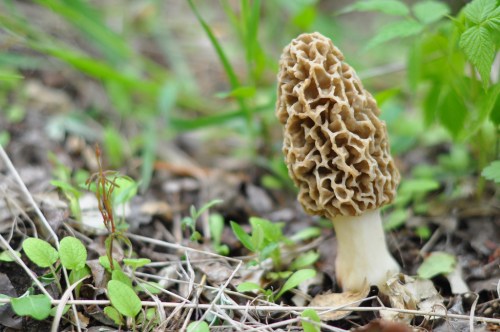
Morel in the Wild: The 2013 Season is upon us!

morel in the wild

morel in the wild, photo by the little red hen

Reports are trickling in from around the state about morels, including some tasty photos from yesterday of morels folks are finding on the Michigan Morel Facebook. Michigan in Pictures has a ton of morel mushroom information to help you find these elusive but delicious delicacies.

Check this out on black and see more in Lynn’s In the kitchen… slideshow.

Speaking of slideshows, don’t miss the morel slideshow in the Absolute Michigan pool on Flickr!

Poe Reef Lighthouse

Poe Reef Light

Poe Reef Light, photo by joeldinda

Terry Pepper has (as usual) a very detailed entry for Poe Reef Lighthouse on his Seeing the Light website. This crib style lighthouse is located off Bois Blanc Island in Lake Huron. The reef is very close to the surface and posed a significant threat to navigation until the decision was made in the 1890s to anchor a lightship there. This served until Lighthouse Service decided to build a permanent station on Poe Reef in 1927:

The station building at Poe Reef was to be an exact duplicate of that which the crew had previously completed at Martins Reef. The main twenty-five foot square structure consisted of a steel skeletal framework to which an exterior sheathing of riveted steel plates was applied. Thirty-eight feet tall, it contained three levels, or “decks”, as the crews assigned to the station knew them. The two upper decks were set up as living quarters, while the main lower deck served as housing for the machinery required for powering the lights, heating system and foghorn.

Centered atop the main structure stood sixteen-foot square, ten-foot high watch room of similar construction, with a single observation window on each side. Finally, a decagonal cast iron lantern room was installed on the roof of the watch room, and outfitted with a Third Order Fresnel lens. The combination of pier and tower provided the Fresnel with a seventy-one foot focal plane, and a visibility range of almost twenty nautical miles in clear conditions. Work was completed at the station and the light exhibited for the first time on the evening of August 15, 1929.

At some point in time, in order to eliminate the possibility of the Poe Reef Light being mistaken for the identical all white structure at Martin Reef, the main deck and watch room of the Poe structure were given a contrasting coat of black paint.

Terry has some cool shots of this light as well including this wide shot with cormorants.

Check Joel’s photo out background bigtacular and see more shots from Poe Reef and elsewhere in his Lighthouses slideshow.

More Michigan lighthouses on Michigan in Pictures.