
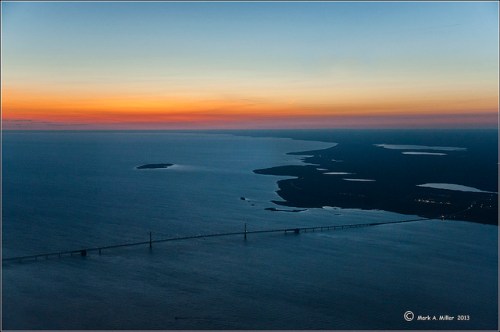
Straits of Mackinac, photo by GLASman1
A gorgeous view of a beautiful bridge. Definitely check it out bigger and see more in Mark’s slideshow.
Much more about the Mackinac Bridge on Michigan in Pictures!
Straits of Mackinac, photo by GLASman1
A gorgeous view of a beautiful bridge. Definitely check it out bigger and see more in Mark’s slideshow.
Much more about the Mackinac Bridge on Michigan in Pictures!
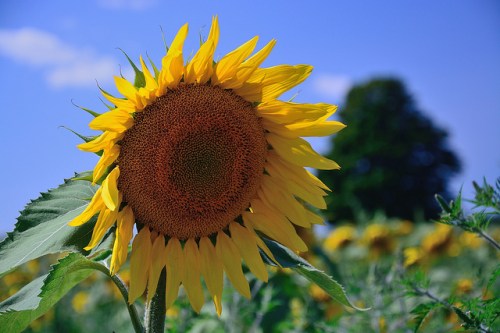
Mr. Sunshine…, photo by Dr. Farnsworth
Michigan Gardener is a fantastic site that can give you all kinds of help with what to put in your garden and how to make it grow. They have a nice article about sunflowers featuring Bob Koenders, owner of the Backyard Bouquet Farm. It begins:
According to the Michigan Department of Agriculture, in 1997 there were 32 farms growing sunflowers on 1,522 acres, and by 2002 there were 91 farms with 2,275 acres. Most of the fields of open sunflowers are oil seed type, grown for oil or seed (for birds or humans). Their heads were bred to hang down, making it more difficult for birds to eat the seeds and rain to ruin the harvest.
…According to the National Sunflower Association, the wild sunflower is native to North America, but commercialization of the plant was done by Russia. It was only somewhat recently that the sunflower plant “returned” to America. Native Americans first developed the wild sunflower into a single-headed plant with a variety of seed colors including black, red, white, and striped black and white. Some archeologists suggest that sunflowers may have been domesticated before corn. The Native Americans used the sunflower seed for grinding into flour, trail snacks, purple dyes, body painting, ceremonial, and medicinal uses. Sunflower oil was used for making bread, as well as on skin and hair. The dried stalks were even used for building materials.
They add some fun facts about sunflowers:
Read on for lots more including tips about growing sunflowers and get tons more sunflower info from the National Sunflower Association.
Check Dale’s photo out background bigtacular and see more in his Flower slideshow.

Eastern Tiger Swallowtail Butterfly (Saline, Michigan), photo by cseeman
The University of Michigan Animal Diversity Web entry for the eastern tiger swallowtail butterfly (Papilio glaucus) says in part:
The eastern tiger swallowtail ranges from Alaska and the Hudsonian zone of Canada to the southern United States, east of the Rocky Mountains.
This species occurs in nearly every area where deciduous woods are present, including towns and cities. It is most numerous along streams and river, and in wooded swamps.
As with most butterflies, Eastern tiger swallowtails tend to be solitary. Males “patrol” for a mate, flying from place to place actively searching for females. “Patrolling” male tiger swallowtails can recognize areas of high moisture absorbtion by the sodium ion concentration of the area. It is believed that the moisture found by these males helps cool them by initiating an active-transport pump. Both male and female tiger swallowtails are known to be high fliers. Groups of fifty butterflies have been spotted in Maryland flying 50 meters high, around the tops of tulip trees.
The tiger swallowtail is thought of as the American insect, in much the same way as the Bald Eagle is thought of as the American bird. It was the first American insect pictured in Europe; a drawing was sent to England from Sir Walter Raleighs’ third expedition to Virginia.
You can read on for more including photos. I also found a page with a listing of Michigan butterflies and apparently we have eight species of swallowtail butterfly. You can also see some great eastern swallowtail photos from Butterflies & Moths. Spoiler alert: the female can look a lot different.
Corey writes that he got this shot at the butterfly bush he planted this year. Check it out background big and see more great shots of this fellow in his butterfly slideshow.

Scarab Club Detroit, photo by Vasenka Photography
The Scarab Club explains that:
The Scarab Club was founded in 1907 by a group of artists and art lovers who enjoyed meeting regularly to discuss art and socialize. The desire to form an arts organization in Detroit during the first third of the 20th century was partially intertwined with the birth of automotive design and the evolution of advertising art inspired by the burgeoning automobile industry. Although generally viewed as a heavily industrial city, Detroit’s artistic community thrived from the success of the automobile.
Many of the original founding members of the Scarab Club consisted of automotive designers, advertising illustrators, graphic artists, photographers, architects, and automobile company owners. Scarab Club members inspired each others’ artistic spirit by entering their artwork in the Annual Exhibition of Michigan Artists held at the Detroit Institute of Arts under the auspices of the Scarab Club from 1911 to 1928 and the DIA from 1929 to 1974.
The club’s themed costumed balls, which began in 1917, were a significant social event in Detroit. Life Magazine covered the 1937 Ball featuring a two-page photo spread. The Detroit News and The Detroit Free Press published two pages of photogravures of costumed guests beginning in 1917.
The energy of the Club continues to the present day, hosting events like the costumed Scarab Club balls, art lectures & openings, live music and more. Read on at scarabclub.org where you can check out some of their photos of the building and the artwork and a great timeline of the club. I dug up an old video of one of their costumed balls that was themed “Inferno” that’s pretty cool.
Check out Vasenka’s photo background bigtacular and jump into his slideshow for more great shots from this cultural treasure.
More art on Michigan in Pictures.
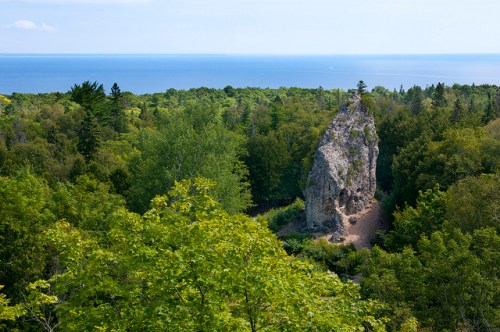
I was surprised to learn that I haven’t posted anything about Sugar Loaf on Mackinac Island. Here’s a summary with help from Wikipedia’s entry for Sugar Loaf Rock, the Mackinac State Historic Parks geology page and some other sources I’ve linked to.
Located not far from the shoreline on the east side of Mackinac Island, Sugar Loaf is a 75′ breccia limestone stack. Thousands of years ago Lake Algonquin covered all but the center of Mackinac Island. When it receded, this tower of rock remained. The people of the region packed maple sugar into cone-shaped baskets of birchbark, and Sugar Loaf Rock was named for its resemblance to one of these cones.
Sugar Loaf was said by some to be the home of Gitchi Manitou, while another tale explains that the rock was the final form taken by a man who asked for immortality and received it, albiet not as he expected. A distinct profile remains in the limestone face of Sugar Loaf Rock. The rock was also used as a site of ritual burials. In 1831, Alexis de Tocqueville and his friend Gustave de Beaumont visited Mackinac Island. De Beaumont reported that the rock was filled with “crevices and faults where the Indians sometimes deposed the bones of the dead.” A natural cave passes through Sugar Loaf from side to side, but it’s too small for any but children.
Check out Anna Lysa’s photo out bigger and see more in her Mackinac Island slideshow.
More from Mackinac on Michigan in Pictures!
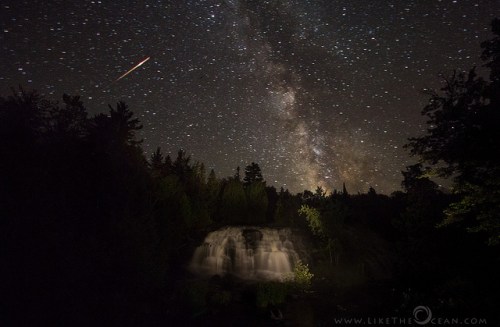
Milky Way over Milky Falls with a dash of Perseids, photo by Like The Ocean
“I am beginning to love the stars too fondly to be fearful of the night.”
~Sathya R.
I hope that you had a chance to catch the annual show that is the Perseid Meteor Shower. In Chasing the Perseids at his blog Like the Ocean, Saytha writes:
45 hours on the road with just few hours of sleep, in search of that one spot to capture the Perseids. The lashing rain, the forecasted aurora that never turned up and the hide and seek with the clouds – it was all fun. Was it all worth it, you bet! The road trip took me to one of the darkest skies of Mid Western US – Bond Falls. Would like to share with you a moment in time from that night. This was one of the two meteor I was able to capture on frame, but loved how everything came together in this shot. I do love when a plan comes together :)
The deafening sound of 500 gallons of water / second from 50 feet
The tranquil silence of the dark night
Milky way adorning the skies
A (Perseids) meteor fireball streaking across the horizon
Definitely a moment of serenity and one I would cherish!
Read on at Like the Ocean Photography, check this photo out bigger and see more in his awesome Nightscape slideshow.
More about Bond Falls at Michigan in Pictures.
IMPORTANT NOTE: Mushrooms can be dangerous and even deadly! Be careful and know what you’re eating. As the saying goes: “There are old mushroom hunters, and bold mushroom hunters, but there are no old, bold mushroom hunters.”

Black Trumpet, photo by I am Jacques Strappe
The Michigan Morel Hunters Club features mushrooms that are in season in their Mushroom of the Month. One of the late summer mushrooms they have highlighted are Black Trumpets (Craterellus cornucopioides):
Black Trumpets (aka horn-of-plenty) mushrooms are a wonderful edible mushroom that grows in Michigan from July through September. They are fragile mushrooms that look like a cornucopia (horn-of-plenty) or maybe like trumpets but are black or gray instead of gold. Despite somewhat funereal descriptions and European names (trompette de la morte in French and trombetta dei morti in Italian), they are very tasty mushrooms that can be widely used in cooking. They are strongly flavored mushrooms with a fragrant aroma. Their strong flavor and aroma allows them to be used in a wide variety of dishes. Though they are difficult to find, they are definitely worth pursuing. Fortunately, they grow in clusters so there often are many where one is found.
…Trumpets are ideal for sophisticated dishes because of their fragrant aroma and strong flavor. Because of their fragrant aroma they are often dried and pulverized for use as a seasoning for everything from soup to steak. They are very easy to dry requiring only a few hours in a dehydrator or a couple of days of open air drying. They are delicious sautéed in butter with parsley and chives as a side dish.
Read more at the MMHC including how to identify them. A good thing is that the only similar mushroom (black chantarelle) is also edible! Also check out these black trumpet photos and ID tips at MushroomExpert.com.
Marjorie says that they found a grove of these tasty critters and harvested a large bag full of them … and that they smell like apricots. View her photo bigger and see more in her surprisingly large fungus & lichen slideshow. There’s lots more from Marjorie on Michigan in Pictures including her multi-day Michigan Photographer Profile.
More mushrooms on Michigan in Pictures!
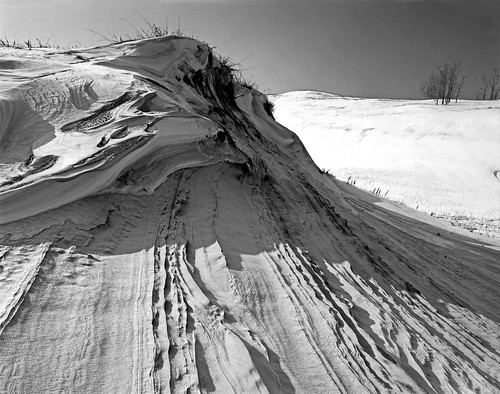
Sleeping Bear Winterscape, photo by ManualFoci
We interrupt this summer to check in with winter. James writes:
I’ve been visiting Sleeping Bear Sand Dunes all my life but it wasn’t until I was an adult photographer that I hazarded a trip up to our northern Michigan National Lakeshore landmark in the depths of Winter. I was confident it would be awesome and I wasn’t disappointed. Driving north on Route 22 from the little town of Empire I turned left onto South Dune Highway and soon could see Glen Lake to my right and Sleeping Bear Sand Dunes to my left. The Visitors Bureau is officially closed in Winter and so I parked my Cherokee at the side of the road and proceeded on foot along Hunter Road to the base of the mountainous dunes. Ahead of me was the leeward side of the dunes and as such they are steep. Part way up I saw an ominous sign that read “Avalanches Stay Off”. I noticed that there were other brave souls already on the dunes and so I figured it was safe to climb.
With Linhof camera on Gitzo tripod and a 35 pound Domke camera bag the climb up the dune was a challenge. Flat, and with small undulating hills punctuated by the occasional tuft of intrepid dune grass, the top of the dunes resemble the high desert plains of the southwest. As if trying to brave the frigid gale winds of nearby Lake Michigan, the sandy hills had solidified into rows of spiny ridges with the top of the hill resembling a marble cake with layer upon layer of sand and ice. In the distance the luminous midday sun lit a gently sloping bank upon which a barren stand of trees proudly stood. I moved my gloveless hands frantically over tilt and swing controls and finally turned the aperture ring to F22. The wind chill was well below zero. I snapped off but two 4 X 5 exposures and quickly donned my Baxter gloves to venture off in search of another Sleeping Bear winterscape.
Check this out background bigtacular and in his A Great Lakes Love Affair slideshow.
You can check out the Sleeping Bear Dunes National Lakeshore website and see more black & white photography on Michigan in Pictures.

Along the Trail, photo by nasunto
Michigan in Pictures regular Nina Asunto is posting trip reports about her trip at the end of June to the Pictured Rocks National Lakeshore. In Day One: Chapel / Mosquito Trailhead to Chapel Beach she writes about a common June annoyance in the Upper Peninsula that this year proved more that annoying:
We arrived at Chapel Beach campground just before noon and had to put our bug nets on as soon as we got there. The campground consists of six sites, which are in the woods at the top of a bluff above Lake Superior. One of them (#6) is at the edge of the woods, and it is close enough to the beach to benefit from the breeze coming from the lake. This site was already occupied, of course, so we chose site #3, which was further into the woods. Under normal circumstances, this would be a really good campsite, with Chapel Creek running alongside it creating a nice atmosphere. Unfortunately, the exceptionally wet spring had ensured that this typically buggy season far exceeded expectations. The word “brutal” doesn’t quite do it justice – it was a buzzing hell-scape. The only thing to do was to set up camp as quickly as possible and flee to the beach.
Curiously enough, I was also in the UP and stopped at Pictured Rocks that weekend. Without Deep Woods Off, I am pretty sure I would have ended up a bloodless corpse! Click to read more (including her analysis of permethrin vs mosquitos). Follow along as Nina posts the rest of the report on Black Coffee at Sunrise.
Check it out bigger and see more in Nina’s Pictured Rocks National Lakeshore | June 2013 slideshow.

Northern Water Snake, photo by Brian Laskowski
The Michigan Department of Natural Resources page on the Northern Water Snake says:
Description: A water snake with dark bands or blotches on a light brown or gray background color. Some old adults may appear solid black or brown. The belly is white with reddish half moon shaped markings; some specimens have an orange belly speckled with brown or black. (The endangered Copper Bellied Water Snake has an unmarked reddish or orange belly.) Adult length: 2 to 4 feet.
Habitat and Habits: These snakes inhabit the shorelines of lakes, ponds, or streams. They swim well, seeking food (frogs and fish) and safety in the water, and often bask on objects hanging over the water. Water snakes are not venomous, but will bite if cornered or handled. They are sometimes mistakenly called “water moccasins” (which are not native to Michigan).
Reproduction: Females give birth to their 7 to 9 inch young in late summer. There are 8 to 48 babies in a litter. The young are gray or brown with bold black bands.
Range and Status: Northern water snakes are found throughout the Lower Peninsula and the eastern Upper Peninsula. Needless persecution by humans has eliminated water snakes from many places where they were once common.
The DNR’s Michigan Snake Page adds that there are just 17 species of snake in Michigan, so do what you can to protect this snake and its kin.
Check it out bigger and see more in Brian’s Michiganscapes slideshow.
More Michigan snakes on Michigan in Pictures.
 Michigan in Pictures