Mr. Shutdown comes to Michigan

North Bar Overlook by Ken Scott
North Bar Lake … overlook by Ken Scott

A taste of the Shutdown’s impact on Michigan via Leelanau.com…

The TC Ticker reports that the federal government shutdown that began at midnight has closed portions of the Sleeping Bear Dunes National Lakeshore:

A park representative said gates will be closed on the park’s campgrounds, bathrooms and popular Pierce Stocking Scenic Drive until the shutdown ends, though visitors may still access the park’s hiking trails and lakeshore(our emphasis)

Sleeping Bear Dunes is one of five national parks in Michigan affected by the shutdown, a move that comes at an unfortunate time for tourism-dependent parks nearing the end of their operating seasons. The Leelanau County attraction, which will operate with a skeleton crew of emergency-only personnel until the shutdown has ceased, normally averages 2,300 visitors a day during the fall season, according to park reports.

The Freep reports that a similar scenario will unfold at other Michigan National Parks with Isle Royale & River Raisin Battlefield Park closing early for the season. Let me stress that you can still enjoy the majority of our parks and trails. In other Michigan-specific news, about 900 Michigan National Guard members are bracing for a furlough notice and training for another 12,000 will be put on hold. More details on the shutdown’s impact on Michigan at mLive.

Check Ken’s photo – taken at a location that will be inaccessible – out bigger and see more in his massive Panoramas slideshow.

Mackinac Harbor Sunset

Mackinac-Island-Sunset

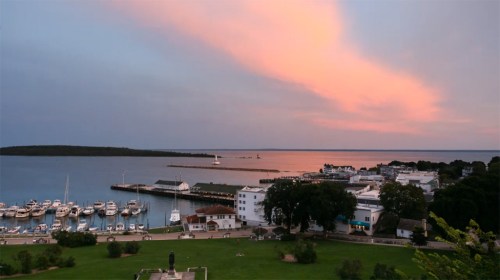
Sunset over Mackinac Island Harbor, photo by Stephanie Stevens Photography

Today’s photo is actually one frame of one of the coolest time-lapses I’ve seen, a time-lapse of Mackinac Island Harbor at the end of the day taken from Fort Mackinac that shows the end of the day boat traffic, the clouds playing across the harbor and even a little glow in the dark frisbee at Marquette Park! Click that link to check it out in HD glory on Flickr!

View more from Stephanie on her Flickr and at Stephanie Stevens Photography.

More Mackinac on Michigan in Pictures!

Charging into the Post-season: Detroit Tigers Clinch Central

Alex Avila

Alex Avila, photo by Keith Allison

On Wednesday night the Detroit Tigers clinched their 3rd straight American League Central crown on the strength of 7 shutout innings by presumptive AL Cy Young candidate Max Scherzer. It looks right now like the Tigers will open the playoffs in Oakland, facing the As once again.

Here’s 10 reasons why the Tigers are returning to the post-season!

Check Keith’s photo of Tiger catcher Alex Avila out bigger and see more in his Detroit Tigers slideshow.

Lots more Detroit Tigers on Michigan in Pictures!

Orange is the new … orange

Orange is the new orange

_JMC1593aw, photo by Jeff Caverly

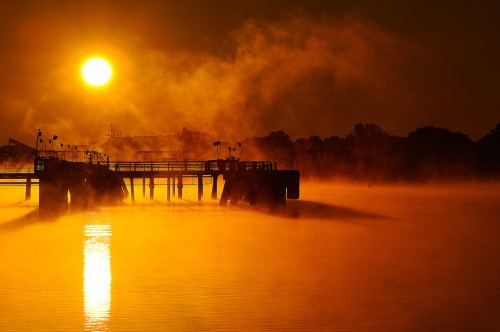
Sunrise on the Saginaw River in Bay City.

Check Jeff’s photo out background big and see more in his slideshow.

More sunrises on Michigan in Pictures.

The Sky Walker of Huron

"Winter Moon" Sturgeon Point , Lake Huron

“Winter Moon” Sturgeon Point, Lake Huron, photo by Michigan Nut

Myths and Legends of our Own Land by Charles M. Skinner (1896) has some incredible stories from Michigan’s first people. Here’s The Sky Walker of Huron:

Here is the myth of Endymion and Diana, as told on the shores of Saginaw Bay, in Michigan, by Indians who never heard of Greeks. Cloud Catcher, a handsome youth of the Ojibways, offended his family by refusing to fast during the ceremony of his coming of age, and was put out of the paternal wigwam. It was so fine a night that the sky served him as well as a roof, and he had a boy’s confidence in his ability to make a living, and something of fame and fortune, maybe. He dropped upon a tuft of moss to plan for his future, and drowsily noted the rising of the moon, in which he seemed to see a face. On awaking he found that it was not day, yet the darkness was half dispelled by light that rayed from a figure near him—the form of a lovely woman.

“Cloud Catcher, I have come for you,” she said. And as she turned away he felt impelled to rise and follow. But, instead of walking, she began to move into the air with the flight of an eagle, and, endowed with a new power, he too ascended beside her. The earth was dim and vast below, stars blazed as they drew near them, yet the radiance of the woman seemed to dull their glory. Presently they passed through a gate of clouds and stood on a beautiful plain, with crystal ponds and brooks watering noble trees and leagues of flowery meadow; birds of brightest colors darted here and there, singing like flutes; the very stones were agate, jasper, and chalcedony. An immense lodge stood on the plain, and within were embroideries and ornaments, couches of rich furs, pipes and arms cut from jasper and tipped with silver. While the young man was gazing around him with delight, the brother of his guide appeared and reproved her, advising her to send the young man back to earth at once, but, as she flatly refused to do so, he gave a pipe and bow and arrows to Cloud Catcher, as a token of his consent to their marriage, and wished them happiness, which, in fact, they had.

This brother, who was commanding, tall, and so dazzling in his gold and silver ornaments that one could hardly look upon him, was abroad all day, while his sister was absent for a part of the night. He permitted Cloud Catcher to go with him on one of his daily walks, and as they crossed the lovely Sky Land they glanced down through open valley bottoms on the green earth below. The rapid pace they struck gave to Cloud Catcher an appetite and he asked if there were no game. “Patience,” counselled his companion. On arriving at a spot where a large hole had been broken through the sky they reclined on mats, and the tall man loosing one of his silver ornaments flung it into a group of children playing before a lodge. One of the little ones fell and was carried within, amid lamentations. Then the villagers left their sports and labors and looked up at the sky. The tall man cried, in a voice of thunder, “Offer a sacrifice and the child shall be well again.” A white dog was killed, roasted, and in a twinkling it shot up to the feet of Cloud Catcher, who, being empty, attacked it voraciously.

Many such walks and feasts came after, and the sights of earth and taste of meat filled the mortal with a longing to see his people again. He told his wife that he wanted to go back. She consented, after a time, saying, “Since you are better pleased with the cares, the ills, the labor, and the poverty of the world than with the comfort and abundance of Sky Land, you may return; but remember you are still my husband, and beware how you venture to take an earthly maiden for a wife.”

She arose lightly, clasped Cloud Catcher by the wrist, and began to move with him through the air. The motion lulled him and he fell asleep, waking at the door of his father’s lodge. His relatives gathered and gave him welcome, and he learned that he had been in the sky for a year. He took the privations of a hunter’s and warrior’s life less kindly than he thought to, and after a time he enlivened its monotony by taking to wife a bright-eyed girl of his tribe. In four days she was dead. The lesson was unheeded and he married again. Shortly after, he stepped from his lodge one evening and never came back. The woods were filled with a strange radiance on that night, and it is asserted that Cloud Catcher was taken back to the lodge of the Sun and Moon, and is now content to live in heaven.

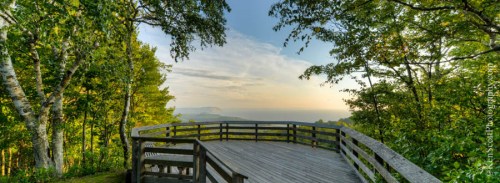
Check John’s photo out bigger and see more in his Lake Huron slideshow.

More Lake Huron on Michigan in Pictures.

South Manitou Island Lighthouse

South Manitou Lighthouse

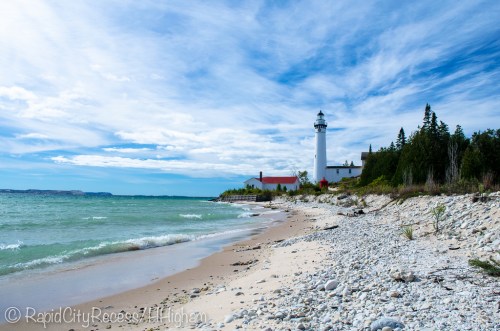
South Manitou Lighthouse, photo by HLHigham

Terry Pepper’s Seeing the Light is a tremendous resource for Michigan lighthouse information. His entry on the South Manitou Island Lighthouse begins:

Located just off the mainland coast of Lake Michigan’s east coast, a group of islands known as the Beaver Archipelago form a chain which marked the western edge of a tight passage along the coast. Known as the “Manitou Passage,” vessel masters taking this narrow passage were able to reduce the travel distance between the ports of Lake Michigan’s southern shore and the Straits of Mackinac by sixty miles, as opposed to taking the more circuitous route through open water to the west of the islands. As the most southerly of this chain of islands, South Manitou also featured one of the areas safest natural harbors, and with 5,260-acres of fine timber growth covering the island, it is not surprising that a few enterprising settlers arrived during the mid 1830’s to sell firewood to steamers taking shelter in the harbor when things turned sour out in the lake. By the late 1830’s it was commonplace to find upward of fifty vessels crowded into the harbor seeking refuge and taking-on supplies when things turned sour out in the lake.

Lying a scant few miles west of Sleeping Bear Point, mariners were hard pressed to locate the southern entrance to the busy passage at night or in times of thick weather, and a cry arose throughout the maritime community to light the southern entrance to the passage. Taking up their call on February 19, 1838, Michigan State Representative Isaac Crary entered a motion before the House of Representatives to erect a lighthouse on South Manitou, and fully cognizant of the vital role played by maritime commerce in the area, Congress responded quickly with an appropriation of $5,000 for the station’s construction on July 7 of that same year.

You can read on at Seeing the Light for the troubled saga of this light which saw high keeper turnover and some tragedy in its long tenure before being decommissioned in 1958. There’s also historical photos like this one showing the structure in full operation.

The light & South Manitou Island are now part of the Sleeping Bear Dunes National Lakeshore. Click that link for visitor information and also check out this satellite view of the South Manitou Light!

Check this out background bigtacular and see more shots of the light and the island in Heather’s South Manitou Island slideshow.

Many more lighthouses on Michigan in Pictures!

Kawkawlin River: the Place of the Pike Fish

Kawkawlin River

Kawkawlin River, photo by conradthedog

A Brief History of the Kawkawlin River from the Kawkawlin Watershed Property Owner Association says that the native name for Kawkawlin was U GUH KON NING or ‘place of pike fish’. They add that the Saginaw Treaty of 1819 was negotiated by Lewis Cass with the Chippewa Indians and opened the lands of Saginaw Valley to settlers for $1.25 per acre and have lots more history & information at the link above.

Check out Jon’s photo background big and see more in his Michigan slideshow.

Many more rivers on Michigan in Pictures.

Mendota Channel Light aka Bete Grise Lighthouse

Bete Grise Lighthouse by Steve Nowakowski

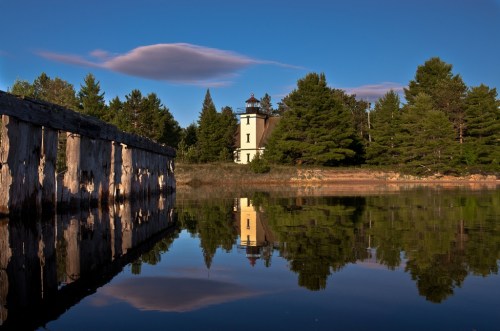
Bete Grise Lighthouse, photo by Steve Nowakowski

Terry Pepper’s Seeing the Light page for the Medota Channel Light says that in response to increasing industrialization around Lac LaBelle, a cut was created from the Lake Superior into Lac LaBelle to allow access to the big ships that plied the Great Lakes.

As a result, the construction of the Mendota Light was first considered by the US Congress in 1867, when an appropriation of $14,000 for the construction of a light station was approved on March 2, with the terms of the contract called for construction of the structure to begin in 1869, with final completion no later than November 1870.

Later that year, it was realized that declining industrial development in the area would no longer support the planned deepening of the cut into Lac Labelle, and it was deemed that the light would serve no purpose. Decommission was ordered, and instructions to dismantle the structure were issued to the crew of the steamer “Haze,” with all equipment to be returned to USLHS headquarters in St. Joseph for eventual reuse. (The lens and mechanics were later reused in the Marquette Breakwater light.)

Thus, the Mendota light station was decommissioned before it saw real service, and the structure sat idle and blinded for the following twenty two years.

In the following years, Great Lakes shipping increased dramatically, and many ships rounding the Keweenaw began using Bete Grise Bay as a shelter during rough seas. In 1892 it was determined that a reactivation of the Mendota light, along with relocation closer to the bay would make bay entry a far safer proposition for such ships seeking shelter. Authorization for reactivation was issued on February 15, 1893, and $7,500 was appropriated to cover the expenses.

Read on for more about this light.

Check Steve’s photo out background bigtacular and see more in his Bete Grise Lighthouse slideshow.

There’s lots more lighthouses on Michigan in Pictures and you might also want to check out the vantage from Bare Bluff on Bete Gris Bay!

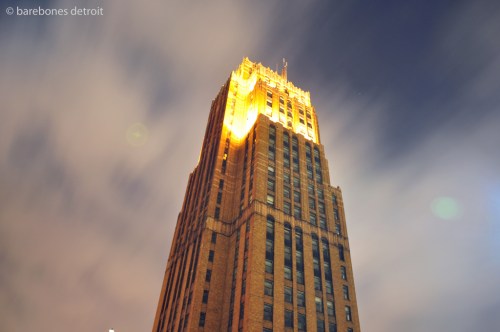
Sunshine on the Stott: Detroit’s David Stott Building Purchased

Untitled
Untitled, photo by BareBonesDetroit

Last week the David Stott Building, Detroit’s 13th tallest skyscraper, sold at auction for just under $9 million. Historic Detroit’s page on the David Stott Building begins:

A towering Art Deco structure honoring Detroit’s flour king, the David Stott Building stretches 38 stories above Capitol Park at the corner of State and Griswold streets.

Construction began on June 1, 1928. The tower cost $3.5 million to build – the equivalent of $46.3 million today, when adjusted for inflation, according to the Bureau of Labor Statistics.

The Stott opened on June 17, 1929, on what had been the sites of the Garrick Theatre, Hodges Building and the Whitney Office Building. It was designed by the architectural firm of Donaldson & Meier, though Henry Meier had died more than a decade earlier. The general contractor was the Martin & Krausmann Co.

The 436-foot tower was first conceived in 1921, and 22 sets of plans were drawn up before a winner was picked. The property was not particularly wide considering the building’s height, which created headaches for Donaldson and led him to go with a tall, slender design.

The tower is made of reddish-orange brick – faced on the first three floors with marble — and limestone, and has several setbacks that taper as the building climbs. “As the new David Stott Building rises a tall, slender but substantial mass of old rose colored brick, it makes a spectacle that arrests the attention and causes the spectator to view it in detail from the sidewalk to the uppermost of its 38 stories,” the Detroit News wrote in June 1929. “The tendency of architectural style in office buildings the country over is toward more lively colors — more lively, but still dignified, warm, pleasing to the eye.”

Read on for more of the history of this hard-luck structure and DEFINITELY click through to view their gallery of historic photos of the David Stott Building – it’s great! You can also follow the listing and sale of the Stott Building at Curbed Detroit.

Check it out bigger and see more in BareBones Detroit’s Rooftops slideshow.

More architecture on Michigan in Pictures.

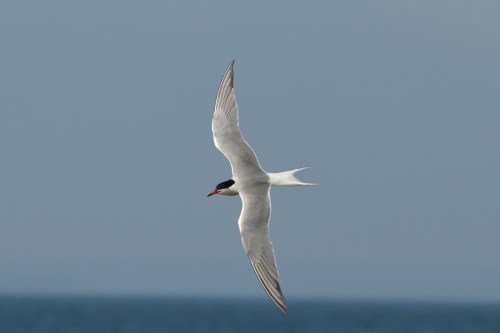
The Turn of the Tern

Turn of the tern

Turn of the tern, photo by MI photographer

The Michigan DNR says that the common tern (Sterna hirundo) is a small colonial waterbird and one of four breeding species of terns in Michigan (Caspian, black, common, and Forster’s terns):

Common terns are white with a black cap, and pale gray back and wings. Their bill is red orange with a black tip. The tail is deeply forked and dark along the outer edges. Immature common terns and adults in their winter plumage have only a partial black cap. It can be distinguished from its close relative the gull by a smaller body size and longer wings. The common tern’s call is a rolling ter-arr and rapid kip-kip-kip.

Common terns are frequently seen hovering in the air over a school of fish. With a sudden plunge downward into the water, they seize fish with their bills. Sometimes they will dive entirely below the surface of the water. Terns eat small fish such as shiners, chubs, and other minnows. They will also eat crustaceans and occasionally, insects such as dragonfly nymphs.

Their winter migration takes these birds to the Atlantic coastal areas in Florida, the Caribbean, and South America. They return to their nesting sites in early spring.

Arriving on their breeding grounds in May, common terns nest in colonies of 10 to 1,000 breeding pairs. They prefer sandy, well drained areas away from mammalian predators and human disturbances. Currently, common terns are using natural and human made islands in the Great Lakes with a few nesting on inland lakes. Common terns construct their nests by creating a depression in the sand with their feet, smoothing and shaping it by sifting in it and turning their bodies. Egg laying and incubation lasts until late June or early July. Both adults take turns sitting on the nest. The adults defend the eggs and young fiercely, diving at intruders, and even striking them with their bills.

Once numbering over 6,000 breeding pairs in Michigan, common terns were found on every Great Lakes shore. Data from 1992 suggest that the population has decreased to an estimated 1,400 breeding pairs. Several factors have contributed to this decline including loss of habitat, competition with gulls, predation, and effects of contaminants. As a result of these factors, the common tern was officially listed in Michigan as a “threatened species in 1978 and has recently undergone a status assessment by the US Fish and Wildlife Service in the Great Lakes for possible listing as Federally endangered.

You can read on for more including information about the huge breeding colony on Lime Island. Also see the Common Tern Sterna hirundo from the Audobon Society andCommon Tern at All About Birds.

William caught this photo off the coast of Mackinac Island in Lake Huron. Check it out bigger and see more shots of this beautiful bird his Mackinac Island slideshow.

Many more Michigan birds on Michigan in Pictures.