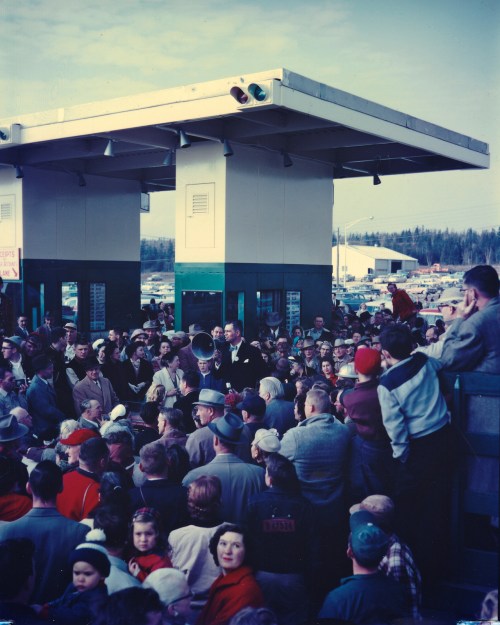
Opening the Mackinac Bridge, November 1, 1957

Opening of Mackinac Bridge - November 1, 1957

Opening of Mackinac Bridge – November 1, 1957, photo by daveumich

An Absolute Michigan feature via Michigan History Magazine on the opening of the Mackinac Bridge on November 1, 1957 says (in part):

With the bridge ready for traffic, but fearing inclement autumn weather at the Straits, officials decided to have an official “opening” on November 1, 1957, but an official “dedication” in late June of the following year.

Amazingly, the weather on the first day of November (preceded by two days of rain and fog) was sunny and pleasant. However, the weather in late June was so cold and wet (with six-foot waves on the Straits) that some of the events were shortened or canceled altogether. According to one observer, it “was a bleak, gray day, more like March than June, and the only parader who looked happy was a snow queen from Cadillac, who rode on an ice throne float, throwing snowballs made of popcorn.”

…On November 1, after paying the $3.25 toll (taken symbolically by former U.S. Senator Prentiss Brown, who chaired the Mackinac Bridge Authority), Governor G. Mennen Williams crossed the bridge (driven in a car by Mrs. Williams because the governor had forgotten his driver’s license). Then, according to United Press International correspondent Thomas Farrell, cars lined up for one mile on both sides of the Straits “swarmed” on to a bridge whose size “staggers the imagination.”

In his opening day remarks, Governor Williams predicted that the bridge would add $100 million annually to the state’s tourist trade. He continued, “Michigan at last is to be one state, geographically, economically and culturally, as well as politically.”

I think we can probably agree that it’s had a tremendous impact on Michigan! About this photo with a unique view of the festivities, Dave writes:

A friend found this large format color slide earlier this year and I scanned it at high resolution. It shows Governor G. Mennen “Soapy” Williams at the tollbooths on the St. Ignace end of the Mackinac Bridge on the day it opened, November 1, 1957. I have seen many photos of this day, but never one quite like this.

Be sure to check this out big as the Mighty Mac to see the faces in the crowd and jump into Dave’s slideshow for more.

Michigan in Pictures has lots more on the Mackinac Bridge and you can get a comprehensive look at the bridge on the 50 Year feature on the Mackinac Bridge at Absolute Michigan.
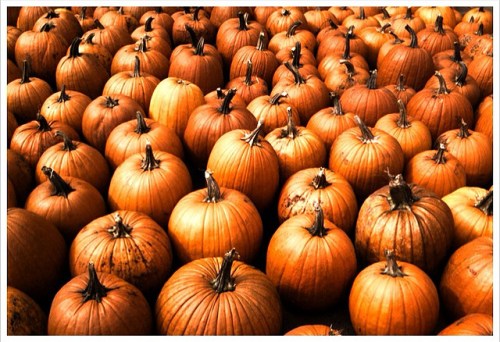
The Pumpkin Armada

Happy Halloween!

Happy Halloween!, photo by jnhkrawczyk

If you’re still in the market for pumpkins, check out this listing of Michigan pumpkin patches, hayrides & corn mazes.

Jill took this shot at Parmenter’s Cider Mill in Northville. View it bigger and see more in her Halloween slideshow.

More pumpkin info on Michigan in Pictures!

Misty Moonrise at Tahquamenon

Misty Moonrise

Misty Moonrise, photo by ShaneWyatt

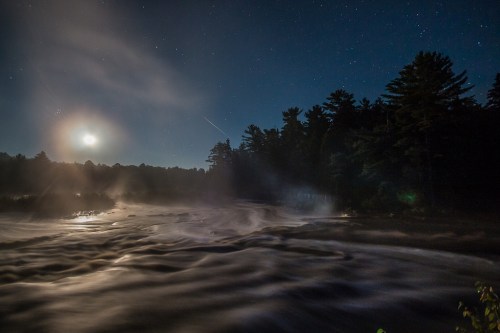
Here’s a gorgeous shot of the moon rising over the mist of Lower Taquamenon Falls – Shane caught a shooting star too!

View his photo bigger and see more including another night shot at the falls in Shane’s stars slideshow.

Wonder Years

Wonder Years

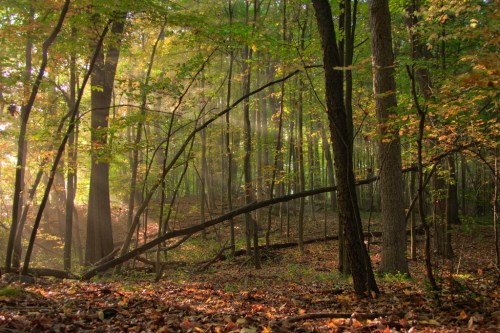
Wonder Years, photo by Aaron Springer

“Sell your cleverness, and buy bewilderment”
– Rumi

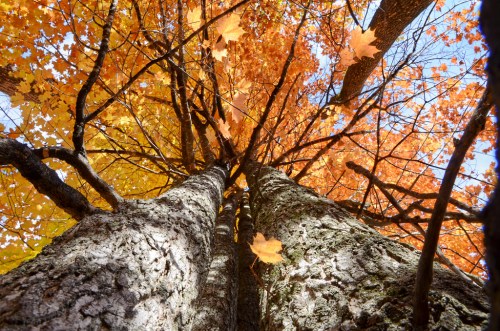
Good advice – here’s hoping you can afford a little bewilderment.

Check Aaron’s photo out bigger and see more in his fall slideshow.

Lots more fall color on Michigan in Pictures.

Kroll’s Service

Untitled

Untitled, photo by J.M.Barclay

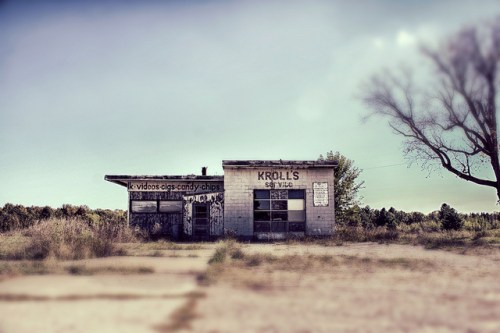
Guessing the repair is going to take a while…

View J.M.’s photo bigger and see more in his slideshow.

One of many at Forty Mile Point

EDIT: WOW!! Check out the video that Tudor did at Forty Mile Point, The Grand Hotel and Fort Mackinac!

2013_10_11-WTA-5DM3-4448

2013_10_11-WTA-5DM3-4448, photo by Tudor ApMadoc

Wikipedia’s U.S. Lighthouses entry says that the United States has had approximately a thousand lights as well as light towers, range lights, and pier head lights. With the second longest coastline in the U.S. and a history of vibrant trade across the Great Lakes, it makes sense that Michigan has the most lights of any state with over 150 past and present lights (166 by their count and as many as 247 by some). While the current number varies depending on who you talk to, 115 seems to be the accepted number.

Terry Pepper’s Seeing the Light is a fabulous guide to the lighthouses of the Great Lakes and definitely a resource to review before you visit a Michigan lighthouse. The Forty Mile Point Light entry in explains:

While the Presque Isle Peninsula had been lighted since 1840, and the entrance to the Cheboygan River fifty miles to the north had been lighted since 1851, the New Presque Isle Light’s range of visibility of 19 miles and the Cheboygan Light’s visible range of 13 miles left an unlighted 18 mile intervening stretch of coastline along which mariners were forced to navigate blind. In it’s annual report for fiscal 1890, the Board recommended that $25,000 be appropriated for the construction of a new light and fog signal at Forty Mile Point near Hammond’s Bay, at the approximate mid point between the two lights.

(the project languished for nearly 60 years until…)

Eleventh District Engineer Major Milton B. Adams selected and surveyed the site for the new Light. With an offer of $200 for the property accepted by the owner, Adams approved the plans and specifications for the station in February 1896. Contracts for the ironwork for the lantern, gallery, boilers and fog whistles were awarded soon thereafter, and with receipt of the materials at the Detroit depot, were loaded aboard the lighthouse tender AMARANTH and delivered to the site on July 5, 1896. Work at the site began with the construction of a wood-framed building, which would be used by the work crew as a temporary dwelling during construction, and converted into a barn for the keeper’s horses on the completion of the work.

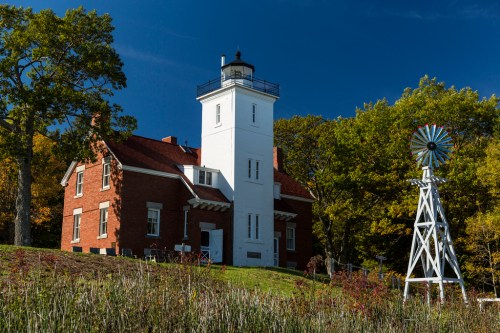
Adams’ plan for the main lighthouse structure was a virtual duplicate of that simultaneously under construction at Big Bay Point on Lake Superior. Consisting of a duplex dwelling with a tower incorporated into the center of one side-wall, the structure stood 35 feet by 57 feet in plan. Erected on a 20″ thick cut limestone foundation, the brick walls featured double walls with an air space between to provide insulation. The integrated tower stood twelve feet in plan, and fifty-two feet in height. The apartments on each side of the dwelling were exact mirrored duplicates and were set-up to afford complete privacy. Each apartment featured its own main entry, cellar, kitchen, parlor, tower entry door and stairway to the bedrooms on the second floor. Indicative of Adam’s thoughtfulness in designing the structure, each of the stairways incorporated a skylight in its ceiling through which the lantern could be observed, thereby allowing both keeper and his assistant to verify the correct operation of the light from within the warmth of their apartment without having to leave the building or climb to the top of the tower itself to see the light. The brick tower was capped by a square gallery with iron safety railing, and a prefabricated octagonal cast iron lantern erected at its center.

Read on for more at Seeing the Light and also check out this shot of the construction crew posing in front of the lighthouse in 1896. Forty Mile Point Light is now a museum, click here to visit their website for more including directions.

Check this photo out bigger, have a look at this panoramic shot of the light and see more in Tudor’s 2013-10 Fall Trip slideshow.

Many more Michigan lighthouses on Michigan in Pictures.

Miles of Fall Color from Landslide Overlook

Landslide Overlook 2

Landslide Overlook 2, photo by LindaB.

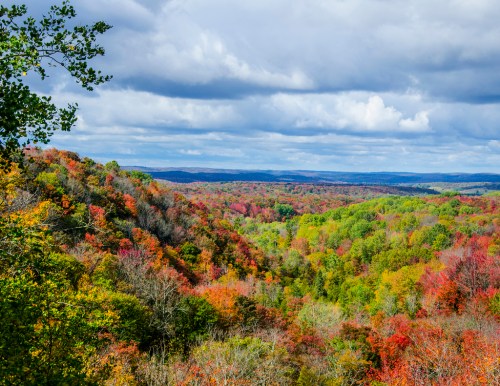
Fall is a time for exploration and seeing new sights. In precisely that spirit of adventure, Linda writes:

Just by looking at the map I said ‘lets take this dirt road and see what color we find.’ I didn’t know it was a seasonal road until we turned onto it and then saw a sign that said Landslide Overlook. So we followed this dirt road, which was rather narrow in spots, until we came to a parking area. It was just a short 1/4 mile walk to this wonderful view of the Jordan River Valley.

You can read more about the Jordan Valley from the DNR and get a map to the overlook on Foursquare.

Check Linda’s photo out background bigtacular and see a couple more shots from this incredible overlook in her slideshow.

More Fall wallpaper on Michigan in Pictures.

Roar

Roar

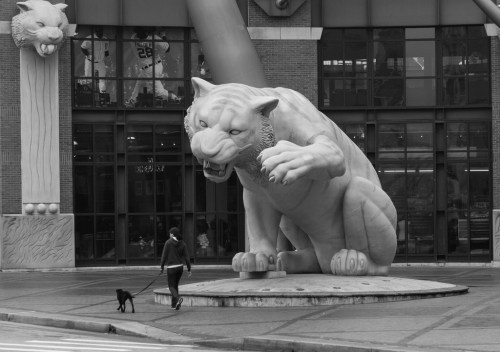
Roar, photo by Matt Gowing

Just sayin’.

Check Matt’s photo out background bigilicious and see more in his Street slideshow.

And oh yeah – go Tigers!

Church of the Hunter’s Moon

Church of the Hunter's Moon

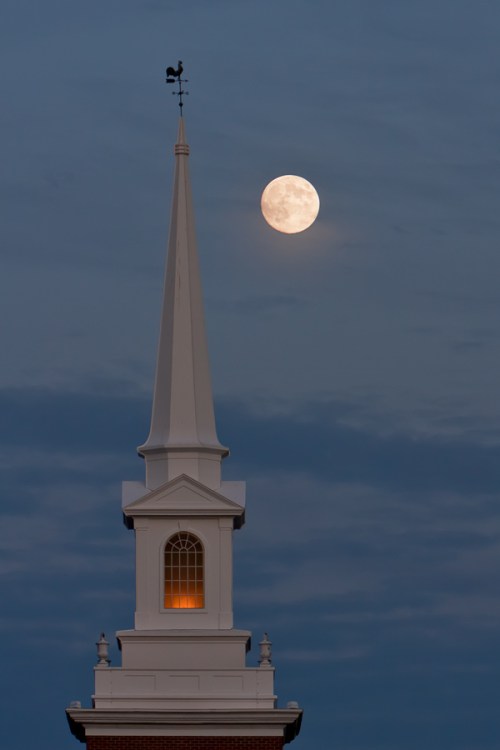
Church of the Hunter’s Moon, photo by Kevin’s Stuff

Deborah Byrd is the founder of one of my favorite sites , EarthSky. Her article Everything you need to know: Hunter’s Moon 2013 explains:

If you’re in the Northern Hemisphere, look for the moon to be bright and full-looking for several nights around October 18, 19 and 20. Around all of these nights, you’ll see a bright round moon in your sky, rising around the time of sunset, highest in the middle of the night. This procession of moonlit nights is what characterizes a Hunter’s Moon.

…the full moon after the Harvest Moon, which is the full moon nearest the autumnal equinox. In the Northern Hemisphere, the Harvest Moon sometimes falls in September and sometimes falls in October. So the Hunter’s Moon sometimes falls in October and sometimes in November.

But the Hunter’s Moon is also more than just a name. Nature is particularly cooperative around the time of the autumn equinox to make the full moonrises unique around this time. Here’s what happens. On average, the moon rises about 50 minutes later each day. But when a full moon happens close to the autumnal equinox – either a Harvest or a Hunter’s Moon – the moon (at mid-temperate latitudes) rises only about 30 to 35 minutes later daily for several days before and after the full moon.

Why? The reason is that the ecliptic – or the moon’s orbital path – makes a narrow angle with the evening horizon around the time of the autumn equinox. The narrow angle of the ecliptic results in a shorter-than-usual rising time between successive moonrises around the full Hunter’s Moon. These early evening moonrises are what make every Hunter’s Moon special. Every full moon rises around sunset. After the full Hunter’s Moon, you’ll see the moon ascending in the east relatively soon after sunset for a few days in a row at northerly latitudes.

Read on for more and definitely subscribe to their email!

Kevin is our go-to guy for all things astronomical. Check his photo out bigger and see more in his The Moon slideshow.

Lots more moon fun on Michigan in Pictures!

A little color and a little light

A little color and a little light

A little color and a little light, photo by RochesterTee

Fall color looks like it will continue to be great for at least another week – get out and wander!

Check this out bigger and see more in Tom’s Springfield Oaks slideshow.

More fall color on Michigan in Pictures!