

Apocalyptic Spring., photo by jonathan_brandt
View Jonathan’s photo bigger, see more in his Panoramas slideshow and check it out giant-sized on Gigapan where (if you go full screen) you can zoom in for an incredible amount of detail.
Apocalyptic Spring., photo by jonathan_brandt
View Jonathan’s photo bigger, see more in his Panoramas slideshow and check it out giant-sized on Gigapan where (if you go full screen) you can zoom in for an incredible amount of detail.
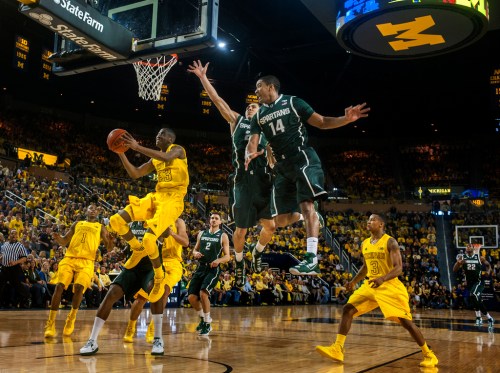
atUmich, photo by Justin_Wan
Three Michigan teams take to the hardwood today for the NCAA Men’s Basketball tourney. It starts with theWestern Michigan Broncos facing Syracuse at 2:45 followed by the media darling Michigan State Spartans vs Delaware at 4:40 and #2 Midwest seed Michigan vs Wafford at 7:10!
Justin got this awesome action shot last year at Ann Arbor’s Crisler Arena for the State News. View his photo bigger and see more in his Winter Sports 2012-2013 slideshow!
More basketball on Michigan in Pictures.
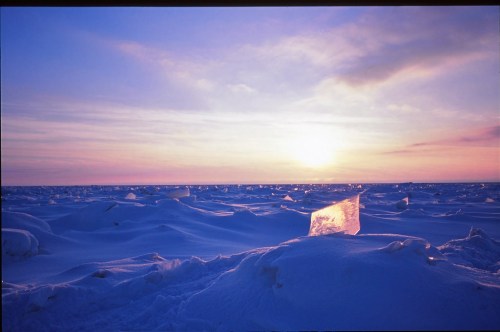
Iced Over, photo by karstenphoto
Stephen shot this photo on Lake Michigan on February 26th using Fujifilm Velvia 100. View it background bigtacular and see more in his winter slideshow.
More film photography and more winter wallpaper on Michigan in Pictures.
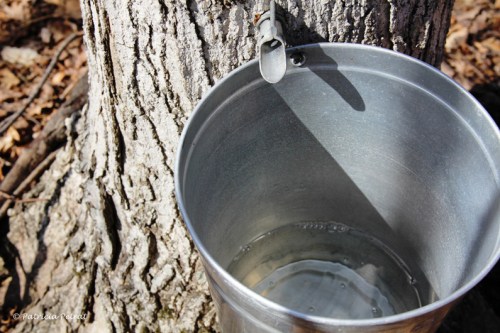
It takes a while ~ 3 of 5, photo by Trish P. – K1000 Gal
I just wrapped up a post about making maple syrup over on eatdrinkTC that you might enjoy. Michigan is 6th in the nation in the production of maple syrup and with a little bit of work and a small investment, you can make it yourself!
One of the photographers we featured is Trish, who has several more from March of 2011. View her photo bigger and see more in her sap slideshow!
More maple syrup on Michigan in Pictures!
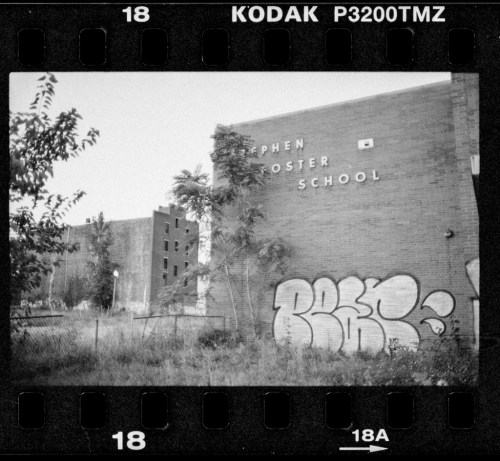
Detroit T3200 Roll 2 exp. 18, photo by Marty Hogan
You’ve seen a lot of Marty’s ranging in the U.P. and lost rural places on Michigan in Pictures and he recently posted photos from a visit to Detroit.
View his photo background big and see more in Marty’s Detroit Kodak T3200 Film slideshow.
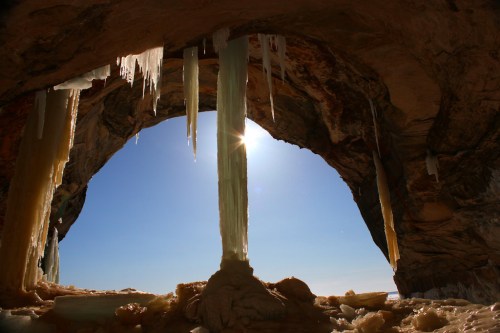
Ice Column / Pictured Rocks National Lakeshore, photo by DIsnowshoe
Jay writes:
Many have cursed the cold of this winter that is almost over now though spring seems a long way off. It has caused hardships and pain but has also given rare opportunities to many who have been willing to bundle up and seek the wonders the cold has brought about.
A few weeks ago a friend asked me on somewhat short notice if I’d join him for a walk along the Pictured Rocks National Lakeshore. I’d walked the cliffs above the Lake before but the extreme cold of this wonderful winter granted us the opportunity to walk on even the Greatest of Lakes. We had two nights out with no fire to warm us but it was well worth it and a most amazing hike.
View his photo background bigtacular and definitely check out more stunning photos from his Pictured Rocks adventure.
Much more from the Pictured Rocks National Lakeshore and more winter wallpaper on Michigan in Pictures!
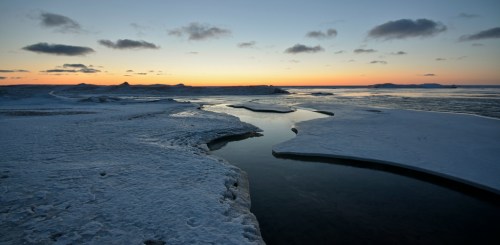
Running Out of Ice, photo by Aaron Springer
Probably wishful thinking, but I’m guessing that’s better than wishless thinking. Enjoy your weekend everyone!
View Aaron’s photo bigger and see more in his Northern Michigan slideshow.
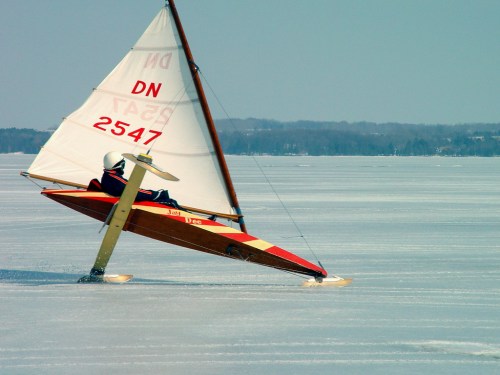
DN hiking it, Elk Lake- Elk Rapids, Michigan, photo by rickrjw
Last night I learned from my iceboating friend Andy that the 2014 Central Regional DN Iceboating Championship will be held this Saturday & Sunday (March 15-16, 2014) on West Grand Traverse Bay. The primary launch site will be the DNR launch at Hilltop Rd. and M-22, approximately 9 miles north of Traverse City and 5 miles south of Suttons Bay on the Leelanau Peninsula. More details at DNA America.
Wikipedia explains that the International DN is a class of ice boat:
The name stands for Detroit News, where the first iceboat of this type was designed and built in the winter of 1936-1937. Archie Arrol was a master craftsman working in the Detroit News hobby shop, and together with iceboaters Joe Lodge and Norman Jarrait designed a racing boat they called the “Blue Streak 60”, later to become known as the “DN 60”. In 1937 a group of 50 laymen worked with Archie in the hobby shop to produce the first fleet of the new iceboats. These first boats broke during the initial season, and after Norm and Joe modified the design to increase the strength, the group got back together to build a second set of iceboats in 1938.
This design, featuring a narrow, single-person cockpit, three steel blades in tricycle style arrangement and a steeply raked mast, remains to this day the most popular ice boat design in use.
…The class has a devout following. The International DN Ice Yacht Racing Association (IDNIYRA) is the governing body for the class. It publishes standards for boat design and allows enthusiasts to assemble for races and to share good ice locations. The DN is raced extensively in the northern United States, Canada, and throughout Northern Europe, with World Championships alternating between North American and Europe each year.
One of the reasons that the DN Ice Boat Class has become so popular over the years has been largely in part to how transportable and fast they truly are. With a steady 10-12 mile per hour wind and good ice conditions, the DN, when piloted properly, can reach speeds in excess of 50 miles per hour. And with just a 12-15 mile per hour steady wind, the DN ice boat can reach a readily attainable 55–65 miles per hour, providing a thrilling rush of purely unadulterated bone chilling wind powered ice sailing.
Rick took this photo of a DN on Elk Lake almost exactly 5 years ago, and March is prime season for ice boating in Michigan due to typical snow melts that lay the thickest ice of the year bare. GT Bay is nearly in my front yard and I can assure you that the ice is thick and almost like glass this year! View his photo bigger and see lots more in his Iceboating slideshow.
More ice boating on Michigan in Pictures including one of my favorite videos, Ice Boat vs Chevy!
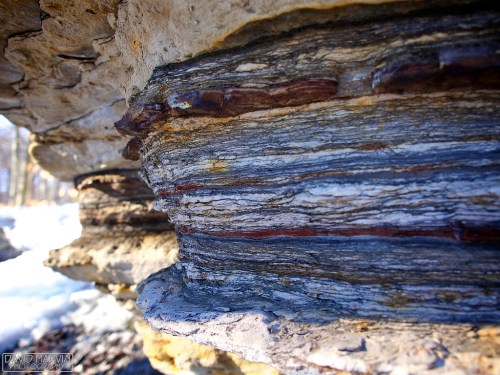
Ledges’ Layers, photo by daveumich
The Earth Science class for educators at Michigan Tech has an online textbook on Michigan Geography & Geology that’s pretty cool. The chapter on the Ledges at Grand Ledge includes At the Edge of an Ancient Ocean that talks about the rocks that make up The Ledges and begins:
The rocks at Grand Ledge are significant for several reasons. Grand Ledge is an “oasis” of bedrock in an “ocean” of glacial drift that blankets the Lower Peninsula, providing geologists a window into the distant past. The diverse set of sedimentary rocks contains a wealth of information on the plants and animals that dominated the Pennsylvanian Period, about 320 to 290 million years ago. The characteristics of the rocks allowed geologists to reconstruct the changing environment that marked the demise of a great inland ocean. The rocks have been quarried and hold economic value. Lastly, Grand Ledge is scenic and enjoyed by hikers, paddlers, and climbers.
Nearly all students of Michigan geology make a pilgrimage to Grand Ledge at some point in their careers. Good exposures of sedimentary rocks are rare in the Lower Peninsula. Not only are the rocks well exposed but they offer an opportunity to test your skills in identifying a variety of sandstones, some shale and limestone, and even 2 coal. The rocks are exposed in a few abandon quarries and in exposures along the Grand River. To get a good look at the rocks you will need drive between exposure north and south of the river. But don’t be discouraged; the distances are short.
As always in geology, the best place to start is at the base of the stratigraphic section, the oldest rocks. The lower part of the section contains shale, siltstone, and type of sandstone called greywacke. The shale is gray and so fine-grained that you cannot see the mud-sized particles that compose it. If you are brave, you might put a tiny piece in your mouth and push it around a bit. Shale feels smooth, almost creamy, a result of the mud. The shale is also soft and erodes to relatively gentle slopes. Shale is exposed at the base of the layers at the Face Brick Quarry. Think of the light-colored siltstone as a silty shale. You might rub the rock against your thumb and see if any small, visible grains come loose. Again, a taste test might be in order. Siltstone will leave a 3 gritty feel in your mouth. Siltstone is exposed at the base of the rock layers at the American Vitrified Quarry. The greywacke is a greenish-gray colored sandstone and the sand grains are visible to your unaided eye, no tasting required. With a hand lens you can see the rock is made of a mixture of sand sizes, what geologists call poor sorting, and a variety of sand compositions, including quartz, feldspar, mica, and fragments of pre-existing rocks. Greywacke is exposed just above the beach at the Face Brick Quarry.
Read on for more and visit Fitzgerald Park at Pure Michigan for more on this cool West Michigan park.
View Dave’s photo background bigalicious, see more in his Grand Ledge, Michigan slideshow and check out more photos from The Ledges on his Marvins’ Gardens blog!
More winter wallpaper on Michigan in Pictures.
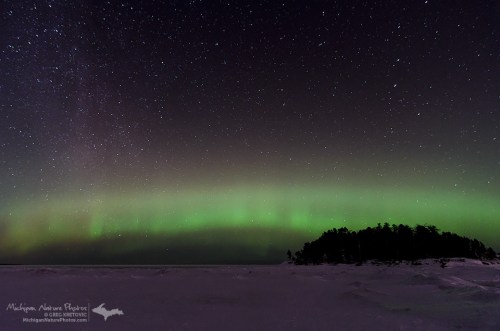
Frigid Auroras Over Superior, photo by Michigan Nature Photog
NOAA’s current space weather forecast reports an M Class (moderate) solar flare from solar region AR2002. Spaceweather.com adds that AR2002 has destabilized its magnetic field, making it more likely to erupt, and that NOAA forecasters are estimating a 60% chance of M-class flares and a 10% chance of X-class flares during the next 24 hours. X-class flares are major solar events that can spawn incredible auroras visible far to the south of us, planet-wide radio blackouts and long-lasting radiation storms. Click to Space Weather for a video of AR2002 development.
While there’s not much chance of a major event, I thought it was interesting that 25 years ago this week, one of the most significant solar storms in memory created a spectacle in the skies as it demonstrated the power and danger of solar weather to modern society. A Conflagration of Storms begins:
On Thursday, March 9, 1989 astronomers at the Kitt Peak Solar Observatory spotted a major solar flare in progress. Eight minutes later, the Earth’s outer atmosphere was struck by a wave of powerful ultraviolet and X-ray radiation. Then the next day, an even more powerful eruption launched a cloud of gas 36 times the size of the from Active Region 5395 nearly dead center on the Sun. The storm cloud rushed out from the Sun at a million miles an hour, and on the evening of Monday, March 13 it struck the Earth. Alaskan and Scandinavian observers were treated to a spectacular auroral display that night. Intense colors from the rare Great Aurora painted the skies around the world in vivid shapes that moved like legendary dragons. Ghostly celestial armies battled from sunset to midnight. Newspapers that reported this event considered the aurora, itself, to be the most newsworthy aspect of the storm. Seen as far south as Florida and Cuba, the vast majority of people in the Northern Hemisphere had never seen such a spectacle. Some even worried that a nuclear first-strike might be in progress.
…Millions marveled at the beautiful celestial spectacle, and solar physicists delighted in the new data it brought to them, but many more were not so happy about it.
Silently, the storm had impacted the magnetic field of the Earth and caused a powerful jet stream of current to flow 1000 miles above the ground. Like a drunken serpent, its coils gyrated and swooped downwards in latitude, deep into North America. As midnight came and went, invisible electromagnetic forces were staging their own pitched battle in a vast arena bounded by the sky above and the rocky subterranean reaches of the Earth. A river of charged particles and electrons in the ionosphere flowed from west to east, inducing powerful electrical currents in the ground that surged into many natural nooks and crannies. There, beneath the surface, natural rock resistance murdered them quietly in the night. Nature has its own effective defenses for these currents, but human technology was not so fortunate on this particular night. The currents eventually found harbor in the electrical systems of Great Britain, the United States and Canada.
You can read on for more about how the storm spawned a power outage in Quebec and pushed US systems to the brink of collapse. If you want to totally geek out on auroral science, check this article out about how the Earth’s magnetosphere actually extends itself to block solar storms.
Greg took this shot in late February in Marquette in -17 temps! View his photo bigger and see more in his northern lights slideshow. You can purchase Greg’s pics at MichiganNaturePhotos.com.
There’s more science and much (much) more about the Northern Lights and Michigan on Michigan in Pictures.
 Michigan in Pictures