Blue Reflections: Comerica Tower loses Comerica

Blue reflections

Blue reflections, photo by eYe_image.

Crain’s Detroit reports that Comerica Inc. will move its remaining Detroit employees out of Comerica Tower at 500 Woodward and renovate a building it owns on Lafayette Avenue. The move follows Comerica’s moving of its HQ to Dallas and will leave the building 70% vacant. It does allow some enterprising entity to put their name on the 2nd tallest building in Michigan.

Wikipedia’s Comerica Tower entry says that:

The building was designed by noted architects John Burgee & Philip Johnson, partners influential in postmodern architecture. One Detroit Center was constructed from 1991 to 1993. To form a stylistic link to the past, it was designed in a historicist fashion, with Flemish-inspired spires.

…The building is famous for its postmodern architectural design topped with neo-gothic spires. It uses a large amount of granite. Sometimes called a “twin gothic structure”, for its pairs of spires, it is oriented North-South and East-West (as named on a plaque along the Windsor waterfront park). One Detroit Center won the Award of Excellence for its design in 1996.

A twin tower dubbed Two Detroit Center was proposed to be built directly east of the tower when the One Detroit Center was proposed, but a soft office market killed the plans, and Two Detroit Center was put on hold, indefinitely.

The photo shows the Renaissance Center (GM headquarters and Michigan’s tallest skyscraper) with Comerica Tower reflected. Be sure to check it out bigger and in Larry’s Abstract Architecture set (slideshow).

You might also enjoy the Comerica Tower slideshow from the Absolute Michigan pool.

Schrunchsicle

Schrunchsicle

Schrunchsicle, photo by The ClayTaurus.

Check this out bigger and in Chris’s Other’s Favorites set (slideshow).

Here’s the icicle slideshow from the Absolute Michigan pool.

Remembering Bob Heft, designer of the 50 star flag

Ren Center at night
Ren Center at night, photo by mikesophia

The Saginaw News has a nice feature on Saginaw resident Bob Heft, designer of the 50 star American flag. Heft was the creator of the longest-serving flag in US history and passed away Saturday at the age of 67:

Heft was 17 in 1958 when he received an unusual phone call from an important individual. When the caller asked for Robert G. Heft, the teenager said, “Yes, but you can call me Bob.” He didn’t realize he was speaking with President Dwight D. Eisenhower. Heft’s high school project had been selected by the president to represent the United States of America and the 50-star U.S. flag was born.

Winford said Heft would “beam with pride” because of his work and was a constant inspiration for children. He said he taught them how to follow their dreams.

Heft visited the White House 14 times under nine presidents and toured with Bob Hope.

You can get a little more about Heft from Wikipedia and at usflag.org, where they relate that his design receieved a B- because it lacked orginality. He did say that he would give Heft a high grade if he could get Congress to accept the design.

Mike says that he loves the flags in front of the Renaissance Center. Check this out bigger and in his Favorite set (slideshow).

The William Peter Mansion in Columbiaville

William Peter Mansion
William Peter Mansion, photo by Sentrawoods

The latest in our series of Mansions Where You Can Spend the Night features the William Peter Mansion. The William Peter Mansion Bed & Breakfast site says that:

William Peter came to Columbiaville in the mid 1800’s as a German immigrant working for the lumber industry. Though he was young and spoke little English, he was a man who worked hard, saved big, and took advantage of the opportunities that came his way.

In 1852 he married a girl by the name of Roxannea Clute. Just 17 at the time her father strongly disapproved of the union due to Peter’s citizenship. Having no other choice the couple decided to elope. They worked hard over the years and built much of the town we know as Columbiaville. With business interests in the town of Toledo the couple decided to move. It was there that they bore and raised two children, Harriet and Alvin.

In 1892 the Peter’s decided to move back to Columbiaville and the Mansion was begun. The materials used in the Mansion’s construction came from Peter’s own lumber yards. Peter’s hired craftsmen and artists from all over to finish the woods and paint the walls and ceilings with gorgeous designs, birds, and flowers. The sixteen room Mansion took four years to complete.

The Mansion possesses a unique architectural style featuring the cubic form of the Italiante which was popular during that time. The main hall and entrance feature a rich paneled oak on the walls with a beautiful parquet floor made from hard oak. Mr. Peter was an expert on timber and enjoyed surrounding himself with its fine specimens.

You can see it bigger and check out the historic marker from Sentrawoods.

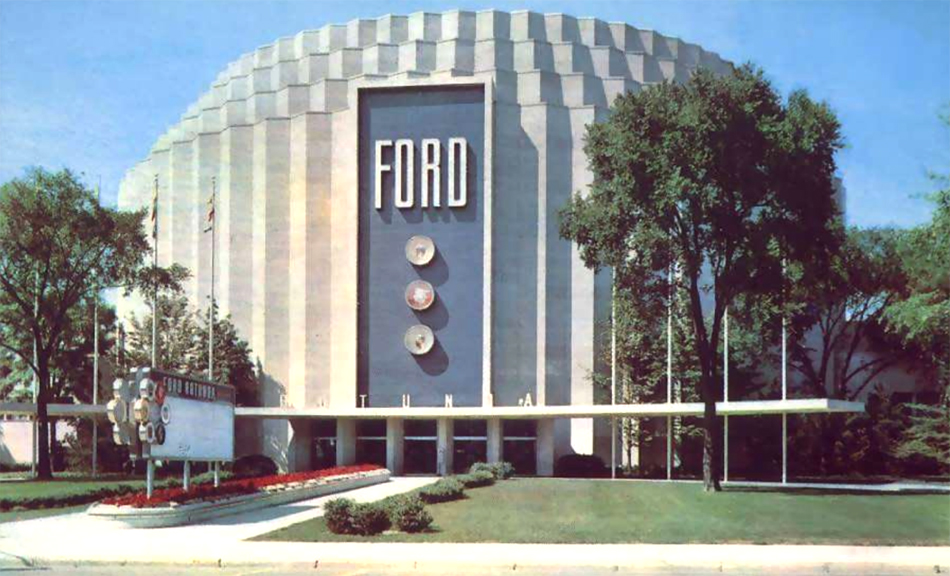
The Ford Rotunda

The Ford Rotunda – Dearborn, Michigan, photographer unknown

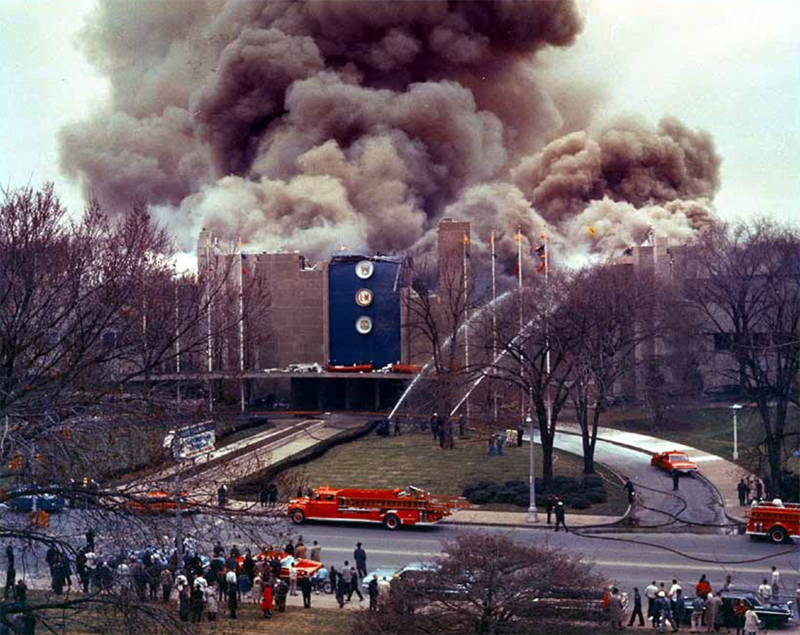
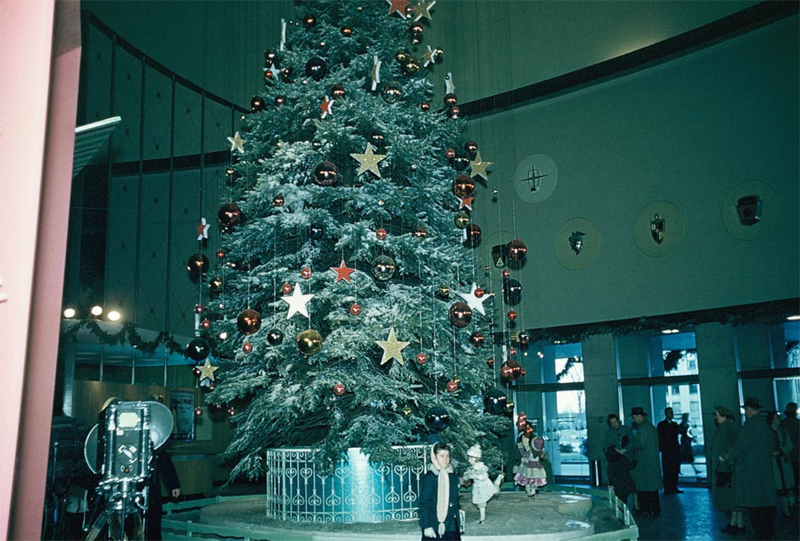
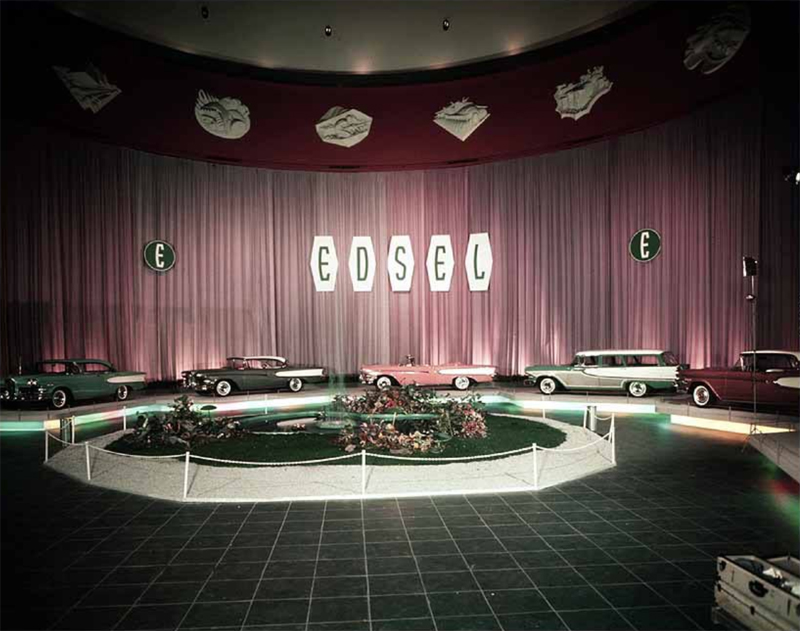
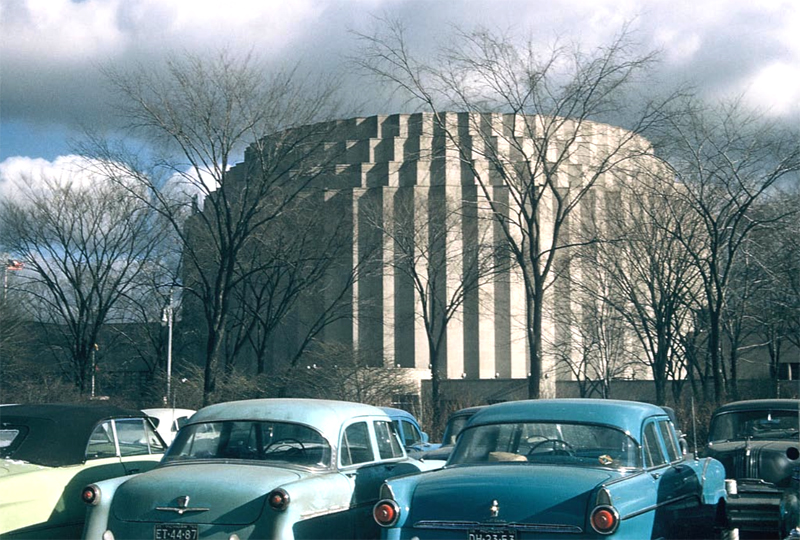
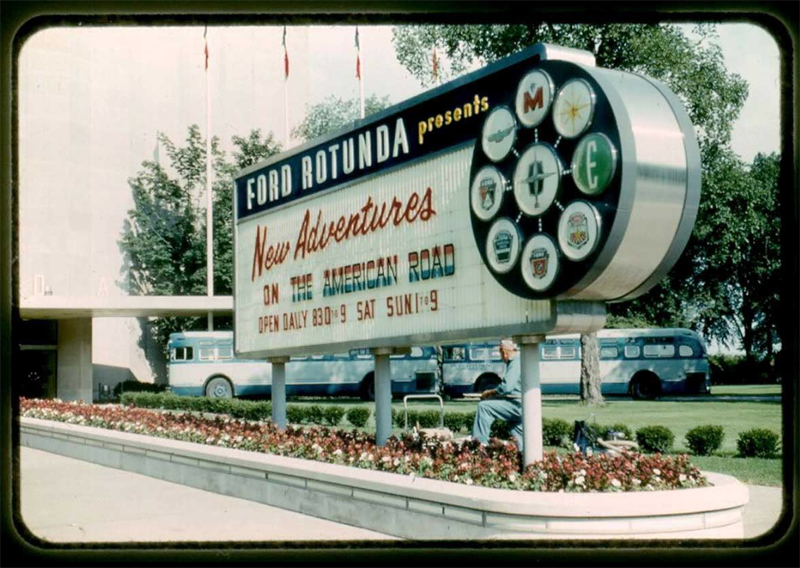
Michigan in Pictures regular Matt passed an email about the Ford Rotunda along that had some cool pictures I thought folks would like to see. When flames consumed a Christmas fantasy from the Detroit News Rearview Mirror begins:

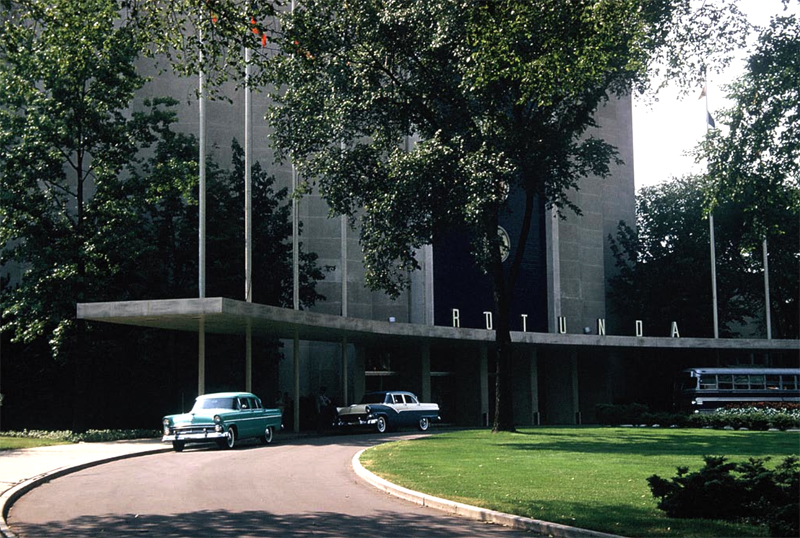
From 1936 to 1962, the gear-shaped Ford Rotunda attracted visitors from around the world. It was the fifth most popular tourist destination in the United States in the 1950s.

The building had its roots in the 1933 Chicago World’s Fair, known as the Century of Progress Exposition, which opened in May of 1933 and attracted more than 40 million visitors over its two-year run. One of the major attractions at the fair was Ford Motor Company’s Rotunda, which was disassembled after the fair and brought back to Dearborn, where it was reconstructed using more permanent materials. Designed to be the showcase of the auto industry, the Ford Rotunda was opened to the public on May 14, 1936.

…In 1960, the Rotunda ranked behind only Niagara Falls, the Great Smoky Mountains National Park, The Smithsonian Institution and the Lincoln Memorial as a national tourist destination. It was more popular than Yellowstone, Mount Vernon, the Washington Monument and the Statue of Liberty.

Read on for the sad tale of how it burned to the ground on November 9, 1962.

Television History – The First 75 Years might be the photographer – there’s some of the same shots there and they write about their parents taking them to see Santa during the Christmas Season at the Rotunda. They also have a nice aerial of how the Ford Rotunda was located in relation to the Rouge Plant.

Old Main and Wayne State University

Wayne State University

Wayne State University, photo by kmaz.

Wayne State University is Michigan’s only urban research university. The 203 acre campus is in Detroit’s University Cultural Center. The main campus and six extension centers are attended by 33,000 graduate and undergraduate students in 13 schools and colleges that offer more than 350 major subject areas.

Wikipedia’s Wayne State University entry says that the university was established in 1868 as the Detroit Medical College. Five more schools were added over the years and in the early 1930s the Detroit Board of Education organized them to form Wayne University. The building pictured is Old Main (c. 1904 photo of Old Main), about which Wikipedia says:

Old Main, originally called “Main Building”, was built December 13, 1894. It was the first major building of Wayne State University. Originally, every course offered was located in Old Main. It was built over a four year period out of limestone quarried from the land directly in front of it. The structure was designed by the architects Malcomson & Higginbotham and contained 103 classrooms, laboratories, offices, and residential space for 3000 students.

…Today, Old Main serves as the home of the College of Liberal Arts and Sciences of Wayne State University as well as accommodating many other classes of different subject matters.

See this bigger in Konrad’s Wayne State University slideshow.

Michigan Courthouses: Van Buren County Courthouse

Van Buren County Courthouse (Paw Paw, Michigan)

Van Buren County Courthouse (Paw Paw, Michigan), photo by courthouselover.

Jordan writes:

The Van Buren County Courthouse was erected in 1901 with the designs of Claire Allen of Jackson, Michigan. It is similar is appearance to the Classical Revival courthouse in Hillsdale, Michigan.

Wikipedia’s entry for Claire Allen says that he was was a prominent architect in southern Michigan in the early twentieth century. He was head of the firm of Claire Allen & Sons and his resume includes the Chelsea Clock Tower.

Be sure to check this out bigger and in his Michigan County Courthouses set (slideshow)

More Michigan courthouse shots on Michigan in Pictures.

Snow Day!

Joyriding

Joyriding, photo by GH Patriot.

Michigan has been socked with the first big blizzard of Winter 2009-2010. Hope you get a chance to enjoy it somehow!

Check it out bigger or in Kevin’s Sports set (slideshow).

Michigan Birds: White-breasted Nuthatch

White-breasted Nuthatch

White-breasted Nuthatch, photo by Beth Crawford 65.

On their White-breasted Nuthatch page, All About Birds notes that although this is the largest nuthatch, it’s still a small bird. They say:

Nuthatches are active, agile little birds with an appetite for insects and large, meaty seeds. They get their common name from their habit of jamming large nuts and acorns into tree bark, then whacking them with their sharp bill to “hatch” out the seed from the inside. White-breasted Nuthatches may be small but their voices are loud, and often their insistent nasal yammering will lead you right to them.

For more about these common Michigan birds including photos and songs, click the link above and also see Sitta carolinensis (white-breasted nuthatch) from the UM Animal Diversity Web and White-breasted Nuthatch on Wikipedia.

That Wikipedia link shows the bird upside down, a position that Beth says this one is usually in. Check out more shots in her White-breasted Nuthatch set (slideshow).

Michigan Big Tree Hunt and the White Ash

White ash canopy

White ash canopy, photo by vaprwere.

A couple of weeks ago mLive featured an article on the 2008-09 Michigan Big Tree Hunt.

The contest, run by Global ReLeaf of Michigan, tries to find the biggest tree in each county every two years, as well as the largest white pine (the state tree), and the largest overall tree in the state — which this year is a 306-inch weeping willow in Van Buren County.

A forester who verified Nelson’s tree said that going by only circumference (206″), it is the largest white ash in a five-county (Grand Rapids) area. But it’s not the largest in the state. The Michigan Botanical Club, a partner in the contest, lists a 247-inch white ash in Leelanau County.

Learn more about the contest (and neighborhood tree planting) from Global ReLeaf of Michigan and more about the White ash at Wikipedia.

Check this photo out bigger and in Joseph’s Tree Images set (slideshow).

Interestingly enough, Joseph is a plant pathologist and writes that this large white ash was photographed in northern lower Michigan, and that like its brethren, it’s threatened by the emerald ash borer, a pretty but destructive insect. The article says that this tree was judged free of the pest.

There’s more about the Emerald Ash Borer and also more tree photos on Michigan in Pictures.