Great Horned Owl

gh4282010-3

gh4282010-3, photo by Sherri & Dan.

Wikipedia says that the Great Horned Owl Bubo virginianus is also known as the tiger owl, or cat owl because of its catlike ears, eyes, shape of head, and appearance when huddled up on its nest. The UM Animal Diversity Web Bubo virginianus page notes that while the owl can see during the day, it has even better vision at night and does its most effective hunting then. They also warn that when the great horned owl has young in its nest, it can be very hostile.

Here’s some fun facts on Great Horned Owls from All About Birds:

  • The Great Horned Owl is the only animal that regularly eats skunks.
  • The Great Horned Owl will take large prey, even other raptorial birds. It regularly kills and eats other owls, and is an important predator on nestling Ospreys. The reintroduction of Peregrine Falcons has been hampered in some areas by owls killing both adult and nestling falcons.
  • The Great Horned Owl is a regular victim of harassment from flocks of American Crows. Crows congregate from long distances to mob owls, and may continue yelling at them for hours. The enmity of the crows is well earned, however, as the owl is probably the most important predator on adult crows and nestlings.
  • Even though the female Great Horned Owl is larger than her mate, the male has a deeper voice. Pairs often call together, with audible differences in pitch.

All three of the sites above have cool photos and owl calls and you might also enjoy this video of a great horned owl being harassed by crows in Mt. Clemens.

Check this out bigger in Sherri & Dan’s slideshow!

Lots more Michigan birds from Michigan in Pictures!

spring is green & unfolding

Untitled, photo by spacelola.

You have to check this out bigger in Laura’s .ypsilanti. slideshow. See more work on her web site.

Hello Spring

Hello spring

I hope you’re all getting a chance in these busy days to give Spring her due.

Check this out bigger in Anita’s Spring slideshow.

Let’s Talk About Tent Worms: Eastern Tent Caterpillars & Forest Tent Caterpillars

Tent Worm

Tent Worm, photo by sisterKRS10.

This year tent worms aka Eastern Tent Caterpillars seem to be a little thicker than normal in northern Michigan. I think the pictured caterpillar is actually a forest tent caterpillar. Both are tent caterpillars, about which Wikipedia says:

Tent caterpillars are readily recognized because they are social, colorful, diurnal and build conspicuous silk tents in the branches of host trees. Some species, such as the eastern tent caterpillar, Malacosoma americanum, build a single large tent which is typically occupied through the whole of the larval stage while others build a series of small tents that are sequentially abandoned. The forest tent caterpillar, Malacosoma disstrium, is exceptional in that the larvae build no tent at all, aggregating instead on silken mats that they spin on the leaves or bark of trees. Tents facilitate aggregation and serve as focal sites of thermal regulatory behavior. They also serve as communication centers where caterpillars are alerted to the discovery of new food finds…

The MSU Horticultural Research Station in Leelanau County has a really cool look at the Forest tent caterpillar in Northern Michigan that explained something I saw this weekend – tent worms leaving a tree on strands of web.

Here’s a PDF that looks at Gypsy Moth Caterpillars, Forest Tent Caterpillars and Eastern Tent Caterpillars and here’s more about Forest Tent Caterpillars and Eastern Tent Caterpillars. Most of what I read says that tent worm infestations are typically not life-threatening for trees. However, if you’re creeped out by these crawlies, eHow has advice for how to get rid of tent caterpillars.

Check this out bigger and in Kristin’s Mother Nature Up Close set (slideshow).

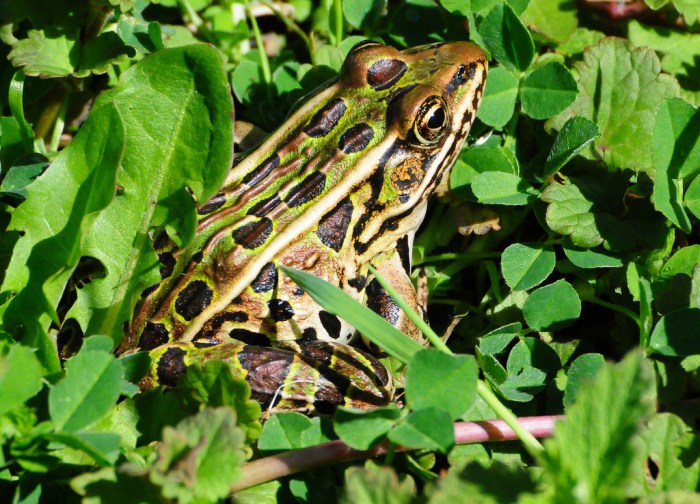
Know Your Michigan Frogs: Northern Leopard Frog

Northern Leopard Frog

Northern Leopard Frog, photo by Adore707.

National Geographic’s Northern Leopard Frog page says that the range of the species:

…is most of northern North America, except on the Pacific Coast. They generally live near ponds and marshes, but will often venture into well-covered grasslands as well, earning them their other common name, the meadow frog.

Leopard frogs will eat just about anything they can fit in their mouths. They sit still and wait for prey to happen by, then pounce with their powerful legs. They eat beetles, ants, flies, worms, smaller frogs, including their own species, and even birds, and garter snakes.

They also note leopard frogs were once the most abundant and widespread frog species in North America, but that declines beginning in the 1970s have significantly reduced their numbers. The Michigan DNR’s Northern Leopard Frog (Rana pipiens) page says that the frogs have had a similar and equally mysterious decline in Michigan, making a sighting of them rare in may parts of the state where they were once common. For more pictures & information, see Rana pipiens at the UM Animal Diversity Web and Northern Leopard Frog on Wikipedia.

See this bigger in Eli’s Nature slideshow.

More Michigan frogs on Michigan in Pictures!

Know your Asparagus

Asparagus CenteredPerformance Artist
Asparagus Centered, photo by sl33stak & Performance Artist, photo by ( Jennifer )

On the left, we have Michigan Asparagus. On the right, we have Empire Asparagus Festival.

Michigan asparagus is at the tail end of its season, Empire Asparagus Festival is today & tomorrow in Empire.

Check it out bigger and in Jamie’s Plants & Flowers set (slideshow).If you can’t make it to Empire, Jennifer has a great Asparagus Festival slideshow!

Head over to absolutemichigan.com/Asparagus for all kinds of asparagus information & recipes!

Grand Rapids is a winner

crossroads
crossroads, photo by pentax hammer (gary syrba)

The U.S. Chamber of Commerce BCLC & Siemens have named Grand Rapids, MI the most sustainable mid-size community in America. Grand Rapids was selected based on efforts to achieve complementary economic, environmental and social goals, as well as to improve the overall quality of life within the city.

See this photo bigger in Gary’s In the City (Grand Rapids) slideshow and connect with Grand Rapids photographers and photos of Grand Rapids in the Grand Rapids, Michigan group on Flickr!

Hang out at the Great Lakes Kite Festival in Grand Haven

Zip Line Kite

Zip Line Kite, photo by yerffej9.

Every year Grand Haven hosts the Great Lakes Kite Festival, a three-day celebration of kites that happens at the beach at Grand Haven State Park. The event features kite competitions, kite demos and special events that celebrate kites. Here’s a sweet video and you can check out the Great Lakes Kite Festival slideshow on Flickr to see the amazing array of kites they get!

Jeff says that he thinks the 2006 kites were better. Check it out bigger and in his Personal Favorites slideshow.

Welcome to Detroit, Mr. Banksy.

Welcome to Detroit, Mr. Banksy.

Welcome to Detroit, Mr. Banksy., photo by b.plus.

I guess that even the world’s most famous graffiti artist needs a vacation every now and then. mLive reports that:

Famed British graffiti artist Banksy has left his mark on Detroit, tagging a crumbling wall near the dormant Packard Plant with an image of a young man and the line, “I remember when all this was trees.”

A photo of the mural recently popped up on Banksy’s official Web site, and at least two local photographers have snapped their own shots verifying the location.

Popular photoblogger Detroit Funk dropped by the Packard site last night (link) and noted that workers from the local 555 Nonprofit Gallery and Studios were attempting to preserve the piece.  Check out his photos here.

Travis Wright of the Metro Times reports Banksy didn’t end his work at the Packard Plant; he also created murals on two buildings along VanDyke. There’s no word on whether he added his mark to the new Mexicantown bridge.

Apparently, he’s hit numerous locations in North America. One might guess that it has to do with his new film Exit Through the Gift Shop. Here’s the Banksy web site.

Check it out bigger in Brian’s a work in progress slideshow.

The Ring-necked Pheasant in Michigan

98 of 365 - Strutting

98 of 365 – Strutting , photo by reddeviltj.

The Michigan DNR Landowner’s Guide has this to say about Pheasants in Michigan:

After their introduction from China in 1895, it didn’t take long for ring-necked pheasants to become one of Michigan’s most popular wildlife species. Because pheasants thrive in a mix of cropland, hayland, grassland, wetland, and brush, populations exploded in southern Michigan. Much of the farmland in the 1940’s and 1950’s provided outstanding pheasant habitat. At that time, farms had small fields from 10 to 20 acres in size surrounded by brushy fencerows and diverse crop rotations.

However, by the 1960’s farmland began to change and people weren’t seeing as many pheasants. The number of farms fell from 190,000 in 1940 to less than 60,000 by 1990. The amount of land farmed also decreased from more than 18 million acres in 1940 to less than 11 million acres in 1990. Although predation, genetics, and overuse of pesticides are among many explanations for the decline of pheasants, Michigan’s changing agricultural scene and loss of habitat are the main reasons.

Furthermore, farming practices have changed over time. Many practices are no longer wildlife friendly, and are aimed at making more money. This has been detrimental to pheasants. Such practices include early and numerous cuttings of hayfields, overgrazing by livestock, spraying of pesticides and herbicides, double-cropping, and fall plowing and disking of crop residues.

You can get information from the DNR about pheasant hunting in Michigan and also see the All About Birds entry for the Ring-necked Pheasant and Wikipedia’s Pheasant page.

Be sure to check this out bigger!

Lots more Michigan birds from Michigan in Pictures!