Wolves almost gone from Isle Royale

Isle Royale Wolf

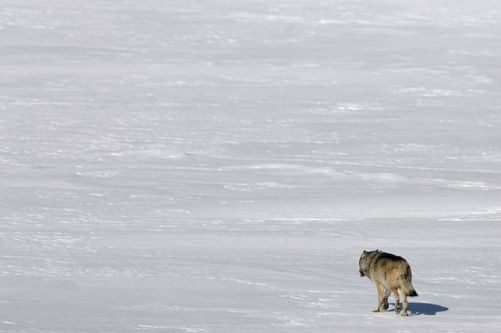
The Urge, photo by isleroyalewolf.org

Last weekend the Freep reported that the delicate biosphere that characterized Isle Royale National Park is about to fall apart. The wolf count is down from nine last year to only three, and Michigan Tech ecologist John Vucetich says he wouldn’t be surprised if none remain next winter.

“What’s really important here is not the presence of wolves, per se,” Vucetich said. “But the wolves need to be able to perform their ecological function — predation. Predation has been essentially nil for the past four years now.”

That’s led to a 22% increase in the moose population for each of the past four years, he said, taking the island population from 500 to 1,200 moose. An individual moose consumes up to 40 pounds of vegetation a day.

“One of the most basic lessons we know in ecology, wherever creatures like moose live, you have to have a top predator,” he said. “If you don’t, the herbivore can cause a great deal of harm to the vegetation.”

… Vucetich and his colleague at Michigan Tech, Rolf Peterson, both support a “genetic rescue” of the island’s wolf population — bringing in wolves from elsewhere to bolster island wolves and help facilitate breeding. The U.S. Forest Service is studying the concept, but that process may take years. If the remaining wolf population doesn’t survive, and the Forest Service ultimately approves of the plan, it may mean creating a whole new pack on the island.

I think that this poses very interesting questions about our role in the ecosystems we seek to preserve. Are we to watch what happens and not interfere like a kid watching an ant farm or a Star Fleet team, or do we accept the responsibility of our decision to preserve and seek to maintain the natural balances and populations? As our climate changes, we will no doubt be called to make these decisions more and more frequently as flora and fauna lose the ability to survive in the places we have set aside for them.

This photo was the first in a series of 40 shared last fall in “Thinking Like an Island” from the Wolves & Moose of Isle Royale. They wrote:

THE URGE. Walk 40 miles in two days searching for a lover that may not even exist. Return home to parents and siblings the next day. The life of a dispersing wolf, unsatisfied.

It’s a great series featuring images by George Desort, Rolf Peterson, John Vucetich, and Brian Rajdl along with text by John Vucetich and Michael Paul Nelson. Click to see this photo bigger on Facebook and then use your left arrow to page through them.

Definitely visit isleroyalewolf.org for lots more about the predator/prey balance of one of Michigan’s most fascinating places.
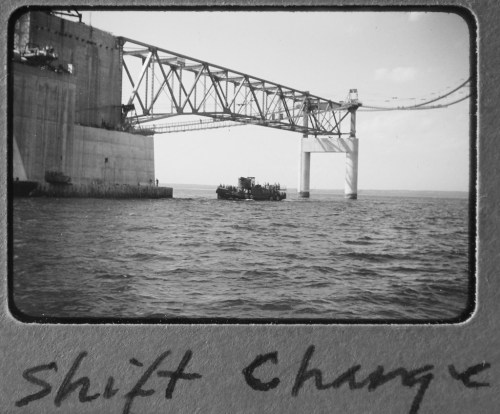

#TBT “Shift Change” – Mackinac Bridge construction, 1956

Shift Change at Mackinac Bridge

“Shift Change” – Mackinac Bridge construction, 1956, photo by otisourcat

What’s your commute looking like today? Mightymac.org has a great account of building the Mackinac Bridge, a process that began on May 7, 1954 and was completed November 1, 1957. It begins:

Construction of the Mackinac Bridge began with the construction of the pillars. Caissons were constructed, floated into position and sunk to provide the footings for the two immense towers which would suspend the center span of the bridge. Once the caissons were in place, creeper derricks were added, which raised materials to erect the towers and continued to climb higher.

The Mackinac Bridge roadway truss sections were assembled in sections and floated into position to be raised into place.

Constructing the Mackinac Bridge actually went on into 1958 and took 48 months, 3,500 workers, 895,000 blueprints & structural drawings, 71,300 tons of structural steel, 931,000 tons of concrete, 42,000 miles of cable wire, 4,851,700 steel rivets, 1,016,600 steel bolts and 99,800,000 dollars. There were 350 engineers and another 7,500 men & women worked at quarries, shops, mills and other locations.

When completed, the Mackinac Bridge was the longest suspension bridge in the world and it is currently the longest suspension bridge in North & South America and the third longest suspension bridge in the world.

Read on for lots more including excellent photos of the process and also see these photos of construction of the Mackinac Bridge from the Mackinac Bridge Authority.

otisourcat writes: This is a color slide, but the aged Ektachrome color is so wonky, that the image is much clearer in B&W. View the photo bigger and see more Mackinac shots right here.

There’s lots more Mackinac Bridge photos & info and lots more Throw Back Thursdays on Michigan in Pictures.

Michigan and Earth Day

Flags of our Grandparents

Flags of our grandparents, photo by PhotoLab507

Today is the 45th Earth Day, and many many not be aware of Michigan’s role in this holiday. The Ann Arbor Chronicle has an excellent feature titled Turbulent Origins of Ann Arbor’s First Earth Day that looks at the national movement in the late 60s to call attention to environmental degradation:

One of the first tasks facing the national organization was to choose a date for the proposed mass teach-ins. They settled on April 22 – “Earth Day,” as it would eventually be named – largely because that date fell optimally between spring break and final exams for most American colleges. (The fact that it is also Lenin’s birthday is apparently a complete coincidence.) But the University of Michigan operated then as now on a trimester system, with April 22 falling right in the middle of finals. As a result, the U-M environmental teach-in was scheduled for mid-March 1970.

The fact that it took place more than a month prior to national Earth Day has led to the misconception that the ENACT teach-in launched Earth Day, or that U-M was host to the first Earth Day celebration. In fact there were environmental events on other campuses as early as December 1969. But that does not in any way diminish the importance of the Ann Arbor event, which was to have a huge influence on the course of what has been called the largest mass demonstration in American history – Earth Day 1970, in which an estimated 20 million people participated.

“The University of Michigan teach-in was not the first or even the second or third – a few small liberal arts colleges had environmental teach-ins in January and February 1970,” says Adam Rome, a professor of history at Penn State who is working on a book about Earth Day. ”But the Michigan event was by far the biggest, best, and most influential of the pre-Earth Day teach-ins. The media gave it tremendous coverage. It was the first sign that Earth Day would be a big deal.”

…Events ran from the early morning until well after midnight, on topics such as overpopulation – “Sock It to Motherhood: Make Love, Not Babies” – the future of the Great Lakes, the root causes of the ecological crisis, and the effect of war on the environment. More than sixty major media outlets covered the action, including all three American television networks and a film crew from Japan. It was the biggest such event that had yet been seen in Ann Arbor – and coming as it did at the tail end of the sixties, it would be one of the last.

At the kickoff rally around 14,000 people paid fifty cents to crowd into Crisler Arena and listen to speeches by Senator Gaylord Nelson, Michigan governor William Milliken, radio personality Arthur Godfrey, and ecologist Barry Commoner, and groove to the music of Hair and Gordon Lightfoot. Another 3,000 who couldn’t get in listened on loudspeakers that were hastily set up in the parking lot.

Read on for lots more and you can also view a video from the first Earth Day at the University of Michigan Bentley Library.

The photographer shared a nice lyric too from Carol Johnson:

The Earth is my mother / She good to me / she gives me everything that I ever need
food on the table/ the clothes I wear/ the sun and the water and the cool, fresh air

View the photo bigger and see more in their slideshow.

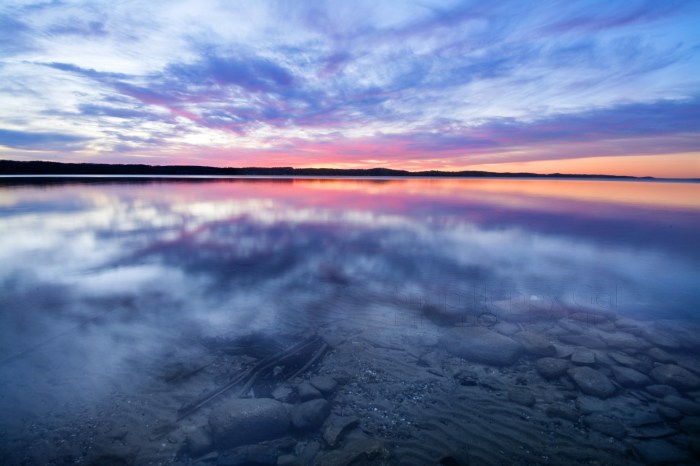
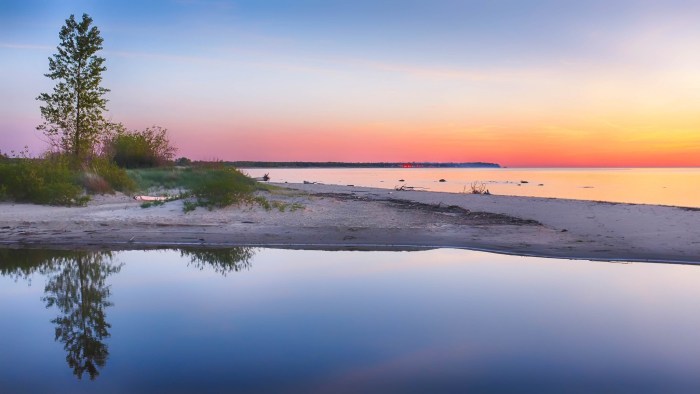
Torch Lake Afterglow

Torch Lake Afterglow

Torch Lake Afterglow, photo by Heather Higham

Wikipedia shares that at 19 miles long, Torch Lake is Michigan’s longest inland lake, and our second largest inland lake*.

The name of the lake is not due to its shape, rather, is derived from translation from the Ojibwa name Was-wa-gon-ong meaning “Place of the Torches”, referring to the practice of the local native American population who once used torches at night to attract fish for harvesting with spears and nets. For a time it was referred to by local European settlers as “Torch Light Lake”, which eventually was shortened to its current name.

View Heather’s photo bigger and see more Torch Lake goodness (including some nothern lights) in her slideshow.

* If you’re curious to see the lineup, Houghton is biggest and the rest are right here.

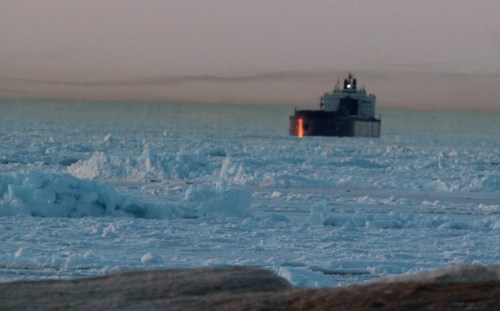
Ice bound, Whitefish Bay

Ice bound, Whitefish Bay

Ice bound, Whitefish Bay, photo by Thom Skelding

Here’s a cool shot from last Saturday on Lake Superior’s Whitefish Bay. I hope that you’re shaking off the ice and getting out to enjoy whatever spring is serving up close to you.

View Thom’s photo background big and see more great shots from Whitefish Bay and elsewhere in his slideshow.

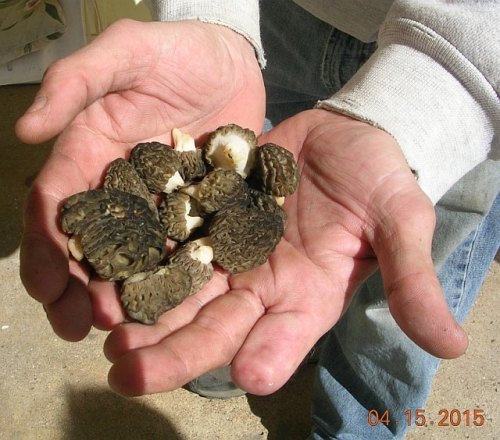
Michigan Morel Alert: Morels in Honor Edition

Morels at the Honor Hotel

Morels at the Honor Motel, photo by Honor Motel

In spring, a young Michigander’s fancies turn to … morels! Here’s a shot from Honor in the northwest Lower Peninsula showing a handful of black morels found on Tax Day. It’s earlier than I would have expected but hopefully it signals a good, long season for these woodland treasures.

Lots more Michigan morel photos and information on Michigan in Pictures!

View the photo bigger on Facebook and follow the Honor Motel for more.

PS: If you’re finding morels anywhere, post a comment here or two our Facebook.

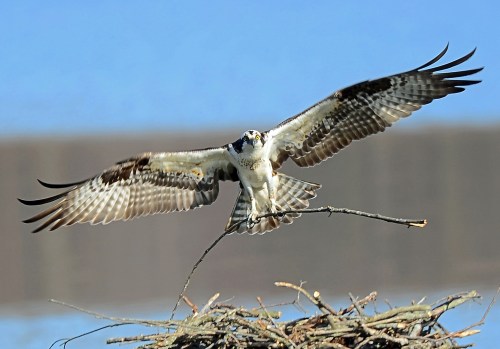
Birds of Michigan: Osprey

Osprey Building a Nest

Osprey Building a Nest, photo by Rodney Campbell

All About Birds from the Cornell Lab of Ornithology is the internet’s best resource for bird information. Their entry for Osprey (Pandion haliaetus) says that osprey are one of the largest birds of prey in North America and one of the most widespread birds in the world, found on all continents except Antarctica. More about osprey at Wikipedia and at Pandion haliaetus (Osprey) from the UM Animal Diversity web.

The Michigan DNR’s Osprey page begins:

The “fish hawk” is brown above and white below, and files with a distinct bend in its wing at the “wrist.” Their feet are equipped with spiny scales and long talons that give them a firm grip on slippery fish, their only prey. Ospreys usually select tall trees in marshes along streams, lakes or man made floodings. They will adapt to artificial nesting platforms. This “help” from humans, along with the restriction of certain harmful pesticides, has helped ospreys recover from the drastic population reductions seen in the 1950s and ’60s. The Nongame Wildlife Fund located 166 pairs in 1988, up from the 81 counted in 1975.

They ask for help in reporting osprey sightings in southern Michigan. Also check out Osprey Watch of Southeast Michigan.

Rodney took this photo of an osprey building its nest in Milford.

MichiganOsprey.com is a great local resource and adds:

Like Bald Eagles, Ospreys often reuse old nests, adding new material to them each season. Ospreys prefer nests near water, especially in large trees, but will also nest on artificial platforms. Ospreys three years or older usually mate for life, and their spring courtship begins a five-month period when they raise their young.

View it background bigtacular and see more in his Birds slideshow.

Michigan in Pictures has lots more Michigan Bird photos!!

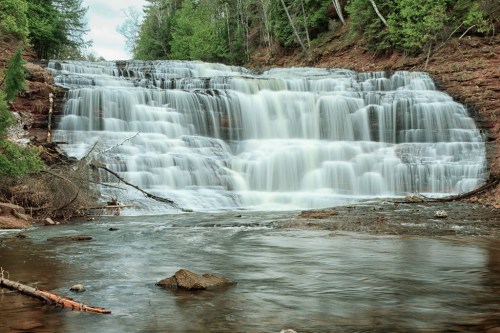
Waterfall Wednesday: Agate Falls on the Ontonagon River

Agate Falls, Bruce Crossing, MI, April, 2010

Agate Falls, Bruce Crossing, MI, April, 2010, photo by Norm Powell

GoWaterfalling.com is the site for Michigan waterfalls. Their page on Agate Falls says that this pretty waterfall is relatively easy to get to and adds:

Agate Falls is a Michigan State Scenic Site 6.5 miles east of Bruce Crossing on MI-28. There is a roadside park (Joseph F. Oravec roadside park) just past the bridge over the Ontonagon River. Unfortunately the provided trails and overlooks are somewhat limited. With some effort you can scramble down to the river to get some very good views of the falls, which seems to be popular with local fishermen, or scramble up the river banks to get to the old railroad bridge over the falls. The bridge is now part of a snowmobile trail.

Bond Falls is just around the corner. From Agate Falls, go east on MI-28 and take a right onto Agate road.O Kun de Kun Falls is 8 miles to the north. Go west on MI-28 and turn north on to US-45.

View Norm’s photo bigger and see more (including Bond Falls and other waterfalls) in his great Michigan Upper Peninsula – April 2010 slideshow.

Many more Michigan waterfalls and also more about the Ontonagon River on Michigan in Pictures!

Better Know a Michigan State Park: Port Crescent State Park edition

Port Crescent State Park

Port Crescent State Park, Michigan, photo by Zack Schindler

The Michigan DNR says that Port Crescent State Park:

…is located at the tip of Michigan’s “thumb” along three miles of sandy shoreline of Lake Huron’s Saginaw Bay. Some of the modern campsites offer a waterfront view, either of the Bay or the Old Pinnebog River channel. Port Crescent recently added a new camper cabin which sleeps six and has a scenic view of Saginaw Bay. A wooden boardwalk parallels the day-use shoreline offering many scenic vistas of Saginaw Bay. The park also offers excellent fishing, canoeing, hiking, cross-country skiing, birding, and hunting opportunities.

And see the map and book campsites here.

View Zack’s photo background bigtacular and see more in his Fuji X-series slideshow.

More state parks and more incredible Michigan wallpaper on Michigan in Pictures.

Perils of Michigan: Quicksand Edition

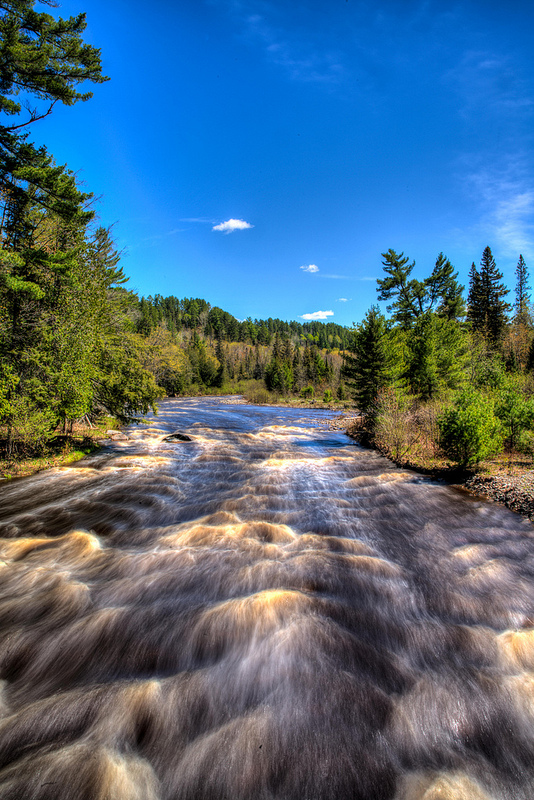
Sturgeon River by Sven

Sturgeon River, photo by Sven

While the ice has melted, leaving the shorelines temporarily free of peril – at least until until bodysurfing season starts – we can take a moment to worry about quicksand. Quicksand in Michigan Streams from Fichigan says:

Everything I know about quicksand I learned from Tarzan movies. The main thing to know is: bad guys don’t make it out, but good guys and gals always do. If you’re a bad guy, please stop reading. Quicksand on a trout stream is a little different than sand bogs in Africa, but there’s some similarity. They are both camouflaged so you don’t see it until it’s too late and if you make it out alive you’ll have an interesting story to tell even if no one believes you.

Quicksand on a trout stream is harder to see since it’s underwater. The stream bottom appears normal except there is no visible hole (sand covers it) so you don’t know it’s here until you start sinking. In waders it’s pretty scary since swimming doesn’t feel like an option.

I’ve found quicksand on the Pine River in Lake County and the Sturgeon River in the Pigeon River State Game Area. On the Pine, the particular spot I know of is a few bends downstream from Raymond Road. The first time I ran into it I was alone. I scrambled to get out and it was like running in place up a sand dune. It was easy to see the exact spot afterwards because a cloud of light gray silt poured out like smoke. An hour later, walking the bank downstream, the silt was still pouring out.

Read on for lots more including his encounter on the Sturgeon River.

I can find photos of almost anything View Sven’s photo bigger on Flickr and see more in his UP Michigan slideshow.

The Sturgeon River is one of Michigan’s Wild & Scenic Rivers – more Sturgeon River on Michigan in Pictures.