Oyster mushrooms

Fungi stacks

Fungi stacks, photo by ETCphoto

Mushroom guru Wildman Steve Brill says that the Oyster mushroom is a mushroom that lives up to its name – it looks, smells, and tastes like oysters! Not surprisingly, the Michigan Mushroom Hunter’s Club has great info on oyster mushroom hunting in Michigan that begins:

Oysters (Pleurotus ostreatus complex) are the mushroom of the month for June. The delicious oysters can be found in many environments as they are a prime wood recycler. Oysters can be found on dead and dying trees especially hardwoods like poplars (a.k.a. aspen), cottonwoods, elms, box elders, etc. though they also can occur on conifers.

The gills of the oysters are white, branched fanning out toward the cap edge and are very decurrent (running down the stalk). Oysters tend to grow in dense clusters of caps, crowded and overlapping. It is not unusual to find oyster in such quantity that a mushroom hunter ends up measuring her find in pounds.

They says that oysters grow throughout the year but are best in the Spring and Fall when they tend to be less buggy. Read on for much more. As a personal note, we filled a shopping bag in about an hour the weekend before last!

Terry found these beauties on a walk at Pyramid Point. Check them out bigger and in Terry’s slideshow.

Mickey Cochrane and the 1934 Detroit Tigers

Detroit Tiger

Detroit Tiger Manager Mickey Cochrane, photo courtesy Boston Public Library

There were few things as exciting as watching somebody trying to get in there on a close play with Cochrane. Home plate was his, you see. You had to take it away from him. Tough? Just the same as a piece of flint.
~Doc Cramer regarding Mickey Cochrane

Yesterday the Detroit Tigers came from behind to beat the White Sox 6-5 in extra innings. It was their 12th in a row and a feat that only 3 Tiger squads have matched. Tiger Tales has the list with 13 in a row in 1927 and 14 from 1909 and 1934.

Speaking of 12 and 1934, the Bleacher Report (which I’m finding to be a really cool sports site) ranks the ’34 Tigers as the 12th best offense in baseball history. While the team ultimately fell to the Gas House Gang in the World Series, they won 101 games and dominated the AL for several years with a lineup was ridiculous, as Motown Sports explains:

The addition of outfielder (Goose) Goslin to a lineup that already featured stars Hank Greenberg and Charlie Gehringer, earned the Tigers’ offense the nickname “G-Men” after the legendary FBI officers of the day. While G-Men were known to get into shootouts with gangsters, the Tigers’ G-Men formed the nucleus of an offense that helped the club roar through the American League in 1934 posting a 101-53 record.

Four Tigers, Greenberg (139), Gehringer (127), shortstop Billy Rogell (100) and Goslin (100), each had 100 RBI campaigns. Gerhinger paced the league in hits, as well, with 214. However, the Tigers of ’34 not only could hit, but they could run, too. JoJo White (28), Pete Fox (25) and Gee Walker (20) finished amongst the top five in the American League steals leaders. The G-Men led the AL in runs, batting average (an incredible .300), doubles and stolen bases in 1934.

Click through for the ’34 Series program and much more about one of the greatest Tiger teams.

The manager of this team was Hall of Fame catcher Mickey Cochrane. He appeared on a 1935 cover of TIME Magazine, won the AL MVP for the Tigers in ’34 and led the Tigers to 2 pennants and the 1935 World Championship. Wikipedia notes that the fiercely competitive “Black Mike” was one of the greatest catchers in baseball history with a .320 batting average over a 13 year playing career, the highest until Joe Mauer surpassed it in 2009!

The photo of Mickey Cochrane on the dugout steps at Fenway Park is from 1934-38. You can view it background big and see more in the Boston Public Library’s Mickey Cochrane slideshow.

More Detroit Tigers photos on Michigan in Pictures including a post about another member of this legendary squad, 2nd baseman Charlie Gheringer.

kayaker shadow

kayaker shadow

kayaker shadow, photo by northernlightphotograph.

Gorgeous shot from Lake Superior.

Check it out bigger and see a great series of kayaking photos in Tim’s slideshow.

Chinook Salmon … and the Grand Haven Haven Salmon Festival

Flying Salmon

Flying Salmon, photo by Mi Bob.

Michigan has two species of salmon, Chinook Salmon (Oncorhynchus tshawytscha) and Coho Salmon (Oncorhynchus kisutch). I’m thinking this is a chinook as it looks like the spots are all the way down the tail fin. The DNR says (in part):

The salmon family, or Salmonidae, includes the salmon, trout, and whitefishes. All are characterized by adipose fin, and have a preference for cold water with a high oxygen content, making the Great Lakes an ideal habitat.

The chinook is a fairly new variety of salmon introduced into the Great Lakes in the 1870s. Sometimes called “King Salmon”, these fish did not reproduce successfully and eventually disappeared. In 1966, Great Lakes states Michigan, New York and Wisconsin, with the help of the province of Ontario reintroduced the Chinook. Great Lakes populations of Chinook are maintained by annual stream stocking programs

Chinook live in Great Lakes shoals or near-shoal waters (less than 100 foot depth(s)) as a rule. In the fall they move into the southern reaches of each of the great lakes, traveling 5-15 miles offshore as they go. In the spring they retrace their route and by the following fall, they congregate at the stream they began their journey at and begin their spawning runs upriver.

…Chinook spawn in streams over beds of large gravel, near riffles. Within two weeks after spawning, adult chinook die. Chinook compete with other salmon and trout for scarce spawning grounds. The following spring the eggs hatch, and the young usually remain in the river for one year before they migrate down to the lake.

Once in the lake, males tend to remain for 1-2 years and females for 3-4 years. The King Salmon average a weight of 30 to 40 pounds and 38 inches in length.

Young chinook in rivers eat insects, insect larvae and crustaceans; adults in the lakes eat fish almost exclusively. In the Great Lakes, smelt and alewives make up their main diet. Predators include rainbow trout, coho salmon smolts and fish-eating birds. The young also compete with trout and other salmon for food.

Anglers prize chinook partly because of their large size and the challenge they present for fishing, and partly because they make a delicious meal. While other pacific salmon species have red flesh, chinook meat is often white.

Speaking of salmon, the annual Grand Haven Salmon Festival takes place this weekend (September 16-18, 2011). It pays tribute to the annual salmon migration and features hands-on learning, education and exhibits about Michigan’s coastal waterways. There’s also arts, crafts, live music, wine, food and all kinds of family fun!

Check this out bigger and in Bob’s slideshow.

More Michigan fish on Michigan in Pictures!

The Final Pitch sets a new record for Papa Grande!

The Final Pitch
The Final Pitch, photo by Rudy Malmquist

Jose Valverde set a Tiger record for saves (view story) on this pitch with his 43d save in 43 chances, sealing a 2-1 victory over the Minnesota Twins. It was the Tigers’ ninth straight victory, and your fun fact for today is that the last time the Tigers won this many games in a row was 1984 … and I think we all know what happened then!

It looks like Detroit is headed for the postseason again. Today the Tigers have American League Division Series tickets on sale – get them at tigers.com/postseason.

Rudy was fortunate enough to attend the game. He says that if you look closely, you can see that the ball has passed the batter but isn’t in the catchers glove yet. Check it out bigger and see more shots from the game in his slideshow!

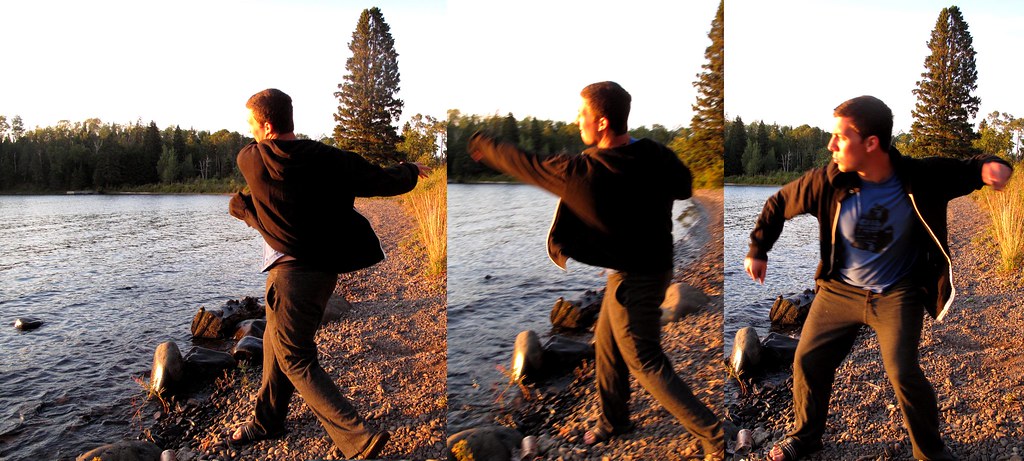
Skipping Out

Skipping Out by Danny Jacobs

Isle Royale National Park by Danny Jacobs

Hey folks, sorry for skipping out yesterday. A little too busy!

Danny took this action series at Isle Royale. Check it out bigger and in his slideshow.

Leaving Behind the Floods and Shame

Leaving Behind the Floods and Shame

Leaving Behind the Floods and Shame, photo by Rob Woodcox

Great title, great portrait, and somewhere in there, I think probably some great advice.

Check it out bigger and see more of his work in his slideshow.

Impossible Dream?

"Impossible Dream"

“Impossible Dream”, photo by Hilarywho

Tigers? Lions? We can dream, can’t we?

Hilary writes:

This spray-paint mural was made by Kobie Soloman. It covers the side of a building at the Russell Industrial Center in Detroit and is made up of elements of Detroit’s sports teams, aspects of Detroit industry, and representation of creative activities at the Russell.

Check this photo out bigger and in her Art slideshow.

Kicking back on the Kalamazoo

The View From My Kayak "Hazy Day's of Summer"
The View From My Kayak “Hazy Day’s of Summer”, photo by Mark Workman

Mark says that he got to enjoy yet another summer sunset on Big Daily’s Bayou off the Kalamazoo River.


Check it out bigger and in Mark’s The View from My Kayak Slideshow.

Wave Goodbye to Summer!

Summer Fun by Smiles7

Summer Fun……, photo by smiles7

Look out! The end of summer is crashing over the breakwall, and about 1.2 million Michiganders are hitting the road for Labor Day Weekend. If you’re one of them (or even if you’re not), you might want to check out Pure Michigan’s Labor Day Weekend page.  Lots of fun stuff there from Arts, Beats & Eats in Royal Oak, the Detroit Jazz Festival to the Fat Tire Festival way up in Copper Harbor.

Of course there’s also the Mackinac Bridge Walk and numerous Labor Day parades and observances.

You don’t really need any plans of course, throw a cooler or tent in the car and get out and grab a little summer before it’s gone!

Check this photo out bigger and in Julie’s Charlevoix slideshow.