Flint Corn, Calico Corn, Indian Corn

Nottawa Fruit Farm 016

Nottawa Fruit Farm 016, photo by bill.d.

Wikipedia’s entry for flint corn says that Flint corn (Zea mays indurata) is commonly known as Indian corn or sometimes calico corn. Its extremely low water content makes it much more resistant to freezing than other vegetables. Slow Food USA’s page on flint corn has some cool info and notes that this corn was the only to survive the infamous Year Without a Summer (1816), when snow fell in June and killing frosts struck in every summer month.

I found a Wisconsin Ojibway legend of the Father of Indian Corn that is very similar to one I heard from Michigan. It tells how a young man went out into the wilderness to seek another way of sustenance for his family.

For the first few days, he amused himself walking in the woods and over the mountain trails. He examined trees, plants, and flowers. This kind of physical effort in the outdoors prepared him for a night of sound sleep. His observations of the day filled his mind with pleasant ideas and dreams.

More and more he desired to know how the trees, plants, flowers, and berries grew. Seemingly they grew wild without much help from the Indians. He wondered why some species were good to eat, while others contained poisonous juices. These thoughts came back to him many times as he retreated to his lodge at night. He secretly wished for a dream that would reveal what he could do to benefit his family and his tribe.

“I believe the Chief of Sky Spirits guides all things and it is to him I owe all things,” he thought to himself. “I wonder if Chief Sky Spirit can make it easier for all Indians to acquire enough food without hunting animals every day to eat.”

“I must try to find a way in my dreams,” he pondered. He stayed on his bed the third day of fasting, because he felt weak and faint. Sometimes he thought that he was going to die. He dreamed that he saw a strong, handsome young man coming down from the sky, advancing toward him. He was richly dressed in green and yellow colours. He wore a plume of waving feathers on his head. His every movement was graceful.

“I have been sent to you,” said the sky-visitor. “The Sky Chief who made all things in the sky and upon the earth intends for me to be your Guardian Spirit and I have come to test you…

Read on to learn how corn was brought to the earth. Check the photo out background bigilicious and in Bill’s Nottawa Fruit Farm slideshow.

The Red Dwarf of Detroit and Other Ghostly Tales

2011 March Du Nain Rouge, Detroit, MI

2011 March Du Nain Rouge, Detroit, MI, photo by vanessamiller.

The last Wednesday of every month is a Weird Wednesday on Absolute Michigan, a time for stories of the spooky and strange. Definitely click that link to get your Halloween on, Michigan style, with stories from the Rowdy Ghosts of the Fenton Hotel to The Ghost of Minnie Quay.

Today’s tale is one of our favorites, the story of the Imp of Detroit, the Nain Rouge who some say has plagued the city since its founding over 300 years ago. It begins:

Among all the impish offspring of the Stone God, wizards and witches, that made Detroit feared by the early settlers, none were more dreaded than the Nain Rouge (Red Dwarf), or Demon of the Strait, for it appeared only when there was to be trouble. In that it delighted. It was a shambling, red-faced creature, with a cold, glittering eye and teeth protruding from a grinning mouth. Cadillac, founder of Detroit, having struck at it, presently lost his seigniory and his fortunes. It was seen scampering along the shore on the night before the attack on Bloody Run, when the brook that afterward bore this name turned red with the blood of soldiers. People saw it in the smoky streets when the city was burned in 1805, and on the morning of Hull’s surrender it was found grinning in the fog. It rubbed its bony knuckles expectantly when David Fisher paddled across the strait to see his love, Soulange Gaudet, in the only boat he could find, a wheel-barrow…

Read on for more, including more recent tales like the 1976 sighting by two employees of Detroit Edison of a small “child” climbing a utility pole on March 1st who then leaped from the top of the twenty-foot pole and scurried away. The next day Detroit was buried in one of the worst ice/snowstorms in its history.

Every March, the people of Detroit conduct the Marche Du Nain Rouge, a celebration to drive the Red Dwarf from the city. Vanessa got this shot there – see it bigger and in her 2011 March du nain rouge slideshow.

The Haunting of White River Light Station

White River Light Station

White River Light Station, photo by CJSmithChicago.

It’s Halloween week on Michigan in Pictures and we’ll try and feature as much Michigan spookyness as possible. Today’s story appears courtesy Still on Duty at White River Light on Absolute Michigan:

When Karen McDonnell is alone she sometimes hears footsteps on the stairway of the former White River Light. But she isn’t afraid. She says, “I like the comfort it gives me. It’s like a watchman, just making sure everything is okay before it’s too late at night.”

McDonnell is the curator of an old lighthouse that has been turned into a museum. She takes care of the light and gives tours to visitors. Sometimes early in the morning or late at night she hears what sounds like somebody climbing the stairs and walking around on the upper level. She wonders if it might be the spirit of the light’s first keeper.

When the White River Light opened in the mid-1870s, William Robinson and his wife Sarah moved in. Over the years, the English couple raised their family at Whitehall. Sarah died at a young age, but William remained the lightkeeper for 47 years. When the government forced the 87-year-old keeper to retire in 1915, William’s grandson became the next lightkeeper at White River. William helped his grandson run the light, but the rules said that only the lightkeeper and his “immediate” family could live at the lighthouse. William would have to leave. But he refused, telling his grandson, “I am not going to leave this building.” He was right. The day before he had to move out, he died. His grandson buried him in a small nearby cemetery…

Read more over on Absolute Michigan and learn more about the lighthouse at White River Light on Terry Pepper’s Seeing the Light.

Check this out background bigtacular and in Chris’s slideshow.

Enter the battleground

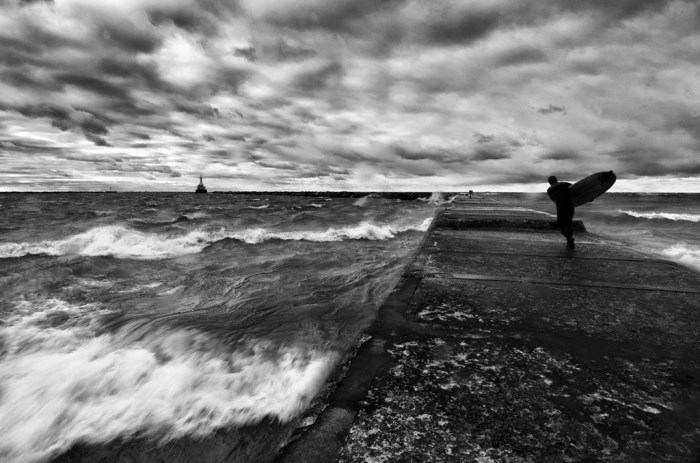
Enter the Battlegroung

Enter the battleground, photo by adonyvan.

While the high windsof the last couple of weeks have wrought damage, there’s one group that welcomes the weather, Michigan’s cold water surfers.

Check out absolutemichigan.com/Surf  for all kinds of Michigan surfing links and features including this one with a great surfing video.

Check this out on black and in Jiqing Fan’s Houghton & UP MI slideshow.

Family of Four on Lake Superior

FamilyofFour

FamilyofFour, photo by Rich Wyllis.

Rich writes:

found these cairns on the beach of Lake Superior. Three were on one rock, while one was left all alone. I tried to find an angle that showed their relationship (hence “family of four”) and used the sidelight from the setting sun to make them stand out from their background

Check it out background big and in his slideshow.

More Michigan beaches from Michigan in Pictures!

Misty morning on the Macatawa River

Misty morning

Misty morning, photo by Fellowship of the Rich.

Gorgeous photo from Holland last week from where Lake Macatawa meets the Macatawa River. Wikipedia says that the Macatawa River, also known as the Black River, drains into Lake Macatawa, adding that the name Macatawa is a mis-phoneticization of the Native American “Muck-i-ta-wog-go-me”, which means “black water.”

Check it out on black and in Rich’s massive Holland, Michigan slideshow.

More sunrises on Michigan in Pictures.

Seul Choix Point Lighthouse

Seul Choix Lighthouse

Seul Choix Lighthouse, photo by DanielBrinks.

The Seul Choix Point Lighthouse (map) is operated by the Gulliver Historical Society and DNR as a park & museum. Terry Pepper’s Seeing the Light’s page for Seul Choix Pointe Light explains:

At the dawn of the 1880’s, the volume of maritime traffic passing between harbors on the western shore of Lake Michigan and Green Bay and the Straits of Mackinac exploded. While the St. Helena Island light station lighted the eastern entry into the Straits, mariners were forced to navigate blind along 100 miles of unlighted upper peninsula coastline before the Poverty Island light came into view at the western end of the passage. With treacherous storms frequent at both ends of the navigation season, mariners frequently chose to ride out such storms in the lee of points protruding into the lake along this 100-mile stretch of unlighted shoreline.

Seeking to both make identification of such a refuge easier, and to mark the shore at an interim point between the two existing lights, the Lighthouse Board recommended that establishment of a light station on the end of Point Patterson, approximately midway between St. Helena Island and Manistique.

It took nearly 20 years to complete – read on for more about what was apparently the Cadillac of lighthouses. The light is also reputed to be haunted, and you can read a lot more about that in The Haunting of Seul Choix Point Lighthouse on Michigan in Pictures.

Check this out bigger and see more in Daniel’s 2020110700 Vacation slideshow.

Shaggy Mane Mushroom

DSC09529_tonemapped

DSC09529_tonemapped, photo by ansonredford.

Mushroom-collecting.com has this to say about the Shaggy Mane Mushroom:

The Shaggy Mane, also occasionally known as the Lawyers Wig, is a distinctive and easy to recognize mushroom. Its size, shape, and tendency to grow in tight groups make it easy to spot even from considerable distance. Shaggy Mane (Coprinus comatus) has an elongated bullet shaped, shaggy cap, with brownish upturned scales and a straight fairly smooth stem.

These grow in summer and fall in grass, wood chips, rocky, or hard packed soil often appearing shortly after a soaking rain. They may grow singly or scattered but often in large, tightly packed groups. Some years they are very common in city and suburban locations, pastures, lawns, gardens, along driveways, etc. Sometimes they are found in huge quantities presenting quite a dilemma since they require almost immediate preparation.

They are very common around this time of year along the roadside as well. Living Afield has a great pic of the Shaggy Mane and you can see a cool timelapse of its lifecycle too! You do need to be careful about a couple of similar mushrooms – see that page for details!

Donald found this beauty in his yard. Check it out background bigilicious and in his slideshow.

More Michigan mushrooms from Michigan in Pictures.

Wolverines, Spartans and Paul Bunyan

100910_UM V MSU FBC DENARD 2 LON

100910_UM V MSU FBC DENARD 2 LON, photo by AnnArbor.com.

In just a few hours, the University of Michigan Wolverines and Michigan State University Spartans will meet for the 104th time for rights to the Paul Bunyan Trophy:

The annual Michigan-Michigan State game gives the winner state bragging rights, an inside track to a bowl game, and last, but certainly not least, ownership of the Paul Bunyan – Governor of Michigan Trophy.

Presented for the first time in the 1953 meeting between the Wolverines and the Spartans, the Paul Bunyan Trophy is the lesser-known of Michigan’s two annual trophy games, shadowed by the nationally recognized Little Brown Jug Game between Michigan and Minnesota.

The Bunyan Trophy was put into circulation by then Michigan Governor G. Mennen Williams. The prize consists of a four-foot wooden statue of the legendary Paul Bunyan astride an axe with feet planted on a map of the state of Michigan. Two flags — one with the Michigan “M” and the other with the Michigan State “S” — are planted on either side of Bunyan. A five-foot stand supports the statue.

The Brown Jug is old news, because the game puts 1st place in the new Legends division of the Big Ten on the line, and both programs are in the top 25. Get a picture of the trophy along with all the links & history on the Michigan vs Michigan State Football Rivalry page on Absolute Michigan.

The photo of Michigan quarterback Denard Robinson being dropped for a loss by MSU’s Chris L. Rucker was taken by Lon Horwedel of AnnArbor.com in last year’s 34-17 Spartan victory. Check this out on black and in AnnArbor.com’s excellent slideshow from last year’s Michigan vs MSU game!

Bare Bluff overlooking Bete Grise Bay

n2c_111-8083

n2c_111-8083, photo by sgowtham.

The Keweenaw Free Guide’s entry for Bare Bluff begins:

Towering some 500 feet above the sparkling waters of Lake Superior, Bare Bluff commands a spectacular view across the lush green forest of the Keweenaw Tip and the encompassing waters of Lake Superior. The rocky bluff sits several miles from any semblance of civilization, standing along the far northern arm of Bete Grise Bay. In fact the only hint of civilization glimpsed from its vantage point os the Mendota Canal breakwaters and lighthouse – producing a landscape much like the early explorers to the region might have experienced. Highlights include the rocky shore of the Keweenaw, Smith Fisheries, the mouth of the Montreal River, Bete Grise Beach, and on clear days the Huron Mountains on the horizon.

Read on for directions. While the Guide deems it “a very difficult trail with a good amount of steep cliffs and sudden drop offs along the way,” Gowtham says it’s a “moderate hike is a price worth paying any day for a glorious view of the eastern shore of Michigan’s Keweenaw Peninsula.”  We should add a link to the Fall Color Tour for the Keweenaw Peninsula (Houghton, Eagle River, Copper Harbor) courtesy Pure Michigan’s Fall Color Tours.

In any case – stunning vista! He took it on October 4th, and you can see there’s still lots of color left! Check it out bigger and on his photo map.