Invasive Menace of the Day: Round Goby

must be exterminated

must be exterminated, photo by Kasey Carroll.

Kasey writes:

About ten seconds after I caught this, my fiancee’s uncle beat it repeatedly against the side of the boat. He said that it was an “intruder from outer waters and it must be exterminated because it eats all the perch eggs in Lake Eerie.” I’m sorry Peta. I didn’t do it.

See this bigger in her Things slideshow. The USGS Invasive Species Center page on the round goby says:

The round goby, Neogobius melanstomus, is a small, bottom – dwelling fish that was first found in the Great Lakes region in 1990. Originally from the Black and Caspian Sea areas of Eastern Europe, it is believed that this exotic species arrived in the ballast water of vessels coming into the Great Lakes. Since the first sighting in the St. Clair River, round gobies have spread to all of the Great Lakes and are working their way inland through the rivers and canal systems.

…Round gobies are found in all of the Great Lakes with the greatest numbers in Lake Erie, Lake St. Claire and southern Lake Michigan. Many of the areas with round goby populations are best described as infested. Once round gobies arrive they can become the dominant fish species. Round gobies prefer rocky, shallow areas, but have flourished in a variety of habitat types. Regardless of the habitat, round gobies are very aggressive fish that compete with native fishes for food and space. Anglers who fish in areas with round gobies often find that the gobies steal their bait and appear to be the only type of fish in the area.

Round gobies can eat zebra mussels in addition to fish eggs, plankton, fish, and benthic invertebrates. Because zebra mussels are filter feeders that accumulate contaminants in their body tissues, round gobies that eat zebra mussels may be consuming a high level of contaminants. When a predatory fish such as a walleye eats a round go by that has fed primarily on zebra mussels, they may be getting a much larger load of contaminants than they would from eating other types of prey fish. This could put dangerous concentrations of contaminants into sport-fish at a much faster rate.

According to the MLive, there are now an estimated 10 million pounds of gobies in Lake Michigan alone! More information at round goby on Wikipedia and from the round goby page on Protect Your Waters. How do we stop their spread? Always follow the procedure to Stop Aquatic Hitchhikers!

A boat full of Michigan bluegills

One of Many

One of Many, photo by mickey-finn.

Mickey Finn says that this picture is from an awesome night of fly fishing for bass and bluegills in Michigan in which he landed over 30 of these hand-sized beauties. The Michigan DNR’s Bluegill (Lepomis macrochirus) page says:

The bluegill is a native to eastern and central North America, including the lower Great Lakes. This fish enjoys a well-deserved popularity with anglers. Many a young angler boasts the delicious bluegill as a first catch, while seasoned anglers using light tackle find it a valiant fighter. Bluegills favor warm waters (64 to 70 degrees F) with plenty of cover such as weed beds, submerged logs, or drop-offs. They usually stay in relatively shallow water, but as temperatures rise in the summer, large bluegills will head for deeper water. This fish also provides good winter sport since it remains active all winter long.

The bluegill spawns in the shallows in the late spring or early summer when the water temperature reaches 65 degrees F. Males build nesting colonies in gravel, sand or mud and will guard the eggs and newly hatched fry until they reach the swimming stage.

Wikipedia’s bluegill entry has lots more about this common sunfish.

Let’s go fishing…

Roll Cast II

Roll Cast II, photo by chrisd1332.

Roll through many more in the Michigan fishing slideshow from the Absolute Michigan group.

Ultimate Fishing Early Risers Edition presents: What’s your favorite Michigan fish?

Early Risers

Early Risers, photo by docksidepress.

The Ultimate Fishing Show – Detroit gave me a few tickets to give away. The show is about fishing trips, boats and gear and it happens January 8-11, 2008 in Novi.

I figured I should offer some over here on Michigan in Pictures, so here’s the deal: Post a comment with your favorite Michigan fish to catch, eat or look at below and then send an email to giveaway@absolutemichigan.com with your name, city and email address and we’ll give away as many as we can!

Note that if you don’t want to go you can still post your fish!

This photo is in Matt’s My Photos by Most Interesting set (slideshow) and like all his photos, it’s posted background bigalicious!

Catch of the Day: Archives of Michigan at Flickr

Fly fisherman with Brown Trout

Fly fisherman with Brown Trout, photo by Photos from the Archives of Michigan.

The photo is captioned Unidentified man holding a brown trout caught on a fly. Location is somewhere in northern Michigan, c. 1930. They have several more Michigan fishing photos including one of Gov. George Romney releasing the first Atlantic Salmon into the Great Lakes in the early 1960s.

View more images from the Archives of Michigan on their Flickr page and also at seekingmichigan.org. Learn more about the Archives at archivesofmichigan.org.

Pickerel Spears, Ice Shanties and the Fishing History of Saginaw Bay

Saginaw Bay Ice Shanty c.1925

Saginaw Bay Ice Shanty c.1925, photo by oldog_oltrix.

Larry writes that this photo was taken by his grandfather at his ice shanty on Saginaw Bay (probably near Bay Park) in the mid-1920s. The 6′ bar between the shovel and the axe is a “spud” used with the axe to make the hole in the hole in ice and the pole coming from the top of the shanty is likely a “pickerel spear”. The This is one of the photos in his Oldog’s OLD PHOTOS set, and it also appears in the Michigan Thumb Memories group.

Over on Michigan Sportsman, Capt. Dan Manyen has written a nice little article titled The Fishing History of the Saginaw Bay. In it, he shares a number of old photos and provides a nice overview of the last few centuries of fishing on what I’m going to guess is Michigan’s largest bay. Capt. Manyen writes that walleye was mis-identified by many back then as pickerel and sold in great numbers to both local fish market outlets and buyers from the eastern states. He says that for many in the area, the burgeoning auto industry…

…did not stop or ease the pain of the Great Depression during this time. What did for many though, including my own Grandfather, was the plentiful fishing and hunting resources the Bay area offered. When Grandpa couldn’t get a job unloading the (Bean Boat) as he called it for .50 cents a day, he’d be out hunting or fishing for a meal for his family. Grandpa talked often about spending all winter out on the ice on Saginaw Bay in a (Pickerel Shanty) spearing pickerel.

I’m not sure where you might want to take this, so here’s the Wikipedia entries for Pickerel, Walleye and Saginaw Bay. You might also be interested in the Saginaw Bay Watershed Initiative Network, the Saginaw Bay Fishing Report and a more recent photo of ice fishing on Saginaw Bay.

Also see Saginaw Bay on Absolute Michigan’s Map of Michigan.

Old Crystal Lake Trout Ice Angler

Old Crystal Lake Trout Ice Angler

Old Crystal Lake Trout Ice Angler, photo by UpNorth Memories.

This photo is part of a neat set of photos titled Older Benzie County Fishing Memories. If old photos are something you enjoy, check out Don’s astonishing collection of old northern Michigan postcards.

For a while, it looked like most lakes in Michigan would need to dig into the archives to get ice this winter. However, as Eric Sharp writes, the Iceman has (finally) cometh.

Fishing at Sunrise

Fishing at Sunrise by DetroitBikeBlog

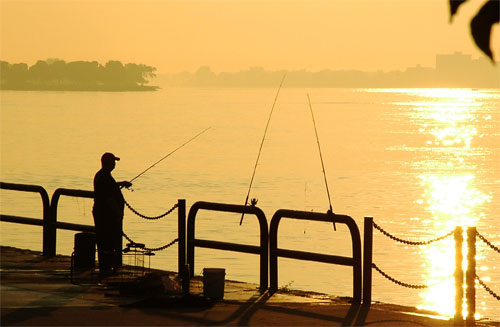
Fishing at Sunrise, photo by DetroitBikeBlog

Mac took this photo of a fisherman on the Detroit River. He maintains the very cool Detroit BikeBlog where more photos of the D can be found.

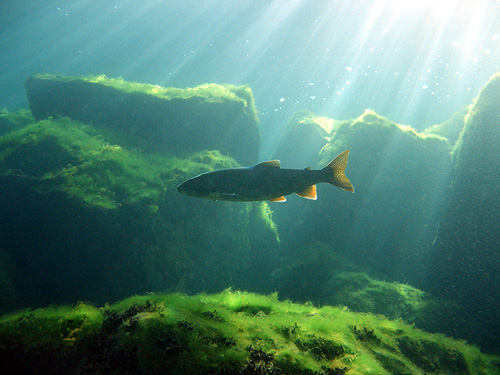
Lake Trout

Lake Trout

photo by Christopher Morey

Christopher Morey writes:

This is a Lake Trout. The picture was taken October 3rd, 2005 while freediving along the outside breakwall of Clinch Marina in Grand Traverse Bay at about 25-30 feet depth. I’d been seeing these fish for about a two weeks when I finally figured out how to approach them.

The trick is to first know when they are hunting in a particular area. The breakwall provided good cover so I would wait back in the rocks on the surface until I saw the school swim by. If all the fish were more or less together then I would wait until well after they passed, breath up and head for the bottom to await their return. If the school was more diffuse I’d make my dive after the lead individuals passed and wait for the rest of the school. If they saw me dive, make abrupt movements of any kind or if I appeared to be heading toward them at all they would spook and avoid the immediate area for long periods of time.

Sometimes, as I waited on the bottom, the Trout would swim around behind me in the rocks and, if I was able to turn with them but remain very still, I could get some fairly close shots. Most were taken toward the end of a very long breathhold.

You can read a great feature on Christopher and his daughter in the Traverse City Record-Eagle and see a whole bunch more pictures of taken while freediving along the Clinch Marina in Grand Traverse Bay and in Lake Michigan south of Pyramid Point in the Sleeping Bear National Park in his Great Lakes Freediving photo gallery.