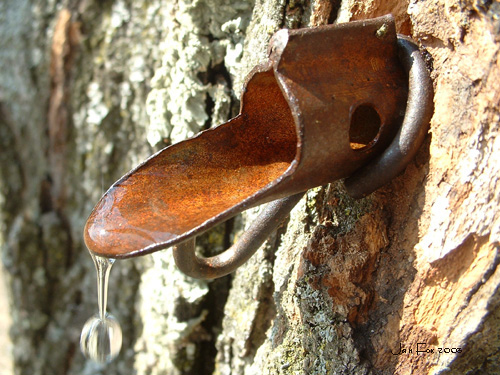
Spile, photo by Jan Fox ©
In an ideal world, I’d be able to lay out the process of making maple syrup using nothing but Michigan photos. Unfortunately, I can’t. I should be able to as my family used to sugar when I was a kid. I can only find a couple of the photos my dad took though. Such is life. I find maple sugaring a fascinating subject, so I’ll try and pull off a whirlwind tour of how it gets made. Bear in mind that we are discussing maple syrup here, Mrs. Butterworth, get outta here!
The roots of maple syrup start with the first Americans, and the fact that somewhere along the line, someone discovered that the sap of maple trees is sweet. If you ever get a chance to taste ice-cold sap in the spring, please do! Be warned that once the trees have budded, sap tastes bitter.
The process of sap collection is relatively simple. A hole is drilled in a maple tree and a spile like the one in the photo above is hammered into the hole. A bucket (or buckets) is then hung on the spile into which sap drips. Cold nights and warm days produce the best sap flow. For a few trees, folk will use a larger bucket while the big sugaring operations use a network of plastic lines.
In any case, the sap is collected and stored until such time as you are ready to boil it down (photo part of a great set of pictures!). This takes hours and hours and it takes 30 or 40 gallons of sap to make one gallon of maple syrup. Anyone who has ever made this knows that there’s no way sugar and carmel coloring are ever going to equal real maple syrup atop a stack of pancakes.
If all goes well, you will be able to see some or all of the photos featured here at the “sweetcycle” tag on Flickr.
View a Collection from 1940 by Marion Post Wolcott in the Library of Congress
How to Make Maple Syrup from the Michigan Maple Syrup Association
Native American Maple Sugaring: One Drip at a Time on Michigan in Pictures
Great information about Michigan maple syrup and maple syrup events from Absolute Michigan
Share Michigan in Pictures:


 Michigan in Pictures