

Foggy river, photo by kthschsslr.
kthschisser writes that he took this photo of a heron on the Flint River near Flushing while rushing to the airport.
Always good to have eyes open and camera handy…
Foggy river, photo by kthschsslr.
kthschisser writes that he took this photo of a heron on the Flint River near Flushing while rushing to the airport.
Always good to have eyes open and camera handy…
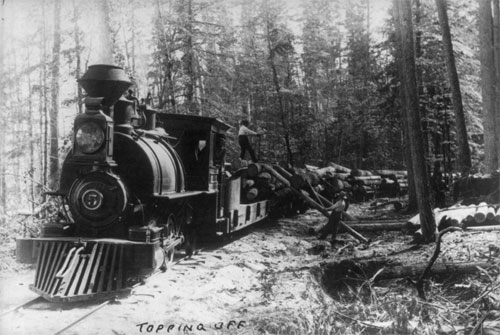
Topping Off, photo by William Morrell Harmer
The photo shows some lumbermen loading the last few logs onto a logging train near Cadillac, Michigan somewhere around 1892. While looking around for something about Cadillac and logging, and on the City of Cadillac’s history page, I learned:
The Shay Locomotive was invented in Cadillac by Ephriam Shay in 1878. The Shay Locomotive was one of the first to have the ability to haul logs on uneven terrain, sharp curves, and up steep hills. Shay Locomotives were used throughout the United States between 1880 and 1945.
That sounded promising, so I went over to ShayLocomotives.com and found in their many pictures a photo of one of the surviving Shays – engine no. 5 in Cass, WV (official site. Take a look at that and tell me if you think they’re the same train. Probably not, but still, I’m thinking this one is a Shay.
Wikipedia’s Shay Locomotive entry says that Shays were built by the Lima Locomotive Works of Lima, Ohio. However six Shay Patent locomotives, known as Henderson style Shays, were built by the Michigan Iron Works in Cadillac.

A Herd of Turkeys, photo by curlyson.
The thought of two guys in the woods chasing turkeys around for a photo is pretty funny.
You can learn more about Michigan turkeys (both wild & plattered) at Absolute Michigan.
Happy Thanksgiving folks.

Portal for the locomotives, photo by smartee_martee.
In addition to taking some great pictures, Marty does a wonderful job of digging up and presenting background information. Fiborn Quarry was one of the largest early 20th century quarry operations in the Upper Peninsula, and Marty’s Fiborn Quarry set (slideshow) begins:
Fiborn Quarry was created by a partnership of the Duluth, South Shore & Atlantic Railroad in 1904. This small company town was built to house the workers (homes and a boarding house), offer a school and a general store. The operations consisted of the quarry plant, crusher house and steam engine shop.
Marty goes on to tell you about the role of limestone in the history of the UP, and he also links over to the Michigan Karst Conservancy. In addition to extensive information on the history of Fiborn (be sure to click the little photos at the bottom of the pages too), the MKC tells you about karst:
Karst is a term that was first applied to a plateau region of the Dinaric Alps in Yugoslavia. It is now used to describe similar regions throughout the world that have features formed largely by underground drainage. Karst terrains are characterized by caves, steep valleys, sinkholes, and a general lack of surface streams because drainage is underground…
What does this have to do with Michigan, a land literally scoured by glaciers, a land covered with glacial clay, sand and gravel? Surprisingly, Michigan contains some areas of true karst. They are limited in extent, but this rarity increases their interest and importance. There is also considerable variety in Michigan karst areas: gypsum karst is found in Kent and Iosco counties; a significant amount of surface drainage goes underground in Monroe County, and reappears at “blue holes” in Lake Erie; spectacular sinkholes and earth cracks are found in Alpena and Presque Isle counties; and the broad band of outcrops of the Niagara Escarpment in the Upper Peninsula hosts a number of karst sinks, springs and caves.
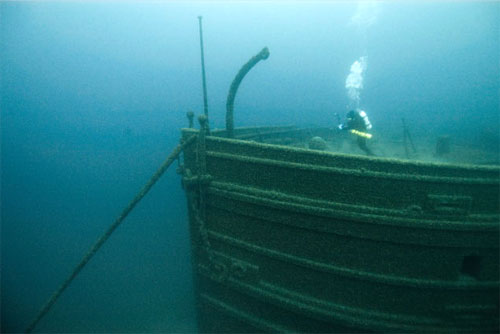
Exploring the Florida, Thunder Bay National Marine Sanctuary
The Thunder Bay National Marine Sanctuary encompasses almost 450 square miles of Lake Huron’s bottomlands off Alpena. It is the thirteenth national marine sanctuary and was established in 2000 to protect a nationally significant collection of nearly 200 shipwrecks, spanning over a century of Great Lakes shipping history. Thunder Bay is the first Great Lakes sanctuary and also the first to focus solely on a large collection of underwater cultural resources. The headquarters of the Sanctuary is the Great Lakes Maritime Heritage Center in Alpena.
The photo above is one of many awesome underwater photos of the Florida and other shipwrecks that can be viewed in their Fieldwork 2007 Gallery. Seriously, this is cool – go look at it and be sure to click the “slideshow” view at the top left to see the larger sized images.
Dave Swayze’s amazing Great Lakes Shipwrecks File includes information on 4,760 great lakes shipwrecks. It says that on May 21, 1897 in dense fog off False Presque Isle, the 271′ package freighter Florida, one of largest boats on the Great Lakes, collided with one of the few that was larger, the steamer George W. Roby. The Roby rescued her crew, but with a large hole in her starboard side, the Florida sank in just 12 minutes in 250′ of water.
There’s more information on the Thunder Bay National Marine Sanctuary and Underwater Preserve over at Absolute Michigan.

platte lake, photo by johnhoneyman.
John has some more beautiful photos of Northern Michigan and he’s thankfully uploaded them large enough to make great backgrounds for your computer!
The Platte River entry on Wikipedia gives you a pretty confusing look at the river’s watershed, so let’s turn to the Platte Lake Improvement Association which says that Big Platte Lake is located in Benzie County near the Village of Honor in northwest lower Michigan. It is approximately 3.3 miles long and 1.6 miles wide, covers approximately 2550 acres, has a maximum depth of 95 feet and an average depth of 24 feet. The primary source of water for Platte Lake is the inflow from the Upper Platte River. With an average inflow of about 4 million gallons per hour, water in the lake has a “residence time” of just 6 months – quite a bit faster than the 10 years most other lakes in the area average.
The site also includes a link to a 1901 article on from The Amateur Sportsman describing the fishing in the lake at the turn of the last century (pdf). I’m told that it’s still pretty darn good!
I’ve added Platte Lake to our Absolute Michigan map of Michigan.

Deep Thoughts and Work Comps, photo by CAVE CANEM
The Center for Michigan is an organization I work with that I very much admire. They are dedicated to helping to transform Michigan’s business, economic, political and cultural climate. One of their efforts to help us get our arms around what we have and to visualize what we could become is their Envision Michigan Competition.
You can see the weekly winners on their web site like Michigan is richer than we think, It’s all about the water and Walking the trails, in which Norma Wolf writes:
My home is in a wooded subdivision in Haslett, a suburb really, of East Lansing. A daily trek down my tree lined street will take me into the woods on a trail that twists and turns through five miles of beauty. I pass through deciduous trees and pine forest. I travel literally through the wetlands and up and over flowing streams. In the Spring I watch as the skunk cabbage makes its appearance and later I delight in the snake dozing in the sun along my path. In the fall the wind through the leaves of maple and oak remind me of the true beauty of this state of Hiawatha.
Entering your photo, essay or video is easy and you can win a part of $30,000 in prizes including weekly Meijer shopping sprees, college scholarships and Michigan vacations. Check it out.
I picked this photo because the photographer is one of too many talented folks who left our state for economic reasons. It seems clear to me that Michigan can’t afford to continue to allow our best to leave and our brightest bulbs to never shine to their full brightness.
In my opinion, that means that we as a state need to commit our efforts, intellects and hard-earned dollars to rebuilding our state as a place that operates with its eyes wide open to the realities of the modern world. I think that the last decade demonstrates that it’s not enough to talk about our commitment to our children, our future and our state and draft plan after underfunded plan. Sooner or later, you actually have to roll up your sleeves and get to work.
I don’t know what your opinion or vision is, but I do know where you could share it…
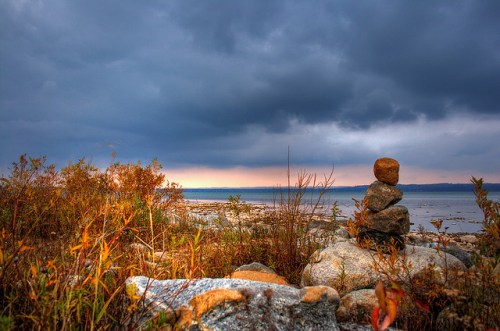
stacked, photo by The Real Ferg.
Ferg took this @ Deepwater Point Natural Area. The Grand Traverse Regional Land Conservancy says Deepwater Point is a 15 acres property is owned by Acme Township on East Bay, north of Traverse City. The plaque reads:
In memory of Clyde H. Reed
Who along with his neighbors fought to protect Acme Township’s Deepwater Point Area – a place precious and dear to him. May we follow his example by being good stewards of this beautiful land for the benefit of future generations.
When I saw this photo, I realized that I had never shared on Michigan in Pictures something that I saw this summer. We called it the Amazing Frankfort Rock Gallery. I spend a ton of time on Michigan’s beaches, but this summer I seemed to see these rock structures everywhere. I wasn’t the only one either.
Anyone in the audience have any idea what’s behind this rock-stacking mania in Michigan?

8 Point White Tail Buck, photo by trekguy
November 15 is opening day of deer season in Michigan – follow that link over lots more from Absolute Michigan.
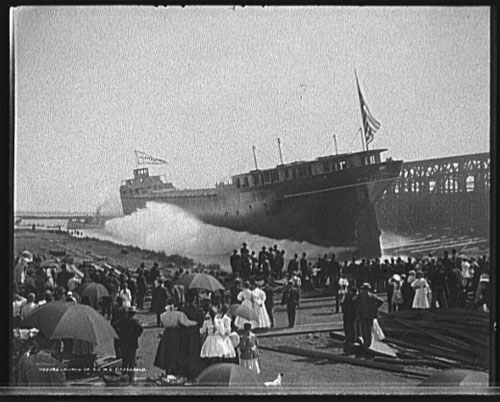
Launch of the S.S. W.E. Fitzgerald at Wyandotte, Detroit Publishing Co.
I have no idea how I ended up at this photo (and why I suddenly feel like Paul Harvey), but here’s what I’ve learned through Boatnerd.com and a forum with a brief article from Boatnerd by Dick Wiklund about the “Little Fitz.”
William and Julia Fitzgerald of Marine City, Michigan sired six sons. The sons were fascinated by the wooden sailing ships and early steamboats on the St. Clair River, and all six became captains of Great Lakes ships. The youngest of these was John Fitzgerald, who started a shipyard in Milwaukee. His son, William E. Fitzgerald, took over the business in the 1890s but died just a few years later. William’s close friend, Captain Dennis Sullivan, built and christened the W.E. Fitzgerald in Wyandotte in his honor in 1906.
The Wyandotte Historical Museum’s history page says that Wyandotte’s shipbuilding industry was started by Eber B. Ward:
Wyandotte produced over 200 ships, varying from small tugs to large steamers and passenger ferries. Under the name of the American Shipbuilding Company the Wyandotte yards flourished. Hulls were constructed in Wyandotte and were taken up the Detroit River to Detroit, Michigan were they were outfitted. Smaller companies such as the E.H.Doyle Hoop & Stave Works(1889)who provided the city’s first electric power, the Regeant Stove Company, the McCord Corp. and the Beals & Selkirk Trunk Company soon made Wyandotte a famous industrial town.
In 1953, the WE Fitzgerald became known as the Little Fitz when the massive freighter named after William’s son was launched. His name, of course, was Edmund Fitzgerald.
The Library of Congress index of Wyandotte photos is heavy ships & shipyards (you may need to go to this page and search for “Wyandotte”). If you’re in the mood for a ton of Great Lakes freighter information (and a little music and “Laker” cooking), head over to Absolute Michigan’s word of the week: Freighter.
 Michigan in Pictures
