Ski it up, Michiganders!

Chris 360 Cross

Chris 360 Cross, photo by btwphotography.

Absolute Michigan has some cool resources for skiers from beginners that are summarized more or less neatly in today’s Michigan Skiapalooza Thursday which begins:

While Winter 2008 hasn’t been good for things like car makers, investments and national economies, it has presented us with some incredible conditions for skiing and snowboarding.

USA Today noticed that Midwest skiers have all kinds of options in Michigan where we have more downhill areas – 42 – than any state except New York with 200 chairlifts, 840 runs and 40 terrain parks!

There’s even a deal for beginning skiers for the whole month of January that you’ll definitely want to check out if you’re a novice without equipment!

You can see this photo (and many more) bigger and bolder in btw’s Nubs Portfolio slideshow (view set) or his Skiing – Nubs Nob slideshow.

Northern Lights Forecast: Predicting the Aurora Borealis in Michigan

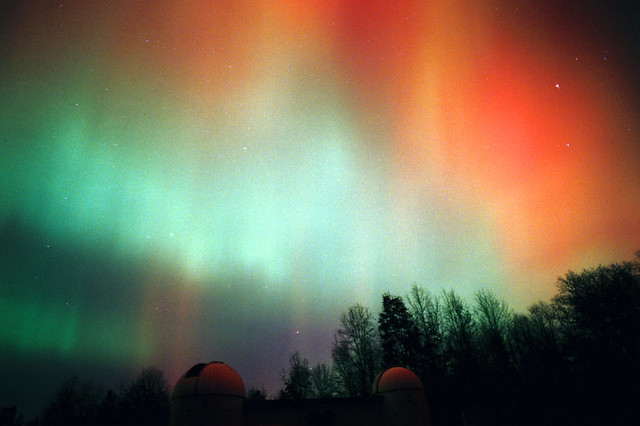
Skyfire by Kevin’s Images

A lot of people end up at Michigan in Pictures every day when searching for the northern lights, and one of the biggest questions I get asked through comments and email is “When and where can I see the Northern Lights in Michigan?”

The Geophysical Institute in Alaska is one of the hotspots for information about viewing the aurora borealis aka the northern lights. In their excellent Aurora FAQ, they answer the question Can you predict when and where there will be aurora?, saying you can, but with less confidence than weather prediction. The aurora is powered by the solar wind, and strong solar winds tend to bring intense auroras.

The Institute’s Auroral Forecast Page presents data on the solar wind forecasts the intensity level of the aurora. You can then check the “Can I see the aurora?” link at the top and also their page on interpreting the aurora, where they offer this advice:

The auroral activity forecast predicts the expected location of the most active auroral forms that can be expected for the given period. Aurora viewing is also affected by a variety of other factors, such as cloud cover, moonlight, and urban light pollution, so what you see will be strongly affected by your particular location and meteorological luck.

The best time to observe aurora is near local midnight, when the most active forms often occur. More precisely, the time to shoot for is an hour or two prior to local geomagnetic midnight, and the forecast maps found here are calculated for that time. If you are a serious aurora watcher, plan to spend the night from about 9 P.M. to 3 A.M. watching for auroral action. Auroral activity tends to come in waves during an evening, which are called auroral substorms. Even during an active period, there will be lulls in which the auroral activity is subdued; however, the patient observer will often see a new burst of activity within an hour or two.

I found that selecting the North Polar view seemed to provide the best view for Michigan, and it appears to me that we need to have an activity level of 3 to see any of the lights in Lower Michigan and 2 for the Upper Peninsula. Based on today’s forecast, it appears that on December 23 we’ll have a chance to see the aurora – if anyone does, please post it here and on the Michigan Northern Lights Log over on Absolute Michigan.

You can see this photo larger and also more shots that Kevin took that night at the James C. Veen Observatory in Grand Rapids in his Astronomy set (slideshow).

For much more Michigan northern lights goodness check out the northern lights category on Michigan in Pictures and the Michigan Tech-based leading page on the northern lights, The Aurora Page. And I might as well slip in this amazing time lapse of the aurora borealis from British Columbia.

Michigan Fox Squirrel

Got My Nut . . . I'm Outta' Here

Got My Nut . . . I’m Outta’ Here, photo by Matt Kedzior.

Wikipedia’s Fox Squirrel entry says that the Fox Squirrel (Sciurus niger) is the largest species of tree squirrel native to North America and are also sometimes referred to as the Stump-eared Squirrel, Raccoon Squirrel, or Monkey-faced Squirrel.

Fox Squirrels depend primarily on tree seeds for food, but they are generalist eaters and will also consume buds and fruits, cultivated grain, insects, birds’ eggs, and small lizards … In their regular diet of nuts, fox squirrels are classic scatter-hoarders that bury caches of nuts in dispersed locations, some of which are inevitably left unretrieved to germinate. (Matt says he watched this little guy dig around for a couple seconds in the snow and he came up with a nut that I assume he buried earlier)

Fox Squirrels are strictly diurnal, non-territorial, and spend more of their time on the ground than most other tree squirrels. They are still, however, agile climbers…

They are gregarious and apparently playful, often chasing each other up and down trees and across yards and clearings. They have a large vocabulary, consisting most notably an assortment of clucking and chucking sounds, not unlike some “game” birds, and they warn the listening world of approaching threats…

Fox Squirrels are also known for being living fossils, skeletally very similar to remains of the oldest-known squirrel, Protosciurus, from the late Oligocene and early Miocene epochs.

For more, check out the Animal Diversity Web pages on the Fox Squirrel and also Michigan DNR’s page on Michigan squirrels.

You can see this bigger in Matt’s slideshow.

Yeah, it’s cold outside…

Yeah, it’s cold outside… by Dale Treadway

After a brief reprieve from the chill over the weekend, winter has ridden roaring winds back to Michigan this morning.

He says you should probably view this photo large and on black, or you can see it and others larger in Dale’s Winter ’08 Series 1 set (slideshow) and try and stay warm!

The Polar Express and Pere Marquette 1225

The Pere Marquette #1225 (Christmas train 12/25) One of the Last!!!

The Pere Marquette #1225 (Christmas train 12/25) One of the Last!!!, photo by David Sr. – Lapeer Photography.

A lot of times I think I’ve written about something on Michigan in Pictures and then when I look, it turns out I haven’t.

Such is the case with the Pere Marquette #1225 Christmas train. David writes that this train was used as the model for the train in the animated movie “The Polar Express” with Tom Hanks (view trailer on YouTube). Wikipedia explains:

The steam locomotive that pulls the Polar Express is modeled after an actual locomotive that is on display at the Steam Railroading Institute in Owosso, Michigan. The Pere Marquette 1225 Berkshire-type (2-8-4), built in 1941 at the Lima Locomotive Works in Lima, OH, was part of the Pere Marquette Railway system before being decommissioned in 1951. Slated for scrapping, it was acquired by Michigan State University (MSU) in 1957 and exhibited on campus.

In 1971, MSU steam enthusiasts commenced the formidable task of restoring the mighty locomotive to operating condition. Restoration was substantially completed in 1985, and in 1988, number 1225 started pulling excursion trains in the Owosso area and around Michigan. The locomotive has been listed on the United States National Register of Historical Places.

In the film, artistic liberty is taken with the appearance of the locomotive and its tender, both being made to seem even more massive than the 794,500 pound (361,136 kilogram) original. Many of the train’s sound effects, such as the whistle blowing and steam exhausting, were created from live sampling of number 1225 while in operation.

Learn more about the train and see it in action at The Steam Railroading Institute in Owosso. See it bigger along with other views of Michigan in David’s Michigan slideshow (view set) and see more photos of the Pere Marquette 1225 in the 1225 Michigan slideshow (really a treat!)

The movie was based on the Caldecott Medal winning book The Polar Express written and illustrated by Chris Van Allsburg. Like the movie, it’s set partially in Van Allsburg’s hometown, Grand Rapids.

More Sunrise This Morning

More Sunrise This Morning

More Sunrise This Morning, photo by jacalynsnana.

As she says: view large (or check this and a few other shots out in her slideshow).

More wintry goodness on the Michigan Winter Wallpaper page.

Step Right Up: Day Care for photographers in Ann Arbor

Step Right Up!, photo by murn

In Gallery Project: Step Right Up! on her awesome blog Relish, Myra explains:

I took a break from working on orders yesterday to join Mary Morgan in visiting the Gallery Project space on S. Fourth Ave. (Ann Arbor), where artists are in the process of installing their pieces for a new show that starts tomorrow, December 10. I don’t normally cover (non-performing) art, but this exhibit is just so cool I couldn’t resist.

The exhibit is comprised of 18 theatrical, interactive scenes — many with costumes and props — designed as backdrops and inspiration for exhibit-goers’ own photographic portraits.

Fulfill your dream of being photographed with a life-size Barbie cake, complete with your own tiara. Or if you’ve always wanted to join the circus, now you can. The 18 different installations are symbolic/conceptual monkey bars for your creative expression. You are limited only by your imagination. Come play!

The exhibit is a fundraiser for the Gallery Project — and a brilliant one at that! A PhotoPasses may be purchased for $20, which entitles you to visit the exhibit and snap as many photos thereof as you’d like over the course of the 6-week show (excluding the opening reception). Tickets for the opening reception (this Friday, December 12) are only $10. If you don’t have a camera or a photographer (or a vast retinue of paparazzi) with you, don’t despair — gallery assistants will be slinging genuine, actual film–based, Polaroid instant cameras, and you may purchase portraits for $5 (or 3 for $10).

Sounds like a blast! Click over to Relish to see more pics of the scenes and head to Myra’s slideshow on Flickr to see the above photo bigger and bolder. You should also read Mary’s article in the Ann Arbor Chronicle!

Michigan road salt & the Detroit Salt Mine

Salt Mountain, photo by otisourcat

In the battle against snow and ice that is waged every winter day on Michigan’s roads, salt remains and essential ingredient. MDOT records for 1991 show that 442,223 tons of road salt were applied to 10,000 linear miles of trunk line maintained under MDOT’s jurisdiction. The Wayne County Road Commission notes that a single salt run for a truck can use up to 12 tons of salt, depending upon the truck size. That page has several more bits of trivia including the fact that at temperatures below 20 degrees, salt begins to lose its effectiveness. It becomes almost completely ineffective at 0 degrees or colder.

The Salt Institute’s page on Michigan salt says that estimated salt deposits in Michigan are astronomical. In the Detroit area alone, it is believed that there are over 71 trillion tons of unmined salt. Geological studies estimate that 55 counties of the Lower Peninsula cover 30,000 trillion tons of salt.

Our largest salt mine is actually the Detroit Salt Mine, operated by the Detroit Salt Company (closed for a time but now re-opened, comes with an annoying & loud Flash warning) and I suppose is makes sense that in 1940 Detroit became the first major city to use rock salt for snow and ice control. The Great Lakes Radio Consortium’s Ann Murray has a great report titled Exploring a Great Lakes Salt Mine that takes you inside the Cleveland salt mine that extends under Lake Erie. The best exploration of the mine is via The ghostly salt city beneath Detroit in the Detroit News:

In a 1925 Detroit News article, miner Joel Payton told about his salt mine job. “The only dirty part of this job is going down to work,” Mr. Payton explained.

“I have to wear this old outfit because the big buckets that take us down get smudgy from the action of the sulphur water on the iron of the buckets.

“The mine itself is dry and clean as pure rock salt in a solid vein 35 feet thick is bound to be. The high vaulted rooms that we have hollowed out have sparkling white floors, walls and ceilings.”

Payton continued, “One reason we don’t have any rats in our Detroit mine is because the rats would have nothing to eat except the leavings of our lunch pails. And by the way, not only are there no rats or cockroaches or other living creature in our mine, but also no remains of living things from past ages. The salt vein is, of course, a dried up sea that once covered this section for hundreds of miles. You’d naturally suppose that some fish or vegetation would have been pickled or fossilized in the brine as it hardened. But I’ve never seen a single fossil or sea shell or any remains of that kind”

The photo above was taken at the Verplank salt dock, Muskegon and you can see more photos of otisourcat has taken of Michigan road salt.

Yellow and Blue With a Touch of Green

Yellow and Blue With a Touch of Green

Yellow and Blue With a Touch of Green, photo by Cherie S..

Brought to you by the Committee for Sunshine and Blue Skies, Michigan Chapter (lapsed).

You can see this photo larger right here or check it out in Cherie’s Foliage and Flowers set (slideshow).

future hopefuls: Michigan Christmas Trees

future hopefuls

future hopefuls, photo by yodraws.

As might be expected, the Michigan Christmas Tree Association is not a fan of fake trees, pointing to hazardous chemicals and such and noting that:

  • Real Christmas trees help filter dust and smog from the air and help stop soil erosion.
  • Christmas trees on a farm produce oxygen – a necessary component of life for people.
  • Real Christmas trees provide a comfortable habitat for a wide variety of wildlife.
  • After the holidays, Christmas trees can be recycled and used for purpose including bird feeders/shelters, fuel chips and mulch. Fake trees end up in a landfill.

I read somewhere that live Christmas trees or decorating a tree outside are the absolute best choice. Anyway, check that link above for all kinds of Michigan tree dealers and info including also see Absolute Michigan keyword Christmas tree for more links and articles.

Yo writes that on this cold and snowy Saturday, they found a tree in record time that was short and sweet with tiny little pine cones. See it bigger in her Somewhere in Michigan slideshow!

If you feel like a visit to the Christmas tree farm or lot is a chore, check out The Christmas Tree Ships for a look at how things were “back in the day”.