A Blue Like No Other: Robin’s Egg Blue

A Blue Like No Other

A Blue Like No Other, photo by sl33stak.

Wikipedia’s American Robin entry (that’s Turdus migratorius for all the 3rd graders out there) says:

The American Robin begins to breed shortly after returning to its summer range. It is one of the first North American bird species to lay eggs, and normally has two to three broods per breeding season, which lasts from April to July.

The nest is most commonly located 1.5–4.5 meters (5–15 ft) above the ground in a dense bush or in a fork between two tree branches, and is built by the female alone. The outer foundation consists of long coarse grass, twigs, paper, and feathers. This is lined with smeared mud and cushioned with fine grass or other soft materials. A new nest is built for each brood, and in northern areas the first clutch is usually placed in an evergreen tree or shrub while later broods are placed in deciduous trees. The American Robin does not shy away from nesting close to human habitation.

A clutch consists of three to five light blue eggs, and is incubated by the female alone. The eggs hatch after 14 days, and chicks leave the nest a further two weeks later. All chicks in the brood leave the nest within two days of each other.

The cool blog ColorBuzz has a cool post about Robin’s Egg Blue that has a number of cool tidbits about this unique shade of blue such as the reason that a robin’s egg is blue is to hide it from color blind mammals and that Tiffany has trademarked the hue.

In case you’re itching for a fight with Tiffany and wondering how to make it, in hex code it’s #00CCCC or 0, 204, 204 in RGB. You might just want to buy the crayon.

You can view this larger in Jamie’s Nature slideshow (or check out the set).

Apricot Blossoms

108::365 apricot tree

108::365 apricot tree, photo by the little red hen – egg money.

See this bigger in Lynn’s 365 in 2009 slideshow.

The story of the Irish Hills Towers

Irish Hills Towers

Irish Hills Towers, photo by dt10111.

The Wikipedia entry for the Irish Hills Towers says that these wooden observation towers were constructed along US-12 in the Irish Hills region in northern Lenawee County as the result of a curious competition along the lines of the skyscraper frenzy in New York:

In the early 1920s, the Michigan Observation Company sought places of high elevation to erect fifty foot high enclosed platforms to boost tourism. In southern Michigan, a tower was placed atop Bundy Hill in Hillsdale County, Michigan and officials sought a knoll in the heart of the Irish Hills in Lenawee County. A farmer who owned half of the knoll, Edward Kelly, turned down the company’s offer to purchase his portion of the land. The adjoining land owner, Thomas Brighton, consented the sale of his plat, and construction of the Irish Hills Observatory commenced.

The opening of the Irish Hills Observatory was announced by The Brooklyn Exponent in September 1924. In a gala celebration on October 4 and October 5, hundreds of people ascended the hill and tower to gaze upon the rolling landscape and crystal blue lakes in all directions. Kelly seemed spited by the exploitation of the MOCs venture, and protested by erecting his own tower. By the end of November, 1924, his own observation platform was in place, just feet away from the MOCs structure, and several feet higher.

The Michigan Observation Company responded by adding a second observation enclosure to the top of its own facilities, now designated as the “Original Irish Hills Tower”. Kelly proceeded to add a raised platform to his “Gray” tower (named as such because of its gray-painted exterior), an act which brought the two edifices to an even height. The MOC informed Kelly that if he attempted to compete with more height given to his tower, they would tear down their own and construct a metal observatory so large that Kelly’s efforts would be nullified. He conceded, and turned his efforts instead to drawing more revenue to his creation.

In the 1950s Frank Lamping purchased both and added a gift shop. The towers closed in 2000.

Here’s a cool postcard from the 1930s of the view from Irish Hills Towers, a sweet photo from Matt Callow and a few photos showing different views of the towers. You can see the location on Waymarks.

See this bigger right here and in Daniel’s Buildings set (slideshow).

More Michigan roadside attractions from Michigan in Pictures!

Sunset Season

sunset, photo by smiles7

Sunset season is here – check the Absolute Michigan pool for all kinds of Michigan sunsets.

marina keh

marina keh

marina keh, photo by suesue2.

See this larger in Sue’s bokeh slideshow and have a happy weekend!

Moonstruck by Lightning

moonandbarn

moonandbarn, photo by Aunt Owwee.

Spring is storm season in Michigan, and where there’s storms, there’s often lightning. One of my favorite blogs, The Everyday Adventurer, has a post about lightning rods that I’ve been meaning to feature. I was waiting for a nice spring storm to rumble through but it looks like the April showers are sleeping in this year.

Wikipedia’s Lightning rod entry explains Ben Franklin’s US invention of the lightning rod (which appears to have been invented in Russia 20 some years before). Like many new inventions, it drew criticism. Here’s what Rev. Thomas Prince, the rector of Old South Church in Boston, said in his 1755 sermon titled Earthquakes the Works of God and Tokens of His Just Displeasure:

“…the more points of Iron are erected round the Earth, to draw the Electrical Substance out of the Air; the more the Earth must needs be charged with it. And therefore it seems worthy of Consideration whether any part of the Earth, being fuller of the terrible Substance, may not be exposed to more shocking Earthquakes. In Boston are more erected than anywhere else in New England; and Boston seems to be more dreadfully Shaken. O! there is no getting out of the mighty Hand of God! If we think to avoid it in the Air, we cannot in the Earth: Yea it may grow more fatal…

Check out this Michigan lightning slideshow from Flickr and be sure to check this out bigger.

Here’s hoping your buildings remain lightning free!

Get out your pen, it’s Tax Day

Pen Macro, Get the point?

Pen Macro, Get the point?, photo by cfoxtrot.

Be sure to check this out bigger.

Everybody’s heard about the Bird

1954-2009

1954-2009, photo by Boston Wolverine.

Detroit Tiger rookie phenom Mark “The Bird” Fidrych died yesterday in an accident. There’s lots more (including a great interview) at Remembering Mark “The Bird” Fidrych on Absolute Michigan.

Samara took this photo at a Red Sox/Tigers game in Boston. It’s part of her baseball miscellany set (slideshow). She also wrote RIP, Mark ‘the Bird’ Fidrych which you should read if at all possible.

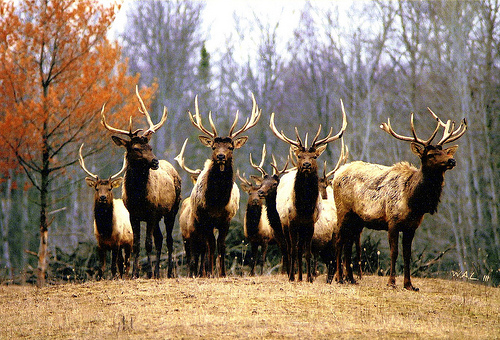
Got Rut? Chillin’ with Michigan’s Elk Herd

Got Rut?

Got Rut?, photo by lonewolv / William A. LaCrosse III.

When I saw this picture (shot in Hillman, MI in 2004) I figured “elk farm.” However, as I looked into the subject I discovered that Michigan has a significant wild elk population. Michigan Elk: Past and Present from the Michigan DNR says:

Michigan’s native elk disappeared around 1875. Today’s elk herd dates back to 1918, when seven western animals were released near Wolverine. From that reintroduction, the number of animals grew steadily to about 1,500 elk in the early 1960s. They reached the point where limited hunting was possible in 1964 and 1965.

… Reduced poaching losses, habitat improvement and successful management of hydrocarbon development resulted in an increase in elk numbers to 850 by 1984.

As the herd grew, problems also increased with forest and agricultural damage. To bring the herd in better balance with its natural food supplies and with the needs of landowners, elk hunting resumed in 1984. Biologists estimated the January 2006 population to be between 800-900 animals. This goal is a winter herd of 800 to 900 elk.

The village of Atlanta claims the title of Elk Capital of Michigan and holds an Elk Festival every September (September 25-27, 2009). You can read more about the second largest species of deer (following only the moose) in Wikipedia’s Elk entry which has this to say about rut:

Adult elk usually stay in single-sex groups for most of the year. During the mating period known as the rut, mature bulls compete for the attentions of the cows and will try to defend females in their harem. Rival bulls challenge opponents by bellowing and by paralleling each other, walking back and forth. This allows potential combatants to assess the others antlers, body size and fighting prowess. If neither bull backs down, they engage in antler wrestling, and bulls sometimes sustain serious injuries.

Find even more elk info and photos under Cervus elaphus, elk (also: red deer; wapiti) from the University of Michigan Museum of Zoology’s Animal Diversity Web.

See this larger in William’s slideshow.

Ring-necked Pheasant

Ring-necked Pheasant

Ring-necked Pheasant, photo by palofmine2.

The All About Birds page on the Ring-necked Pheasant and Wikipedia’s Common Pheasant entry both note that the pheasant is native to Asia and is one of the most hunted birds in the world. If you’re interested, the Michigan DNR has information about Pheasant season and gamebird preserves.

You can see this photo larger in Renee’s excellent Birds slideshow.