Hepatica … and other Michigan Wildflowers

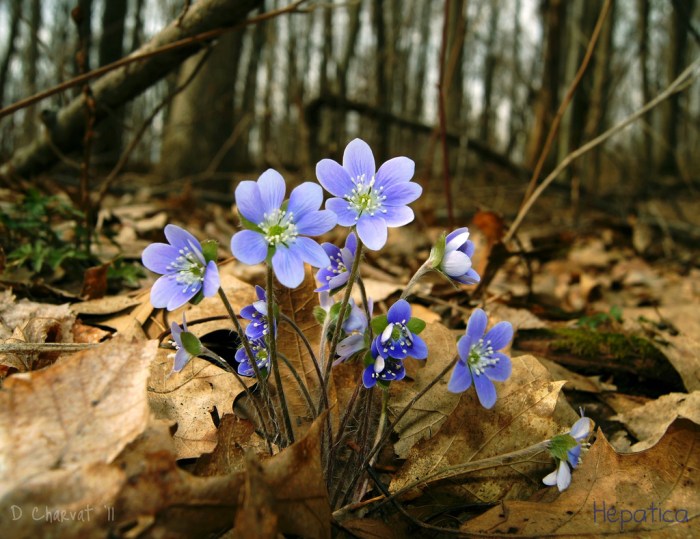
Hepatica by Diane Charvat

Hepatica, photo by d charvat.

Wikipedia says that Hepatica was named for its leaves, which, like the human liver (Greek hepar), have three lobes. It was once used as a medicinal herb. Owing to the doctrine of signatures, the plant was thought an effective treatment for liver disorders. Although poisonous in large doses, the leaves and flowers may be used as an astringent, demulcent for slow-healing injuries and as a diuretic.

Check this out background bigalicious and in d charvat’s Michigan wildflowers slideshow.

More spring wallpaper on Michigan in Pictures!

Arbor Day, Michigan and Exposure.Detroit!

visually grounded

Untitled, photo by caterpillars and visually grounded photo by mlephotos

Today (April 29) is Arbor Day, a nationwide celebration that encourages people to take the simple action of planting trees. According to the Arbor Day history page, Arbor Day was founded in 1872 by Julius Sterling Morton. Morton grew up in Detroit and graduated from the University of Michigan. He actually grew up in Monroe, and you can read his story from Hometown History Tours (a very cool site btw!).

look who's showing at the woodbridge!!

A whole ton of Arbor Day can be found at the Michigan Arbor Day Alliance (Facebook).

I was faced with a bind this morning when I became aware of the fact that two of my favorite photographers, Laura Dyszynski aka caterpillars and Meghan East (mlephotos), were the subject of the latest Exposure.Detroit opening tomorrow night (April 30) from 7-10 PM at the Woodbridge Pub in Detroit! Click for all the details!

Thankfully, both women had photos of trees to choose from!

Check Laura’s out bigger and in her slideshow.

You can see Meghan’s photo on black and in her you like {top 30 favorites} slideshow, but the best way to see both of their work is to go to their show!

Almost Tulip Time in Holland!

It's like a dream

It’s like a dream, photo by cae3 – Anita

Tulip Time in Holland is just around the corner! The annual celebration of Holland’s Dutch heritage and tulipular beauty takes place May 7-14, 2011 and features parades, music, dancing and much more. They explain that:

This year is a particularly special celebration as we recognize the bicentennial anniversary of the birth of the founder of the Holland, Michigan: Reverend Albertus C. Van Raalte, who led his congregation of Dutch Calvinists in founding our city in 1847. To commemorate his birth, a Bilateral Conference will take place in Holland, Michigan and the Netherlands in the fall of 2011. For more information, visit www.dutchheritagewestmichigan.com.

Like most celebrations, the Tulip Time Festival started as a relatively small event, which was proposed by Miss Lida Rogers, a high school biology teacher. In 1927, Miss Rogers presented the idea of commemorating Holland’s Dutch heritage, history and culture to the Women’s Literary Club. Her proposal was accepted, and in 1929, the City of Holland planted its first crop of 100,000 tulips. The overwhelming number of visitors to our small town resulted in the community’s decision to repeat the event. As thousands of spectators soared to hundreds of thousands, the celebration lengthened by days, and pageantry, costumes and parades and the popular Dutch Dancers were added to produce a week-long festival that is now over 80 years old.

“Tulip Time” on Michigan in Pictures has all kinds of photos & information about this festival!

Check this out bigger and in Anita’s Explored slideshow.

I Am Toad

I Am Toad

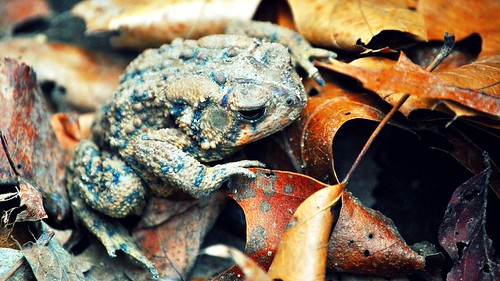
I Am Toad, photo by DavidGuthrie.

The Michigan DNR Frog & Toad page answers the question “How can you tell a frog from a toad?” saying:

It’s been said that a toad is just a lumpy frog! Toads do have thicker, more warty skins compared to the smoother skin of most frogs. Toads are adapted for drier conditions than frogs, though they spend much of their time burrowed into moist soil during times when the air is drier. Toads have shorter hind legs than frogs, comparatively speaking, and move in short hops or simply walk instead of making long leaps.

They say that Michigan has two species of “true” toads, the American Toad and Fowler’s Toad. This little guy is an Eastern American Toad (Bufo americanus) and you can read more about them on Michigan in Pictures. If you’re in a friendly mood, consider building a toad house!

Check this out bigger and in David’s Spring slideshow.

The Red-Bellied Woodpecker sings Happy Birthday, John James Audubon

Bobby Dazzler

Bobby Dazzler, photo by Spring Noel.

I never for a day gave up listening to the songs of our birds, or watching their peculiar habits, or delineating them in the best way I could.
~John James Audubon

Today is the birthday of John James Audubon. That entry on Wikipedia relates that he was born Jean-Jacques Fougère Audubon. In 1803 at age 18, he immigrated to the United States and anglicized his name to John James Audubon. Learn more about him and the society that bears his name at audubon.org.

I didn’t really think that there would be a Michigan tie-in, but it turns out that the single most valuable book in the University of Michigan is (you guessed it) Audubon’s Birds of America:

In 1838, the Regents of the University of Michigan authorized the purchase of John James Audubon’s Birds of America. Held in the Special Collections Library, the eight-volume, double-elephant-folio edition is the single most valuable printed book in the MLibrary collections.

Here’s the beginning of the Family XVI. PICINAE. WOODPECKERS. GENUS I. PICUS, Linn. WOODPECKER. entry from that book:

Much of what I have said respecting the habits of several of our Spotted Woodpeckers applies to the present species, which differs, however, in the greater extent of its migration in the spring and summer months, when the greater number of those which return from the south to our Middle and Eastern Districts proceed considerably farther northward than the Hairy Woodpecker, although not so far as the Canadian. In winter I have found the Red-bellied Woodpecker the most abundant of all in the pine barrens of the Floridas, and especially on the plantations bordering the St. John’s river, where on any day it would have been easy to procure half a hundred. Indeed, on this account, and from its well-known notes, the officers and men of the United States’ schooner Spark, as well as my assistants, always spoke of it by the name of chaw-chaw. Perhaps it partly obtained this name from the numbers of it cooked by the crew in the same manner as the dish known to sailors by the same name.

It is, however, less common in the United States than the Hairy Woodpecker; but its range is as extensive, for I have found it from the Texas to the extremities of the British provinces of Nova Scotia, and as far inland as I have travelled. It appears, however, that it does not inhabit the Fur Countries, as no mention is made of it by Dr. RICHARDSON, in the Fauna Boreali-Americana. It is generally more confined to the interior of the forests, especially during the time of its breeding, than the Hairy Woodpecker, although in winter I have found it quite as easily approached. In autumn it frequently occurs in the corn-fields, where it takes its share of the grain, in common with the Hairy, the Downy, and other Woodpeckers. It is a lively and active bird, fond of rolling its tappings against the decayed top-branches of trees, often launching forth after passing insects, and feeding during winter on all such berries as it can procure. Its flight is strong and better sustained than that of the Yellow-bellied or Hairy Woodpeckers, and, like the Golden-winged species, it not unfrequently alights across the smaller branches of the trees, a habit which, I assure you, is oftener exhibited than has been supposed, by all our species of this interesting tribe of birds.

More at Red-bellied Woodpecker on All About Birds including their calls & drums.

Spring writes that you can see why they’re called Red Bellied Woopeckers when you see one the red belly exposed. Check it out bigger and in her Birds slideshow.

Many (many) more birds on Michigan in Pictures.

Michigan moose viewing isn’t hard when there’s a Bull Moose in the road

Bull Moose

Bull Moose, photo by Pure Michigan.

The entry for Alces alces (moose) at the UM Animal Diversity Web says that what we call “moose” are known as Eurasian elk in Europe. Moose live near water ponds, lakes, rivers and swamps that hold their favorite foods and help keep them cool. Their large bodies, inability to sweat and the heat produced by fermentation in their guts mean they can’t endure temperatures above 80 degrees for long. Also see Moose on Wikipedia.

Moose are native to Michigan but although Michigan granted moose full legal protection in 1889, moose had disappeared from the Lower Peninsula in the 1890s and only a handful remained in the Upper Peninsula. (Moose in Michigan whitepaper). The February survey of Michigan moose estimates 500 total moose, with about 433 of these concentrated in Marquette, Baraga and northern Iron counties.

The DNR’s Guide to Moose Viewing in the Upper Peninsula includes maps and suggests that to while moose locations are difficult to predicta:

…there are three areas where visitors would do well to begin their quest. The center of the moose country in the western U.P. is Van Riper State Park. In the eastern Upper Peninsula, Tahquamenon Falls State Park and Seney National Wildlife Refuge offer the best chances of seeing moose.

…Look for moose in the early morning and evening when summer temperatures are coolest.

Moose often are associated with water, so areas around beaver ponds and along the edges of lakes, streams, and swamps are good places to look. Van Riper and Tahquamenon Falls state parks have moose information centers with interpretive materials including a kiosk and a video on Michigan moose recovery efforts. Interpretive staff can provide the latest information on the local herd and recent sightings. In addition to moose, loons, eagles, black bears, deer, foxes, and even wolves may be seen in moose country.

Caution must be taken when watching moose. Moose should not be approached. They can be unpredictable and aggressive. Most dangerous are cow moose with young, or bulls during the mating season (September and October).

Pure Michigan has the name “Susan Ballreich on this photo so I assume she caught the shot of the bull moose on the Peshekee Grade road near Marquette. Check it out bigger and in their massive Fall 2010 slideshow.

The Man on the Cross by Marshall Fredericks

Cross in the Woods

Cross in the Woods, photo by jimmythekid1.

The National Shrine at the Cross in the Woods says that the sculpture is titled The Man on the Cross:

The sculpture of the crucified Christ was titled “The Man on the Cross” by the renowned Michigan sculptor Marshall Fredericks. It is made of bronze 3/8″ to 1/2″ thick. It weighs seven tons, is twenty-eight feet tall from head to toe, and the outstretched arms span twenty-one feet. The figure of Christ is attached by thirteen bolts 30″ long and 2″ thick that were made when the figure was cast in Norway.

Fredericks wanted to portray Christ in a peaceful way. It was his dream to “give the face an expression of great peace and strength and offer encouragement to everyone who viewed the Cross”. Christ is symbolized just at the moment when He commends Himself to His Father. The sculptor received special permission from the Vatican to omit the crown of thorns and the wound on Jesus’ side.

Here’s a photo of Fredericks at the installation. They have more about the shrine and the sculptor. You can also see more of Marshall Fredericks work on MIchigan in Pictures.

See more views of the sculpture in James’ Cross in the Woods slideshow.

Earth Day, high above our piece of the Earth

Great Lakes, No Clouds

Great Lakes, No Clouds, photo by NASA Goddard Photo and Video.

Today is Earth Day (and also Good Friday). You can read all about Michigan’s role in Earth Day on Michigan in Pictures and check the list of Earth Day events in Michigan from earthday.org.

I thought this shot from the NASA Goddard Space Flight Center was a perfect image, and it’s a great lead-in to their Earth Day 2011 slideshow, which looks at almost 40 years of Landsat images. NASA says:

Launched in 1972, the Landsat program is the longest continuous global record of the Earth’s surface. It continues to deliver both visually stunning and scientifically valuable images of our changing planet, allowing us to plan for the future of Earth’s precious resources.

Check this out big as Michigan an in their Explored! slideshow.

Two Photographers Play In The Street…

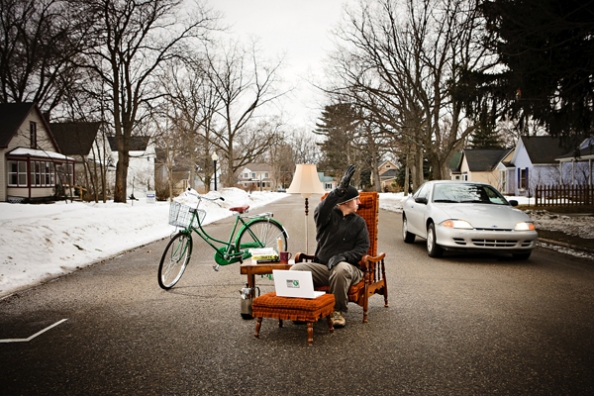
The Wave, photo by Brian Confer

It isn’t often one of your favorite photographers (Brian Confer) shoots some cool portraits of another of your favorite photographers (Gary Howe) who happens to also run one of your personal favorite blogs (My Wheels Are Turning). When Gary posted some of the photos on Two Photographers Play In The Street & Nobody Gets Hurt yesterday, I knew I had to feature it here. He explains:

For this Reclaim the Streets themed concept we simply dragged some of my furniture into the street, gathered a few of my favorite books and wheeled the Flying Pigeon around. Brian took care of the rest with his excellent sense for lighting and mood. Other than a reschedule because of too much sun and blue sky, it went smooth. No one hurt, no one delayed.

You can see more photos from the shoot right here, and definitely read the excellent feature they were for: Old school social networking: TC’s Gary Howe wants to build a truly connected city.

See more photos from Brian at Studio B Photography.

Iroquois Pt. Light under Orion

Iroquois Pt. Light under Orion

Iroquois Pt. Light under Orion, photo by yooper1949.

Check this shot out bigger and see the whole series in Carl’s slideshow.

Michigan in Pictures has more about Iroquois Point Lighthouse which is located near Brimley on Lake Superior’s Whitefish Bay. If you click through, you can learn lots more from Terry Pepper including that the point got its name in 1662 after the local Ojibwa encountered a band of intruding Iroquois.