The 17-story Tower Building was built in 1929 for the new Union and Peoples National Bank. The Tower Building was at that time referred to as the “Golden Towers.”
…In 1975 it was sold to the County for a nominal sum by the Raymond Kolowich family and became the County Tower Building. The County Commissioners’ Chamber is located on the 2nd floor up the marble flight of stairs. Italian leaded stained glass windows surround the chamber which was originally the main banking area.
At the top there is a “Falcon Cam” that is trained on the nest of a peregrine falcons! Click through to watch the chicks grow up!
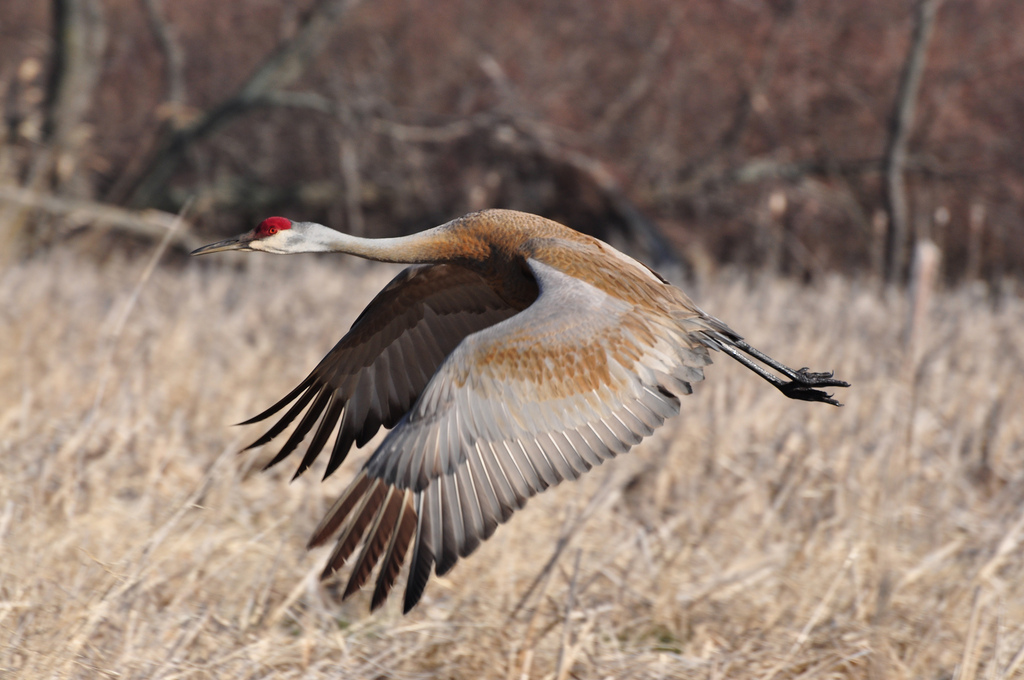
The Baker Sanctuary in northwest Calhoun County is a Michigan Audubon sanctuary that hosts thousands of cranes. It was established in 1947 and was the first crane sanctuary in America. They have fantastic information about sandhill cranes in Michigan. They write that the Sandhill Crane (Grus canadensis) is one of only 15 species of cranes in the world and is one of just two crane species native to North America.
While the Whooping Crane, our other native crane, is highly endangered and restricted to only a few areas of the West, the Sandhill is more widespread and in most areas is more abundant. Once nearly eliminated from Michigan, Sandhill Cranes have made a comeback and now are becoming one of the state’s most popular watchable wildlife species.
Cranes are tall, stately birds with a heavy body, long neck and long legs. Standing four to five feet high and possessing a wing span of six to seven feet, Sandhill Cranes are Michigan’s largest bird. Long, skinny legs and neck give a false impression of size; the males weigh an average of about 12 pounds and the females around 9-1/2 pounds. Except for this size difference, both sexes look alike.
…Sandhill Cranes have a variety of vocalizations, the most common of which is generally described as a repeated series of trumpeting “garoo-a-a-a” calls that can be heard for over a mile. One of the reasons for this remarkably loud and penetrating call is an unusual windpipe. In most birds the trachea passes directly from the throat to the lungs, but in Sandhills it is elongated by forming a single loop which fills a cavity in the sternum. It is not surprising that the louder and more harmonic Whooping Crane has a longer trachea with a double loop.
Almost a century after the founding of Petoskey, on June 28, 1965, Governor George Romney signed a bill that made the Petoskey Stone Michigan’s official State Stone. It was fitting that Miss Ella Jane Petoskey, the only living grand-child of Chief Petosegay, was present at the formal signing. The legislation is very general. The bill simply states that the Petoskey Stone is the State Stone. The designation of Hexagonariapercarinata was made by Dr. Edwin C. Stumm in 1969. Dr. Stumm made this distinction based on his extensive knowledge of fossils.
This specific fossil coral is found only in the rock strata known as the Alpena Limestone. The Alpena Limestone is part of the Traverse Group of Devonian age. The Alpena Limestone is a mixture of limestones and shales. The outcrops of these rocks are restricted to the Little Traverse Bay area near Petoskey.
This weekend (May 13-15) is Durand Railroad Days. This annual event is in its 36th year and was established in 1975 to pay tribute
to the rail industry that helped develop the nation and was responsible
for the settlement of Durand late in the 1870s. The Michigan Railroad History Museum at Durand Union Station says:
The village of Durand was built up around the railroads in the late 1870’s. Durand Union Station was designed by Spier and Rohms and originally built in 1903. Eighteen months thereafter it was almost completely destroyed by fire and was rebuilt in 1905.
This was a very busy station as the Grand Trunk Western and Ann Arbor Railroads crossed at grade there. During the early 1900’s when the railroad industry was at its peak, 42 passenger trains, 22 mail trains, and 78 freight trains passed through Durand daily. Durand Union Station handled approximately 3,000 passengers per day, making it a prospering hub of the industry.
Read about the event & museum using the links above and definitely put the museum on your list of places to visit!
Check Tim’s photo out bigger. He writes that he was inspired by an old black & white photo from nearly the same spot.
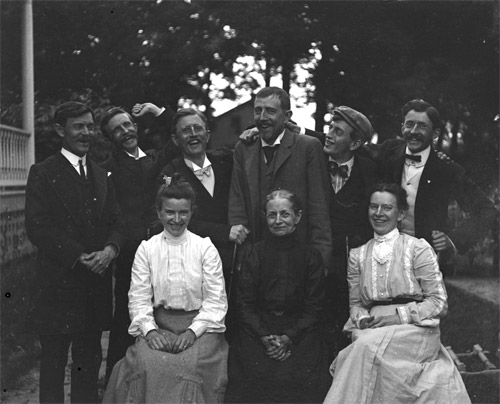
Over on the Dusty Diary, Laura writes that she would pay good money to know what the remark was is this unknown portrait.
At first I thought this was a wedding portrait. Now I think this is a family. All the guys, with the possible exception of the guy on the left, share a facial resemblance. There is a familial informality in the manner in which two of the men are grasping the chair backs. I’m guessing the person who made the remark in question is the tall guy in the center. Also suspecting that remark in question was a bit naughty. Woman on left is married… to whom? One of these gentlemen?
Also, older woman’s face is probably the single most beautiful thing I’ve seen this past week.
Click through to see the photo bigger and some details shots of their faces and definitely tune into the Dusty Diary for regular gems that Laura finds in the Yspilanti archives!
The Detroit Studio Collective is holding their Grand Opening this Saturday (May 7) from noon to 10 PM (location). The photographers (some of whom have been featured on Michigan in Pictures) are Bobby Alcott, Rebecca Gutierrez, Kellie Saunders, Rob Terwilliger, Josh Willerton and Eric Peoples.
The annual National Cherry Festival got its start around 1910, as cherry growers in the Grand Traverse area began to hold informal “blessing of the blossoms” ceremonies each year at blossom time in May. Businesses jumped on the bandwagon (cherry truck?) in 1925 for the formalized “Blessing of the Blossoms Festival” which was such a big deal that in 1930 they expanded to 3 days and in 1930 President Herbert Hoover attended the opening. The next year the Cherry Festival was declared a national affair and in 1933 they moved it to summer.
Although it’s now a summertime affair (July 2-9, 2011), the wineries on the Old Mission Peninsula hold an annual Blossom Days celebration (May 14 & 15 this year). My informal read of the cherry blossoms here says that tart cherry blossoms will be in full swing with sweets kicking off.
Apparently in 1906 there was some sort of spiritual attraction of orchards, because to the south in Benton Harbor, the Reverend W. J. Cady of the First Congregational Church in Benton Harbor was the first to urge his parishioners to drive through the orchards and view the fruit blossoms. Cady termed them “symbols of life renewed” and his sermon is credited with the birth of the Blossomtime Festival. Now the Blossomtime Festival in St. Joseph/Benton Harbor is shared between the oldest and largest multi-community festival in the state of Michigan. Join them this Saturday (May 7) for the Grand Floral Parade and more!






 Michigan in Pictures