Help the National Audubon Society with their Christmas Bird Count

Out On A Limb

Out On A Limb, photo by Beth Crawford 65.

The Great Lakes Echo tipped us off to the National Audubon Society Christmas Bird Count. :

Each of the citizen scientists who annually braves snow, wind, or rain, to take part in the Christmas Bird Count makes an enormous contribution to conservation. Audubon and other organizations use data collected in this longest-running wildlife census to assess the health of bird populations – and to help guide conservation action.

From feeder-watchers and field observers to count compilers and regional editors, everyone who takes part in the Christmas Bird Count does it for love of birds and the excitement of friendly competition — and with the knowledge that their efforts are making a difference for science and bird conservation.

In years past, the Christmas Bird Count has helped the Society document species health and develop plans. Click to learn how to get involved!

See Beth’s photo of a pine siskin, a common finch, bigger and in her beautiful winter slideshow.

Many more Michigan birds on Michigan in Pictures.

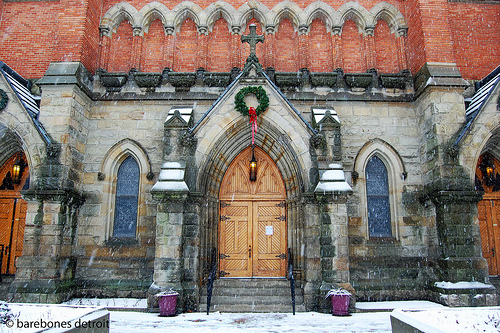
Christmas in Old Detroit

Untitled, photo by BareBonesDetroit

The Detroit News has a fantastic feature titled Christmas traditions in Old Detroit: Pigeon pie, horse racing, tapers on trees that is a wonderful look at the history of the Christmas holiday in Detroit. They begin:

Although Protestant churches in Detroit did not embrace the Christmas holiday until the 1840s, it was long celebrated in the French Catholic Churches such as Detroit’s oldest parish, St. Anne’s. (pictured above)

Before Christmas trees became the rage, the French holiday tradition in Detroit was represented by yule logs, reveillon feasting, and horse races. Yule logs were enormous logs or sometimes entire tree stumps that filled the hearth along with a half cord of wood to get it started. Holiday feasting began on Christmas Eve in a tradition called reveillon (pronounced Ray-veh-yon), which is still celebrated in Quebec and New Orleans (at least for the tourists).

In Detroit, families would carry a lantern to midnight mass and leave it with a beggar at the church door. When the Christmas mass was over, they would pick up their lantern and give a Christmas tip to the beggar. They then would go home for the feast that would last until 8 a.m.

The reveillon supper was a sumptuous menu that included la tourtiere — a meat pie made with pigeons in the 19th century and later with pork, veal or other game. Other dishes might include a stew of meat balls and pork, minced pork pie, turkey, pumpkin pie, mince pie and new cider.

There’s a whole lot more including holiday menus, toys, the hazards of decoration and even holiday horse racing through the streets of the city by the French and Ulysses S. Grant! Definitely read the rest and check out the photo gallery which includes some great old photos! About this photo from December 2010, BareBonesDetroit wrote:

Day Six: During the holidays, many of us end up donning our Sunday best and heading over to our local place of worship. Lucky for us here in Metro Detroit, the city overflows with churches, and even has a synagogue. Ste. Anne’s is the oldest church in Detroit. It’s massive structure is a beacon from both sides of the International border we share with Canada. For the season, it’s facade becomes even merrier. If you’ve never visited, for the history lesson and stained glass alone, it’s worth a visit.

View this photo bigger and see more in his Twelve Days of Christmas slideshow. Also be sure to check out barebonesdetroit.com for a cool photographic tour of the D!

More Christmas traditions on Michigan in Pictures…


Mighty Michigan Maples vs Acid Rain

mighty maple

mighty maple, photo by aimeeern.

“Though a tree grows so high, the falling leaves return to the root.”
– Malay proverb

A couple of weeks ago we reported on the threat to Michigan Eastern Black Walnut trees from Thousand Cankers Disease, but apparently they’re not the only significant Michigan tree in peril. Now the Wall Street Journal is reporting that scientists are warning that acid rain will damage Great Lakes maples in the coming decades:

Sugar maple abundance already has dropped in parts of the northeastern U.S. and southeastern Canada over the past 40 years, primarily because of high acid levels in soils. The upper Great Lakes have mostly escaped the damage because the area’s soils are rich in calcium, which provides a buffer against acid.

But in an article published this month in the Journal of Applied Ecology, scientists said they had discovered another way that acid rain harms sugar maple seedlings in upper Great Lakes forests.

It causes excessive nitrogen buildups that prevent dead maple leaves from decaying after falling to the ground, hampering growth of new trees, said Donald Zak, a professor of ecology and evolutionary biology at the University of Michigan.

“The thickening of the forest floor has become a physical barrier for seedlings to reach mineral soil or to emerge from the extra litter,” Zak said. “What we’ve uncovered is a totally different and indirect mechanism by which atmospheric nitrogen deposition can negatively impact sugar maples.”

If you’re into plant biology, you might enjoy Simulated N deposition negatively impacts sugar maple regeneration in a northern hardwood ecosystem from the Journal of Applied Ecology. If you’re into fall color or maple syrup, you might enjoy encouraging your elected representatives to take action to protect the future of these glorious trees.

Check this out big as a maple tree and in Amy’s autumn slideshow.

More beautiful maples can be found in our fall wallpaper archives.

The Light at Point Aux Bec Scies

 Pt. Betsie Lighthouse

Pt. Betsie Lighthouse , photo by GLASman1.

Point Betsie Light is one of the most photographed lighthouses in the world. The Friends of Point Betsie website notes that the point was originally known by the French as “Point Aux Bec Scies,” meaning “sawed beak point” and that it was was built in 1858 at a cost of $5000. If you want to get a taste of life at a lighthouse, you can rent the Assistant Keeper’s apartment in the summertime.

Check it out bigger and in Mark’s slideshow.

Much more about Point Betsie Lighthouse on Michigan in Pictures!

Petit Portal and the geology of Pictured Rocks

DSC00824_tonemapped

DSC00824_tonemapped, photo by ansonredford.

While Petit Portal – also called Petit Arch and Arch Rock by some – is often confused with the partially caved in Grand Portal, it’s a smaller and as yet intact formation. You can read about some of these from the Pictured Rocks National Lakeshore website. The two arches (and many cave structures) are formed by the powerful action of Lake Superior waves on the soft sandstone that underlies the harder layers above.

You can read more about the geology of Pictured Rocks from Oh Ranger! (a cool site I just found today) and also this PDF on geology from the Lakeshore. If you want to see them up close, the boat tours from Munising are worth every penny.

Donald took this 5 years ago. Check it out background bigtacular and in his stunning Pictured Rocks Nat’l Lakeshore slideshow which includes some jaw-dropping shots of Chapel Rock and even a look from inside Petit Portal.

Much more on the Pictured Rocks on Michigan in Pictures.

Coming Home

Iraqi child won't let go of Mich. Guardsman

Iraqi child won’t let go of Mich. Guardsman, photo by The National Guard.

The Iraq War began on March 20, 2003 and was formally ended yesterday, December 15, 2011. At 8 years, 9 months it was longer than Vietnam, longer than World War II. This Detroit Free Press article on the costs of the war in Iraq says they include 4,487 dead and 32,226 wounded Americans and over 100,000 Iraqi dead. Michigan’s contribution was at least 159 dead and 1,000 wounded, according to Pentagon records. Military Times has the number at 216, and you can see the list of Michiganders who gave their lives in the Iraq War.

Retired Marine and Iraq vet Steve Maddox says that veteran’s challenges are just beginning and cannot be answered by yellow ribbons or catchy sloganeering. In addition to combat injuries and frightening suicide rates he writes:

I see post-Iraq War challenges that are as big, if not bigger than those we faced as a nation for the past eight years. Iraq and Afghanistan veterans face higher unemployment rates than their contemporaries. In Michigan, with an overall unemployment rate hovering around 10%, Iraq and Afghanistan veterans’ unemployment rate is over 29%, by far the highest in the country.

One of the articles I read noted that we’re not leaving Iraq in very good shape. The Iraqi Hope Foundation was founded by Michigan Tech alum and Iraq veteran Major Don Makay. The foundation seeks to honor the sacrifices of veterans by building stability and prosperity of Iraq through investment in small and mid-level businesses. Read more about it right here.

About this photo, the National Guard says:

U.S. Army Sgt. Thomas Loyd, assigned to Foxtrot Company, 425th Infantry (Long Range Surveillance), Michigan National Guard, based in Selfridge, Mich., holds hands with an Iraqi child in Sununi, Iraq, Oct. 29, 2009. Loyd was standing outside the mayor’s office while a meeting was taking place when the child attached himself to Loyd and would not let go. (U.S. Navy photo by Mass Communication Specialist Carmichael Yepez/Released)

See it background big and see a few more in their Michigan slideshow.

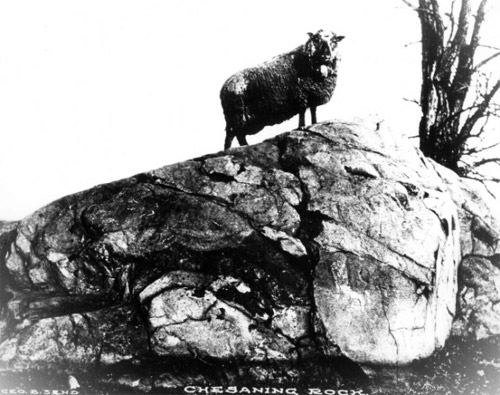
Chesaning and the Chesaning Rock

Chesaning Rock, photo by George B. Send (Courtesy Seeking Michigan)

The Wikipedia page for Chesaning, Michigan says that:

The first mention of Chesaning in the written pages of history is the Saginaw Treaty, signed in 1819. This treaty was between members of the Saginaw Tribe, Chippewa Indians and the government of the United States. They established a number of reservations, including 10,000 acres (40 km2) along the banks of the Shiawassee River known as “Big Rock Reserve.” Chesaning is a Chippewa word meaning “big rock place”. The treaty continued in effect until 1837 when a second treaty led to the reserve being surveyed and offered for sale in 1841. The first land was sold at $5 per acre to brothers Wellington and George W. Chapman, and Rufus Mason. After making their land purchase, they traveled back to Massachusetts and moved their families to their new wilderness home by late summer of 1842.

During the months they had been away from their land, several settlers had moved into the area, building a dam and a sawmill. A few years later, a grinding mill was added. The new settlers named their community “Northampton” in honor of the home they had left in Massachusetts. In 1853, the legislature changed the name to Chesaning, the traditional name for the village and township. The first township elections, held in 1847, are considered to be the official birthday of the community.

The Chesaning Historical Society has some more old photos of Chesaning, and Michigan GenWeb has a lot more Chesaning history.

I found this photo from the early 1900s at Seeking Michigan when I was looking for a photo for a feature on Saginaw’s coal mines. I think you’re agree it was simply too awesome not to share. ;)

They explain that The rock was one of the features of the area since Chesaning was settled. Located in woods to the east of Chesaning, the large rock inspired the name of the area. See it bigger at Seeking Michigan and check out more funny photos on Michigan in Pictures.

Waiting on Winter

Sunset on Ice
Sunset on Ice, photo by Happyhiker4

While we wait and wonder when winter will wander in, many folks including Mark are digging through their archives for helpful pictures to remind Old Man Winter to get busy. About this photo from last January Mark writes:

I had traveled to the icy shores looking for a chance to see the sunset from an icy shoreline. Little did I know I would be blessed in incredible beauty. I wanted to feel the ice and the textures were just incredible. I ran my fingers over the smooth solid ice. The ice held such a deep color as the sun put on an incredible show. Blessed in Nature. What a Life!

Check it out on black and see more of Mark’s amazing work in his Ice slideshow.

Charles W. Howard Santa Claus School in Midland

Santa Chair

Santa Chair, photo by LadyDragonflyCC -See through my eyes!.

“He errs who thinks Santa enters through the chimney. Santa enters through the heart.”
– Charles W. Howard

The Charles W. Howard Santa Claus School in Midland was established in 1937 and is the longest continuously running Santa Claus School in the world. The school is a nonprofit and seeks to uphold the traditions and history of Santa Claus and to help its students improve their presentations of Santa Claus. A nice feature on the school in the LA Times explains that:

Howard, the school founder, was a Santa with an impressive resume that included being St. Nick for Macy’s. He opened the school in 1937 after coming across too many other Santas with frayed beards, shoddy suits and limited knowledge of reindeer. (current director Tom) Valent took over the school in 1986 and retains most of Howard’s original curriculum, along with modern additions such as contract issues and how to endure the rigors of being a mall Santa (get a flu shot and negotiate regular bathroom breaks).

…Valent’s cheerful demeanor belies the seriousness with which he approaches his mission of ensuring that Santa Claus embodies perfection, from fresh breath and clean whiskers to impeccable morals. He’s not here to get these Santas jobs — the school has no placement services. He’s here to make sure that whether they play Santa in malls or parades, or in hospitals, homeless shelters or private parties, they do it flawlessly.

“It’s a privilege to be Santa Claus,” said Valent, who has been Santa Claus himself for 35 years, from Greenland to Midland. “You’re taking on a character that stands for all good things.”

Be sure to check out their photo gallery on Facebook, and if you’re interested, the 2012 Santa School takes place October 18th – 20th and is taking reservations now.

Speaking of Santa, yesterday on Absolute Michigan we had an in-depth feature on including charities in your holiday gift plans that might give you chance to share some of that Santa spirit.

Check this out on black and in Christine’s My Favs slideshow.

Loop and Swirl – Superior Falls (Wisconsin/Upper Michigan Border)

Loop and Swirl - Superior Falls (Wisconsin/Upper Michigan Border)

Loop and Swirl – Superior Falls (Wisconsin/Upper Michigan Border), photo by Aaron C. Jors.

On Saturday we dove into Mittengate – the lighthearted battle between Michigan & Wisconsin over the Badger State’s use of the mitten in tourism promotion.

To help keep the cheese-loving hordes at bay, we’re lucky to have the Montreal River and Superior Falls! GoWaterfalling’s page on Superior Falls explains:

Superior Falls is located on the Montreal River just a few hundred yards from Lake Superior. The Montreal River forms part of the border between Michigan and Wisconsin so the falls is technically in both states, but it is most easily visited from the Michigan side. I do not know if it can be visited from the Wisconsin side.

This is an impressive waterfall consisting of several drops and some very dramatic gorge walls. Unfortunately there is a dam a short distance above the falls and most of the water is diverted for power generation. The power company is required to maintain at least 20 cubic feet of water per second flowing over the falls. Early spring is the best time to see the falls…

The fence is a bit frustrating and often blocks your view, but it also will save you from a long, long fall into the gorge. The overlook is at the top of the gorge wall pictured below.

They also note that Northern States Power operates the Superior Falls Hydro plant in the area – you can see more photos of the falls and of the small power plant at the unofficial Superior Falls homepage.

Check this photo out bigger and in Aaron’s Waterfalls sideshow. He also has a great photo of Tannery Falls on Michigan in Pictures and there’s tons more Michigan waterfalls in our Waterfall category!