Dream on

Dream On

Dream On, photo by Unified Photography

I can’t make sense of what happened yesterday at Sandy Hook Elementary School and have nothing to say other than that my thoughts and prayers are with these families and all of us.

Get this photo background big and view more in Kenneth’s Sleeping Bear Dunes slideshow.

Happy Hobbit Day

Please come in...  3 Weeks Later

Please come in… 3 Weeks Later, photo by Craig – S

“There is nothing like looking, if you want to find something. You certainly usually find something, if you look, but it is not always quite the something you were after.”
― J.R.R. Tolkien, The Hobbit

Today The Hobbit: An Unexpected Journey opens. It really has nothing at all to do with Michigan, but it’s arguably the most powerful fairy tale of the modern era and also my personal favorite tale, both Tolkein’s books and Peter Jackson’s masterful films. So Happy Hobbit Day everyone, and may you find what you’re looking for and the good things you are not!

Craig took this photo at Margaret McIntire’s Boardwalk Cottage on Mackinac Island. Check it out as big as Smaug and see more including another view of this door in his Mackinaw – Mackinac Island slideshow. If it catches your fancy, you can buy a print from Craig too!

If you want to see some real Michigan hobbit homes, check out Earl Young’s boulder houses in Charlevoix.

McGulpin Point Lighthouse on the Straits of Mackinac

McGulpin Point Lighthouse Emmet County

McGulpin Point lighthouse circa 1900, courtesy Emmet County Davenport collection/Terry Pepper

Terry Pepper’s Seeing the Light says that McGulpin Point Lighthouse entry tells the story of this point at the tip of Michigan’s mitten from circa 1000 BC when the great Odawa war chief Sagemaw more or less wiped out the Mus-co-desh tribe for an insult to the Odawa to when John McAlpine and his Native American wife settled on McGulpin Point in the 1760s. Their son Patrick McGulpin was given the patent on this land and the first recorded deed in Emmet County in 1811.

With the opening of the Erie Canal in 1825, Americans started to flood to the Chicago area. During the 1850s, vessel traffic through the Straits of Mackinac was increasing rapidly, and while the Waugoshance Light marked the western entry into the Straits, and the Bois Blanc Island light marked the eastern entry, the absence of a navigational aid within the shoal-ridden Straits themselves made passage during darkness and periods of low visibility extremely dangerous. To answer that need, the Lighthouse Board petitioned Congress for the construction of a lighthouse and fog bell at McGulpin Point, approximately two miles west of Fort Michilimackinac. Congress responded favorably to the request on August 3, 1854 with the appropriation of $6,000 for the station’s construction.

However, as a result of difficulties in obtaining clear title to the land, no action was taken on the station’s construction for more than a decade. With the original appropriation unspent and expired, the Board again petitioned Congress for the construction of a station at McGulpin Point in 1864, this time receiving $20,000 for the project on July 26, 1866.

Work began at McGulpin Point early in 1869, and the station was built as a mirror image of the design used at Chambers Island and Eagle Bluff lights under construction in the Door County area that same year. This plan, which is sometimes referred to as the “Norman Gothic” style, was also later also used at Eagle Harbor in 1871, White River in 1875, and at Passage and Sand Islands in 1882. (click for photos of these lights)

The keepers dwelling and integrated tower were constructed of Cream City brick with the tower integrated diagonally into the northwest corner of the dwelling. The first and second stories of the tower were approximately ten feet square with buttressed corners, while the tower’s upper portion consisted of a ten-foot octagon. Similar to other stations built on this plan, the tower is double-walled with a circular inner wall approximately four inches thick and eight feet in diameter to house a set of cast iron spiral stairs. The tower was capped with a prefabricated decagonal cast-iron lantern and outfitted with a fixed white Third-and-a-half Order Fresnel lens.

You can learn a lot more if you read on at Seeing the Light including the role the light played in knowing when the lakes would be opened for navigation, the role of Keeper Davenport and his 9 children in the rescue of the Waldo A. Avery, how the light was decommissioned in 1906 after the construction of Old Mackinac Point Lighthouse and passed into private hands and its return to the public domain.

Today McGulpin Point Lighthouse is an Emmet County park and open to the public. There’s many resources including the McGulpin Point brochure and some photos from a 2012 CMU archaeological dig.

You can see more photos by clicking through. Also check out the McGulpin Point slideshow from the Absolute Michigan pool on Flickr for some modern day photos!

Many more Michigan lighthouses on Michigan in Pictures.

12-12-12

twelve

twelve, photo by n.elle

A few things I have found…

Nicole shot this at the Greektown Casino. Check it out on black and see more great work in her Flickriver.

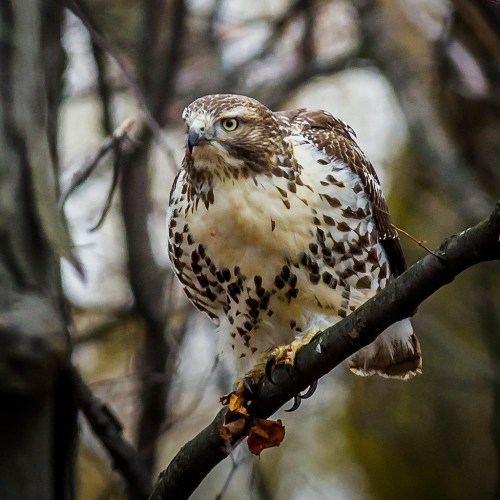
Know Your Michigan Birds: Cooper’s Hawk

10 January ~ Breakfast (with an Attitude)

10 January ~ Breakfast (with an Attitude), photo by MichaelinA2

All About Birds says that Cooper’s Hawks (known as the Chicken Hawk in England) are among the bird world’s most skillful fliers, tearing through tree canopies in high speed pursuit of other birds. They have more information and hawk calls and offer some fun facts:

  • Dashing through vegetation to catch birds is a dangerous lifestyle. In a study of more than 300 Cooper’s Hawk skeletons, 23 percent showed old, healed-over fractures in the bones of the chest.
  • Once thought averse to towns and cities, Cooper’s Hawks are now fairly common urban and suburban birds.
  • Life is tricky for male Cooper’s Hawks. As in most hawks, males are significantly smaller than their mates. The danger is that female Cooper’s Hawks specialize in eating medium-sized birds. Males tend to be submissive to females and to listen out for reassuring call notes the females make when they’re willing to be approached. Males build the nest, then provide nearly all the food to females and young over the next 90 days before the young fledge.
  • The oldest known Cooper’s Hawk was 20 years, 4 months old. (and apparently good at either providing food or flying fast!)

See Michael’s photo on black and see more in his Top 99 Most Popular Photographs slideshow.

Many more Michigan birds on Michigan in Pictures!

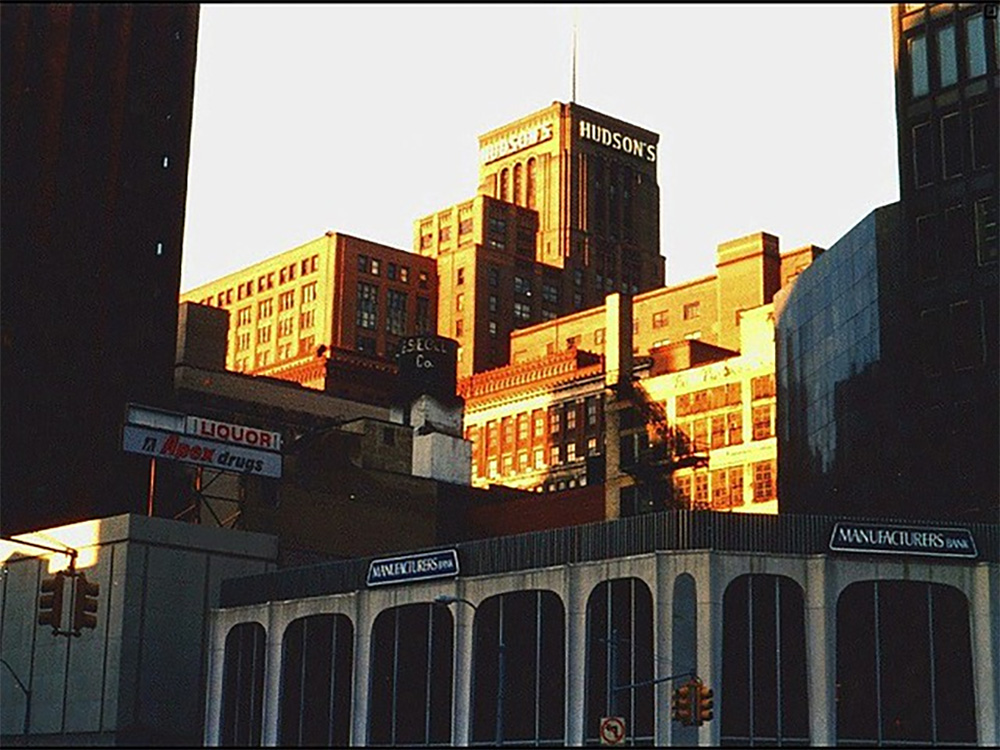
Hudson’s, a Detroit Icon

JL Hudsons Detroit by John Honeyman

hudsons, photo by johnhoneyman

One of the signs that the holidays are approaching that I see on Michigan in Pictures is a surge of visits to the post about Holiday Shopping at J.L. Hudson in Detroit. Hudson’s was demolished in 1998, but the store remains a cherished memory for many.

Wikipedia’s entry for the J.L. Hudson Department Store and Addition says that the building was designed by Smith, Hinchman, & Grylls and named after the company’s founder, Joseph Lowthian Hudson. Construction began in 1911 with many additions throughout the years before being “completed” in 1946. Hudson’s Department Store at Historic Detroit has some great photos and a lot of facts:

  • The store was 2,124,316 square feet, making it second in size among department stores to only Macy’s in New York. Even then, Macy’s is only 26,000 square feet bigger.
  • The store was spread out over 32 floors: 25 floors, two half-floors, a mezzanine and four basements.
  • At 410 feet, Hudson’s was the tallest department store in the world.
  • The building had 51 passenger elevators, 17 freight elevators, eight employee elevators and 48 escalators. Its largest freight elevator could accommodate a semi trailer.
  • Hudson’s had to have three transformer centers in the store: They generated enough juice to power a city of about 20,000.
  • The store had 39 men’s restrooms, 50 for women and 10 private ones for executives. The largest was a women’s lounge on the fourth floor that had a whopping 85 stalls.
  • It had 705 fitting rooms, a world record.
  • The dining rooms and cafeterias served an average of 10,000 meals a day – not counting the 6,000 meals a day served in the employee cafeteria on the 14th floor. The 13th floor dining room was renowned for its Maurice salad and Canadian cheese soup.
  • The store originally had 18 entrances and 100 display windows, which were changed weekly.
  • The store featured more than 200 departments across an incredible 49 acres of floor space, and it featured about 600,000 items from 16,000 vendors from 40 countries. The building had 51 elevators serving its 17 floors of retail.

Much more at Historic Detroit and you will also want to check out Hudson’s in the Department Store Museum, a Hudson’s photo tour from Detroit Yes and a nice video of photos of Hudson’s.

Check this out on black and see more in John’s arkitektura slideshow.

Support Michigan in Pictures with Patreon

Viewing the Geminid Meteor Shower

IMG_2549mod - Aurora Borealis

IMG_2549mod – Aurora Borealis, photo by something28

UPDATED FOR 2013! via EarthSky:

The peak night of the 2013 Geminid meteor shower is expected to be from late evening tonight (Friday, December 13) until dawn tomorrow (December 14). The meteors will be flying, but will you see them in the bright light of the waxing gibbous moon? The brighter ones, yes, and the Geminids do tend to be bright. If you want a moonless sky, your best bet on this night is to watch in the narrow window between moonset and dawn on Saturday.

Welcome to the “Spot the Geminid Meteor” edition of Michigan in Pictures! EarthSky’s Meteor Shower Guide for 2012 says that the last meteor shower of 2012 will be the Geminids, peaking late night December 13 until dawn December 14:

The final major meteor shower of every year (unless one surprises us!) is always the December Geminid shower, often producing 50 or more meteors per hour. It is a beloved shower, because, as a general rule, it’s either the August Perseids or the December Geminids that give us the most prolific display of the year. Best of all, the new moon guarantees a dark sky on the peak night of the Geminid shower (mid-evening December 13 until dawn December 14). But the nights on either side of the peak date should be good as well. Unlike many meteor showers, you can start watching the Geminids by 9 or 10 p.m. local time. The peak might be around 2 a.m. local time on these nights, because that’s when the shower’s radiant point is highest in the sky as seen around the world. With no moon to ruin the show, 2012 presents a most favorable year for watching the grand finale of the meteor showers. Best viewing of the Geminids will probably be from about 1 a.m. to 3 a.m. on December 14.

Click through for some meteor viewing tips and here’s hoping for another Aurora Borealis/Geminid combo!

Paul shot this north of Lansing in December 2006 when the Geminid shower was complimented by a fantastic Northern Lights display! Can you see the meteor a little right of center? Click to view on black, see more in his The Night Sky slideshow or view all 80 photos from the evening in his December 14, 2006 gallery.

There’s lots more meteors & northern lights on Michigan in Pictures!

Eli & Edy Broad Art Museum at Michigan State University

Art Museum Night

Art Museum Night, photo by AaronSnyderPhoto

The Eli & Edy Broad Art Museum at Michigan State University opened in early November. The museum features the historical collection from the Kresge Art Museum. They explain that:

This collection, which spans cultural production from ancient Greece and Rome and pre-Columbian cultures through Medieval and Renaissance art to the modern and contemporary will enable the Broad MSU to explore the art of our time through the long lens of art history. Highlights of the museum’s collection include: Greek and Roman antiquities; medieval and Renaissance illuminations; Old Master paintings; 19th century American paintings; 20th century sculpture by artists such as Alexander Calder and Jenny Holzer; and works by contemporary artists such as Chuck Close and Ann Hamilton. Collection growth and new acquisitions will focus on modern and contemporary works (post 1945).

You can search the collection at collections.artmuseum.msu.edu. The museum was designed by architect Zaha Hadid who has a fantastic photo gallery of the latest addition to MSU’s campus. You might also enjoy their virtual tours.

Check this out background big and see more including another angle in Aaron’s MSU Landscape slideshow.

More Michigan museums on Michigan in Pictures!

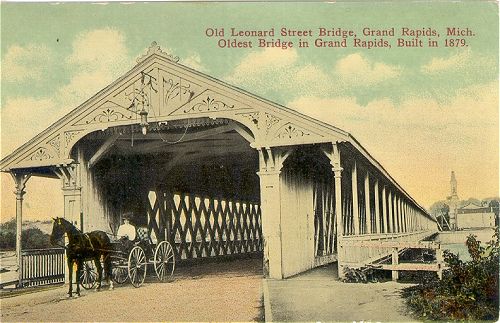
Old Leonard Street Bridge in Grand Rapids

leonard street bridge

Old Leonard Street Bridge, by Peter Oosse

When I was researching last week’s post on Michigan’s longest covered bridge, I found a neat feature about the historic bridges of Grand Rapids. It looks at three bridges, the Bridge Street Bridge, the Pearl Street Bridge and the Leonard Street Bridge:

In 1879, at a time when other bridges were being replaced by wrought iron spans, a new covered bridge was erected by City Engineer William Seckel at the Leonard Street crossing. This bridge, at a length of 832 feet, earned the distinction of being the longest covered bridge ever built in the State of Michigan. This ornately portaled, lattice truss bridge served the city’s traffic until 1913.

Click through for more and also see another view of Leonard Street Bridge.

The photo reads Old Leonard Street Bridge, Grand Rapids, Mich. Oldest Bridge in Grand Rapids, Built 1879. It’s from early 1900s by photographer Peter Oosse and you can see more shots from turn of the century Grand Rapids in the collection of William Blik at WellWooster.com. There’s a lot more Grand Rapids history there too!

Much more Michigan history on Michigan in Pictures.

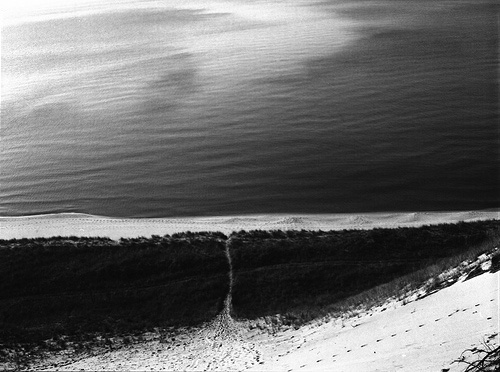
Lake Michigan

Lake Michigan

Lake Michigan, photo by karstenphoto

Check this out background bigtacular and see more in Steve’s Film! slideshow.

More black & white photography and more Lake Michigan from Michigan in Pictures.