Space Weather outlook: Mostly clear with a chance of Northern Lights!

Colorful

Colorful, photo by Xueqian-Vision Photography

Today’s Space Weather Forecast says that there’s chance for R1 – R2 (minor – moderate) solar radio blackouts are possible through 26 April due to solar Region 1726 which will rotate off the visible disk on or about 26 April.

Check this out on black and see more in Xueqian-Vision Photography’s Keweenaw Peninsular – Here We Are slideshow.

Much (much) more about the aurora borealis including how weather on the sun impacts the northern lights on Michigan in Pictures.

Happy 101st Birthday, Tiger Stadium

Tigers at night

Tigers at night, photo by baklein62

101 years ago today on April 20, 1912, Tiger Stadium opened at the corner of Michigan & Trumbull in Detroit’s Corktown Neighborhood. Last year Eric Adelson of Yahoo Sports observed that this milestone passed largely unmarked:

It was 100 years ago this weekend. Ty Cobb scored the first run by stealing home. From that day until 1999, this very spot rumbled with din and greatness. Pretty much every legend that played in Fenway in the 20th century also played here. Lou Gehrig sat himself down for the first time in 2,130 games here, ending his incredible ironman streak. Babe Ruth hit his 700th home run here. Reggie Jackson hit one into the right field light tower here during the ’71 All-Star game. The Tigers won World Series titles here in 1968 and again in 1984, with Kirk Gibson launching a late-inning home run off Goose Gossage that no Tigers fan alive to see it will ever forget. Fair to say this was the most exciting place in the history of Michigan.

And now there’s hardly a trace. Fans committed to honoring the old stadium in some form maintain a home plate, a pitcher’s mound, two chalk lines for base paths and two benches where the dugouts used to be. The 125-foot flagpole from the old center field is still standing.

While the old ballpark’s birthday is definitely passing unmarked again this year, mLive hadan article about the uncertain future of the site a couple of weeks ago. If you’d like to do a little remembering, head over to 100 years at Tiger Stadium on Absolute Michigan for a whole lot more about this beloved ballpark and links to videos including the intro to the DVD Michigan & Trumbull featuring Ernie Harwell. (a 2 1/2 minute stroll through Tiger Stadium)

Check Barney’s photo out on black and see a whole lot more in his great Baseball as Art slideshow.

Lots more Detroit Tigers pictures on Michigan in Pictures!

Fledge Season & Great Horned Owlets

Great Horned Owlets

Great Horned Owlets, photo by Kevin Povenz

April is the season for owls to fledge, or learn to fly. The Raptor Education Group from over in Wisconsin has a page about owlets that includes what to do if you come across one of these cute balls of fluff on the ground:

Great-horned Owls do not build their own nest. Instead, they choose an old nest of a crow, hawk, or even a squirrel to call their own.

When the young owls are 6-8 weeks old, they begin to venture from their nest. This is before they can actually fly. Nature’s method provides owlets opportunities to develop their leg muscles that will very soon be catching their own prey. In a natural setting owlets that appear to have fallen from their nest actually have fledged. In a natural wooded area, bushes and smaller trees provide a ladder of sorts and allow the chicks to climb to a higher perch until they can fly. When owls nest in a city with concrete below them rather than a soft forest floor, problems arise. That is also the case with a well-manicured park or lawn setting that has nothing that can function as a ladder for the tykes.

…If you find a young owl, leave it where it is, unless it is in imminent danger. Give us a call and let us help you decide if the adults are in attendance and the chick is just fledging naturally or if there is something wrong with the little one. Remember, owls are nocturnal for the most part and are not easy to see during daylight hours. Mom and dad could be very close and yet be so well camouflaged they are hard to see.

Michigan in Pictures has a feature on Great Horned Owls with a lot more about these birds!

View this on black, check out more from Kevin on Michigan in Pictures and definitely have a look at his great Birds of Prey slideshow.

Walking on the beach

"Footprints" ,   Twelvemile Beach, pictured Rocks National Lakeshore - "Michigan Nut Photography"

“Footprints”, Twelvemile Beach, Pictured Rocks National Lakeshore, photo by Michigan Nut

“I’d rather do 20 miles on soft sand than 10 miles on the side of the road. There is something about being where water meets land. I feel very clicked-in there. I feel like I can go forever.”
~Loreen Niewenhuis

USA Today has a feature on Loreen Niewenhuis, a Battle Creek resident who has hiked a good deal of the shorelines of all the Great Lakes. As to why, she explains:

“Our older son had gone off to college. The nest was emptying. I’d gotten my” master’s of fine arts degree … “but I felt I could stack up novels and not have an agent and be in my office writing novels forever,” says Niewenhuis, 49. “So I thought, let me do something completely different and get out of my office.”

So she put on her hiking boots. She got out the office.

Boy, did she ever.

Click through to read more about her journey and what she learned along the way. You can keep up with Lorraine’s latest including a planned walk on 1000 of Michigan islands on her Facebook page and at laketrek.com.

This photo is of Twelve Mile Beach in the Pictured Rocks National Lakeshore on Lake Superior, certainly one of the state’s best beaches. Check John’s photo out on black and see more in his My Favorites slideshow.

Lakes Michigan, Huron, Superior & Erie? Michigan in Pictures has them and all kinds of beach photos!

Frog Sex: It’s Complicated

Frog Sex Its Complicated

BACKYARD NATURE, photo by John E Heintz Jr

April is the time when we start to hear some of Michigan’s 13 species of frogs and toads making noise. While the green frogs pictured above were confusing their Frogbook friends in July, most of the distinctive spring frog calls are males advertising that they’re looking for love. The Michigan frog & toad page from the DNR explains:

As temperatures rise in early spring, frogs begin to move to their breeding sites. The actual timing depends on the warmth of the air and water, and the humidity, but there is noticeable order in which the various Michigan species become active and begin voicing their breeding calls. For example, in southern Michigan the raspy voice of the Western Chorus Frog is usually heard first, often in late March, followed quickly by the highpitched peeps of the Spring Peeper. In a few days the woodland swamps are filled with the quack like calls of the male Wood Frogs, while in another week in open marshes the low snores of the Leopard Frog are barely heard over the squeaky songs of newly arrived Red Winged Blackbirds.

The first warm rains of April bring American Toads out of the woods to the breeding ponds, where the air is soon filled with their melodious trills. Several of our frogs postpone their breeding activities until later in spring, when air and water temperatures are higher. Included in this late group are the Gray Tree Frog, Blanchard’s Cricket Frog, and Green and Bull Frogs.

Frogs are far more often heard than seen. Most frog sounds are the advertisement calls of the males, intended to attract the females for breeding. Frog voices may carry for long distances, especially the higher pitched calls of the smaller species. The males increase the loudness of their calls by ballooning out their throats or special sacs at the sides of their throats, creating a kind of resonating chamber. Only males produce advertisement calls, but both sexes may give shorter warning calls or screams when danger threatens. Males can also produce distinct calls that warn away rival males that approach their calling or breeding sites.

Female frogs and toads may lay hundreds or even thousands of eggs. These are usually attached to underwater vegetation or left floating in large masses at the surface. During egg laying, the male clings to the female’s back and fertilizes the eggs. The small, dark eggs are protected by layers of a jelly like substance. They may be in rounded masses (as in Wood and Leopard Frogs), loose clusters (Gray Tree Frogs), long necklace like strings (Toads), thin surface films (Bull and Green Frogs), or deposited singly or in small clusters (Spring Peeper). Many frog eggs are eaten by predators such as fish, turtles, and aquatic insects, or are lost to drying or destruction by micro organisms.

Read on for more and also read more about the frog life cycle from All About Frogs.

Check this out on black and see more in John’s BACKYARD NATURE slideshow.

More frogs & toads and more of our “Best Friends in Nature” series on Michigan in Pictures!

Old Fire

old fire

old fire, photo by Marty Hogan

Marty took this shot near Houle & Wilson in Menominee County in the UP. One of the commenters on his photo who grew up about 3/4 of a mile from there explained that the kilns were used by a sawmill for drying lumber.

Check this out on black, see the whole group of them right here and see several more views of this ruin in his August 2012 slideshow!

More from Marty on Michigan in Pictures!

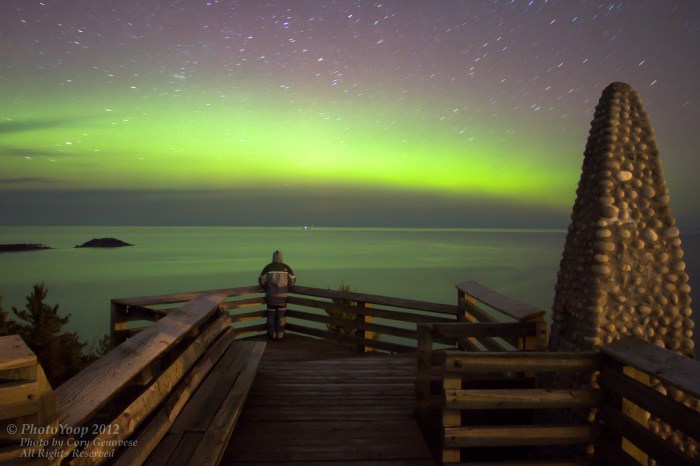
The Lyrid Shower, Comet Thatcher and the Northern Lights

Superior Bow Selfpic by PhotoYoop

Superior Bow Selfpic, photo by PhotoYoop

The Lyrid Meteor Shower at spaceweather.com explains that:

Every year in late April Earth passes through the dusty tail of Comet Thatcher (C/1861 G1), and the encounter causes a meteor shower–the Lyrids. This year the shower peaks on Saturday night, April 21st. Forecasters expect 10 to 20 meteors per hour, although outbursts as high as 100 meteors per hour are possible.

Lyrid meteors appear to stream from the bright star Vega in the constellation Lyra. In fact, Lyrids have nothing to do with Vega. The true source of the shower is Comet Thatcher. Every year in April, Earth plows through Thatcher’s dusty tail. Flakes of comet dust, most no bigger than grains of sand, strike Earth’s atmosphere traveling 49 km/s (110,000 mph) and disintegrate as streaks of light.

Lyrid meteors are typically as bright as the stars in the Big Dipper, which is to say of middling brightness. But some are more intense, even brighter than Venus. These “Lyrid fireballs” cast shadows for a split second and leave behind smokey debris trails that linger for minutes.

Occasionally, the shower intensifies. Most years in April there are no more than 5 to 20 meteors per hour during the shower’s peak. But sometimes, when Earth glides through an unusually dense clump of comet debris, the rate increases.

There’s no way of knowing whether or not this would be a big year, but I’d say that with the Iron Lady’s recent passing, there’s a chance! FYI, Comet Thatcher was named by A.E. Thatcher way back in 1861.

Nobody I know caught the Northern Lights Saturday night, but I thought that Cory’s photo taken when he went looking for Lyrids on April 22, 2012  would be the next best thing! Check it out on black and see more in his Space slideshow.

More northern lights and more meteors on Michigan in Pictures.

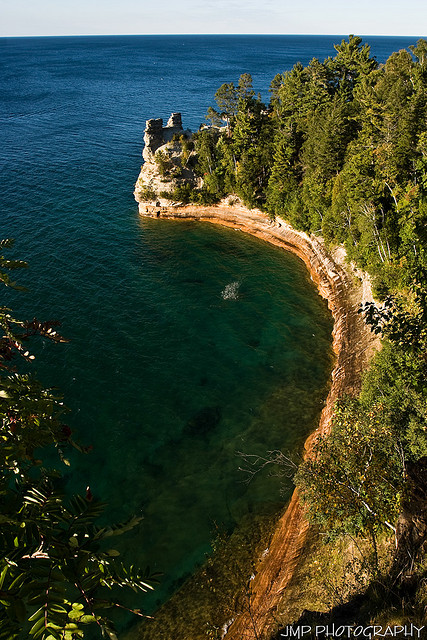
Before the fall at Miner’s Castle

Miners Castle

Miners Castle, photo by James Marvin Phelps

The Pictured Rocks National Lakeshore feature on the collapse of one of the two turrets at Miner’s Castle explains that 7 years ago today:

On Thursday morning, April 13, 2006, the northeast turret of Miners Castle collapsed. One turret remains on Miners Castle, the best-known feature of Pictured Rocks National Lakeshore. The collapse was reported via cell phone by fisherman in the area, according to chief ranger Larry Hach.

Most of the rock fell north and into Lake Superior, and there were no injuries. The lower overlook platform near Miners Castle appears to be unaffected.

While the rockfall at Miners Castle on April 13 was startling, such events are not rare along the Pictured Rocks escarpment. At least five major falls have occurred over the past dozen years: 1) two different portions of Grand Portal Point, 2) the eastern side of Indian Head just east of Grand Portal Point, 3) Miners Falls just below the (now modified) viewing platform, and 4) beneath the lip of Munising Falls (along the former trail that went behind the cascade).

All the rockfalls involved the same rock unit, the Miners Castle Member of the Munising Formation. Rock units are named for places where they were first technically described. The Miners Castle Member consists of crumbly cross-bedded sandstone that is poorly cemented by secondary quartz, according to U.S. Geological Survey Research Ecologist Walter Loope.

Rockfalls along the cliffs typically occur in the spring and fall due to freezing and thawing action of Mother Nature.

Check this photo out bigger, see Jim’s “after” photo and get a lot more great photos in his Pictured Rocks National Lakeshore slideshow.

There’s more from Jim and more from Pictured Rocks on Michigan in Pictures!

Spring Bokeh

Untitled

Untitled, photo by Brooke Pennington

I refuse to give the ice storm that’s outside my door any power.

Brooke takes some great shots of flowers – check this out on black, see more in his slideshow or here on Michigan in Pictures.

More about bokeh.

Twin Turbines

TWIN TURBINES

TWIN TURBINES, photo by marsha*morningstar

Art is all around us. Check out Marsha’s photo from Blissfield on black and see more in her ARTSY slideshow.

More art on Michigan in Pictures.