The Ghost Bike

The Ghost Bike Commemorating Curt Dombecky, 4/23/1948-7/14/2012

The Ghost Bike Commemorating Curt Dombecky, 4/23/1948-7/14/2012, photo by joeldinda

This is a somber reminder as the weather warms and bikers return to the roads that hurrying or texting or lack of attention can result in tragedy. Ghostbikes.org explains:

Ghost Bikes are small and somber memorials for bicyclists who are killed or hit on the street. A bicycle is painted all white and locked to a street sign near the crash site, accompanied by a small plaque. They serve as reminders of the tragedy that took place on an otherwise anonymous street corner, and as quiet statements in support of cyclists’ right to safe travel.

The first ghost bikes were created in St. Louis, Missouri in 2003. Currently there are over 500 ghost bikes that have since appeared in over 180 locations throughout the world. For those who create and install the memorials, the death of a fellow bicyclist hits home. We all travel the same unsafe streets and face the same risks; it could just as easily be any one of us. Each time we say we hope to never have to do it again — but we remain committed to making these memorials as long as they are needed.

View Joel’s photo background big and see more in his Grand Ledge slideshow.

The observant will note that Michigan in Pictures featured a photo from Joel just last week, but sometimes that’s just how it goes. Much more from Joel on Michigan in Pictures.
 

Good Harbor and Good Harbor Bay

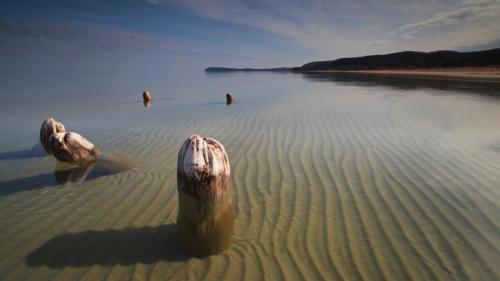
Spring on Good Harbor Bay

Spring on Good Harbor Bay, photo by Eric Raymond

Good Harbor is located on the northern edge of Sleeping Bear Dunes National Lakeshore at the Lake Michigan end of County Road 651. Today only evidence of the vanished village are the pilings of what was once a 500′ dock that could load 4 schooners at a time. The Good Harbor page from the Lakeshore explains that logging in the area began in 1863 to supply cordwood fuel for  steamers, leading to the founding of a village in the 1870s.

Shortly after 1880 (Henry) Schomberg bought out Schwartz’s interest and built a big sawmill which had a capacity of 30,000 feet in a 10-hour day.

…The Schomberg Lumber Company ran a hotel, two stores which became a shopping center for the local farmers, and a saloon. The township line between Centerville and Cleveland townships ran down the middle of Main Street in Good Harbor. Centerville did not allow saloons, so Good Harbor’s saloon was built on the Cleveland township side of the street … At the height of the lumber business, the mill worked day and night during the winter and during the day in the summer. As many as 75 teams of horses were used hauling logs to the mill, lumber to the dock, and supplies to the camps. The lumber company owned some of the teams and the rest were owned by local farmers and rented to the lumber company. At its peak, the mill cut 8,000,000 board feet of lumber per year.

The schooners were loaded by farmers who were called to work at the dock when the ships arrived. Good Harbor had no protection from storms with a northwest wind, so ships had to leave the dock and sail to the Manitou Islands for protection when a storm would come up. Sometimes storms would come up too fast and the ships were driven aground.

You can read on for more and also see some of the wrecks in the area in the Manitou Passage Underwater Preserve.

Check this out bigger and see more great photos from the Sleeping Bear and Leelanau Peninsula (including another shot of the pilings by Terry Clark) on Eric’s Leelanau County Facebook page.

Tulip Time in Holland

Yellow Tulips
Yellow Tulips, photo by srab44_2000

Holland’s annual celebration of Dutch heritage and culture, the Tulip Time Festival, starts Friday May 4th and runs through May 11th. While last year’s crazy March heatwave had tulips blooming in mid-April, tulips have been in the slow lane in 2013 due to a cool spring. The good news according to meteorologist Bill Steffen is that a well-timed warmup should have tulips in near perfect bloom this year.

Check this photo out background bigtacular and see more in E. Benson’s Tulip Time Festival 05/2009 slideshow.

More tulips and more Holland on Michigan in Pictures.

Michigan wine is growing on the vine!

Good wine

Good wine, photo by {Anita}

April is Michigan Wine Month and as we bid farewell to a chilly April with signs of a much more springlike May on the way, I’d like to shout out the  Michigan Grape & Wine Industry Council.

Michigan reached the 100 winery mark in 2013, and the Wine Council is the state entity tasked with sharing all the good news about this booming industry. This month they launched an all-new website packed with information about our state’s wineries & wine industry including Michigan wine events, the history of Michigan’s wine industry and some facts about Michigan wine. Some highlights:

  • Michigan has 15,000 acres of vineyards making Michigan the fourth largest grape-growing state. Although most of the acreage is devoted to juice grapes such as Concord and Niagara for juice, about 2,650 acres are devoted to wine grapes, making Michigan the fifth state in wine grape production in the nation.
  • Michigan’s vineyard area has doubled over the last 10 years.
  • Our state’s wineries produce more than 1.3 million gallons of wine annually, making Michigan 13th in wine production, with the vast majority of production from Michigan-grown grapes.
  • Three types of grapes are used for wine in Michigan: Vinifera (classic European), Hybrid (botanical crosses of vinifera and native North American grapes), and true native varieties (often used to juice production).
  • Vinifera planted in Michigan include Riesling, Chardonnay, Pinot Grigio/Gris, Pinot Blanc, Gewürztraminer, Auxerrois,
  • Pinot Noir, Cabernet Franc, Cabernet Sauvignon and Merlot. Hybrids include Vidal, Chambourcin, Marechal Foch and Vignoles.
  • Each year, Michigan’s wine, grapes and grape juice products and related industries produce nearly $790 million of total economic value to the State of Michigan and account for more than 5,000 jobs across the state.

Check this photo out on black and also see more from Anita on Michigan in Pictures.

Michigan in Pictures also has more about Michigan wine!

Detroit Water Board Building

Water Board Building Upper Floors--Detroit MI

Water Board Building Upper Floors–Detroit MI, photo by pinehurst19475

historicdetroit.org’s page on the Water Board Building explains:

The Art Moderne-styled Water Board Building has been a familiar part of Detroit’s skyline since October 1928. The Common council provided $1 million in the 1927-28 city budget for a triangular-shaped building on a site bounded by Randolph, Farmer, and Bates Streets. Louis Kamper – a Detroit-based architect known for his work on the houses of prominent Detroiters, as well as Detroit landmarks like the Book Building (1917), the Washington Boulevard Building (1923), and the Book-Cadillac Hotel (1924) – originally planned for a 14-story building. But, “because of the high value of the site, the Board decided that … it would build a twenty story building.”

The completed building reflects the trend toward simplification of forms typical of the Jazz Age. Standing 23 stories, it is comprised of a five-story base, a 15-story shaft, and a three-story penthouse. The total cost – including the $250,000 paid for the site, and the architect’s five-percent commission – was $1,768,760.20. It was one of the last buildings designed by Kamper, who was in his late sixties during its design and construction.

…The BOWC’s new building was constructed in a record-breaking seven months. It was considered state-of-the-art and fireproof by 1928 standards.

Click over to Historic Detroit to read a whole lot more and see a couple of old photos. Also check out the Water Board Building at Detroit 1701 where I found a link to this 300 year history of the Detroit Water Board.

View the photo big as the building and see more in pinehurst19475’s water board building slideshow.

More architecture on Michigan in Pictures.

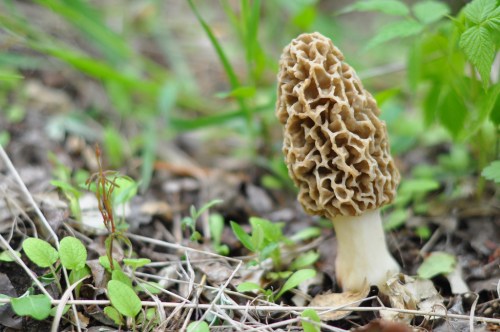
Morel in the Wild: The 2013 Season is upon us!

morel in the wild

morel in the wild, photo by the little red hen

Reports are trickling in from around the state about morels, including some tasty photos from yesterday of morels folks are finding on the Michigan Morel Facebook. Michigan in Pictures has a ton of morel mushroom information to help you find these elusive but delicious delicacies.

Check this out on black and see more in Lynn’s In the kitchen… slideshow.

Speaking of slideshows, don’t miss the morel slideshow in the Absolute Michigan pool on Flickr!

Poe Reef Lighthouse

Poe Reef Light

Poe Reef Light, photo by joeldinda

Terry Pepper has (as usual) a very detailed entry for Poe Reef Lighthouse on his Seeing the Light website. This crib style lighthouse is located off Bois Blanc Island in Lake Huron. The reef is very close to the surface and posed a significant threat to navigation until the decision was made in the 1890s to anchor a lightship there. This served until Lighthouse Service decided to build a permanent station on Poe Reef in 1927:

The station building at Poe Reef was to be an exact duplicate of that which the crew had previously completed at Martins Reef. The main twenty-five foot square structure consisted of a steel skeletal framework to which an exterior sheathing of riveted steel plates was applied. Thirty-eight feet tall, it contained three levels, or “decks”, as the crews assigned to the station knew them. The two upper decks were set up as living quarters, while the main lower deck served as housing for the machinery required for powering the lights, heating system and foghorn.

Centered atop the main structure stood sixteen-foot square, ten-foot high watch room of similar construction, with a single observation window on each side. Finally, a decagonal cast iron lantern room was installed on the roof of the watch room, and outfitted with a Third Order Fresnel lens. The combination of pier and tower provided the Fresnel with a seventy-one foot focal plane, and a visibility range of almost twenty nautical miles in clear conditions. Work was completed at the station and the light exhibited for the first time on the evening of August 15, 1929.

At some point in time, in order to eliminate the possibility of the Poe Reef Light being mistaken for the identical all white structure at Martin Reef, the main deck and watch room of the Poe structure were given a contrasting coat of black paint.

Terry has some cool shots of this light as well including this wide shot with cormorants.

Check Joel’s photo out background bigtacular and see more shots from Poe Reef and elsewhere in his Lighthouses slideshow.

More Michigan lighthouses on Michigan in Pictures.

Grand Rapids Flood of April 2013

Waterwindows

Waterwindows, photo by Canon Screwdriver (gary syrba)

This mLive article on the historic Grand River flooding in Grand Rapids explains that April 2013 is now the third wettest month on record for the city:

Evan Webb with the National Weather Service in Grand Rapids said 10.57 inches of rain had fallen in the city this month as of 8 a.m. Wednesday, its wettest month in 17 years. That should come as no surprise to West Michigan, which saw weeks of heavy rainfall caused widespread flooding and led the Grand River to crest at record levels.

Grand Rapids already had shattered its longstanding April rainfall record, but just crept into the top three wettest of any month of the year.

The No. 1 spot goes to June 1892, when 13.22 inches of rain fell. Second place belongs to September 1986, when 11.85 inches doused the city.

Webb said it is possible Grand Rapids could see enough rain to put it in the No. 2 spot, but it is unlikely with only a week and a half left in the month.

mLive also has some crazy pictures of the flooding including some great aerial photos and a timeline of the flooding.

View Gary’s photo on black and see more in his Water, water, everywhere … but not a drop to drink slideshow. He writes:

All the rain we have had, and the heavy winter added to the water levels a bit around here. The floods are near records. The Grand River, which goes through the heart of the city and ends at Lake Michigan hits the flood limit at 18′. We went 3 1/2 feet over that. Many buildings flooded, many roads were covered for days, and many, many basements flooded. Our sump pump has been running non-stop for two weeks. We have been lucky… we only had about 20 gallons of water that got into the basement… though the sump pump has siphoned thousands of gallons from around our house. Many neighbors had a few inches of water in their basements. A lot of homes have dumpsters in the driveway. Pretty sad. Still… the crowds downtown looking at the floods and taking photos are amazing. People are everywhere, and most are fine.

You might also be interested in the Great Michigan Flood of 1908.

The Monarch and Hartwick Pines

Logging Era Grayling MI Monster Hartwick Michigan White Pine called the Monarch RPPC 1942 at the Memorial Park prior to Hartwick becoming a State Park

Logging Era Grayling MI Monster Hartwick Michigan White Pine, photo by UpNorth Memories – Donald (Don) Harrison

This Friday, April 26th is Arbor Day, and I thought it would be nice to take a look what is probably the most famous trees in Michigan’s history and the place where it once grew, Hartwick Pines State Park. In 1927, Karen Michelson Hartwick purchased over 8,000 acres of land that included 85 acres of old growth white pine from the Salling-Hanson Company of Grayling. Mrs. Hartwick was a daughter of  a founding partner of the logging company and shortly after the purchase, she donated the land to the State of Michigan as a memorial park named for her husband, the late Major Edward E. Hartwick of Grayling. A nice article from the Toledo Blade about Hartwick Pines explains:

This is Hartwick Pines, the largest stand of “old growth” forest in Michigan’s Lower Peninsula. Here, white pines, red pines and hemlocks ladder their way 160 feet to the sky.

…There are approximately 24,000 trees in the Hartwick Pines old growth grove today, but not all are “old growth” trees. Lightning and wind claim a few of the old trees each year, and they are replaced with a mixture of hardwoods and pines.

A large hemlock near the parking lot was recently damaged by a storm and had to be removed. Its stump showed 365 annual rings. The most famous tree at Hartwick Pines — The Monarch — lost its crown in a 1992 storm and then died four years later. It was 155 feet tall when healthy, with a circumference of 12 feet and an estimated age of 325 years.

Read on and learn more about Hartwick Pines from the State of Michigan.

See this big as the Monarch and jump in to Don’s slideshow of postcards for more vintage scenes from Hartwick Pines!

PS: The Monarch was a white pine, Michigan’s State Tree.

New owner for Irish Hills Towers

Irish Hills Towers from Route 12 (View 1)

Irish Hills Towers from Route 12 (View 1), photo by DarrylW4

The Adrian Daily Telegram reports that ownership of the Irish Hills Towers has formally been transfered to the Irish Hills Historical Society, a 501(c)(3) nonprofit. The towers have been stabilized and are being evaluated, and it appears that the IHHS would need about $300,000 to restore this attraction. Keep up with their progress at the Irish Hills Historical Society Facebook.

This page on the Irish Hills Towers notes that the top of the towers is 1400 feet above sea level, which makes them the highest point in southeastern Michigan. On a clear day (if they were open) you could see for seven miles with a ten lakes visible.  Michigan in Pictures has more shots of these iconic landmarks including the history of the towers and a crazy cool photo by Matt Callow.

Darren took the photo and suggests that he’d like to see the towers restored and converted to a museum for Michigan’s Roadside Attractions. Check it out on black and see more in his Irish Hills Towers slideshow.