Land of the Lost: Central Mine

land of the lost

land of the lost, photo by Marty Hogan

The Keweenaw Historical Society page on Central Mine and Village explains:

One of the most noteworthy historical sites in Keweenaw County is Central, or Central Mine, a village that once was the home for over 1,200 people, and the site of one Keweenaw’s most successful mines. The mine, opened in 1854, produced nearly 52 million pounds of copper by the time it closed in 1898.

Several miners’ homes and buildings still stand on the site. In 1996, the Keweenaw County Historical Society acquired 38 acres of the old Central site. Some of the residences are being restored, and a Visitors Center provides interpretive exhibits not only about the mine but also about the miners’ families, homes, schools and churches.

Click through for maps, photos and more information about Central and other sites.

Marty took this photo in Engine House No.2 at the Central Mining Company in Central, Michigan. He says that from 1875-1898, it housed the Steam Hoist for Shaft No.2. Check it out background bigtacular and see more in his Central, Michigan slideshow.

There’s a whole lot more from Marty and his travels to some of Michigan’s coolest places that once were on Michigan in Pictures!


Falling back at Sturgeon Falls

Lower Falls Sturgeon Gorge

Lower Falls Sturgeon Gorge, photo by Shadows in Reflection

Say hello to your last early evening light for a while today, and don’t forget to set your clocks back for Daylight Savings Time tonight!

Back in May I posted a pic of Sturgeon Falls raging with the spring snowmelt. I thought Michael’s photo provided a cool look at how much the snowmelt changes the flow of UP rivers from spring to fall.

Michael writes that this is an awesome place and a must visit if you like waterfalls. See it bigger and see more in his slideshow.

For a look at how to get there, check out the North Country Trail guide for the Sturgeon Gorge area and see many more Michigan waterfalls on Michigan in Pictures.

The road to winter is short

Juxtaposition

Juxtaposition, photo by HLHigham

“Autumn is the greatest reminder: It reminds us how dreamlike beauties our earth has and it reminds us how all these beautiful dreams can easily vanish!”
~Mehmet Murat ildan

Michigan has already seen its first snows of the winter, and we all know it won’t be long before that dusting of snow settles in. I’m not saying that to depress anyone – just to remind you to take a moment to soak up the last of the fall color wherever you can find it this weekend!

Check Heather’s photo out background big, see more in her fall slideshow and also see her photo from just a couple of days before.

More fall or winter wallpaper on Michigan in Pictures!

Happy Halloween!

DSC_6744_edited-1.jpg

Untitled, photo by Bearcats Photography

Mike writes that every year they have family and friends over for homemade stew and fresh bread. He says the only catch is they have to carve a pumpkin.

I’m thinking that’s a great plan – Happy Halloween everyone!!

View his photo background bigtacular and see more in his slideshow.

More Halloween fun on Michigan in Pictures!

Murder Mystery at Grand Island North Light

Grand Island North Light by Jeff Shook

Grand Island North Light, photo by Jeff Shook

The photo above is from the Grand Island North Light page at Terry Pepper’s Seeing the Light. Head over there for all kinds of information about one of Michigan’s lonelier lighthouses.

As Halloween is tomorrow, I thought I’d share the tale of a mysterious murder at North Light from the Center for U.P. Studies at Northern Michigan University.

On June 12, 1908 the body of 30-year old Edward S. Morrison, the assistant lightkeeper at North Light, was discovered in a small sailboat near Au Sable Point. Although identification took a while, since few of the local people knew him, it was definite once made. Morrison had a distinctive tattoo of thirteen stars on his left arm, leaving no doubt as to the identity of the remains. Initial reports said his head had been “battered almost beyond recognition” and that “the head and shoulders were fearfully crushed, as if battered by a club.” Inexplicably though, a coroners jury concluded death was due to exposure, thought to be caused by the rough weather on the 7th. A reported second coroners jury also examined the evidence and returned a verdict that the members were not able to tell how he died, but they had a strong suspicion of murder!

Morrison had been assistant keeper only six weeks when he met his death. A native of Tecumseh, Michigan, he joined the Lighthouse Service on May 1, 1908 and secured the assistant keeper’s appointment at North Light. Friends claimed he had a “bright and sunny disposition” and that he “didn’t have an enemy in the world.”

The keeper of the light was George Genery, a long-time veteran of the Service. Appointed to North Light in 1893, he had been the assistant keeper at Menagerie Island, Isle Royale from 1887 until his posting to Grand Island. It was later claimed he had trouble keeping his assistants since none lasted longer than a season. Working with Genery was said to be difficult at best. The keeper was in Munising on June 6 to get supplies.

Baffled by the discovery of Morrison’s body and the knowledge that the beacon had been dark for nearly a week, a delegation from Munising went out to the light. They discovered the supplies Genery had brought back from Munising still piled on the dock. An empty wheel barrow stood nearby and his coat dangled undisturbed on a hook in the boathouse. Morrison’s vest was hanging carefully on the back of a chair, his watch and papers safe in a pocket. Of the three boats normally kept at the station, reports differed whether two or only one was missing. The last official log entry was made on June 5, while the slate entry for the 6th was made in Morrison’s hand. Neither gave a clue to anything being amiss. Other than the untended lamp, all else was normal, without evidence of any unusual occurrence. Local volunteers manned the light until the service send a replacement.

Authorities immediately started a search for the missing keeper, but he had completely dropped out of sight. There were reports that five different men had seen him at various times in Munising between June 9 and 12, and that he was drinking heavily. His wife, living in town, claimed no knowledge of his whereabouts and did not seem overly concerned with his strange disappearance.

There were several theories proffered to explain the case. One said the two men had gone out to lift nets and that Genery had fallen overboard and drowned. Morrison, unfamiliar with a sailboat, then drifted about helplessly until finally perishing from exposure. Friends, however doubted such reasoning. They considered Morrison an expert sailor, and in fact he had previously owned a 32-foot sailboat on the Detroit River.

Another theory is based on their having been paid on the 6th; that they were attacked by one or more unknown assailants on the island, murdered, robbed and the bodies dumped into the sailboats and cast adrift. Morrison’s eventually made shore. Genery’s never did. Lonely to distraction, no better location for such a crime could be imagined. No one else was in the area to witness such a heinous deed. The nearest other occupant on the island was the Cleveland Cliffs game keeper, whose house was seven miles to the south. There was a story that a body was later discovered in the east channel, but it was apparently never identified so whether it was the missing keeper is unknown. Finding “floaters” was not that unusual, so no definite link between it and Genery was possible.

The third theory was that Morrison was murdered by Genery…

Read on for more and also have a look at Death at the Lighthouse by Loren Graham as reviewed by the Moonlit Librarian.

The photographer is Jeff Shook of the Michigan Lighthouse Conservancy, an organization that does great work in the preservation of Michigan’s lighthouses.

American Kestrel, the Sparrow Hawk

American Kestrel with mouse

American Kestrel with mouse, photo by Kevin Povenz

The American Kestrel entry at Wikipedia says:

The American Kestrel (Falco sparverius), sometimes colloquially known as the Sparrow Hawk, is a small falcon, and the only kestrel found in the Americas. It is the most common falcon in North America, and is found in a wide variety of habitats. At 19–21 centimeters (7–8 in) long, it is also the smallest falcon in North America. It exhibits sexual dimorphism in size and plumage, although both genders have a rufous back with noticeable barring. Juveniles are similar in plumage to adults.

The American Kestrel hunts by hovering in the air with rapid wing beats or perching and scanning the ground for prey. Its diet typically consists of grasshoppers, lizards, mice, and other small birds. It nests in cavities in trees, cliffs, buildings, and other structures. The female lays three to seven eggs, which both sexes help to incubate. It is a common bird to be used in falconry, especially by beginners.

All About Birds adds that it’s perhaps the most colorful raptor in the world, Wing over to their American Kestrel (Falco sparverius) page for photos, kestrel calls & more info.

More birds on Michigan in Pictures.

Check it out on black and see more in Kevin’s amazing Birds of Prey slideshow.

Many more Michigan Birds on Michigan in Pictures!

Remembering Detroit Tigers Manager Jim Leyland

James Richard Leyland

James Richard Leyland, photo by Buzz Click Photography

In 11 Reasons Baseball Is Going To Seriously Miss Jim Leyland Buzzfeed, Emily Orley & Matt Kiebus offer some really great reflection on the career of one of the great managers of the last two decades, concluding simply:

He was the last of his kind.

Jimmy Leyland never cared about being politically correct. He cared about his players, the fans, and winning baseball games. He rarely had a filter with the media and never met an umpire he wouldn’t give a piece of his mind. He was old-school in the greatest sense of the word, and he was beloved for it. He helped make Pittsburgh a baseball town, led the Marlins to a World Series, and embodied the city of Detroit. He enjoyed a cigarette and stiff drink, but most importantly he loved baseball, and baseball is going to miss him.

Definitely read the whole piece for some good thoughts (and video) about a Tiger legend. More about Leyland:

  • Jim Leyland on Wikipedia says that Leyland began his baseball career with the Tigers when they signed him as a catcher on September 21, 1963. A career .222 hitter, he managed the Montgomery Rebels. His last victory on Sept 26 was his 700th for the Tigers and clinched his 3rd straight Central title. He and Tony La Russa are the only managers who have led two different MLB franchises to three consecutive division titles.
  • Leyland’s entry at Baseball Reference details his career record. Leyland spent just over a decade managing in the Tigers minor league system before being taped as an assistant coach by Tony La Russa for the White Sox. He was named Pirates manager in 1986, moved to the Marlins in ’97 (when they won the Word Series), and spent a year with the Rockies in 1999. In 2006 after serving as a scout for 7 years, he returned to the  dugout for the Tigers. He compiled a 1769-1728 record in 3499 games over 22 seasons, winning 3 pennants and one World Series.
  • Here is Leyland’s press conference on retirement along with an article detailing his career from the Detroit Tigers. They note his 700 regular-season managerial wins are the third most in Tigers history, trailing only Sparky Anderson (1,331) and Hughie Jennings (1,131). His .540 winning percentage as Tigers manager ranks only behind Steve O’Neill (.551 from 1943-48) among managers with at least 500 wins.
  • Detroit writer Michael Rosenberg has a nice piece in Sports Illustrated that gives a little more in-depth look at the man from someone who covered him well.

About his photo from late September 2007, Spike says:

Now THIS is a rare shot: Jim Leyland smiling! The Tigers Manager usually shows no emotion but took this opportunity at the last 2007 home game to leave the umpires in stitches. Who knows what Leyland cracked before his audience on the mound but they quickly hid their grins as the opposing manager approached and scolded them.

Check it out on black and see more in great shots of Detroit moments in Spike’s sports slideshow.

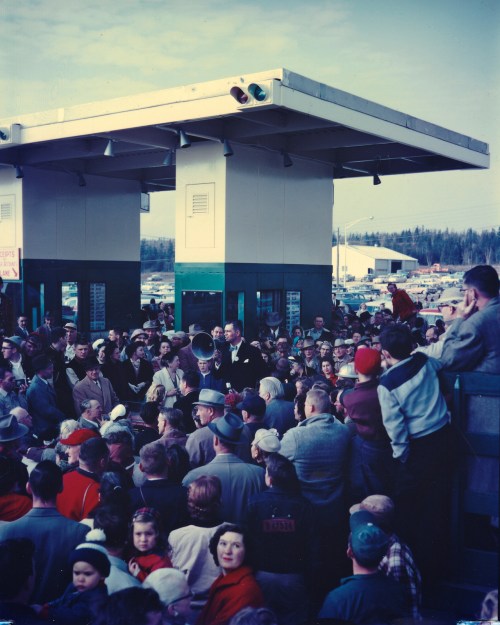
Opening the Mackinac Bridge, November 1, 1957

Opening of Mackinac Bridge - November 1, 1957

Opening of Mackinac Bridge – November 1, 1957, photo by daveumich

An Absolute Michigan feature via Michigan History Magazine on the opening of the Mackinac Bridge on November 1, 1957 says (in part):

With the bridge ready for traffic, but fearing inclement autumn weather at the Straits, officials decided to have an official “opening” on November 1, 1957, but an official “dedication” in late June of the following year.

Amazingly, the weather on the first day of November (preceded by two days of rain and fog) was sunny and pleasant. However, the weather in late June was so cold and wet (with six-foot waves on the Straits) that some of the events were shortened or canceled altogether. According to one observer, it “was a bleak, gray day, more like March than June, and the only parader who looked happy was a snow queen from Cadillac, who rode on an ice throne float, throwing snowballs made of popcorn.”

…On November 1, after paying the $3.25 toll (taken symbolically by former U.S. Senator Prentiss Brown, who chaired the Mackinac Bridge Authority), Governor G. Mennen Williams crossed the bridge (driven in a car by Mrs. Williams because the governor had forgotten his driver’s license). Then, according to United Press International correspondent Thomas Farrell, cars lined up for one mile on both sides of the Straits “swarmed” on to a bridge whose size “staggers the imagination.”

In his opening day remarks, Governor Williams predicted that the bridge would add $100 million annually to the state’s tourist trade. He continued, “Michigan at last is to be one state, geographically, economically and culturally, as well as politically.”

I think we can probably agree that it’s had a tremendous impact on Michigan! About this photo with a unique view of the festivities, Dave writes:

A friend found this large format color slide earlier this year and I scanned it at high resolution. It shows Governor G. Mennen “Soapy” Williams at the tollbooths on the St. Ignace end of the Mackinac Bridge on the day it opened, November 1, 1957. I have seen many photos of this day, but never one quite like this.

Be sure to check this out big as the Mighty Mac to see the faces in the crowd and jump into Dave’s slideshow for more.

Michigan in Pictures has lots more on the Mackinac Bridge and you can get a comprehensive look at the bridge on the 50 Year feature on the Mackinac Bridge at Absolute Michigan.

The Pumpkin Armada

Happy Halloween!

Happy Halloween!, photo by jnhkrawczyk

If you’re still in the market for pumpkins, check out this listing of Michigan pumpkin patches, hayrides & corn mazes.

Jill took this shot at Parmenter’s Cider Mill in Northville. View it bigger and see more in her Halloween slideshow.

More pumpkin info on Michigan in Pictures!

Misty Moonrise at Tahquamenon

Misty Moonrise

Misty Moonrise, photo by ShaneWyatt

Here’s a gorgeous shot of the moon rising over the mist of Lower Taquamenon Falls – Shane caught a shooting star too!

View his photo bigger and see more including another night shot at the falls in Shane’s stars slideshow.