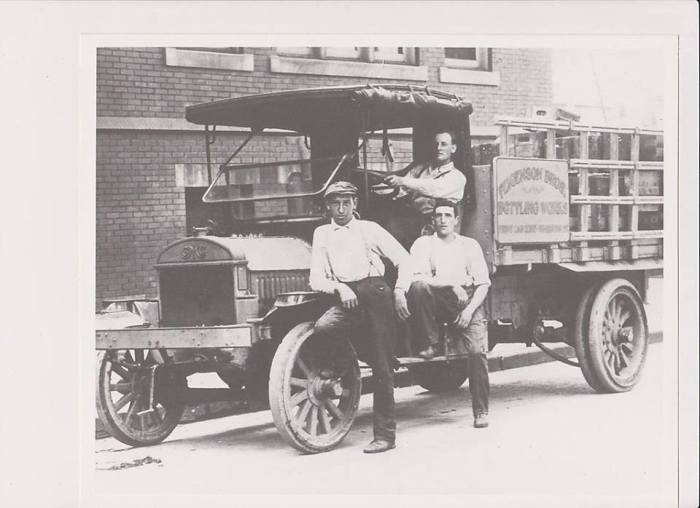
Faygo founding Feigenson brothers with their first truck

Founders of Feigenson Bros. Bottling Works  Faygo

Founders of Feigenson Bros. Bottling Works

Tomorrow (November 4th) is the 107th birthday of Detroit-based Faygo. The Encyclopedia Of Detroit entry for Faygo Pop at the Detroit Historical Society says:

In 1907, Russian immigrant brothers and bakers, Ben and Perry Feigenson, began playing around with the idea of creating soft drinks based on their frosting flavors. They bottled their soda – which they called “pop” because of the sound it made when the lid was removed – in fruit punch, strawberry and grape flavors at a factory on Pingree Street. They sold their soda pop from their horse-drawn wagon the day after it was made.

Soon, the brothers developed the Feigenson Brothers Bottling Works, but they changed the name to Faygo in 1921 because “Feigenson” was too long to fit on the labels. They moved their growing bottle works to Gratiot Avenue in 1935, which is still used today to create Faygo pop.

The brothers ran Faygo until the mid-1940s, when they gave the company to their sons. Faygo was sold only in Detroit and Michigan until the late 1950s because it had a limited shelf life. At that time, company-hired chemists determined that impurities in the water prevented the pop from staying carbonated. The company then developed a water filtering system that stretched the shelf life to more than a year.

Faygo became popular outside of Michigan in the late 1960s when the company began advertising during televised Detroit Tigers games. Today, Faygo, which comes in over 30 flavors, is sold in many states east of the Mississippi River.

In 1987, the Feigenson family sold the Faygo company to National Beverage Company which is based in Florida. National Beverage, which also owns Shasta, kept the Detroit bottling works and the company’s employees. Many have worked for Faygo for over 30 years.

Today, the most popular Faygo flavor remains one of the earliest the Feigenson brothers developed: Redpop.

Click through for a couple fun items in their collection and also check out Faygo’s history page for a nice timeline.
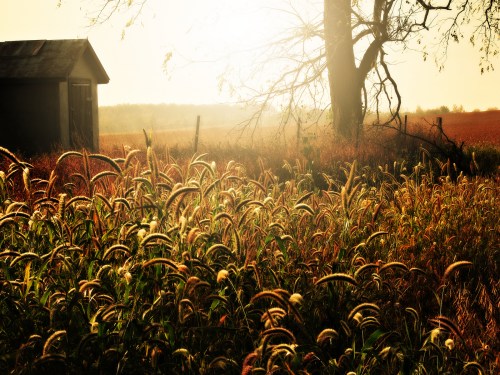
The old shack

The old shack

The old shack, photo by Amanda Nelson

View Amanda’s photo background bigtacular and see more in her slideshow.

More Fall wallpaper on Michigan in Pictures.

Happy Halloween 2014!

Rochester Hills Stonewall Pumpkin Festival @ Van Hoosen Farm

Rochester Hills Stonewall Pumpkin Festival @ Van Hoosen Farm, photo by Mike

When black cats prowl and pumpkins gleam,
May luck be yours on Halloween.
~Author Unknown

I’d like to wish all of you a happy & safe Halloween. Watch out for those little ghosts & goblins as you’re out and about, and here’s hoping that you get to feel some of the magic of pretend tonight!

View Mike’s photo bigger and see more in his Rochester Hills Stonewall Pumpkin Festival 2014 slideshow. Also be sure to follow Mike at StormchaserMike Photography on Facebook!

More Halloween through the years from Michigan in Pictures.


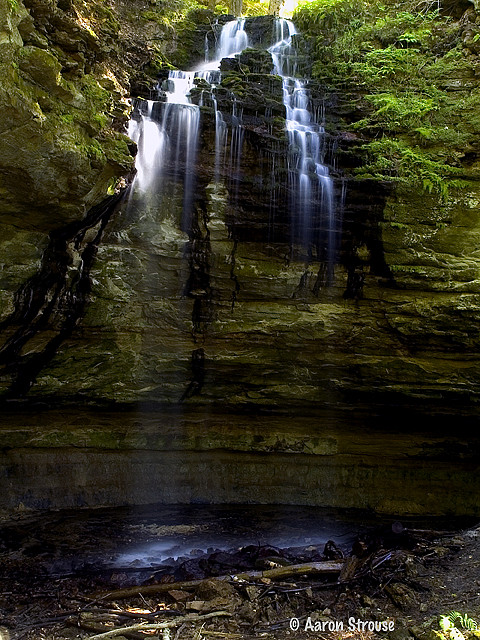
Waterfall Wednesday: MNA Memorial Falls aka Twin Falls

memorial falls
memorial falls, photo by Aaron Strouse

GoWaterfalling.com is the go-to source for information about Michigan’s waterfalls. Their page on MNA Memorial Falls says (in part):

MNA Memorial Falls is in Munising, off of H-58. Some of the locals refer to this waterfalls as “Twin Falls”. This is a very seasonal waterfall and is often dry. However when the water is flowing, which may only be after a good rain or when the snow is melting, you will be treated to a very pretty gorge with two waterfalls in it. MNA Memorial Falls is owned by the Michigan Nature Association and it is open to the public.

To visit the falls from Munising, head east on H-58 and turn right on Nestor street. There is a sign that says “MNA Memorial Falls” on the right. Park here and follow the trail. The trail will take you to the top of the falls. There is a small wooden bridge that crosses the creek just above the falls. The trail continues downstream along the top of the gorge and then works its way back to the base of the falls. It is at most a 10 minute walk.

Two streams empty into this gorge, but the second one likely only has water after or during a good rain. One very interesting feature of this gorge is a “window” in the walls between the two falls. You can crawl through this window, or just walk around it. You can see each of the waterfalls through this window.

Read on for lots more including driving directions and information about nearby falls to visit including Tannery Falls. You can also learn more about the Michigan Nature Association and their preserves at michigannature.org.

View Aaron’s photo bigger and see more great shots in his awesome Michigan waterfalls slideshow.

Many more Michigan waterfalls on Michigan in Pictures!

Coming Home

Coming Home

Coming Home, photo by David Frey

David got a great shot of the SS Badger car ferry arriving in Ludington on its last crossing of Lake Michigan for the 2014 season.

View his photo background bigtacular and see more of his Ludington photos right here.

More SS Badger pics on Michigan in Pictures!


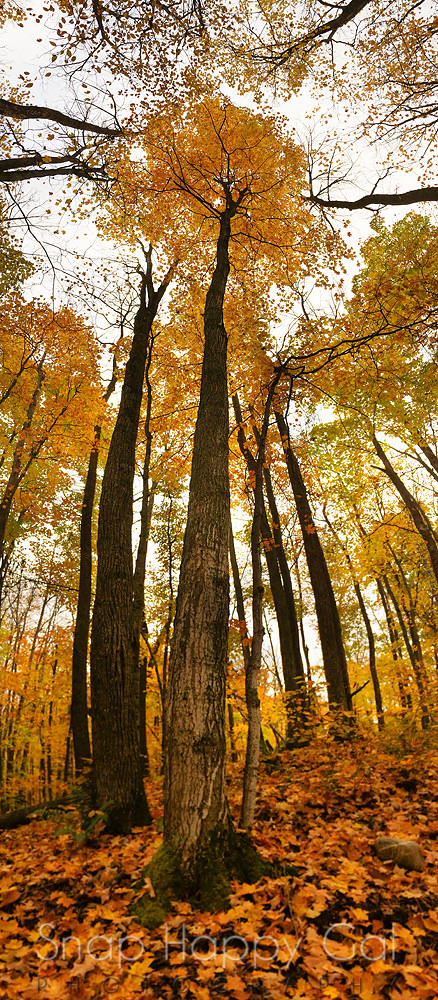
Seeking Ash Survivors

Tall Tall Tree

Tall Tall Tree, photo by Heather Higham

The Freep reports that the search is on for survivor ash trees in Ohio & southeastern Michigan:

Researchers studying a tree-killing beetle are asking residents in northwestern Ohio and southeastern Michigan to help them with a scavenger hunt of sorts.

Scientists think there are few ash trees in the wild that have been able to withstand the emerald ash borer and are hoping that they could provide some clues about how they were able to fend off the destructive beetle.

“They just want to understand the mechanism,” said Jane Hodgins, a spokeswoman for the U.S. Forest Service’s Northern Research Station in Minnesota.

Researchers decided to focus on looking for these “survivor” trees in northwestern Ohio and southeastern Michigan, because that’s where the ash borer first took hold in the United States, The Blade reported.

The beetle is native to Asia and arrived in the U.S. around more than a dozen years ago. It has since killed about 50 million ash trees in the Upper Midwest.

Some homeowners have been able to save their ash trees by treating them with insecticides, but the scientists are looking for trees that have survived on their own.

Read on for more.

View Heather’s photo bigger and see more in her Fall slideshow.

Please Note: I can’t see the leaves here so these trees that I think are ash might not be – looks awesome though! Also, if you think you just saw a photo from Heather here, way to pay attention!!

More trees on Michigan in Pictures.

Bikes pumping up Michigan’s economy

Kalamazoo River Valley Trail

Kalamazoo River Valley Trail, photo by Bill Dolak

This pic reminded me of an article I read a couple weeks ago in the Detroit News on the economic impact of bicycles in Michigan:

Bicycling pumps an estimated $668 million per year into Michigan’s economy, according to a recent report from the Michigan Department of Transportation. That figure factors in the nearly 800 people employed in bicycle-related jobs, along with retail revenue, tourism expenses, lower health care costs and a boost in productivity.

The study, “Community and Economic Benefits of Bicycling in Michigan,” put the spotlight on five communities to gauge how the sport affects their bottom line.

Michigan’s second-largest city, Grand Rapids, benefited most from cycling. It earned $39.1 million, nearly double the $20.7 million Detroit brings in. Ann Arbor easily grabbed second place with a $25.4 million boost.

…Grand Rapids began adding bike lanes on city streets in 2010 and now has 55 miles of bike lanes with more planned. It has a cycle track, hundreds of bike racks and an extensive trail network in the suburbs, said Suzanne Schulz, Grand Rapids’ managing director of design, development and community engagement.

“We are really trying to take a more holistic view of transportation infrastructure for the entire community because a lot of people don’t have cars,” Schulz said.

Read on for more or dig into the full study from MDOT.

Bill took this shot on the Kalamazoo River Valley Trail. View it background bigtacular and see more in his Michigan: Kalamazoo County slideshow.

More bikes and bicycles and more fall wallpaper on Michigan in Pictures!

The Solar Eclipse of October 23, 2014

Solar Eclipse - October 23, 2014

Solar Eclipse – October 23, 2014, photo by David Marvin

Although the clouds didn’t want to cooperate, David got a few shots of yesterday’s solar eclipse. See this one background big and click to his slideshow for more.

More eclipse photos on Michigan in Pictures. And speaking of eclipses, check out this awesome time lapse of the October 8 Blood Moon eclipse by Central Michigan University astronomy prof Axel Mellinger!

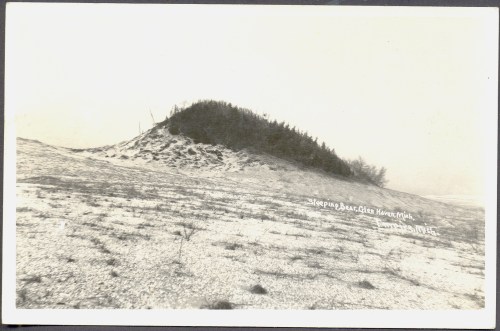
#TBT: The Bear of Sleeping Bear Dunes

Glen Haven MI Sleeping Bear Dunes Empire and Glen Haven Marked RPPC Kodak Stampbox Unsent what looks like a hump of low scrub bushes is actually a forest hill buried in sand

Glen Haven MI Sleeping Bear Dunes, photo by Don…The UpNorth Memories Guy… Harrison

Tuesday was the 44th anniversary of the founding of the Sleeping Bear Dunes National Lakeshore. You may have heard the Chippewa tale that inspired the name of the park:

“Long ago, along the Wisconsin shoreline, a mother bear and her two cubs were driven into Lake Michigan by a raging forest fire. The bears swam for many hours, but eventually the cubs tried and lagged behind. Mother bear reached the shore and climbed to the top of a high bluff to watch and wait for her cubs. Too tired to continue, the cubs drowned within sight of the shore. The Great Spirit Manitou created two islands to mark the spot where the cubs disappeared and then created a solitary dune to represent the faithful mother bear”.

You might not be aware, however, that “the Bear” was also an actual formation atop a dune about a mile north of the Pierce Stocking Overlook. The Lakeshore says that the formation pictured above…

…hardly looks like a bear now, for it has been changing rapidly in recent years. At the turn of the century, it was a round knob completely covered with trees and shrubs. You can still see some of the thick vegetation that gave it a dark shaggy appearance.

…For a long time, the Sleeping Bear Dune stood at about 234 feet high with a dense plant cover. However, through most of the twentieth century, erosion has prevailed. By 1961, the dune was only 132 feet high, and by 1980, it was down to 103 feet. The process is a continuing one. The major cause of the dune’s erosion was wave action wearing away the base of the plateau on which the dune rests. As the west side of the dune loses its support, it cascades down the hill. The wind, too, is a major agent of erosion, removing sand and destroying the dune’s plant cover.

You can see what the area looks like now and read more right here.

View Don’s photo background bigtacular and get daily blasts from the past in his Northern Michigan Photo Postcards – Our History and Heritage group on Facebook!


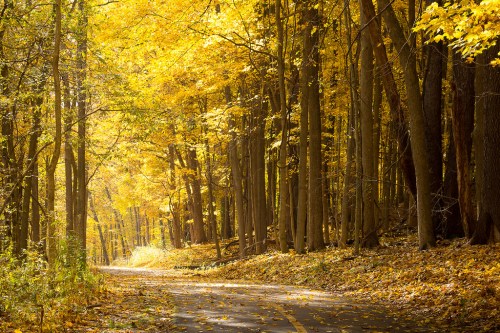
Fall on the Ludington State Park Ridge Trail

Ludington State Park Ridge Trail

Ludington State Park, Ridge Trail, photo by otisourcat

If it seems to you that fall colors are more erratic this year than usual, it’s not all in your head! The Great Lakes Echo feature by Juliana Moxley titled Last winter’s cold legacy: Fall colors slower to peak explains (in part) that last winter’s extreme cold is the culprit:

The harsh 2014 winter is partly to blame, said Bert Cregg, a professor in the department of horticulture at Michigan State University.

We are still having a good fall color season in Michigan, but we are likely to see some trees in full color while others are just beginning to turn, he said.

“As you’ll recall, last winter was extremely cold — one of the coldest winters on record,” Cregg said. “The winter stress delayed leaf-out for many trees, and then the tree’s timing was further delayed by a cold rather than normal spring.”

A warming climate can also affect fall color, said Howard Neufeld, a professor in the department of biology at Appalachian State University in North Carolina. Higher temperatures, altered timing and/or amounts of precipitation, changes in humidity, changes in cloud cover, increases in the length of the growing season and higher levels of nitrogen inputs in the ecosystem can all affect fall color variance.

“Increased precipitation means that light levels are most likely lower, and trees will do less photosynthesis,” Neufeld said. “With less photosynthesis, there are fewer sugars in the leaves. Warmer temperatures mean higher respiration rates, and more sugars will be metabolized.”

You can read on for lots more including an explanation of the scientific processes that impact color change.

The photo above by otisourcat shows that patchy color well. See it bigger and see more in their slideshow. More about the trail and park in the Ludington State Park guide.

More Michigan trails and more science on Michigan in Pictures!