Sunset Boulevard: Michigan Avenue version

Sunset Boulevard

Sunset Boulevard, photo by Derek Farr ( DetroitDerek ).

This last week of December always feels like you’re waiting at the light for it to change so you can cruise into the next year. As you wait, if there’s anything you’re hoping for Michigan or yourself for 2010 (or anything you’d prefer to leave in 2009), why don’t you post it as a comment below?

View this bigger in Derek’s Explored slideshow (view the set).

Blue Reflections: Comerica Tower loses Comerica

Blue reflections

Blue reflections, photo by eYe_image.

Crain’s Detroit reports that Comerica Inc. will move its remaining Detroit employees out of Comerica Tower at 500 Woodward and renovate a building it owns on Lafayette Avenue. The move follows Comerica’s moving of its HQ to Dallas and will leave the building 70% vacant. It does allow some enterprising entity to put their name on the 2nd tallest building in Michigan.

Wikipedia’s Comerica Tower entry says that:

The building was designed by noted architects John Burgee & Philip Johnson, partners influential in postmodern architecture. One Detroit Center was constructed from 1991 to 1993. To form a stylistic link to the past, it was designed in a historicist fashion, with Flemish-inspired spires.

…The building is famous for its postmodern architectural design topped with neo-gothic spires. It uses a large amount of granite. Sometimes called a “twin gothic structure”, for its pairs of spires, it is oriented North-South and East-West (as named on a plaque along the Windsor waterfront park). One Detroit Center won the Award of Excellence for its design in 1996.

A twin tower dubbed Two Detroit Center was proposed to be built directly east of the tower when the One Detroit Center was proposed, but a soft office market killed the plans, and Two Detroit Center was put on hold, indefinitely.

The photo shows the Renaissance Center (GM headquarters and Michigan’s tallest skyscraper) with Comerica Tower reflected. Be sure to check it out bigger and in Larry’s Abstract Architecture set (slideshow).

You might also enjoy the Comerica Tower slideshow from the Absolute Michigan pool.

Remembering Bob Heft, designer of the 50 star flag

Ren Center at night
Ren Center at night, photo by mikesophia

The Saginaw News has a nice feature on Saginaw resident Bob Heft, designer of the 50 star American flag. Heft was the creator of the longest-serving flag in US history and passed away Saturday at the age of 67:

Heft was 17 in 1958 when he received an unusual phone call from an important individual. When the caller asked for Robert G. Heft, the teenager said, “Yes, but you can call me Bob.” He didn’t realize he was speaking with President Dwight D. Eisenhower. Heft’s high school project had been selected by the president to represent the United States of America and the 50-star U.S. flag was born.

Winford said Heft would “beam with pride” because of his work and was a constant inspiration for children. He said he taught them how to follow their dreams.

Heft visited the White House 14 times under nine presidents and toured with Bob Hope.

You can get a little more about Heft from Wikipedia and at usflag.org, where they relate that his design receieved a B- because it lacked orginality. He did say that he would give Heft a high grade if he could get Congress to accept the design.

Mike says that he loves the flags in front of the Renaissance Center. Check this out bigger and in his Favorite set (slideshow).

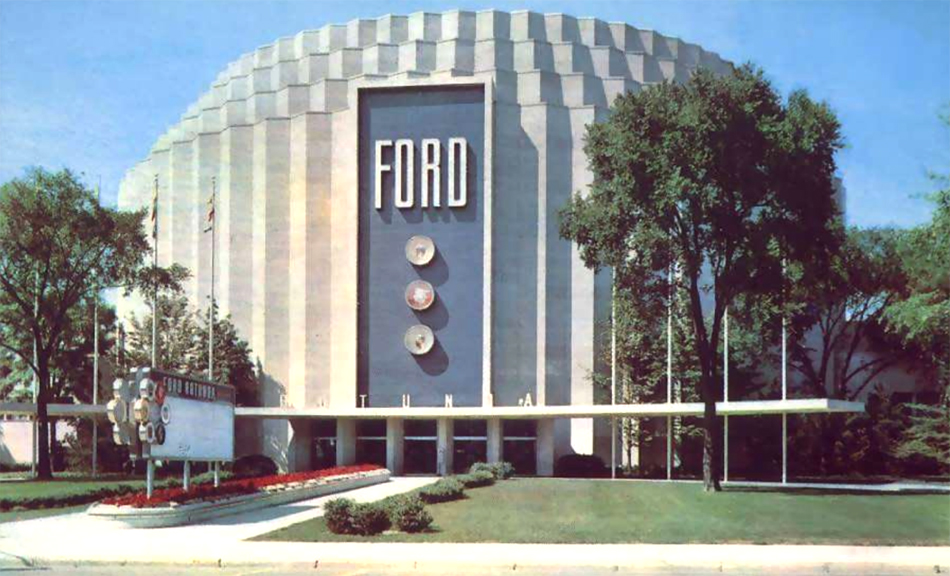
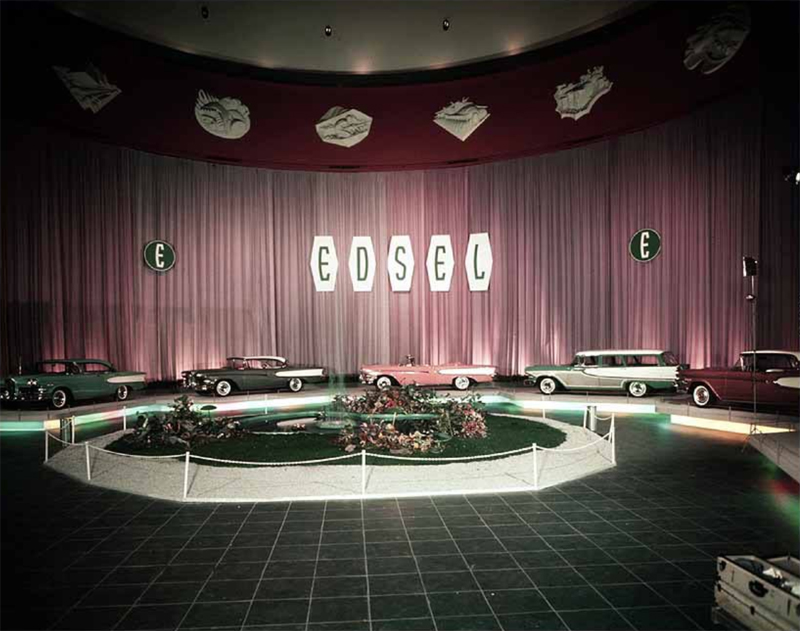
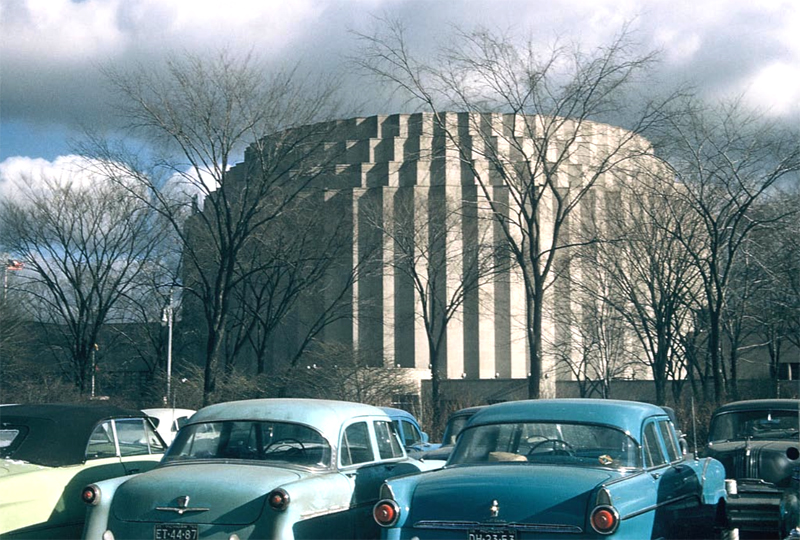
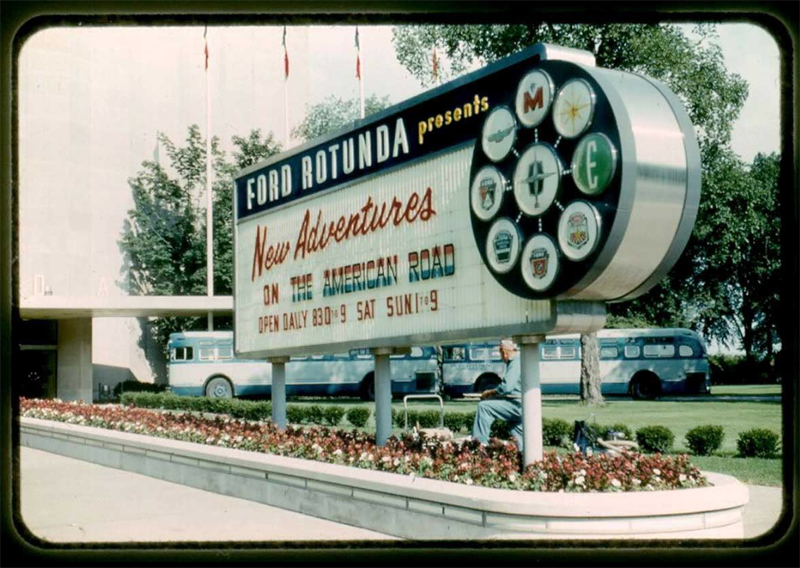
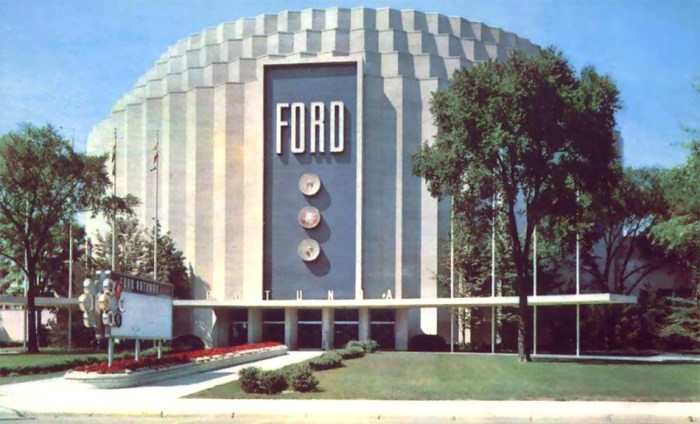
The Ford Rotunda

The Ford Rotunda – Dearborn, Michigan, photographer unknown

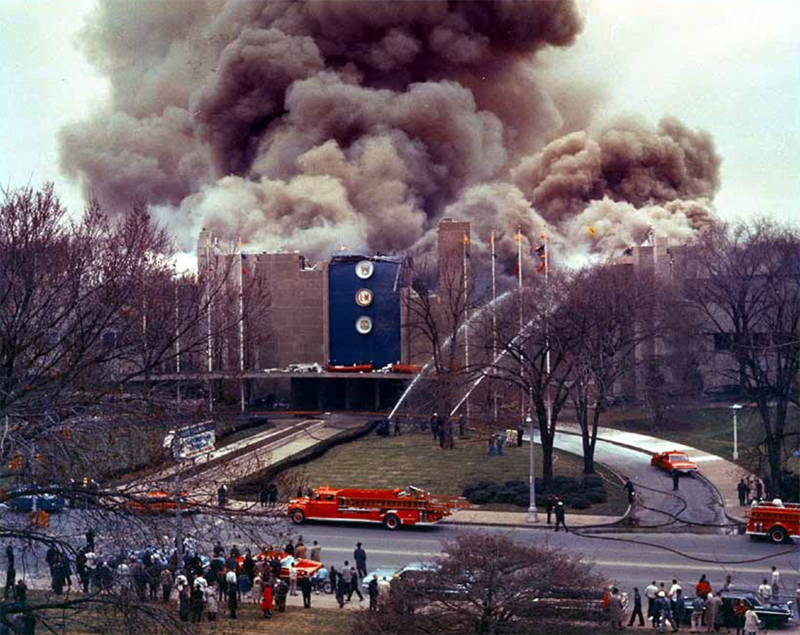
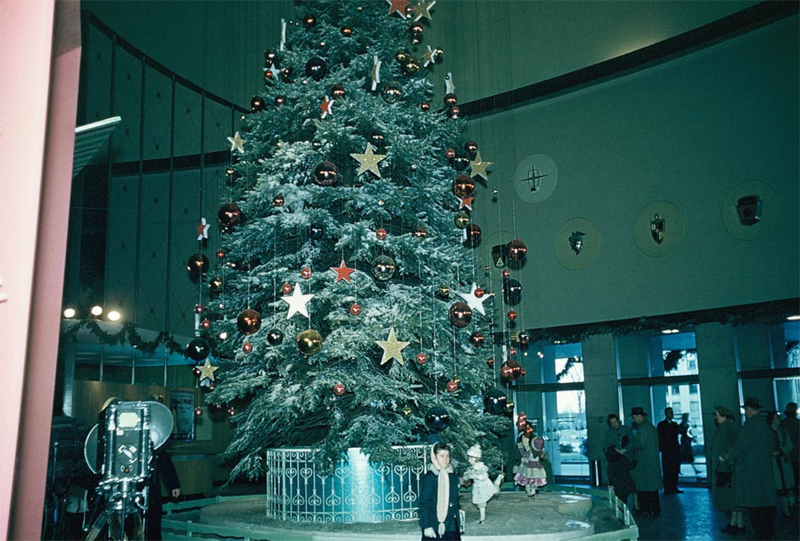
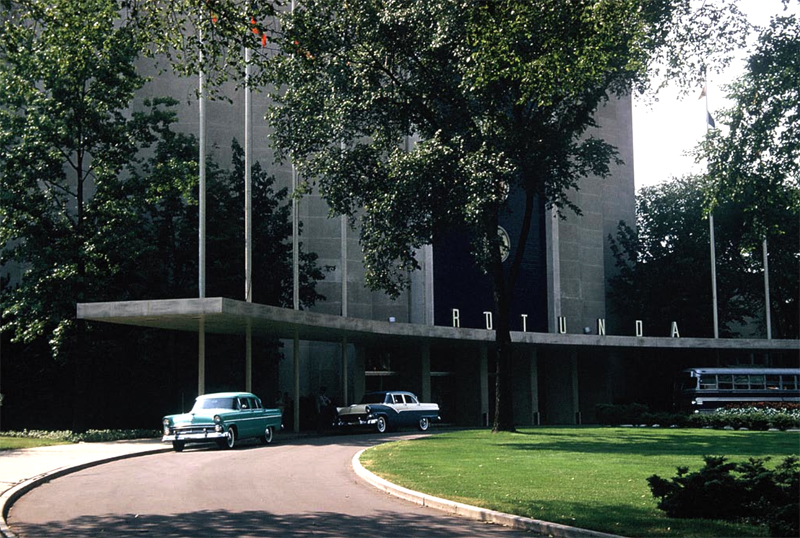
Michigan in Pictures regular Matt passed an email about the Ford Rotunda along that had some cool pictures I thought folks would like to see. When flames consumed a Christmas fantasy from the Detroit News Rearview Mirror begins:

From 1936 to 1962, the gear-shaped Ford Rotunda attracted visitors from around the world. It was the fifth most popular tourist destination in the United States in the 1950s.

The building had its roots in the 1933 Chicago World’s Fair, known as the Century of Progress Exposition, which opened in May of 1933 and attracted more than 40 million visitors over its two-year run. One of the major attractions at the fair was Ford Motor Company’s Rotunda, which was disassembled after the fair and brought back to Dearborn, where it was reconstructed using more permanent materials. Designed to be the showcase of the auto industry, the Ford Rotunda was opened to the public on May 14, 1936.

…In 1960, the Rotunda ranked behind only Niagara Falls, the Great Smoky Mountains National Park, The Smithsonian Institution and the Lincoln Memorial as a national tourist destination. It was more popular than Yellowstone, Mount Vernon, the Washington Monument and the Statue of Liberty.

Read on for the sad tale of how it burned to the ground on November 9, 1962.

Television History – The First 75 Years might be the photographer – there’s some of the same shots there and they write about their parents taking them to see Santa during the Christmas Season at the Rotunda. They also have a nice aerial of how the Ford Rotunda was located in relation to the Rouge Plant.

Old Main and Wayne State University

Wayne State University

Wayne State University, photo by kmaz.

Wayne State University is Michigan’s only urban research university. The 203 acre campus is in Detroit’s University Cultural Center. The main campus and six extension centers are attended by 33,000 graduate and undergraduate students in 13 schools and colleges that offer more than 350 major subject areas.

Wikipedia’s Wayne State University entry says that the university was established in 1868 as the Detroit Medical College. Five more schools were added over the years and in the early 1930s the Detroit Board of Education organized them to form Wayne University. The building pictured is Old Main (c. 1904 photo of Old Main), about which Wikipedia says:

Old Main, originally called “Main Building”, was built December 13, 1894. It was the first major building of Wayne State University. Originally, every course offered was located in Old Main. It was built over a four year period out of limestone quarried from the land directly in front of it. The structure was designed by the architects Malcomson & Higginbotham and contained 103 classrooms, laboratories, offices, and residential space for 3000 students.

…Today, Old Main serves as the home of the College of Liberal Arts and Sciences of Wayne State University as well as accommodating many other classes of different subject matters.

See this bigger in Konrad’s Wayne State University slideshow.

Lines

Lines

Lines, photo by Ralph Krawczyk Jr.

If you don’t know Ralph, you should.

Be sure to check it out bigger or in his Digital Goodness slideshow.

See more from Ralph on Michigan in Pictures.

The Cutting Room Floor

God and Automobiles

God and Automobiles, photo by g. s. george.

Yesterday on Absolute Michigan we featured Generation Y Michigan, a project of Michigan Radio that is probing why young adults leave Michigan (or buck the trend and choose to stay). While poking around, I found an engaging feature by Colleen Hill of Pixelgawker that features the photography of Geoff George (a regular on Michigan in Pictures). It’s titled Editors and Image Makers: On Photographing Detroit, Part 1 and begins:

One of the most important jobs in the media, that of the editor, often goes unseen. A well-edited film is seamless in its delivery. There are no awkward cuts or pauses, and the plot transcends time and distance effortlessly. Recently Detroit has been a prime topic of interest both in the national media and in film. With the copious number of photographs and footage of the city circulating the Internet and television, I can’t help but wonder, what is the edited version of Detroit that resides in the minds of the most of Americans? What are the parts left behind on the cutting room floor?

Read on for a lot more! About the photo above, Geoff writes:

This is the memorable and ironic view that greets every motorist traveling south on I-75 towards downtown. Thousands of these motorists are surely suburban GM workers on their way to work every day, and the irony of this chance alignment is hopefully not lost on them. In the background, the Renaissance Center, Detroit’s tallest building and GM World Headquarters. In the foreground, St. Josaphat, a 105-year old still-functioning relic from Detroit’s heyday. Detroit is the Motor City, but the sins committed here cannot be forgotten or forgiven–from the hundreds of murders every year to the construction of a freeway system that divided and destroyed vibrant and working neighborhoods. Hopefully this image will one day have different associations.

For me, it is a powerful view that is quintessentially Detroit. I’m sure it’s been photographed hundreds of times, but the balance and contrast between Detroit’s largest and most infamous glass skyscraper, a struggling community church, and the freeway that cut a swath across the city and acted as a runway for white flighters provides me with endless fascination. I hope you will find it equally stimulating.

You can see a whole lot more in Geoff’s the city on the strait: detroit set (slideshow).

The Pontiac Silverdome

Abandoned Pontiac Silverdome - Pontiac Mi

Abandoned Pontiac Silverdome – Pontiac Mi, photo by Derek Farr ( DetroitDerek ).

Crain’s Detroit reported yesterday afternoon that an as yet unnamed Canadian company has purchased the Pontiac Silverdome for $583,000.

Ballparks.com’s page on the Pontiac Silverdome notes that at 80,368, the massive Silverdome long had the largest seating capacity in the NFL. The air-supported and cable-restrained facility was the largest of its kind in the world and is the first successful example of a fiberglass fabric roof system. From Wikipedia’s entry on the Pontiac Silverdome, I found this site dedicated to Silverdome architect C. Don Davidson. The site explains:

After working in the south as a prominent architect for several government and city projects, Davidson returned home in 1965 to a city that was slowly dying and stated in his own words, *”It looked as if someone had dropped a bomb on the city”. In 1966 he was hired at the University of Detroit to teach architecture and urban planning.

It was then when Davidson and his U.of D. class embarked upon an urban renewal project for Pontiac under the direction of Bruno Leon, Dean of Architecture.

You’ll definitely want to click through for drawings, press clippings and more about the Pontiac Silverdome.

Curiously enough, Derek’s photo appears on that site! See it bigger in his Detroit Ruins (and other cities) slideshow.

If you’d like a video look, you can check out the auction preview video (go to about 1:20 to get past the auction promo). If you’d rather just see what it looks like with laser lights and a rave going on, how about this video of Project Hardcore @ Silverdome in 2009?

Urban myPhone

Urban myPhone

Urban myPhone, photo by gatsbyj.

This photo makes me think that social media will probably replace advertising someday.

You can see this bigger in Christian’s Around Detroit slideshow (view the set).

You might also enjoy Detroit at Night from the Absolute Michigan pool on Flickr.

Exposure.Detroit November Show


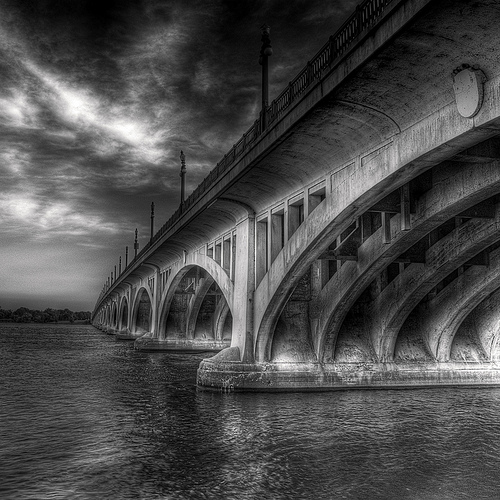
take it to the bridge, photo by b.plus

The Exposure.Detroit November Photography Exhibit Opening Party takes place this Saturday (November 7) from 7-10 PM at the Bean & Leaf Cafe in Royal Oak. The show features the work of Robert Monaghan, Jim Barclay, Allan Machielse, Bethany Helzer and Brian Day.

Check Brian’s photo of the Douglas MacArthur Bridge (aka the Belle Isle Bridge) out bigger in his Interesting slideshow (set) or dive into his Flickriver.