
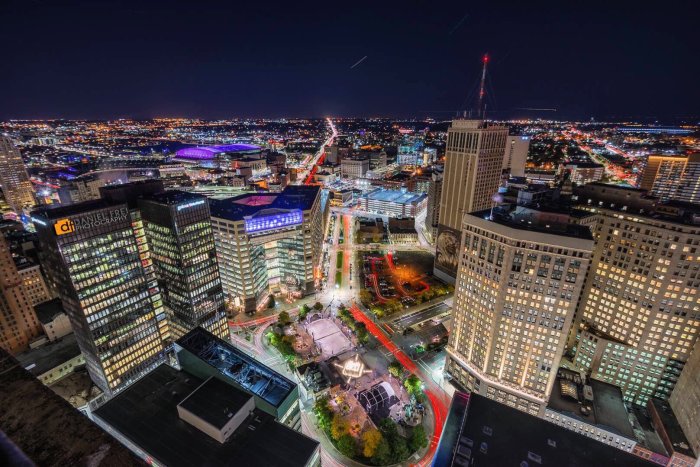
Executive Level in the city of Detroit, photo by Dan Frei Photo
Follow @danfreiphoto on Twitter and view & purchase his work on his website.
Executive Level in the city of Detroit, photo by Dan Frei Photo
Follow @danfreiphoto on Twitter and view & purchase his work on his website.
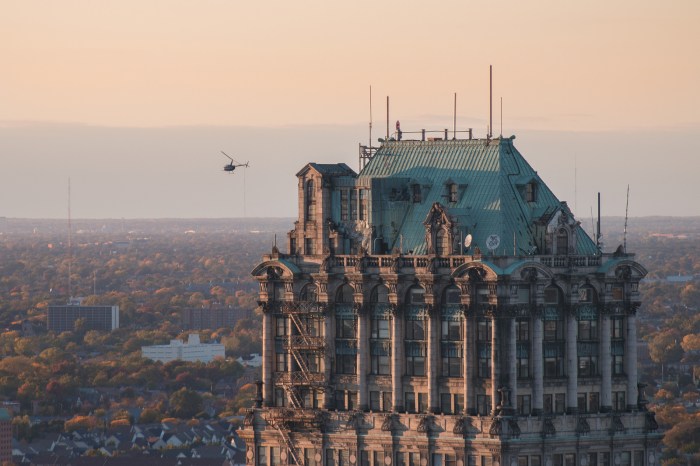
Fly By, photo by Tom Hughes
Historic Detroit is definitely one of the best websites if you want to dig deeper into the history of Michigan’s largest city. Dan Austin’s entry on the Book Tower & Book Building has current and historical photo galleries of both buildings, map and an extensive account about the history of the structure. It says in part:
She’s one of a kind. Some might even say beautiful in its ugliness.
No skyscraper in Detroit, let alone the Midwest, looks quite like the Book Tower on Washington Boulevard. It’s a rather awkward-looking building, whether you look at its unusual maze of an external fire escape or the intricate, over-the-top details on its crown that are tough to appreciate without a pair of binoculars. It’s an undeniably unique piece of the city’s skyline and a rare breed of classical Renaissance-style architecture and skyscraper. As an added bonus, joined at its hip is one of the city’s oldest surviving office buildings.
The 36-story Book Tower opened in 1926 on the southwest corner of Grand River Avenue and Washington, coincidentally, the original lot that the Books’ grandfather had bought on the boulevard. Its first tenant was Detroit Bond & Mortgage. At 475 feet tall, the Book Tower would lay claim to the title of tallest building in town. Though it would hold the honor only briefly: The 47-story Penobscot Building would overtake it two years later. Today, the Book Tower is good for only the seventh-tallest landmark in town.
…Intricately carved Corinthian columns, florets, scrolls and crests are all over the place. Horizontal bands of Italian Renaissance ornamentation break up the towering skyscraper with nude female figures gracing its midsection like a belt. Nearly from ground to the top of the 36th floor, the building is covered in detail. Ferry quotes Kamper as saying, with a trace of a Bavarian accent, “I like it varm.” “Varm” or not, Kamper’s strategy on the Book tower didn’t work. His decision has been ridiculed and criticized by critics almost from the onset for not realizing the limitations on designing a structure so tall. He didn’t take a fire evacuation route into consideration when designing it, necessitating the addition of the unusual fire escape all the way down the tower. Kamper had the building faced in a porous limestone that sucked up pollutants in the air, making it almost impossible to keep clean.
Read on for lots more and follow HistoricDetroit.org on Facebook – good stuff!
View Tom’s photo bigger, see more in his Detroit slideshow, and view and purchase work from his website.
More buildings & architecture on Michigan in Pictures.
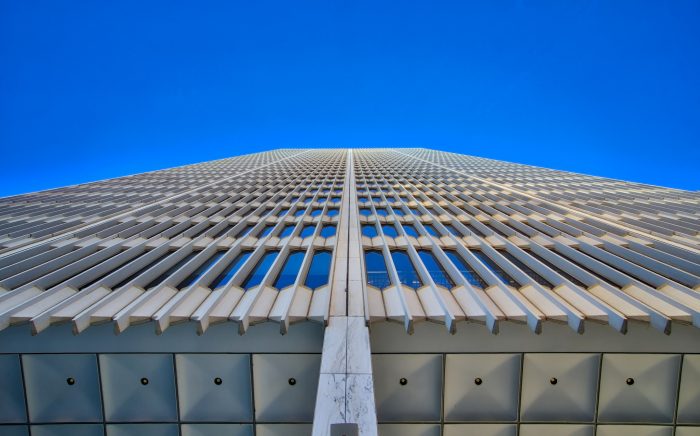
One Woodward, Detroit MI, photo by sbmeaper1
Denise McGeen’s article on One Woodward Avenue at HistoricDetroit.org says (in part):
At the heart of Detroit’s Civic Center, towering over Hart Plaza, Woodward Avenue and the Detroit River stands One Woodward, one of Detroit’s most celebrated mid-century modern structures.
The building was commissioned in 1958 by the Michigan Consolidated Gas Company Building. Detroit architect Minoru Yamasaki designed the skyscraper in association with the firm Smith, Hinchman & Grylls. The building would open in 1963 and marked a first for Yamasaki, who had never designed a skyscraper before. The building incorporates a pre-cast concrete exterior, narrow windows, Gothic arches, decorative tracery and sculptural gardens that later became the architect’s signature motifs. It has been called the fore-runner to Yamasaki’s renowned World Trade Center in New York.
…The tower’s all-welded, steel frame is clad with two-story, pre-cast concrete panels that hold 4,800 vertical hexagon-shaped floor-to-ceiling windows. The panels hang above the exterior terrace as if dripping from the building’s frame. Hexagonal grillwork wraps the building’s top two stories. The roofline features delicate crenellation — an architectural feature similar to a castle’s battlements.
Read on for much more including the challenges this project posed for Yamasaki as his first project.
View sbmeaper1’s photo big as a skyscraper and see more in their slideshow.
More architecture on Michigan in Pictures.
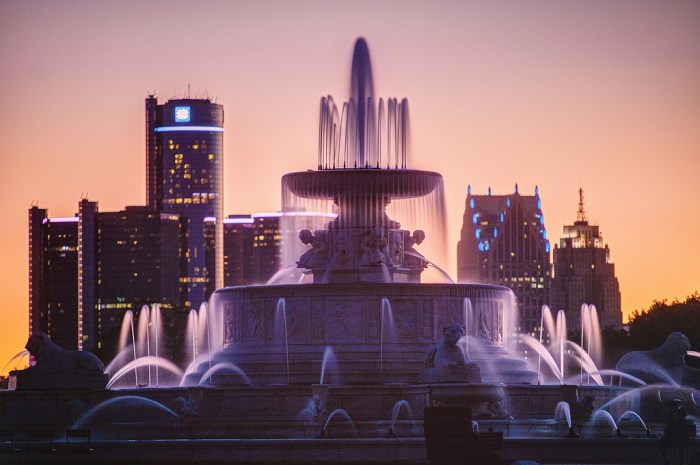
scott memorial fountain | belle isle | detroit, michigan, photo by s o u t h e n
View Ryan’s stunning shot of the Detroit Skyline from Belle Isle bigger on Facebook, see more in his Nights in Detroit slideshow, and if you’d like him to apply his mad photography skills for your wedding or engagement, head over to ryansouthen.com.
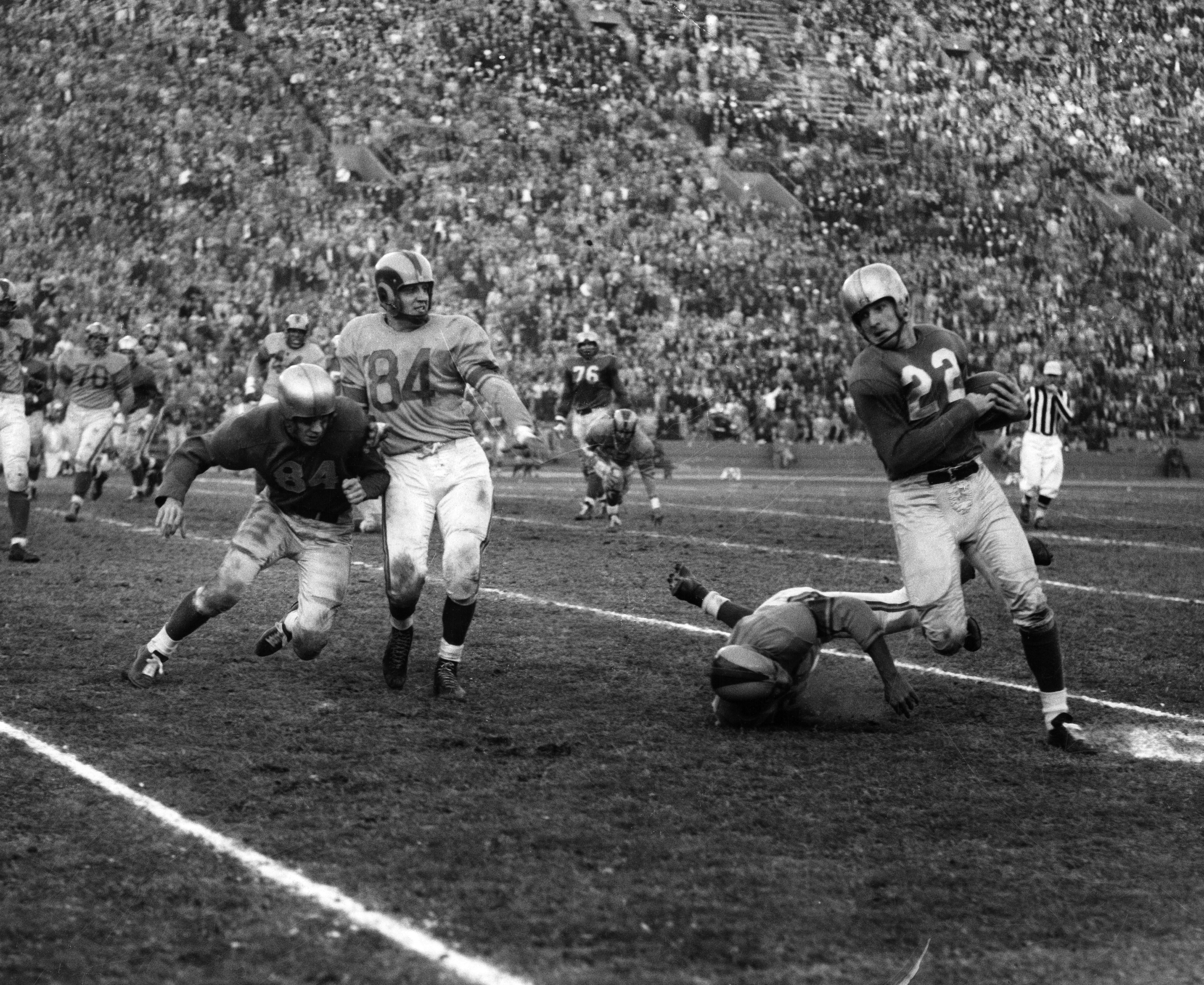
Well, football season is almost here and Detroit Lions’ fans are probably feeling optimistic, so it’s probably time to explain The Curse of Bobby Layne:
In 1958, after leading the Lions to 3 NFL Championships and providing Detroit nearly decade of Hall of Fame play, the Lions traded Bobby Layne. Bobby was injured during the last championship season and the Lions thought he was through and wanted to get what they could for him. According to Legend, as he was leaving for Pittsburgh Bobby said that Detroit “would not win for 50 years”. In the pages that follow we present evidence that supports and confirms the existence of this curse which has been plaguing this team for nearly half a century.
Read on for more. You can also watch an ESPN feature on the origin of the Curse of Bobby Layne and check out Bobby Layne in the Pro Football Hall of Fame.
View the photo background bigtacular.
More Detroit Lions on Michigan in Pictures.
This had a photo of mine that was apparently of another artist. He was kind of rude in the email so there will be no link. Your lesson for today is to be nice! ;)
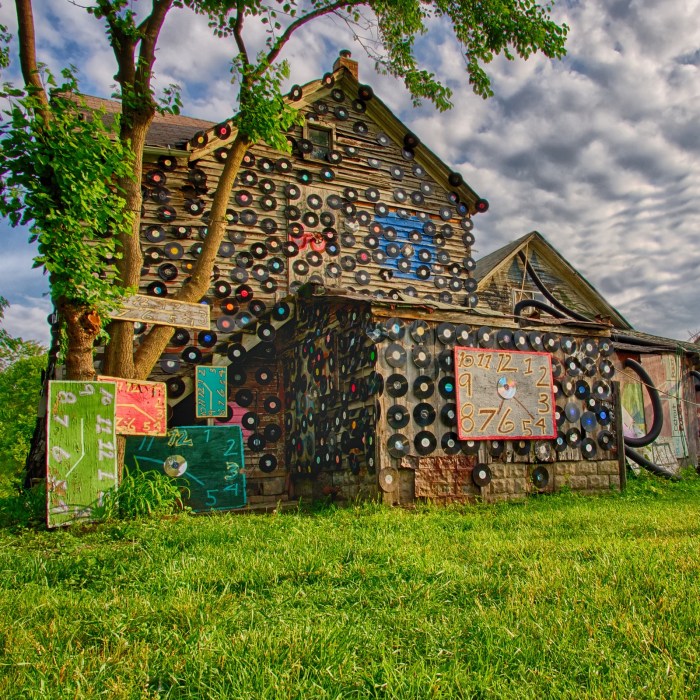
Heidelberg Project-Detroit, MI, photo by Mike Boening
“Here we are now 30 years later. Time to move on. Gotta go in a new direction. Got to do something I’ve not done before.”
~Tyree Guyton
The Freep reports that Tyree Guyton, artist and developer of The Heidelberg Project in Detroit, will be taking his project down, piece by piece as the organization works toward “Heidelberg 3.0”:
A confluence of factors have pushed Guyton to change course: an increasing awareness of his own mortality as he reached 60, the toll that the fires have taken on his psyche, the increasing number of project commissions that are pouring in from across the country and across the globe and the Sisyphean burden of keeping the Heidelberg Project going for literally half his life.
…By next summer, visitors to the two-block stretch of Heidelberg Street — where Guyton started his project in 1986 as a response to the rampant blight in the neighborhood of his youth — will notice familiar sights slowly disappearing. In two years, all of the magically transformed found objects that crowd the empty lots between houses are expected to be gone: broken dolls, shopping carts, TVs, shoes, telephones, a Noah’s ark of stuffed animals piled high as an elephant’s eye, the debris splashed with optimism and painted polka dots and dozens of Guyton’s paintings of clocks and primitive portraits.
Guyton’s plan to disassemble the Heidelberg Project marks a dramatic turning point in the history of a seminal public art adventure that for many has come to represent the soul of contemporary Detroit.
Read on for more including a brief video interview with Guyton and visit heidelberg.org for more information and photos from 3 decades of the Heidelberg Project.
View Mike’s photo background big, see more in his Heidelberg Project slideshow, and click for 300+ more photos of the Heidelberg Project in the Absolute Michigan pool on Flickr!
More Michigan art on Michigan in Pictures.
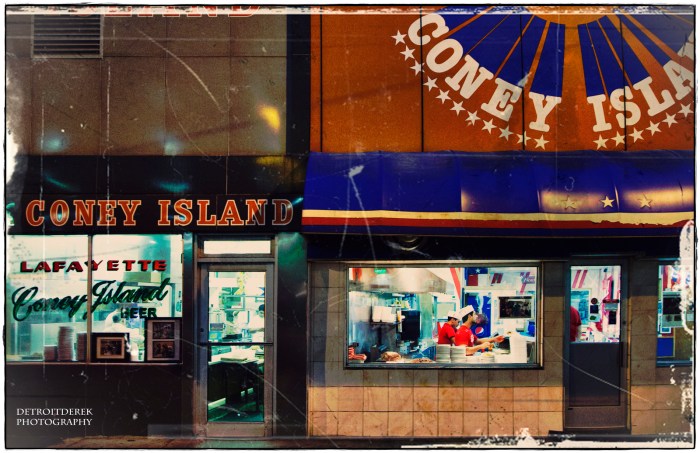
On Any Given Night, photo by Derek Farr
When mLive writer Emily Bingham realized that Michigan didn’t have an official state food, she set out to determine what their readers thought. The winner was the coney island hot dog which squeaked by my personal favorite, the pasty. Share what you think Michigan’s signature food is in the comments!
The Encyclopedia of Detroit entry for the Coney Dog says:
Many people think that the Coney dog, also called the Coney Island hot dog, got its start on Coney Island, NY where the hot dog was created. In actuality, this popular food got its start in Michigan, although the exact location is still disputed. Three locations in Michigan all claim to be the birthplace of Coney dogs: American Coney Island in Detroit, Lafayette Coney Island in Detroit and Todoroff’s Original Coney Island in Jackson.
In 1917, Gust Keros opened American Coney Island. A few years later Keros’s brother opened Lafayette Coney Island next door. Both of these Detroit Coney Islands are incredibly popular to this day, where there is an on-going argument over which establishment serves the best Coney dog. The dispute has been featured on several food television shows, including Food Wars and Man v. Food.
A Coney dog is a beef hotdog, topped with an all meat, beanless chili, diced white onions, and yellow mustard. A true Coney dog uses made-in-Michigan products.
Lots more about the coney dog on Absolute Michigan.
View Derek’s photo bigger where you can also read about the history of friendly competitors Lafayette Coney Island & American Coney Island. See more in his massive Signs & Billboards slideshow.
Michigan food on Michigan in Pictures!
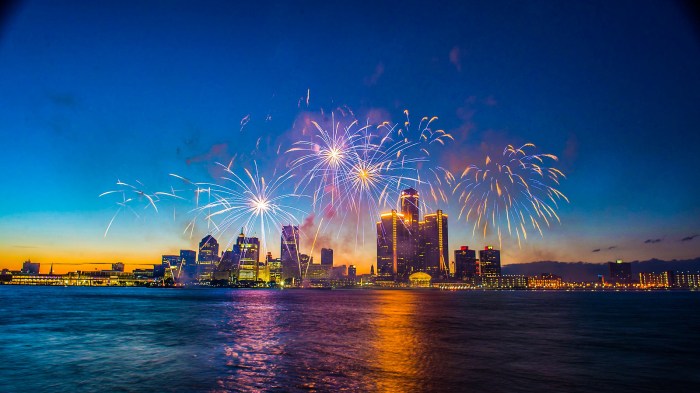
Untitled, photo by Micigama K
I hope you have a wonderful (and hopefully long) weekend that’s as free of care as you can make it.
If fireworks are your thing, here’s an awesome site by a real human listing Michigan fireworks displays. Also check out Michigan Fireworks Friday over on Absolute Michigan for an update on Michigan’s fireworks laws.
View the photo of the fireworks over Detroit bigger and see more in Micigama’s 2016-06-27-Detroit Fireworks slideshow.
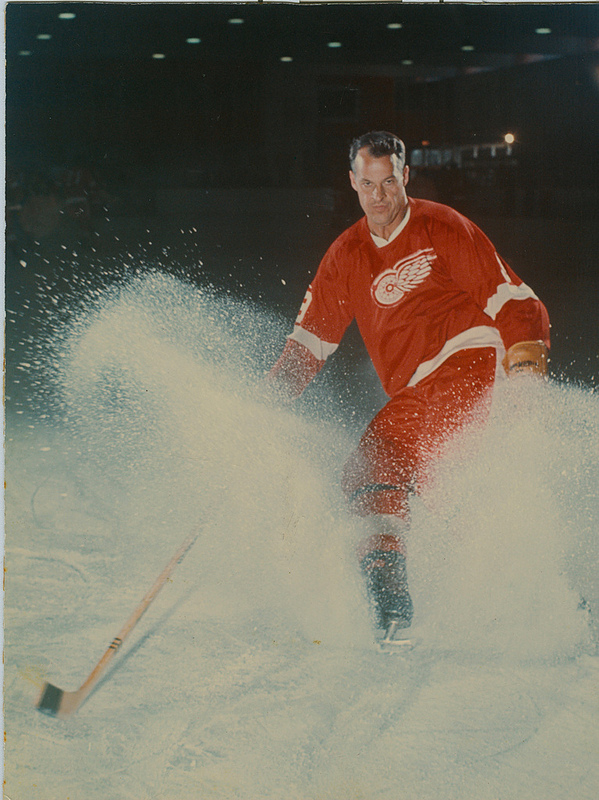
Gordie Howe 1960s, photo by Edward Noble (via Wayne T. ‘Tom’ Helfrich)
The Detroit Red Wings shared the sad news that hockey legend Gordie Howe passed away yesterday morning. The Hockey Hall of Fame has an excellent profile of Gordie Howe that reads (in part):
Gordie Howe is referred to as simply “Mr. Hockey”. World War II had just ended when he first entered the National Hockey League, and when he played his final NHL season 33 years later, Wayne Gretzky was playing his first. Over those five decades, Howe didn’t just survive, he was dominant – on the scoring lists, in battles in the corners, on game-winning goals and when the year-end awards were handed out. He was a big man, though by modern standards no behemoth, but what set him apart was his incredible strength.
Though other superstars could be deemed somewhat better scorers, tougher fighters or faster skaters, no player has approached Gordie Howe’s sustained level of excellence. Incredibly, Gordie finished in the top 5 in NHL scoring for 20 straight seasons. To endure and excel, Howe needed a unique set of qualities, both physical and mental, and the foundations for his astonishing career were laid in him from an early age.
Howe grew and matured quickly, and when he was 15 he made a bid to play with the New York Rangers, attending the team’s training camp in Winnipeg. He was homesick, however, and before the end of the camp he returned to Saskatchewan. He made a better impression with the Detroit Red Wings the next year, joining a group of Red Wing veterans and untried youngsters to work out in front of Detroit boss Jack Adams. The ambidextrous Howe drew Adams’ attention from the start with a sizzling rush down the left wing and a sharp shot. The next minute he escaped down the right wing, switched his stick to the other side and still with a forehand zipped another shot at the goal.
Howe made his professional debut when he was 18, taking up the right wing for Detroit at the beginning of the 1946-47 season. He was 6′ tall and just over 200 pounds, making him one of the heavier players in the league…
…Apart from his forbidding temperament, Howe’s athletic and savvy playing style also contributed to his longevity. He never wasted energy if he didn’t need to, especially after he cut down on the number of fights he’d take part in early in his career. He was economical with his movements, anticipating when and where the play would intersect with his effortless progress around the ice. He often played 45 minutes of a game when the average total was 25. Observers noticed that when his exhausted line returned to the bench, Howe was the first to recover and raise his head, ready for another shift.
In all, Howe was selected to 21 NHL All-Star squads, 12 times to the First Team. Six times he led the NHL in scoring to capture the Art Ross Trophy and six times he won the Hart as the league’s most valuable player. His Detroit teams won the Stanley Cup four times.
Howe had been in his prime during a defensive era, the 1940s and 1950s, when scoring was difficult and checking was tight. When he was 40, in 1967, the league expanded from six to 12 teams and the number of offensive opportunities grew with it. Howe played the 1968-69 season on a line with Alex Delvecchio and Frank Mahovlich, the mercurial but talented star who had moved to Detroit from Toronto. Mahovlich was big, fast and skilled and Delvecchio was a gifted playmaker. The three were dubbed “the Production Line 3” and Howe’s scoring returned to the levels of his youth and then beyond. He topped 100 points for the first time, scoring 44 goals and adding a career-high 59 assists.
Read on for much more and watch the Legends of Hockey profile of Gordie Howe below.
Wayne T. ‘Tom’ Helfrich shared this photo by longtime Michigan news photographer Ed Noble, then of the Pontiac Press and later of the Oakland Press. Tom writes that Ed had a photo shoot with Gordie and knew he was a big fan and brought him this print. View the photo bigger and see more great old shots in his Detroit Red Wings slideshow.
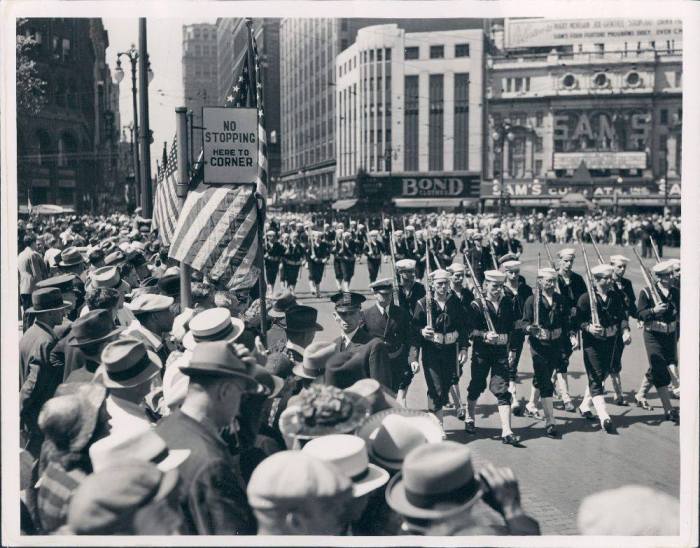
1939 Detroit Memorial Day Parade, photo by Buildings of Detroit
Buildings of Detroit shared this photo back in 2013 saying:
Tonight the Wayback Machine continues to show us views of Detroit’s Memorial Day Parade down Woodward, this time in 1939. Most of the structures remain as they were in the previous 1920 image (click to see it!). We can clearly see Kern’s and an expanded Hudson’s, as well as Eaton Tower, Bond Clothing, and the Majestic Building along with the Detroit Opera House, now transformed into Sam’s Cut Rate clothing store.
View the photo bigger and definitely follow Buildings of Detroit on Facebook for lots more about Detroit’s unique architectural heritage.
Lots more Detroit on Michigan in Pictures!
 Michigan in Pictures