Pope Frances Passes

Copper Top by Rudy Malmquist

Copper Top by Rudy Malmquist

I’d like to share my condolences to those mourning the passing of the Pope. The Associated Press shares that Pope Francis, the Catholic Church’s first Latin American pontiff, has died.

Jorge Mario Bergoglio was born Dec. 17, 1936, to Italian immigrants in Buenos Aires, Argentina, the eldest of five children. He was ordained a Jesuit priest in 1969 and led the religious order in Argentina during the country’s murderous dictatorship from 1976-83. He became archbishop of Buenos Aires in 1998 and elevated to cardinal in 2001 by St. John Paul II. He was elected the 266th pope on March 13, 2013, on the fifth ballot.

Francis’s first included:

  • The first pope from the Americas.
  • The first from the Jesuit order to be elected pope.
  • The first to take the name of Francis, after St. Francis of Assisi.
  • The first to visit Iraq, meeting its top Shiite Muslim cleric in 2021.

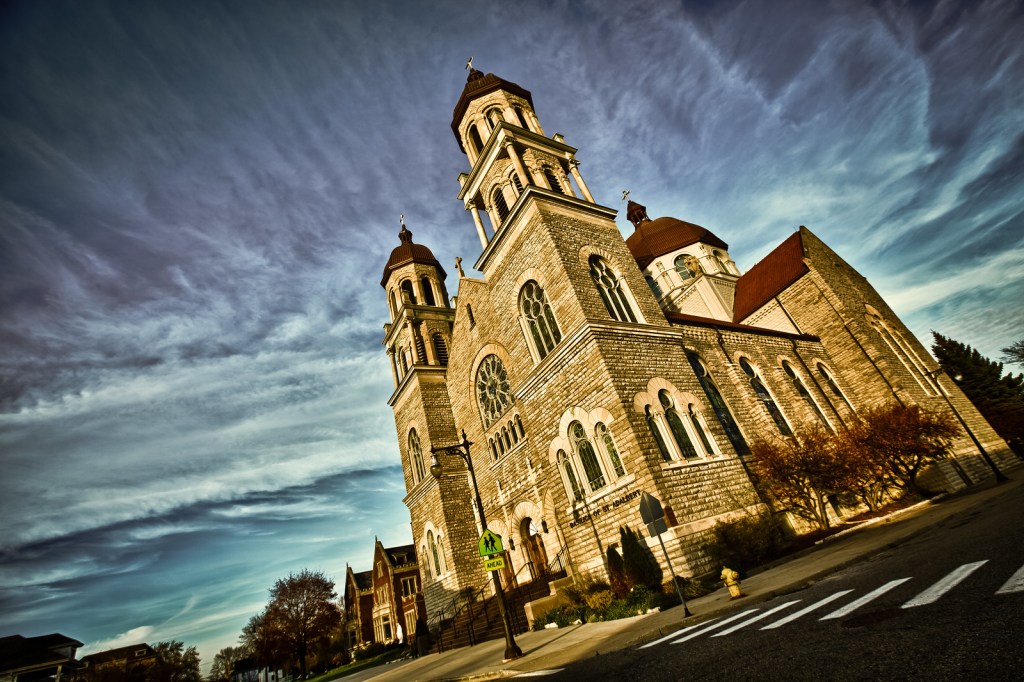
Rudy took this photo of the Basilica of St Adalbert in Grand Rapids back in 2010. Head over to Flickr to see his latest.

Support Michigan in Pictures with Patreon

Remembering the Edmund Fitzgerald

“Does anyone know where the love of God goes when the waves turn the minutes to hours?”

It’s November 10th again, which means that for the 48th year straight year I have Gordon Lightfoot’s legendary ballad to the Witch of November on repeat. My absolute favorite version of the song (as many of you know probably all too wdell) is this version that Joseph Fulton created way back in 2009. Given YouTube’s ruthlessness on music copyright, I have to assume that Lightfoot blessed this because from the moment Harry Reasoner begins speaking, who wouldn’t?

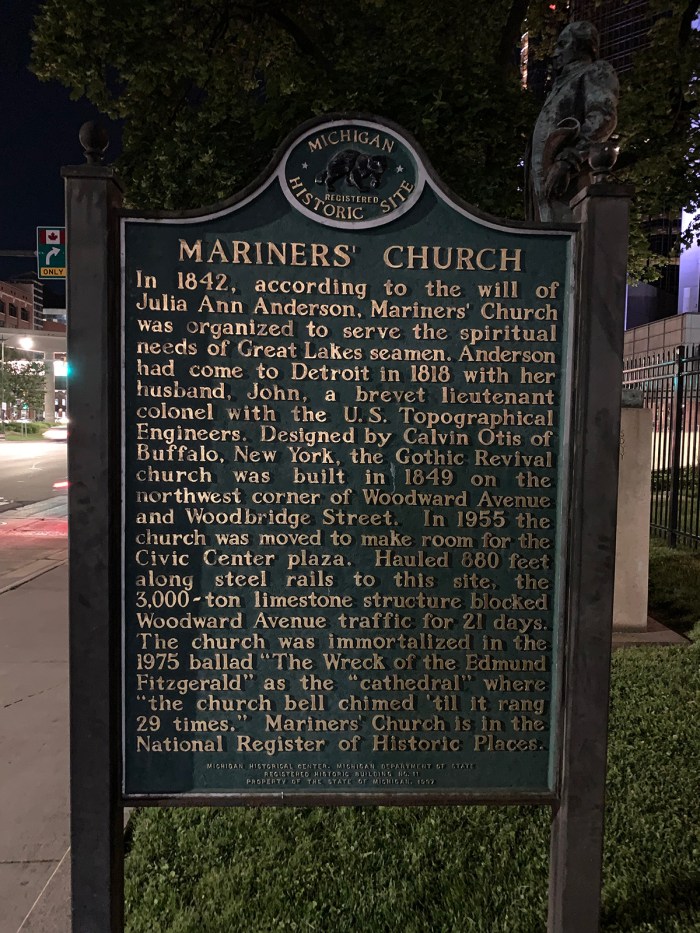
You can join the 49th annual Great Lakes Memorial Service, a remembrance of the crew of the Edmund Fitzgerald in person at Mariners’ Church in downtown Detroit or on their YouTube livestream at 11am today. On November 11, 1975 they rang their church bell 29 times in honor of all the sailors that lost their lives due to the wreck of the S.S. Edmund FItzgerald. They do it every year, and the beloved service also commemorates all sailors who have lost their lives on the Great Lakes.

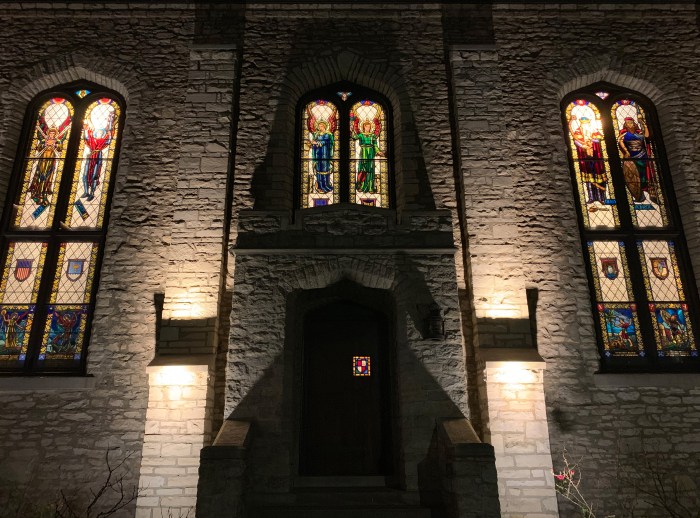
Here are a couple of photos I took recently of the beautiful stained glass and the historical marker at Mariners’ Church which is between Hart Plaza and the Renaissance Center on the riverfront in downtown Detroit. Lots more about the Edmund Fitzgerald on Michigan in Pictures!

Stained Glass Windows at Mariners Church in Detroit
Mariners Church Detroit Historical Marker
Support Michigan in Pictures with Patreon

The Petoskey Underwater Crucifix

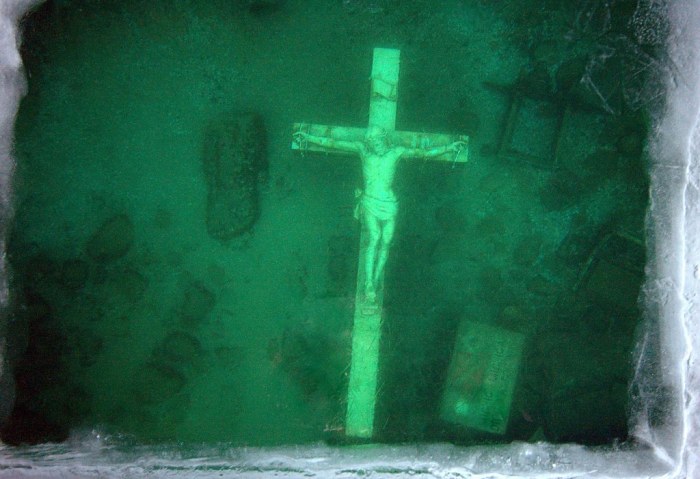
Petoskey Crucifix by Martin McReynolds

Petoskey Crucifix by Martin McReynolds

The Petoskey Visitors’ Bureau shares the story of the Petoskey Underwater Crucifix:

About 800 feet offshore and under 21 feet of water lies an Italian white marble crucifix, the only known freshwater-underwater crucifix. It came to Petoskey in 1962 in a round-about way, and has become a draw for divers and visitors alike ever since. You will not find a shrine like this anywhere else in the U.S.

The 11-foot tall crucifix, with a 5-foot 5-inch figure of Jesus Christ, was placed in the Bay, near the Petoskey breakwall at Bayfront Park, by the Wyandotte-based Superior Marine Divers Club in 1962. Its original intent was to honor Charles Raymond, a Southgate diver who drowned in Torch Lake. Later, the club expanded the focus of the monument to memorialize all those who have perished at sea.

Its origins date back to the late 1950s, when a grieving mother and father from Rapson in Michigan’s Thumb area had it crafted in memory of their son, Gerald Schipinski. Gerald was 15-years-old in 1956 when he was accidentally killed by a shotgun on the family farm.

After being crafted in Italy, the cross was broken during shipping to the Rapson Catholic church; the family rejected the damaged crucifix and it was sold in an insurance sale to the Wyandotte dive club. The crucifix made its way to Little Traverse Bay and was first placed by the U.S. Icebreaker Sundew 1,200 feet off the Petoskey breakwall on Aug. 12, 1962.

…in the early 1980s Dennis Jessick was president of the Little Traverse Bay Dive Club, and he proposed a winter viewing of the crucifix. The first was held in 1986, affording the community the chance to view the statue through a hole made in the ice. Lights are placed under water to help with viewing. The viewing of the crucifix,” as the locals call it, has continued.

The viewing of the Crucifix is always free and takes place if the ice is thick enough and other weather related conditions are right, usually in the end of February or early March. (NO VIEWING IN 2022) A tent is set up at the viewing area – which is a sure sign to the public that the viewing is taking place. It is also publicized in local media and on local Chamber of Commerce and Visitors’ Bureau web sites.

More at the Petoskey Visitors Bureau & for sure check out this article on the crucifix from Northern Michigan Mish-Mash for a ton more info & some photos. Not gonna lie – I was really hoping to see this in person this year, but unfortunately there won’t be a public viewing in 2022 as there usually is. 

Martin took this photo back in 2009. Head over to his Well Liked gallery on Flickr for lots more great shots from Petoskey & elsewhere.

Support Michigan in Pictures with Patreon

The Swamp Angel of Leo Creek

Swamp Angel by Mark Smith

Swamp Angel by Mark Smith

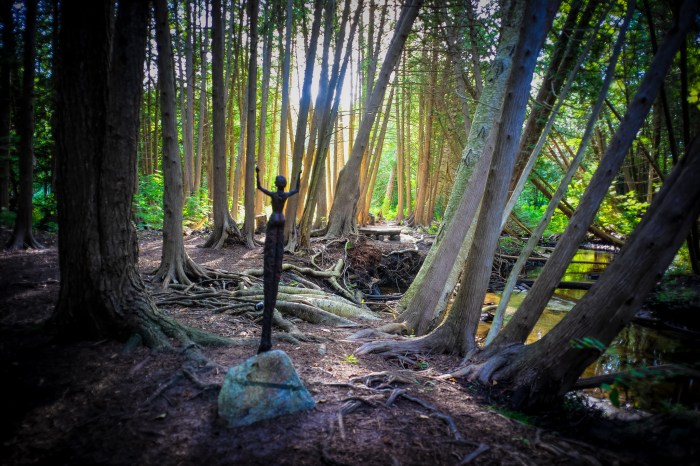
Mark writes that the nave, altar and the stained glass windows are all in alignment in his photo from the Leo Creek Preserve, a pretty cool outdoor learning laboratory & permaculture garden in Suttons Bay. The mission of Leo Creek Preserve is:

…to use its unique creek, forest, and agricultural spaces to provide, for all people, an outdoor learning laboratory to investigate water and woodland ecology, intensive soil regenerating practices, and to bring art into the garden gathering spaces. We value strengthening our connection to the natural world and bringing people together to work towards a beautiful, healthy, productive and regenerating environment, and sharing its abundance.

Pretty cool! Follow Mark at downstreamer on Flickr for more great photos!

Support Michigan in Pictures with Patreon

Temple Beth El by architect Minoru Yamasaki

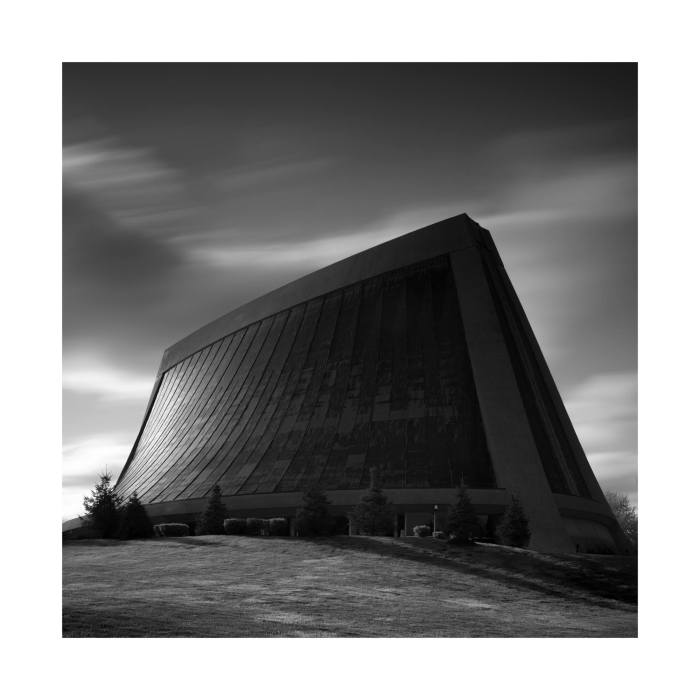
Temple Beth El, Study #01, photo by Brian Day

Temple Beth El was established in 1850 as the first Jewish congregation in the state of Michigan. Their history page notes that there were just 60 Jews out of a population of 21,000 at that time.

The Michigan Notable Book Michigan Modern’s page on Temple Beth El says in part:

Temple Beth El is located in Bloomfield Township, Michigan, on a low rise adjacent to Telegraph Road, a wide and heavily traveled thoroughfare. Mature spruce and pine trees are present around the base of the structure to shield the worshippers from outside distractions. The unmistakable design of the sanctuary incorporates a tent-like form to recall the “Tent of Meeting” referenced in the Bible and the earliest places of worship used by the Jewish people. The cast-in-place concrete structure consists of two pairs of closely placed sloped columns, or tent poles, supporting curved ridge beams at the top of the structure and tied together by elliptical ring beams at the structure’s base. Below the ring beam is a transparent curtain wall of clear glazing that gives the illusion, from the exterior and interior that the tent-form roof is hovering above the open sanctuary space. Between the ridge beams is a transparent skylight that provides natural light into the sanctuary and further emphasizes the “lightness” of the structure. Catenary steel cables suspended between the ridge and ring beams support the gentle curve of the lead-coated copper roof which soars some seventy feet above grade.

The administrative offices, social halls and religious school are located in a one-story wing that extends north from the main entrance to the sanctuary on the building’s west elevation. The Temple Beth El comprises approximately 112,500 square feet, and can accommodate up to eighteen hundred worshippers.

Read on for more!

View the photo bigger on Facebook where there are other photos in his Metro Detroit Modern Architecture Study and see more of Brian’s photography at brianday.org.

Heavenly curtain at the Phoenix Church

A special Sunday “I changed the cover of the Michigan in Pictures Facebook” edition of Michigan in Pictures.

God is Light

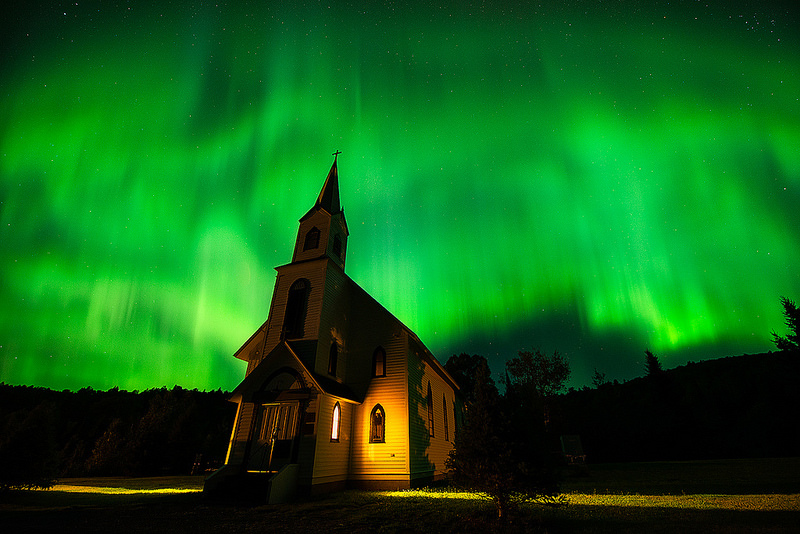
God is light, photo by Jiqing Fan

The Keweenaw County Historical Society page about their Phoenix Church in Houghton explains:

St. Mary’s Church was built in 1858 to serve the Catholic residents in the nearby mining community of Cliff, scene of the area’s first major copper discovery in 1844. Services continued until 1899 when the church was dismantled and reassembled in Phoenix, where it was renamed The Church of the Assumption. Masses were held until 1957, when the last service marked a century of providing spiritual guidance to mining families and their descendants.

In 1985 the Keweenaw County Historical Society took over the property and began extensive repair and restoration work. The church now appears much as it did when folks from another century knelt in prayer, a fitting memorial to one chapter of Keweenaw’s proud heritage. Although now deconsecrated, the church is still used for weddings and memorial services.

More on Pheonix Church from the Keweenaw County Historical Society.

View his photo bigger on Flickr and see more in his Houghton & UP Mich slideshow.

More northern lights and more churches on Michigan in Pictures.

Church of the Hunter’s Moon

Church of the Hunter's Moon

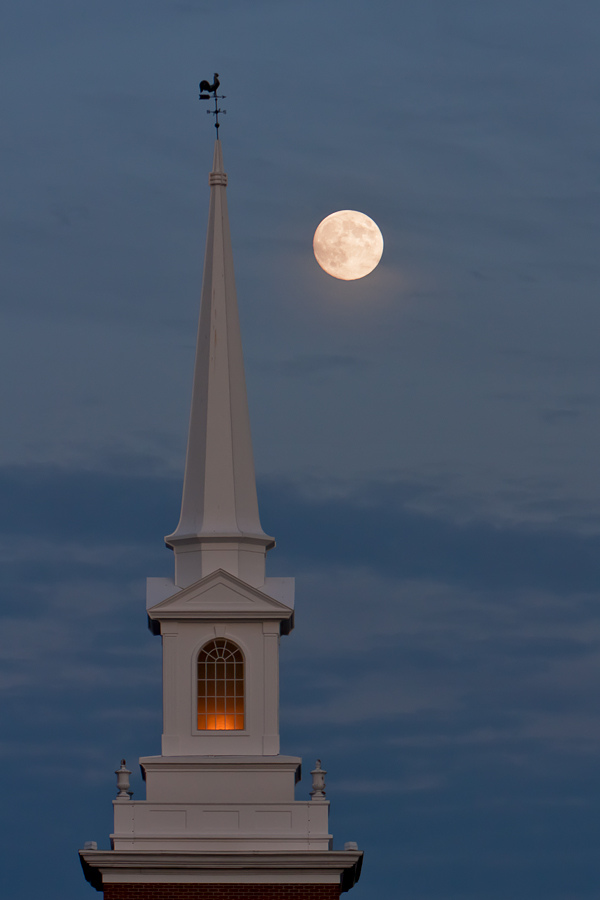
Church of the Hunter’s Moon, photo by Kevin’s Stuff

Deborah Byrd is the founder of one of my favorite sites , EarthSky. Her article Everything you need to know: Hunter’s Moon 2013 explains:

If you’re in the Northern Hemisphere, look for the moon to be bright and full-looking for several nights around October 18, 19 and 20. Around all of these nights, you’ll see a bright round moon in your sky, rising around the time of sunset, highest in the middle of the night. This procession of moonlit nights is what characterizes a Hunter’s Moon.

…the full moon after the Harvest Moon, which is the full moon nearest the autumnal equinox. In the Northern Hemisphere, the Harvest Moon sometimes falls in September and sometimes falls in October. So the Hunter’s Moon sometimes falls in October and sometimes in November.

But the Hunter’s Moon is also more than just a name. Nature is particularly cooperative around the time of the autumn equinox to make the full moonrises unique around this time. Here’s what happens. On average, the moon rises about 50 minutes later each day. But when a full moon happens close to the autumnal equinox – either a Harvest or a Hunter’s Moon – the moon (at mid-temperate latitudes) rises only about 30 to 35 minutes later daily for several days before and after the full moon.

Why? The reason is that the ecliptic – or the moon’s orbital path – makes a narrow angle with the evening horizon around the time of the autumn equinox. The narrow angle of the ecliptic results in a shorter-than-usual rising time between successive moonrises around the full Hunter’s Moon. These early evening moonrises are what make every Hunter’s Moon special. Every full moon rises around sunset. After the full Hunter’s Moon, you’ll see the moon ascending in the east relatively soon after sunset for a few days in a row at northerly latitudes.

Read on for more and definitely subscribe to their email!

Kevin is our go-to guy for all things astronomical. Check his photo out bigger and see more in his The Moon slideshow.

Lots more moon fun on Michigan in Pictures!

Bishop Baraga, the Snowshoe Priest

Bishop Baraga Shrine, L'Anse

Bishop Baraga Shrine, L’Anse, photo by RPM-Photo

Bishop Frederic Baraga passed away 145 years ago on January 18, 1868. He was born on June 29, 1797* in the castle of Mala vas in the Northwestern part of Slovenia, and for over half of the 71 years of his life Baraga covered a vast territory of over 80,000 square miles in Michigan, Wisconsin, Minnesota and Canada. The history page at the campaign for sainthood of Bishop Baraga explains that:

Father Baraga arrived in the New World on December 31, 1830. For the next 37 years he travelled the length and breath of the Great Lakes area to minister to the Ottawa and Chippewa Indians. His first mission (Arbre Croche, 1833-1835) was established along the shore of Lake Michigan at present day Harbor Springs to Cross Village. Fr. Baraga labored two years at Grand River (1833-1835) presently known as Grand Rapids, before moving his mission to LaPointe (1835-1843) and L’ Anse (1843-1853) on Lake Superior. During the summer months, Father Baraga traveled on foot and by canoe. During the winter months, he traveled on snowshoes thus giving him the titles of “Apostle of the Lakelands” and “Snowshoe Priest.” He wrote long and frequent accounts of his missionary activities including a three-volume diary. He also wrote seven Slovenian prayerbooks and authored 20 Native American books which inlcudes his monumental Grammar and Dictionary of the Chippewa Language , still in use today. He was the first bishop to write a pastoral letter in both the English and Chippewa languages.

From 1840 to his death, he ministered to the immigrants who came to the Upper Peninsula of Michigan to work in the iron and copper mines of the region. About the same time, he began the practice of rising at 3 a.m. in the summer and 4 a.m. in the winter to spend three hours in prayer, which he continued until the end of his life. His responsibilities grew even greater when he was named bishop of the newly created Vicariate of the Upper Michigan. He was consecrated bishop in Cincinnati on November 1, 1853. The lack of priests and money weighed heavily on his heart. Due to his hard work and dedication, Bishop Baraga was able to report to the Holy See a year before his death that his diocese rested on a firm foundation, with enough priests and churches for the fast-growing area. Sault Ste. Marie was his See City until 1866, at which time he moved to Marquette-a more centrally located and accessible city by both ship and train. In the Fall of 1866 while attending the Council of Baltimore, Bishop Baraga suffered a severe stroke. Afraid that his fellow bishops would not allow his return to the severe climate and remote regions of Lake Superior, he begged the priest who accompanied him (Rev. Honoratus Bourion) to take him back to Marquette. Understanding his bishop wanted to die among his flock, Rev. Bourion practically carried Baraga to the train for the long trip back to Marquette.

There’s a lot more about Baraga there including an excellent tour of Baraga’s life in the Upper Peninsula that I imagine would make a great vacation.

You can have a look at Bishop Baraga right here and read more in the entry for the Venerable Frederic Irenaeus Baraga in Wikipedia where I found the link for an online version of Father Baraga’s 1853 Ojibwe Dictionary. Here’s the direct link to the dictionary. You can read more about the Baraga shrine at Roadside America.

View RPM’s photo on black and see more in his Mich-ellaneous slideshow.

*Coincidentally enough, that’s my birthday too!

November 28th: Full Beaver Moon in 2012 and sungrazing Comet ISON in 2013!

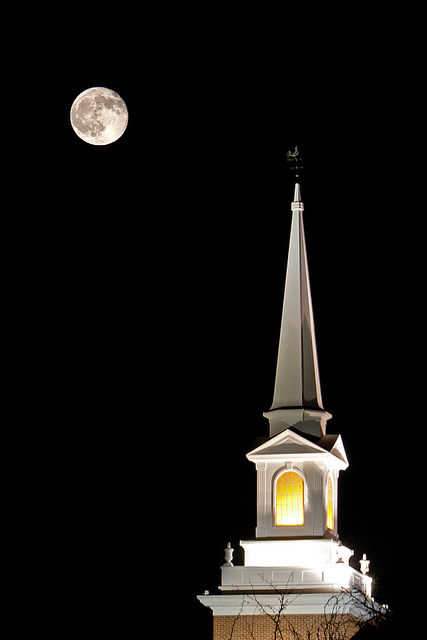
I can see a Church by Moonlight

I can see a Church by Moonlight, photo by Kevin’s Stuff

November’s moon will be full tonight, November 28th. Known as the Beaver Moon or the Frosty Moon in colonial times, November’s full moon was named the White Moon by Chinese, Dark Moon by the Celts, Snow Moon in Medieval England and the Moon When Horns Are Broken Off by the Sioux.

You’ll want to circle November 28th on your calendar because on November 28, 2013, Comet ISON will have a close encounter with the Sun and potentially be one of the biggest acts to hit the celestial stage in quite a while. The comet is what is known as a sungrazing comet, one that passes extremely close to the surface of the sun. Many sungrazers are incinerated by the passage, but those that don’t can put on a great show. SPACE.com says that although there’s no guarantee, Comet ISON could produce an incredible display:

The most exciting aspect of this new comet concerns its preliminary orbit, which bears a striking resemblance to that of the “Great Comet of 1680.” That comet put on a dazzling show; it was glimpsed in daylight and later, as it moved away from the sun, it threw off a brilliantly long tail that stretched up from the western twilight sky after sunset like a narrow searchlight beam for some 70 degrees of arc. (A person’s clenched fist, held at arm’s length, covers roughly 10 degrees of sky.)

The fact that the orbits are so similar seems to suggest Comet ISON and the Great Comet of 1680 could related or perhaps even the same object.

Comet ISON will be barely visible to the unaided eye when it is in the predawn night sky, positioned against the stars of Leo in October 2013.

On Oct. 16 it will be passing very near both Mars and the bright star Regulus — both can be used as benchmarks to sighting the comet. In November, it could be as bright as third-magnitude when it passes very close to the bright first-magnitude star Spica in Virgo.

The few days surrounding the comet’s closest approach to the sun on Nov. 28, 2013, are likely to be most interesting. It will whirl rapidly around the sun in a hairpin-like curve and perhaps becomes a dazzlingly bright (negative-magnitude) object.

The comet will then whirl north after perihelion and become visible during December both in the evening sky after sunset and in the morning sky before sunrise. Just how bright it will be and how long the tail may get during this time frame is anybody’s guess, but there is hope that it could evolve into a memorable celestial showpiece.

You don’t have to wait until November as comet C/2011 L4 is due to make a close approach to the sun in March of 2013!

See Kevin’s photo on black and see more in his great Astronomy in 2011 slideshow.

More of Michigan’s moon on Michigan in Pictures!

Greensky Hill … and Greensky Bluegrass

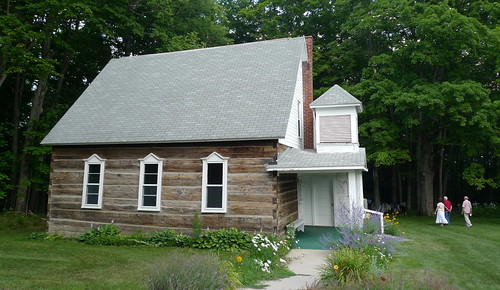
Greensky Hill Indian Mission Church

Greensky Hill Indian Mission Church, photo by jhhymas

Today’s post is in the “Stories I Found When Exploring Other Stories” category. Over on Absolute Michigan today we’re giving away two pairs of tickets to the October Festival at the Commons this Friday night in Traverse City. Greensky Bluegrass is a great band that tours nationally but hails from Michigan, and if you’re interested in seeing them and enjoying this festival in my backyard, click here to check it out & enter to win.

The Michigan Historical Marker text for Greensky Hill Mission via michmarkers.com reads:

Here in the 1840’s the Chippewa Indian missionary, Peter Greensky, established a Protestant mission in an area where legend says Indian chiefs once held their councils. New trees have been planted in an arrangement similar to that of the trees that made up the original council circle. Mission services first were held in a rude building of boughs and bark. In the 1850’s the Indians built the present church. It is a fine example of the old log style construction with hand-hewn timbers and notched corners. Windows, doors, and much of the lumber were brought by canoe from Traverse City to Pine Lake (now Lake Charlevoix) and then carried two miles to this site. Methodist services for the Indian congregation have been held here regularly to the present.

The Greensky Hill Indian Mission United Methodist Church adds that Peter Greensky started his preaching in the Leelanau area in the 1830s, serving as a guide and interpreter for his missionary Peter Doherty before acquiring a following of his own as a strong preacher with great influence among his people. His congregation traveled with him to the Charlevoix area. In 1860 he was put in charge of the all-Indian Pine River Mission, now known as Greensky Hill where he served there until his death in 1866.

June adds that her son-in-law’s mother was Ovenia Greensky Shomin, a direct descendant of the founder of this church. Check this out background big and see lots more photos of the mission and grounds (including details of the logs) in her Greensky Hill slideshow.

More Michigan churches on Michigan in Pictures.