Newaygo Mill … and Newaygo County

Newaygo Mill

Newaygo Mill, photo by evanfarinosi.

Evan started the Newaygo County group on Flickr and he’d love it if you’d share your photos on the area there.

The City of Newaygo’s history page says:

The City of Newaygo is the oldest community in Newaygo County. The Penoyer and Brooks families were among the first settlers to Newaygo. They founded Newaygo’s first saw mill known as the “Big Red Mill” … The proximity of the Muskegon River was the driving force of Newaygo’s early economy, with mills, lumbering, and recreation developing near by.

I also found a cool gallery of historical photos of logging in Newaygo County in the Newaygo County Historical Archives.

Since I don’t know when we’ll pass this way again, I should say that Wikipedia’s entry on Newaygo says that the population was 1,670 at the 2000 census. I also added Newaygo, MI to the Absolute Michigan map of Michigan.

Where the Buffalo Roam

Where the Buffalo Roam

Where the Buffalo Roam, photo by DaddyNewt.

DaddyNewt says that this buffalo roams at the Detroit Zoo

When I saw it, I asked him if it had been extensively photoshopped. He replied:

I don’t have photoshop but I did manipulate it digitally, then I printed it on regular copy paper. Then I stained it , spattered it, crumpled it, broiled it, smeared it with dirt, ironed it and then scanned it back in and manipulated it some more. Sometimes I get kind of obsessed.

He’s uploaded it huge size and yes, it makes a ridiculously cool computer background!

The Copper Miner’s Strike of 1913 and the tragedy at Calumet’s Italian Hall

Copper Miners outside Dunn's Bar

dunns 6th calumet, photo by Ztef

I usually try to make Michigan in Pictures a happy place to be because there’s enough unhappy things out there. Every so often, however, I think there are stories that warrant a look and rememberance if only to say: “Let’s make darn sure this never, ever happens again.”

Ztef captioned the above photo rather sparsely with Copper miners strike outside of Dunn’s bar on 6th Street in Calumet, Michigan – 1913, but he has provided a link to Calumet: The Copper Miner Strike of 1913. This page offers a very detailed and readable account (complete with some great old photos) of the labor troubles in Keweenaw during the early part of 20th Century from the perspective of the Zawada family, Poles who worked in the copper mines for the mining giant Calumet & Hecla. Of this photo it says:

Strikers outside of Dunn’s Bar, a favourite among miners. Just next door to Dunn’s was the No. 203 local WFM office (Western Federation of Miners). The sign on the left reads: “Something just as good Miners ask for bread, Jim [MacNaughton, C&H General Manager] offers lead”. The sign in the middle reads: “One man machine Our Agitator”. The sign on the right reads: “We demand higher wages and better working conditions”. The men in front are holding copies of the Miner’s Bulletin, but the headlines are not clear.

As you can read at the link above, the strike was characterized by escalating violence, calling in of the National Guard and even murder. The chaos culminated with what has been called a Disaster, Tragedy and even Massacre at Calumet’s Italian Hall. Copper Country Reflections’ Italian Hall Tragedy page at Pasty.com explains:

By the end of December, the miner’s strike had been waged for 5 long months, with no end in sight. The mining companies and their supporters were holding firm in their resistance to the WFM, while the union was still somewhat solid in its position.

To temporarily set aside their cares, a group of union members planned a Christmas eve celebration for their children at the Italian Hall on Seventh Street in Calumet. I can only assume that the activities that evening must have been the most fun these children had since the start of the strike. Unfortunately, the excitement turned to tragedy as someone, his identity never learned, cried FIRE. As the children and adults panicked, many worked their way towards the stairwell. The first unlucky souls quickly realized the doors at the bottom would not open. Were they locked? Was somebody holding them closed?

It is hard to comprehend, but 73 men, women and children died in that staircase. Some were crushed, others died from suffocation. Can you imagine the shock of the rescuers when they finally pried open the doors? As they pulled bodies up and out of the staircase?

The page above also includes photos that are definitely not for the faint of heart. If you’d like to explore further, there’s more information and photos at the Italian Hall 1913 Massacre site and you can see a photo of the Michigan historical marker & memorial at the site of Italian Hall in Calumet.

One thing you definitely should do is watch the moving accounts of survivors of the tragedy at the December 2007 update from the 1913 Massacre Film Project. The movie project has been going for several years and it looks like it will be very good.

The Absolute Michigan map of Michigan has the location of Italian Hall in Calumet.

Sunlit Pine

Sunlit Pine

Sunlit Pine, photo by MSU Ben.

Ben says that this is one of the first shots he took with his Ansco folding 6×6 camera. It’s one of the photos in his Best Shots set. He’s in the Michigan State Photo Club and yes, they have a Flickr group.

Mark O’Brien has a nice ansco camera page and you can see a bunch of photos of Afga/Ansco cameras from the Camera Museum (Camera Museum main page).

Foggy river

Foggy river

Foggy river, photo by kthschsslr.

kthschisser writes that he took this photo of a heron on the Flint River near Flushing while rushing to the airport.

Always good to have eyes open and camera handy…

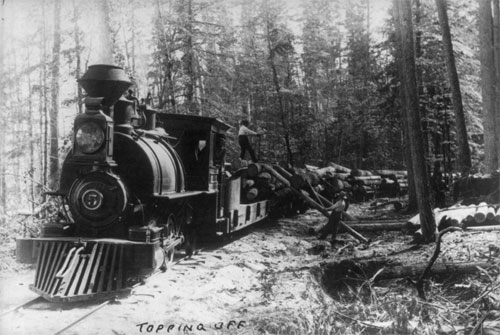
Topping off engine number 5

Topping Off the logging train

Topping Off, photo by William Morrell Harmer

The photo shows some lumbermen loading the last few logs onto a logging train near Cadillac, Michigan somewhere around 1892. While looking around for something about Cadillac and logging, and on the City of Cadillac’s history page, I learned:

The Shay Locomotive was invented in Cadillac by Ephriam Shay in 1878. The Shay Locomotive was one of the first to have the ability to haul logs on uneven terrain, sharp curves, and up steep hills. Shay Locomotives were used throughout the United States between 1880 and 1945.

That sounded promising, so I went over to ShayLocomotives.com and found in their many pictures a photo of one of the surviving Shays – engine no. 5 in Cass, WV (official site. Take a look at that and tell me if you think they’re the same train. Probably not, but still, I’m thinking this one is a Shay.

Wikipedia’s Shay Locomotive entry says that Shays were built by the Lima Locomotive Works of Lima, Ohio. However six Shay Patent locomotives, known as Henderson style Shays, were built by the Michigan Iron Works in Cadillac.

Opening Day

8 Point White Tail Buck by trekguy

8 Point White Tail Buck, photo by trekguy

November 15 is opening day of deer season in Michigan – follow that link over lots more from Absolute Michigan.

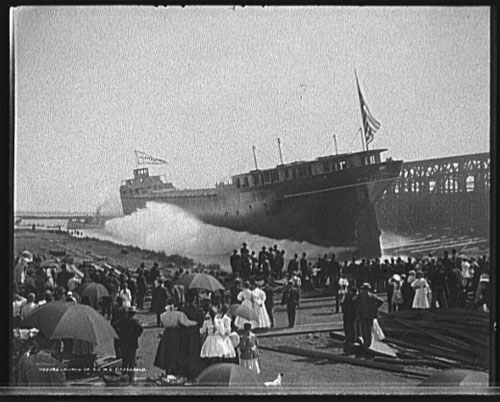
Wyandotte shipbuilding, the Fitzgerald brothers and the launch of the Little Fitz

Launch of the W.E. Fitzgerald at Wyandotte

Launch of the S.S. W.E. Fitzgerald at Wyandotte, Detroit Publishing Co.

I have no idea how I ended up at this photo (and why I suddenly feel like Paul Harvey), but here’s what I’ve learned through Boatnerd.com and a forum with a brief article from Boatnerd by Dick Wiklund about the “Little Fitz.”

William and Julia Fitzgerald of Marine City, Michigan sired six sons. The sons were fascinated by the wooden sailing ships and early steamboats on the St. Clair River, and all six became captains of Great Lakes ships. The youngest of these was John Fitzgerald, who started a shipyard in Milwaukee. His son, William E. Fitzgerald, took over the business in the 1890s but died just a few years later. William’s close friend, Captain Dennis Sullivan, built and christened the W.E. Fitzgerald in Wyandotte in his honor in 1906.

The Wyandotte Historical Museum’s history page says that Wyandotte’s shipbuilding industry was started by Eber B. Ward:

Wyandotte produced over 200 ships, varying from small tugs to large steamers and passenger ferries. Under the name of the American Shipbuilding Company the Wyandotte yards flourished. Hulls were constructed in Wyandotte and were taken up the Detroit River to Detroit, Michigan were they were outfitted. Smaller companies such as the E.H.Doyle Hoop & Stave Works(1889)who provided the city’s first electric power, the Regeant Stove Company, the McCord Corp. and the Beals & Selkirk Trunk Company soon made Wyandotte a famous industrial town.

In 1953, the WE Fitzgerald became known as the Little Fitz when the massive freighter named after William’s son was launched. His name, of course, was Edmund Fitzgerald.

The Library of Congress index of Wyandotte photos is heavy ships & shipyards (you may need to go to this page and search for “Wyandotte”). If you’re in the mood for a ton of Great Lakes freighter information (and a little music and “Laker” cooking), head over to Absolute Michigan’s word of the week: Freighter.

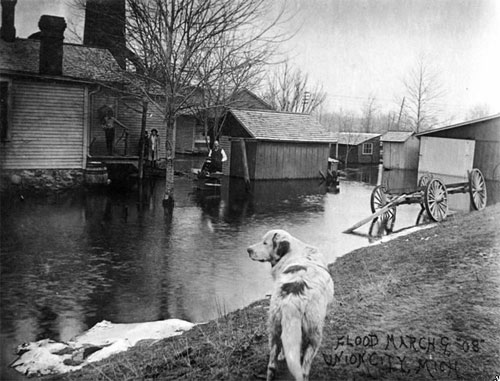
Union City history and the Flood of 1908

Union City Flood, 1908

Union City 1908 Flood, photo from UC1960

This photo is one of hundreds of historical postcards from Union City, Michigan posted to a site called Footnote to which I was recently referred. The site has an interesting interface and is one of a growing number of sites that try to leverage the power of social networks (and of course clicky-draggy stuff) to provide a richer experience. In Footnote’s case, they’re focusing on history and the result is pretty cool.

Union City is located south of Battle Creek, where the Coldwater River joins the St. Joseph River (I swear I didn’t plan that tie-in!). In an effort to prove that they have everything about everything, Wikipedia has an entry titled Floods in the United States: 1901-2000 which has this to say about the Michigan Flood of March 1908:

In February, snowstorms had deposited a significant snowpack across the region. Then, in early March, heavy rains and warmer conditions set in, setting the stage for a flood. The Kalamazoo River flooded Albion when the Homer Dam broke around 3 p.m. on March 7. By midnight, the bridges surrounding town were underwater. Six buildings in Albion collapsed, which caused over US$125,000 in damage (1908 dollars).

Union City lost its bridge in the flooding – here’s a photo. You have to see this great photo from the same flood in Battle Creek.

Lith Print: Ghost Forest

Ghost Forest

Lith Print: Ghost Forest, photo by Matt Callow.

Holga, Tri-X, lith print.

You can read more about the Sleeping Bear Dunes Ghost Forest, check out a slideshow of photos from the Sleeping Bear Dunes National Lakeshore taken during Matt’s time as Glen Arbor Art Association’s Artist-in-Residence and read the Michigan in Pictures photographer profile of Matt Callow.

There’s a ton of information about Lith printing at lithprint.com.